Square Review: All-in-One Payments and POS, With Pricier Online Rates in 2026
Square was founded in 2009 by Jack Dorsey and Jim McKelvey in San Francisco. The idea reportedly came from McKelvey losing a sale because he couldn’t accept credit card payments, which led to the development of Square’s signature card reader that plugged into a smartphone’s headphone jack. The company later rebranded to Block, Inc. in 2021, with Square remaining as one of its core business units.
Square built its reputation on simplicity: a free card reader, no monthly fee, and a flat rate that anyone could understand without reading a fee schedule. That foundation is still mostly intact, but Square has changed its pricing structure since late 2025, and the gap between its in-person and online rates has widened. For businesses evaluating Square today, that distinction matters more than it used to.
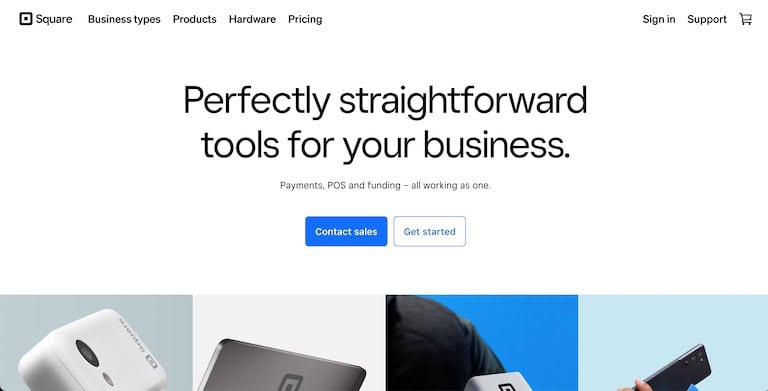
Square’s biggest strength remains its all-in-one ecosystem. It isn’t just a payment processor; it’s POS software, hardware, invoicing, payroll, and inventory tools bundled into one account. For a brick-and-mortar retailer or café, this means you can run your entire operation, taking payments, tracking stock, managing staff, from a single dashboard rather than stitching together separate tools.
For in-person sales specifically, Square is still genuinely competitive. On the Free plan, in-person card payments cost 2.6% plus $0.15, a rate that holds up well against most competitors and comes with no monthly commitment. The free card reader and straightforward hardware options make it easy for a new business to start accepting cards within minutes.
Online payments are where the picture has shifted. Square raised its Free-plan online and invoice rate to 3.3% plus $0.30 as of January 2026, up from the 2.9% rate many older reviews still quote. That puts Square’s online pricing above Stripe’s standard rate and noticeably above what Shopify Payments charges. Merchants on the Plus plan, at $49 a month, get a lower 2.9% online rate, but that only pays off once monthly volume is high enough to offset the subscription cost.
One quiet advantage Square holds over several competitors is its dispute policy: it charges no chargeback fee, which matters for businesses in categories with higher return or dispute rates. You still lose the disputed funds if a chargeback goes against you, but you’re not also paying a $15–25 penalty on top of it, as you would with many other processors.
The other thing to watch with Square, as with most aggregator-style processors, is account stability. Square uses automated risk monitoring, and that occasionally results in delayed payouts or account reviews, particularly for businesses with sudden spikes in volume or higher-risk product categories. It’s not unique to Square, but it’s worth factoring in if predictable cash flow is critical to your business.
Overall, Square remains an excellent choice for in-person and hybrid retail businesses that want an integrated POS and payments system without monthly fees. Online-only sellers, especially those doing meaningful volume, should run the numbers against Stripe or Shopify Payments before defaulting to Square, since the 2026 rate changes have made it less automatically competitive for ecommerce-only use cases.
Pros of Square
- Free POS software and a free card reader to get started
- Competitive in-person processing rate at 2.6% + $0.15
- No monthly fee required on the base plan
- No chargeback fees, unlike most major processors
- Strong all-in-one ecosystem covering payments, inventory, and payroll
- Fast, predictable next-business-day deposits
Cons of Square
- Online processing rate rose to 3.3% + $0.30 on the Free plan in 2026
- Lower online rates require a paid Plus or Premium subscription
- Less cost-effective for online-only or high-volume ecommerce sellers
- Account holds and reviews can occur with little warning
- Flat-rate pricing becomes less competitive than interchange-plus options as volume grows
- Manually keyed transactions carry a higher 3.5% + $0.15 rate
Final Verdict
Square earns its reputation for a reason: it’s still one of the easiest ways for a small or hybrid business to start accepting payments without monthly fees or technical setup. The 2026 pricing changes make it a less obvious choice for online-only sellers, but for in-person and brick-and-mortar businesses, it remains one of the most dependable, all-in-one options available.