











What “Best eCommerce Platform” Actually Means in 2026
Before comparing platforms, it is important to define what “best” really means in 2026. Many articles skip this step and jump straight into features or pricing. That approach creates confusion because the needs of online businesses have changed. The best eCommerce platform today is not the one with the most tools. It is the one that gives store owners control, stability, and room to grow without forcing them into long-term constraints.
In 2026, store owners care less about flashy dashboards and more about ownership. This includes owning their data, controlling their hosting environment, and deciding how their store evolves over time. Platforms that restrict access, limit customization, or force upgrades can slow growth and increase costs as a business scales.
Cost predictability is another key factor. The best platform is not always the cheapest at the start, but the one where costs remain clear and manageable as traffic, products, and orders increase. Monthly fees, transaction charges, and required add-ons all affect long-term profitability. A platform that looks affordable in year one can become expensive by year three.
Flexibility also defines “best” in 2026. Online businesses now sell across regions, currencies, and channels. They need freedom to adjust checkout flows, shipping rules, taxes, and product structures without rebuilding their store. Platforms that allow full control at the system level make these changes easier and faster.
Finally, longevity matters. A good platform should support a business for many years, not just during launch. That means stable architecture, active development, and the ability to adapt as regulations, customer expectations, and technology change.
When evaluating whether OpenCart is the best eCommerce platform in 2026, these criteria set the foundation. Ownership, cost control, flexibility, and long-term viability matter more than surface-level features.
How OpenCart’s Open-Source Model Compares to SaaS Platforms
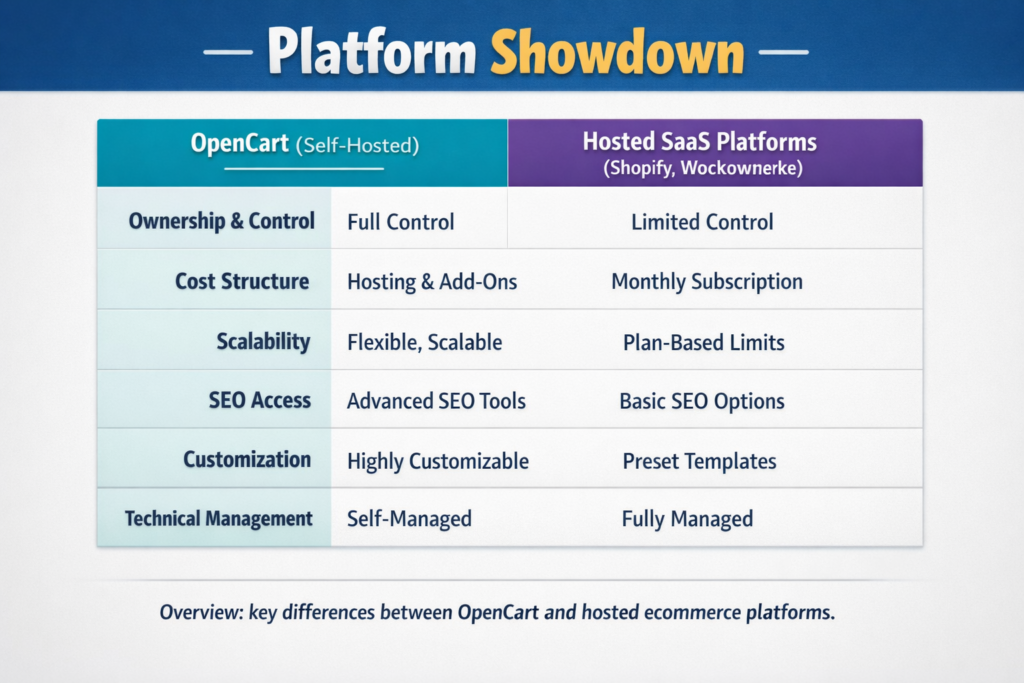
To understand how OpenCart compares to SaaS platforms in 2026, the key difference is control. OpenCart is open source. SaaS platforms are not. This single distinction affects how a store is built, managed, and scaled over time.
With an open-source platform, the store owner controls the software, the hosting environment, and the data. The code can be modified, extended, or optimized to match real business needs. Nothing is locked behind permission, usage limits, or pricing tiers. If a store needs a custom checkout flow, a specific tax rule, or a unique integration, it can be built directly into the system.
SaaS platforms take a different approach. They prioritise speed of setup and simplicity by controlling the infrastructure and limiting access to the underlying system. This can work well for early-stage sellers, but it often creates restrictions as the business grows. Features are added based on the platform’s roadmap, not the store owner’s priorities. When needs change, merchants are often forced to adapt their business to the platform instead of the other way around.
Cost structure also differs significantly. OpenCart does not charge monthly software fees or transaction percentages. Costs are tied to hosting, development, and extensions chosen by the business. SaaS platforms bundle costs into recurring subscriptions and transaction fees, which rise as sales increase. Over time, this can turn growth into an ongoing expense rather than a reward.
Another important factor is exit freedom. With OpenCart, the store belongs entirely to the business. It can be moved to a new server, redesigned, or expanded without platform approval. SaaS platforms control access, migrations, and sometimes even store availability, which introduces long-term risk.
Total Cost of Running an Online Store on OpenCart vs Hosted Platforms
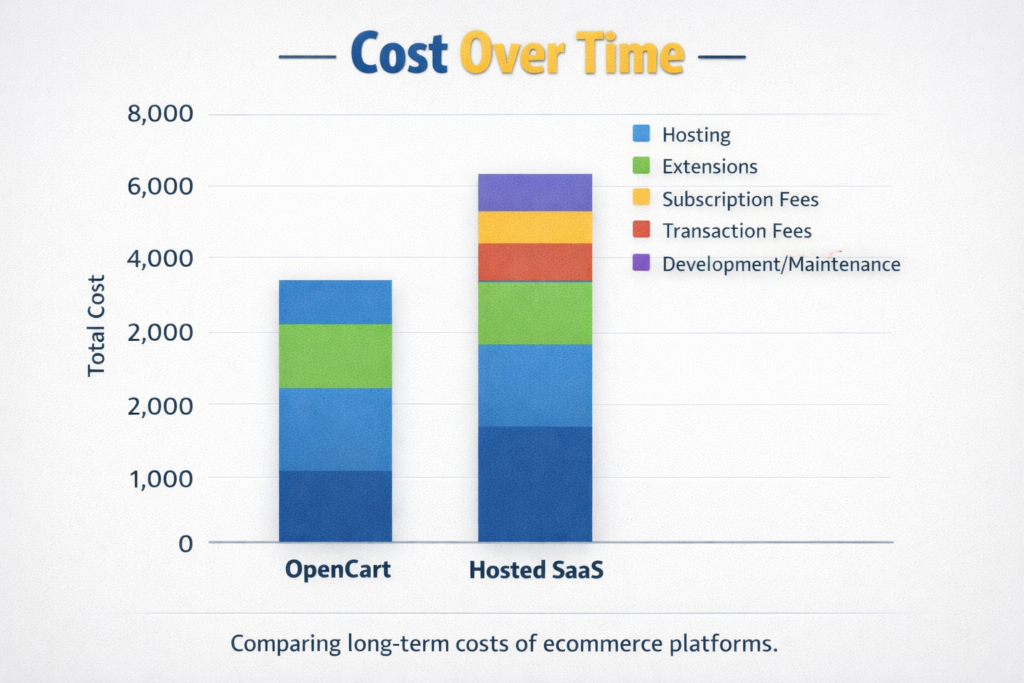
When comparing eCommerce platforms in 2026, the real cost is rarely obvious at the start. Many platforms appear affordable during setup but become expensive once the store begins to grow. To judge cost properly, it helps to look beyond monthly prices and understand how expenses change over time.
OpenCart does not charge a software subscription fee. The core platform is free to use, which immediately removes a fixed monthly cost. Store owners pay for hosting, optional extensions, and development work when needed. This means costs are tied to actual business decisions rather than imposed by the platform itself.
Hosted platforms usually bundle costs into a monthly plan. As sales increase, additional fees often appear. These can include higher-tier subscriptions, transaction percentages, paid apps, and usage-based limits. What starts as a low monthly fee can quickly scale into a significant operating expense, especially for stores with growing order volumes.
Another cost difference appears during expansion. With OpenCart, upgrading server resources or adding features is a choice, not a requirement. A store can invest more only when growth justifies it. On hosted platforms, growth often forces upgrades. Higher traffic, advanced reporting, or international selling can push a store into more expensive plans.
Long-term ownership also affects cost. OpenCart stores can be maintained, optimised, or redesigned without platform approval. There is no penalty for staying on the same version or hosting provider. Hosted platforms control upgrades, pricing changes, and feature access, which can increase costs without improving the store’s performance.
Store Performance and Speed: How OpenCart Handles Growth in 2026
Store speed is no longer a technical detail. In 2026, it directly affects conversion rates, search visibility, and customer trust. Slow stores lose sales before a product page even loads. When evaluating performance, the real question is not how fast a platform feels at launch, but how well it performs as traffic, products, and integrations increase.
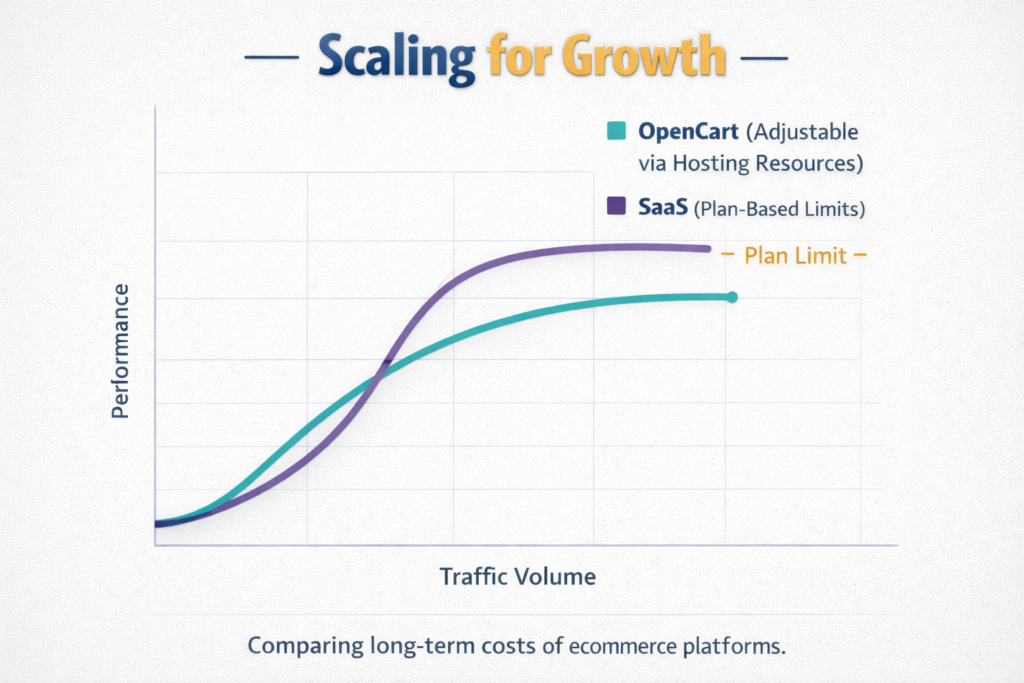
OpenCart’s performance advantage comes from control. Because it is self-hosted, store owners choose their own server environment. This allows businesses to scale resources based on real demand. Faster CPUs, more memory, better caching, and regional hosting can all be added without changing platforms. Performance improvements are applied at the infrastructure level, not limited by a shared system.
As stores grow, database size and request volume increase. OpenCart is designed to handle this through optimised queries, modular extensions, and compatibility with modern caching layers. When configured correctly, it can support high product counts and heavy traffic without forcing structural changes to the store.
Hosted platforms take a different approach. Performance is managed centrally, which removes setup complexity but limits optimisation options. Store owners cannot fine-tune server behaviour or caching rules. When traffic spikes or catalog size grows, performance depends on plan limits rather than technical choices. In many cases, upgrading to a higher plan is the only way to maintain speed.
Another factor is consistency. OpenCart stores behave predictably because changes are controlled by the business. Updates, extensions, and design changes are tested before going live. Hosted platforms often roll out system-wide updates that affect performance without notice, leaving store owners to react rather than plan.
Flexibility and Customisation for Real-World Business Needs
Flexibility is one of the main reasons businesses reassess their eCommerce platform as they grow. In 2026, online stores are rarely simple. They sell different product types, operate across regions, and adjust processes as the business evolves. A platform must support these changes without forcing workarounds.
OpenCart is built with this reality in mind. Its structure allows store owners to customise almost every part of the system, from product layouts to checkout logic. Products can be physical, digital, subscription-based, or configured with complex options. Pricing rules, discounts, and customer groups can be adjusted to match how the business actually sells.
Checkout control is another area where flexibility matters. OpenCart allows changes to payment order, validation rules, shipping logic, and tax handling. This is important for stores that need to comply with regional regulations or optimise checkout for conversion rather than follow a fixed template.
Multi-store capability also plays a role in real-world use. OpenCart allows multiple storefronts to run from a single installation. This makes it easier to manage different brands, languages, or regions without duplicating systems. Each store can have its own design, products, and pricing while sharing the same backend.
Hosted platforms often limit customisation to protect simplicity. While this reduces setup effort, it also restricts how far a store can adapt. Changes outside the platform’s approved structure usually require paid apps or are not possible at all. Over time, this can force businesses to adjust their operations to fit the software.
SEO Control and Search Visibility: Where OpenCart Stands Today
Search visibility is one of the main reasons store owners reconsider their platform. In 2026, organic traffic still drives long-term revenue, but only when a platform allows full control over how pages are structured, indexed, and optimised. SEO is no longer just about keywords. It is about technical precision and consistency.
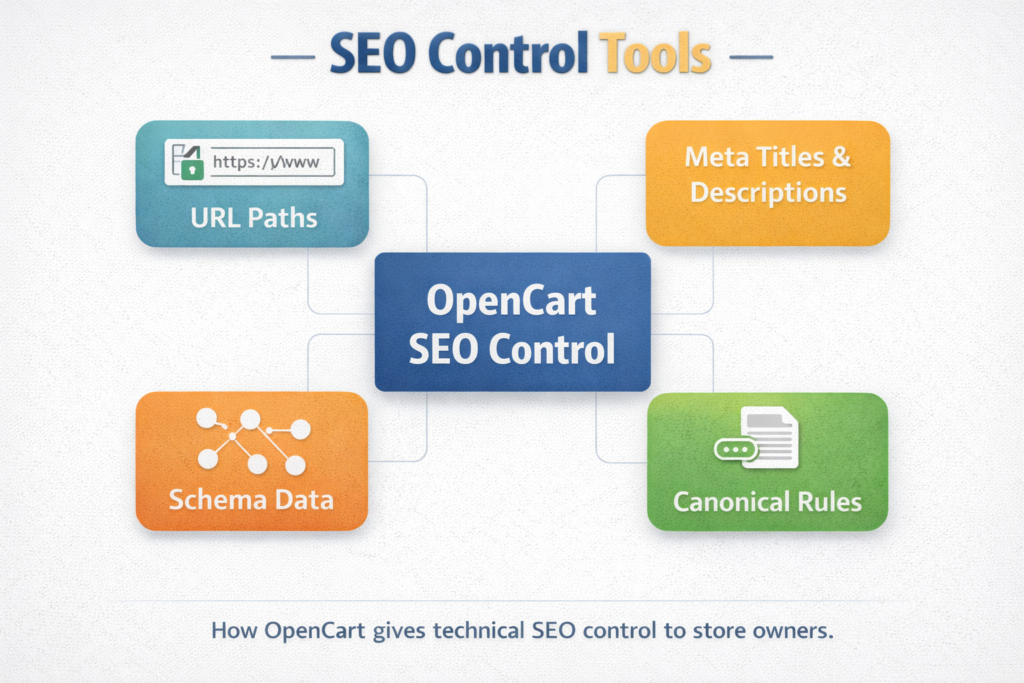
OpenCart gives store owners direct control over core SEO elements. URLs, metadata, page structure, and indexing rules can all be managed without relying on third-party systems. This makes it easier to align the store with search engine requirements and adapt when algorithms or best practices change.
Unlike platforms that hide SEO settings behind paid plans or apps, OpenCart treats search optimisation as a core capability. Store owners can fine-tune how category pages, product pages, and content pages are handled at a technical level. This is especially important for stores with large catalogs or international targeting.
OpenCart also supports clean site architecture. Pages can be organised logically, internal linking can be controlled precisely, and duplicate content issues can be addressed directly. These details matter more in 2026 as search engines place greater emphasis on structure and crawl efficiency.
Key areas where OpenCart supports SEO control include:
-
Full control over URL structure, including keyword-based and readable URLs
-
Direct access to meta titles, descriptions, and heading hierarchy
-
Support for structured data and schema through extensions or custom logic
-
Clear handling of canonical URLs to reduce duplication
-
Flexibility to manage index and noindex rules at page level
Hosted platforms often simplify SEO by abstracting these settings. While this works for basic stores, it can limit optimisation as competition increases. When advanced changes are needed, store owners may rely on paid apps or platform updates that do not align with their strategy.
Payments, Shipping, and Tax Setup for Global Selling
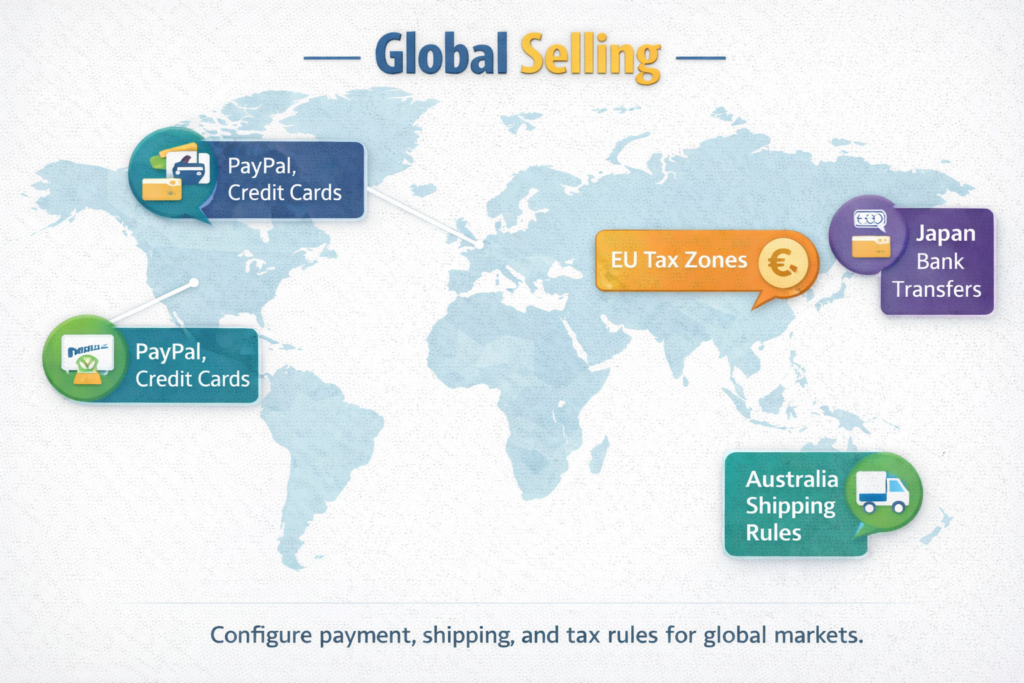
Selling internationally in 2026 requires more than adding a payment button and a shipping rate. Customers expect local payment options, accurate delivery pricing, and clear tax handling at checkout. A platform must support this complexity without forcing businesses into rigid systems.
OpenCart is designed to handle global selling at a structural level. Payments, shipping, and tax rules are configured directly within the platform, allowing store owners to adapt their setup to different regions, currencies, and regulations. This is especially important for businesses that sell across multiple markets or plan to expand gradually.
Payment flexibility is one of OpenCart’s strengths. Store owners can choose from a wide range of gateways and control how and where each option appears. This makes it easier to offer region-specific payment methods without changing the core store logic.
Shipping configuration is equally detailed. OpenCart allows shipping costs to be calculated based on weight, price, location, or custom rules. Businesses can define different methods for domestic and international orders, apply free shipping thresholds, or integrate with carriers when needed.
Tax handling is treated as a system function rather than an add-on. OpenCart supports multiple tax rates, zones, and customer groups, which helps businesses stay compliant as they sell across borders.
Key areas where OpenCart supports global selling include:
-
Multiple payment gateways with regional control and currency support
-
Shipping rules based on zones, weight, order value, or custom logic
-
Separate domestic and international delivery methods
-
Tax rates configured by country, region, and customer type
-
Support for multi-currency pricing and localisation
Hosted platforms often simplify global selling by offering preset rules. While this reduces setup time, it can limit accuracy and flexibility. Businesses may need paid apps or higher plans to unlock basic international features.
Security, Updates, and Store Ownership Responsibilities
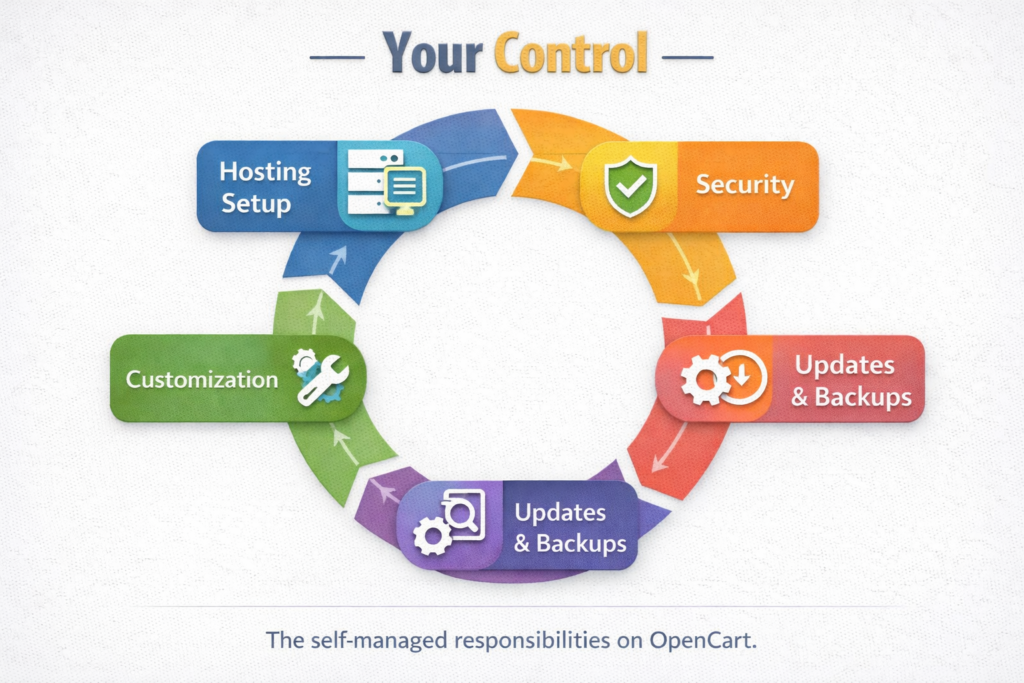
Security is a shared responsibility in 2026, not a background feature. Store owners are expected to protect customer data, maintain compliance, and keep their systems stable as threats evolve. When choosing an eCommerce platform, the real question is not who handles security, but how much control and accountability the business wants.
OpenCart follows a self-managed security model. This means the store owner controls hosting, updates, backups, and access rules. While this requires involvement, it also provides transparency. Nothing is hidden, delayed, or forced. Businesses decide when to update, what to test, and how to secure their environment based on their risk profile.
Updates in OpenCart are deliberate rather than automatic. This reduces the chance of unexpected changes breaking a live store. Owners can test updates on staging environments, review extension compatibility, and schedule releases during low-traffic periods. This approach suits businesses that value stability over forced upgrades.
Ownership is another critical factor. With OpenCart, the store, database, and files belong entirely to the business. There is no dependency on a third-party platform to keep the store accessible. If hosting providers change or costs increase, the store can be moved without restriction.
Key aspects of OpenCart’s security and ownership model include:
-
Full control over hosting security, firewalls, and server configuration
-
Manual update management to reduce unexpected downtime
-
Ability to choose backup frequency, storage, and recovery methods
-
Clear separation between core platform and extensions
-
Complete ownership of store data, files, and customer information
Hosted platforms take a different approach by managing security centrally. This reduces effort but also removes visibility and control. Updates are automatic, changes can happen without notice, and access depends on platform policies. For some businesses, this trade-off is acceptable. For others, it introduces long-term risk.
Who OpenCart Is Best Suited For in 2026
OpenCart is not designed to be everything for everyone. In 2026, it works best for businesses that value control, clarity, and long-term ownership over quick setup and platform-managed convenience. Understanding who benefits most helps avoid mismatched expectations.
OpenCart suits store owners who want their eCommerce platform to adapt to their business, not the other way around. It rewards planning, structure, and a willingness to manage key parts of the store environment.
OpenCart is particularly well suited for:
-
Growing businesses that expect increasing traffic, products, or international sales
-
Store owners who want full control over hosting, performance, and technical setup
-
Businesses that rely on organic search and need precise SEO control
-
Merchants selling across regions with complex shipping or tax rules
-
Agencies and developers managing multiple stores or client projects
-
Brands planning to run their store for many years without forced migrations
OpenCart also fits teams that prefer predictable costs. Instead of paying ongoing platform fees tied to revenue, businesses can invest in hosting and development when growth requires it. This approach works well for stores with steady or seasonal sales patterns.
It may also appeal to businesses that already work with technical partners. When a developer or agency is involved, OpenCart’s flexibility becomes an advantage rather than a barrier. Custom workflows, integrations, and optimisations can be built directly into the store.
However, OpenCart is less suitable for users who want a fully managed experience with minimal responsibility. It assumes that the business is comfortable making decisions about hosting, updates, and configuration, either directly or through a trusted partner.
Where OpenCart May Not Be the Right Choice
OpenCart offers flexibility and control, but those strengths are not ideal for every business. In 2026, choosing the right platform also means understanding when a tool may add friction instead of value. Being clear about limitations helps businesses avoid costly mismatches.
OpenCart requires a level of involvement that some store owners do not want. Because it is self-hosted, decisions around hosting, updates, and maintenance cannot be ignored. While these tasks can be outsourced, they still require oversight and planning.
OpenCart may not be the best choice for:
-
First-time sellers who want a store live within hours with no technical setup
-
Businesses that prefer automatic updates without testing or review
-
Store owners who do not want responsibility for hosting or security decisions
-
Small side projects with no plans to scale or customise beyond basics
-
Teams without access to technical support or an agency partner
The learning curve is another consideration. OpenCart is logical, but it assumes users understand basic eCommerce concepts such as hosting environments, extensions, and version updates. For users who want everything handled by the platform, this can feel demanding.
Ongoing maintenance also matters. While OpenCart does not force updates, ignoring them can create security or compatibility issues over time. Businesses must be willing to schedule updates, review extensions, and keep the system healthy.
OpenCart vs Shopify vs WooCommerce: Practical Differences That Matter
Comparisons between platforms often focus on surface-level features. In 2026, the real differences show up in ownership, cost structure, and how much control a business keeps as it grows. Looking at OpenCart, Shopify, and WooCommerce side by side makes those differences clearer.
OpenCart is a self-hosted, open-source platform. The store owner controls the software, hosting, and data. Customisation is handled at the system level, and costs are driven by infrastructure and development choices rather than mandatory subscriptions.
Shopify is a fully hosted SaaS platform. It prioritises speed of setup and ease of use. Hosting, security, and updates are managed by Shopify, but access to deeper customisation and advanced features is tied to plans and apps.
WooCommerce sits on top of WordPress. It combines content management with eCommerce and works well for stores that already rely on WordPress. Flexibility is high, but performance and stability depend heavily on hosting quality and plugin choices.
Key practical differences that affect daily operations include:
-
Ownership and control
OpenCart offers full ownership of files and data. Shopify retains platform control. WooCommerce ownership depends on WordPress hosting and setup. -
Cost structure over time
OpenCart has no software fees. Shopify uses monthly plans and transaction fees. WooCommerce is free to install but often requires paid plugins and hosting upgrades. -
Customisation depth
OpenCart allows direct system-level changes. Shopify limits customisation to approved methods. WooCommerce relies on plugins and theme compatibility. -
Performance scaling
OpenCart scales through server resources. Shopify scales through plan limits. WooCommerce scales with hosting quality and optimisation effort. -
SEO and technical access
OpenCart provides full technical SEO control. WooCommerce offers strong SEO through WordPress. Shopify abstracts many technical SEO settings.
In 2026, the choice between these platforms depends on priorities. Shopify suits businesses that want convenience and are comfortable with platform rules. WooCommerce works well for content-driven stores already invested in WordPress. OpenCart suits businesses that want long-term control, predictable costs, and freedom to shape their store without platform-imposed limits.
What Long-Term Store Owners Gain From Using OpenCart
Long-term store owners think differently from first-time sellers. In 2026, the focus shifts from launching quickly to running a stable, adaptable business over many years. The value of an eCommerce platform is measured by how well it supports change without forcing disruption.
OpenCart is built for longevity. Its open structure allows businesses to evolve their store gradually rather than replace it when requirements change. This matters when products expand, markets shift, or regulations evolve.
One of the biggest long-term gains is independence. Store owners are not tied to a vendor’s pricing model, roadmap, or policy changes. Decisions are made based on business needs, not platform limitations. This reduces risk and avoids forced migrations that can disrupt revenue and search visibility.
Cost stability is another advantage over time. Because there are no mandatory software fees or revenue-based charges, growth does not automatically increase platform costs. Investments are intentional and tied to clear outcomes such as performance improvements or new functionality.
Long-term OpenCart users also benefit from continuity. Stores can be redesigned, optimised, or extended without rebuilding the entire system. Data structures remain consistent, which protects historical data, SEO equity, and customer records.
Key benefits long-term store owners gain include:
-
Full ownership of store data, code, and infrastructure
-
Freedom to change hosting providers without platform restrictions
-
Ability to customise or rebuild parts of the store without migration
-
Predictable costs that do not rise automatically with revenue
-
Stable foundations for SEO, performance, and integrations over time
Another often overlooked benefit is strategic flexibility. OpenCart allows businesses to pause, scale back, or pivot without contractual pressure. This is valuable for seasonal businesses or brands operating in changing markets.
In 2026, long-term success in eCommerce depends on control and adaptability. OpenCart supports this by treating the store as business infrastructure, not a temporary service. For owners planning to operate for years rather than months, this long-term stability becomes a decisive advantage.
Final Verdict: Is OpenCart the Best eCommerce Platform in 2026?
Whether OpenCart is the best eCommerce platform in 2026 depends on how a business defines success. There is no single platform that fits every use case. The right choice comes down to control, cost expectations, and how the store is expected to grow over time.
OpenCart stands out for businesses that treat their online store as long-term infrastructure. It offers ownership, flexibility, and predictability in areas where many platforms introduce limits. For store owners who want freedom from recurring platform fees and full control over how their store operates, OpenCart remains a strong option in 2026.
That said, OpenCart is not the easiest platform to start with. It assumes involvement, planning, and a willingness to manage or outsource technical decisions. Businesses looking for instant setup with minimal responsibility may find hosted platforms more suitable.
When deciding if OpenCart is the best choice, store owners should consider:
-
Whether long-term ownership and independence matter more than quick setup
-
If predictable costs are preferred over subscription-based pricing
-
Whether SEO, performance, and system-level control are business priorities
-
If the store is expected to scale, expand internationally, or run for many years
-
Whether technical support is available internally or through a partner
In 2026, “best” no longer means simplest or most advertised. It means fit. OpenCart is best for businesses that value control, stability, and the ability to shape their platform as their needs change.

Ben Ajenoui is the Founder of SEO HERO LTD, a Hong Kong based SEO agency helping startups and established businesses improve search visibility, drive organic growth, and build sustainable online performance. He specialises in SEO strategy, technical optimisation, and content-led growth.