Business Advertising: What It Is, How It Works, and How to Make It Pay Off
Many businesses spend money on advertising without being fully sure what they are buying, why one channel works better than another, or how to tell whether the spend is paying off. That is where problems start. A business can run ads, get clicks, and still see weak leads, low sales, or poor returns if the advertising does not match the buyer, the offer, or the stage of the buying journey.
Business advertising is the process of paying to put your message in front of the right people to create awareness, generate leads, or win sales. It can include search ads, social media ads, display banners, video ads, print media, outdoor placements, radio, and other paid formats. The method changes, but the goal stays the same: put a clear offer in front of people who are likely to care, at a time when they are ready to notice or act.
How it works is more practical than many people think. A business chooses a channel, defines who it wants to reach, sets a budget, builds the advert, and tracks what happens next. That might mean a local service company paying for Google Ads when people search for help nearby, or an online store using paid social ads to show a product to people who fit a certain interest or buying pattern. Good advertising is not just about getting seen. It is about being seen by the right people with the right message.
Making advertising pay off depends on more than spending more money. It depends on choosing the right channel, writing a message that makes sense to the audience, sending traffic to a page that supports action, and measuring results properly. A weak advert can waste budget quickly. A well-planned campaign can bring in steady leads, stronger brand recall, and sales that are easier to track and improve over time.
This article looks at what business advertising really means, how different types of advertising work, where businesses often waste money, and what to do if you want better returns from your budget. The aim is not to make advertising sound bigger than it is. The aim is to explain how it works in real use, so a business can make better decisions before spending more.
What business advertising really means today
Business advertising today is no longer just about putting a message in front of as many people as possible. That older model focused heavily on reach. The modern version is more selective, more measurable, and far more tied to commercial outcomes. A business is not simply paying for exposure. It is paying for the chance to reach the right person, in the right place, with the right message, at the right time.
That shift matters because buyers do not move in a straight line anymore. They compare brands across search, social media, video, marketplaces, review platforms, email, and websites before they decide what to do. In that environment, advertising is not a separate activity sitting beside the business. It is part of how the business gets discovered, shapes perception, creates demand, and supports conversion.
Today, business advertising means using paid channels to influence real buying behaviour. Sometimes the goal is immediate, such as getting a lead form completed or generating a sale. Sometimes it is broader, such as building awareness in a local market, staying visible during a long buying cycle, or reminding potential buyers that the business exists when they are ready to act. The advert itself is only one part of the system. The audience targeting, offer, landing page, timing, and follow-up all affect whether the spend works.
It also means accepting that visibility alone is not enough. A campaign can generate impressions, clicks, and attention but still fail commercially. If the wrong people see the advert, if the message is vague, or if the offer does not match buyer intent, the spend may look active without producing meaningful business value. That is why modern advertising is judged less by how busy it looks and more by what it produces.
For many businesses, advertising today also means balancing short-term and long-term goals. Some campaigns are built to generate enquiries now. Others are designed to make the brand more familiar so future sales become easier and cheaper to win. The strongest advertising strategies usually do both. They capture current demand while also improving future recall and trust.
This is especially important in competitive markets. Buyers have more options, more information, and less patience. They often make decisions quickly, and they notice relevance faster than they notice creativity. A polished advert may attract attention, but relevance is what gives it value. That is why good business advertising today is less about shouting louder and more about aligning message, audience, and intent.
In practical terms, business advertising today means five things:
- paying for targeted visibility, not random exposure
- matching the advert to where the buyer is in the decision process
- using clear offers and messages instead of vague brand language
- tracking outcomes that matter, such as leads, sales, and cost per result
- improving performance over time through testing and measurement
The businesses that do this well tend to treat advertising as an operating system, not a one-off promotion. They test channels carefully, learn what buyers respond to, and refine campaigns based on evidence rather than assumption. That is what business advertising really means today. It is not just promotion. It is a structured way to create attention that has a realistic chance of turning into revenue.
Why many businesses waste money on advertising
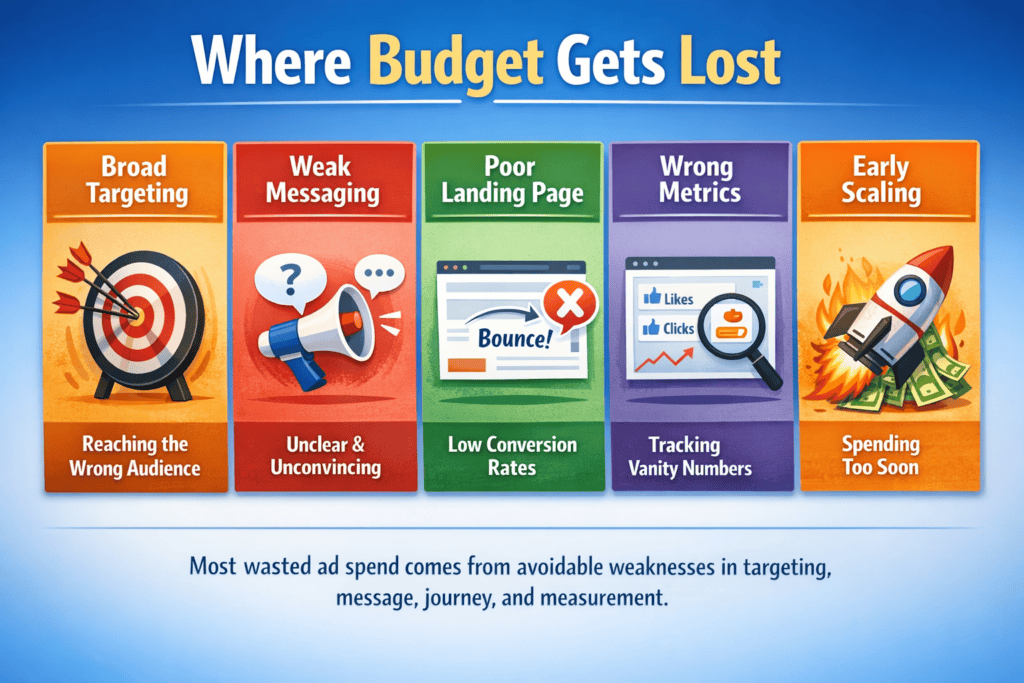
Many businesses waste money on advertising because they treat spending as strategy. They launch campaigns before they are clear on who they want to reach, what they want the advert to achieve, or how they will judge success. The result is predictable. Money goes out, activity looks busy, but the business struggles to connect that spend to real enquiries, qualified leads, or sales.
One of the biggest problems is poor audience targeting. If the advert reaches people who are unlikely to need the product, trust the business, or act soon, the budget gets diluted fast. This happens often when businesses choose broad targeting in the hope of reaching more people. More reach can sound positive, but wider exposure does not automatically mean better results. In many cases, it simply means more wasted impressions and lower-quality clicks.
Another common issue is weak messaging. An advert can be well designed and still fail if the message is unclear, generic, or too focused on the business instead of the buyer. Many companies talk about being trusted, experienced, or high quality without explaining why that matters in practical terms. Buyers respond better when they can quickly see what the offer is, who it is for, and what problem it solves. If that is missing, the advert may get ignored or misunderstood.
Poor landing pages also waste large amounts of advertising budget. A business might pay to drive traffic successfully, only to send people to a page that is slow, confusing, or not built for conversion. When the page does not match the promise in the advert, users lose confidence. When the next step is unclear, they leave. In those cases, the problem is not always the advertising itself. The problem is the journey after the click.
Many businesses also waste money because they advertise without understanding buyer intent. Someone searching for a service urgently behaves differently from someone casually browsing on social media. Someone comparing suppliers needs different information from someone already ready to buy. When a business shows the same message to every type of buyer, the advert becomes less relevant. Relevance is one of the main factors that decides whether an advert works.
Budgeting mistakes make the situation worse. Some businesses spend too little to gather useful data, then assume the channel does not work. Others spend too much too quickly before testing the message, audience, or offer. Both approaches are risky. Advertising usually works best when the budget is controlled, the variables are limited, and the business learns what performs before scaling up.
There is also a measurement problem. Many businesses focus on surface-level numbers such as impressions, reach, or clicks because those figures are easy to see. But visibility is not the same as return. If a campaign brings traffic that never converts, the business may mistake movement for progress. Advertising should be judged by commercial outcomes, not just platform activity.
In practice, businesses often waste money on advertising for a few clear reasons:
- they target too broadly
- they use weak or vague messaging
- they send traffic to poor landing pages
- they ignore buyer intent
- they scale too early
- they track the wrong metrics
- they keep campaigns running without proper review
The deeper issue is usually not the advert alone. It is the lack of alignment between audience, message, offer, and destination. Good advertising works when those parts support each other. When they do not, even a large budget can disappear with very little to show for it.
That is why businesses should stop asking only how much to spend on advertising and start asking better questions first. Who is the buyer. What action do we want. Why should this person care now. What happens after the click. How will we know whether the campaign is paying off. Those questions protect budget far better than guesswork ever will.
How to choose the right advertising channels for your business
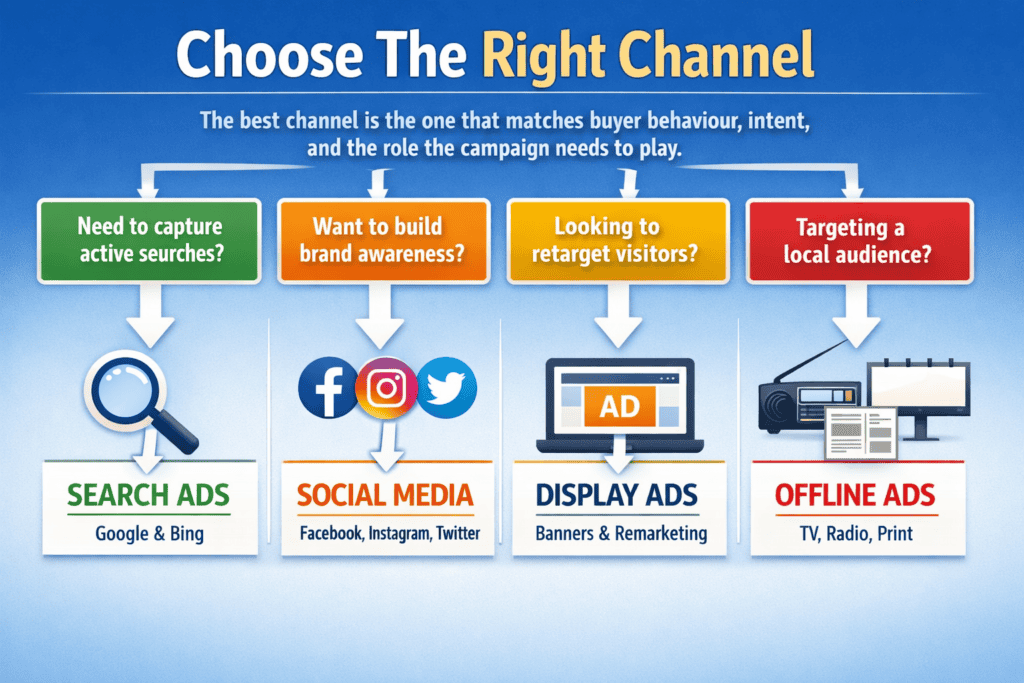
Choosing the right advertising channels starts with a simple point. The best channel is not the one people talk about most. It is the one that gives your business the best chance of reaching the right buyer at the right stage of decision-making.
Many businesses choose channels based on trend, habit, or pressure. They see competitors using Facebook, Google, TikTok, LinkedIn, radio, or print and assume they should do the same. That often leads to wasted spend. A channel only makes sense when it matches your audience, your offer, your budget, and the way people buy from you.
The first question is where your buyers are when they are most likely to act. If someone urgently needs a plumber, accountant, locksmith, or delivery service, they are more likely to search on Google than scroll social media hoping to find one. If you are selling visually appealing products, social platforms may create stronger interest earlier in the buying journey. If you are targeting business decision-makers, LinkedIn, search, email, and industry media may be more effective than broad consumer channels.
The second question is what you are asking the advert to do. Not every channel is equally strong at every job. Some channels are better at capturing demand that already exists. Others are better at creating awareness or keeping your brand visible over time. Google Ads often works well when users already know what they want and are actively searching. Social media advertising can work well when the goal is to introduce an offer, build familiarity, or retarget users who have already engaged. Offline channels such as print, events, direct mail, or outdoor ads can still be useful when local visibility and repeated exposure matter.
You also need to think about buying cycle length. A person choosing lunch may decide in minutes. A company choosing a service provider may take weeks or months. Shorter buying cycles often respond well to direct-response channels with a clear call to action. Longer cycles usually need more than one touchpoint. In those cases, the right channel mix may include awareness, retargeting, and lead nurturing rather than a single advert trying to do everything at once.
Budget matters as well. Some channels can absorb large amounts of spend quickly, while others require more patience or creative effort. A smaller business should not assume it needs to be everywhere. It is usually better to run one or two channels properly than spread budget too thinly across six. Focus makes testing easier, results clearer, and waste easier to control.
A practical way to choose the right channels is to assess five things:
- where your target audience actually pays attention
- how people usually discover and compare businesses like yours
- whether the channel fits your product, service, or price point
- how quickly you need results
- whether you can track performance clearly
For example, a local service business may find that search advertising and Google Business Profile visibility support direct enquiries far better than broad display advertising. An ecommerce brand with strong visuals may perform better through paid social, influencer partnerships, and remarketing. A B2B company selling high-value services may need a mix of search, LinkedIn, email, and content-led promotion because trust and consideration take longer to build.
It also helps to separate channels by purpose. Some are built to capture intent. Some are built to create interest. Some are built to bring people back. When businesses understand that difference, they stop expecting every platform to deliver the same result. That leads to better planning and fewer wrong assumptions.
The strongest channel choice is usually not based on theory alone. It is based on testing. Start with the channels most likely to match buyer behaviour. Run controlled campaigns. Compare lead quality, cost, and conversion performance. Then build from evidence, not opinion.
That is how to choose the right advertising channels for your business. Do not start with what is popular. Start with how your buyers behave, what your business needs, and which channels give you the clearest path from attention to action.
Paid search, social media, display, and offline ads: what each one does
Not all advertising channels do the same job. Businesses often waste money when they expect every advert to produce immediate sales, regardless of platform. In reality, each channel has a different strength. Some capture existing demand. Some create interest. Some build familiarity over time. The better a business understands that difference, the easier it becomes to choose the right mix and judge performance fairly.
Paid search ads
Paid search ads are built to capture demand that already exists. They appear when people actively search for a product, service, or solution. That makes them one of the strongest channels for intent-driven advertising.
If someone searches for “emergency plumber near me,” “best payroll software for small business,” or “kitchen renovation company,” they are already showing interest. The advert works because it responds to a need that already exists. This is why paid search often performs well for service-based businesses, local providers, ecommerce stores with clear product demand, and companies targeting buyers who are already comparing options.
The main value of paid search is timing. It puts the business in front of people when they are already looking. That makes it useful for:
- lead generation
- direct enquiries
- bookings and quote requests
- product sales from high-intent searches
- local service discovery
Its weakness is that it usually does less to create new demand. If people are not searching yet, paid search cannot reach them in the same way broader awareness channels can.
Social media ads
Social media ads are designed to interrupt attention and create interest. People on social platforms are usually not searching for a solution in the same focused way they are on search engines. They are browsing, watching, scrolling, and reacting. That means the advert has to work harder to stop attention and make the offer feel relevant quickly.
This channel is often strong for visual products, lifestyle brands, promotions, events, launches, and remarketing. It can also be effective for lead generation when the audience targeting is clear and the offer is simple. Social media is especially useful when a business wants to introduce something to potential buyers before they start actively searching.
Its main strengths include:
- building awareness
- promoting offers to defined audiences
- retargeting people who already visited the website
- generating engagement and interest
- supporting brand familiarity over time
The risk is that clicks can come from curiosity rather than buying intent. That is why social ads need strong creative, clear targeting, and a landing page that moves the user toward action.
Display ads
Display ads are usually visual banner-style adverts placed across websites, apps, and digital networks. Their role is less about capturing strong intent and more about visibility, repetition, and reminder.
They are often used to keep a brand in front of people after they have visited a website, viewed a product, or shown some earlier interest. This makes display useful for remarketing. It can also support broader awareness campaigns when the goal is repeated exposure rather than immediate conversion.
Display ads are commonly used for:
- remarketing to previous website visitors
- keeping the brand visible during longer buying cycles
- promoting awareness at scale
- supporting product or campaign recall
Their weakness is that cold display traffic is often less engaged than search traffic. On its own, display advertising can produce weak results if the targeting is broad or the creative is easy to ignore. It usually works better as part of a wider system rather than as the only advertising channel.
Offline ads
Offline ads include print, radio, direct mail, outdoor advertising, event sponsorships, leaflets, billboards, and other non-digital placements. Some businesses overlook them because digital platforms are easier to track, but offline advertising can still work well when local visibility, repeated exposure, or physical market presence matters.
For local businesses especially, offline ads can help reinforce trust and recognition. A person may see a business van, a roadside sign, a local magazine advert, or a flyer long before they search online. In some sectors, that repeated exposure helps the business feel familiar and established.
Offline advertising is often useful for:
- local brand awareness
- geographic targeting
- event and community visibility
- repeated real-world exposure
- reaching audiences less responsive to digital ads
Its main limitation is measurement. It is often harder to track exact results compared with digital campaigns. That does not mean it lacks value, but it does mean the business should be realistic about what it is trying to achieve.
Why this difference matters
The problem is not that one channel is good and another is bad. The problem is expecting the wrong outcome from the wrong channel. A search ad may be ideal for urgent demand. A social ad may be better for introducing an offer. A display ad may work best as a reminder. An offline ad may support trust and local visibility over time.
In simple terms:
- paid search captures existing intent
- social media creates interest and supports discovery
- display builds visibility and reminders
- offline ads strengthen local presence and familiarity
The businesses that get better results usually do not ask which channel is best in general. They ask what each channel is meant to do and where it fits in the buyer journey. That is what turns advertising from random activity into a more deliberate and profitable system.
How to match your advertising to buyer intent
Matching advertising to buyer intent means understanding what the person is trying to do at the moment they see your advert. Not every buyer is ready to purchase immediately. Some are just becoming aware of a problem. Some are comparing options. Some are close to taking action. Good advertising works because it respects that difference instead of pushing the same message at everyone.
This matters because the same advert will not work equally well for every stage of the buying journey. A person who has never heard of your business needs a different message from someone already searching for a provider. A buyer comparing prices needs different information from someone who is looking for proof, trust, or speed. When businesses ignore this, they often waste budget by showing the wrong message at the wrong time.
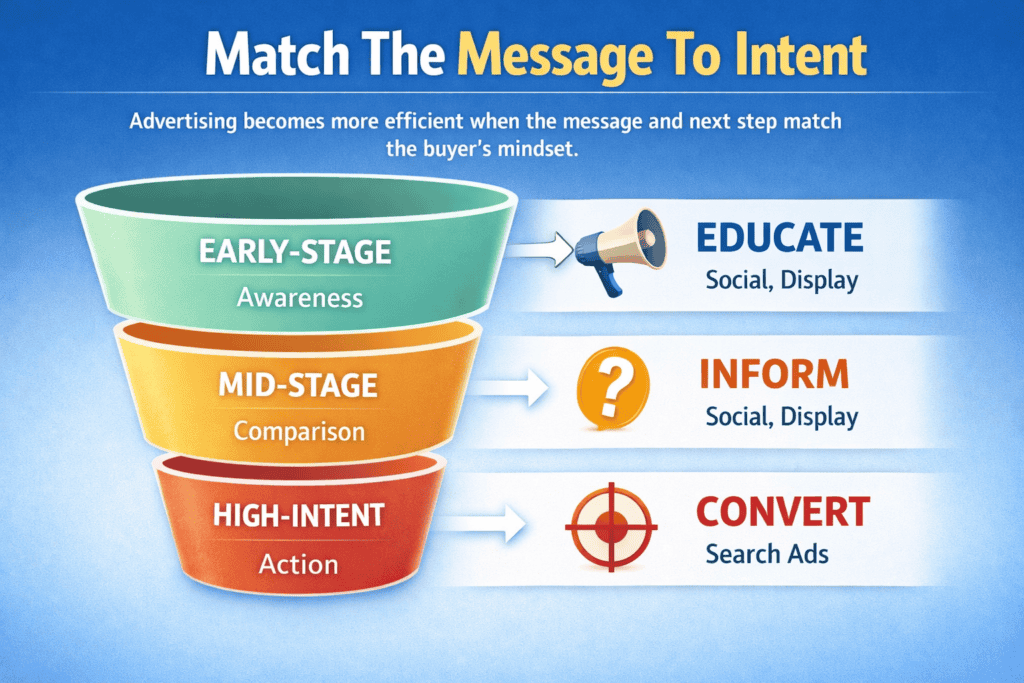
At a basic level, buyer intent usually falls into three broad stages.
Early-stage intent
At this stage, the buyer is aware of a need, problem, or interest, but is not yet ready to choose a provider. They may be researching, learning, or exploring possibilities. The goal of advertising here is not to force a sale too early. It is to build interest, show relevance, and make the business worth remembering.
This is where awareness-focused messages tend to work better. The advert should help the buyer understand the problem, introduce a useful offer, or show why the business deserves attention. Social media, video, content-led promotion, and broad awareness campaigns often fit this stage well.
The message here should focus on:
- the problem being solved
- the value of the offer
- why the business is relevant
- a low-friction next step
Mid-stage intent
At this stage, the buyer is actively comparing options. They know what they need, but they are weighing providers, products, features, pricing, reviews, or outcomes. This is where many businesses lose ground because they still advertise too broadly or speak too vaguely.
Buyers at this stage need clarity. They want to know what makes the offer different, whether it fits their needs, and why they should trust the business. The advertising should move beyond awareness and provide reasons to choose. That may include proof points, benefits, use cases, pricing signals, or a stronger call to action.
Useful messages here often highlight:
- why the offer stands out
- what the customer gets
- proof, trust, or results
- reasons to compare less and act sooner
Search ads, retargeting, product-specific social ads, email follow-up, and comparison-focused landing pages often work well for this stage.
High-intent stage
At this stage, the buyer is close to action. They may be searching with clear commercial intent, revisiting the website, checking availability, or looking for final reassurance before converting. This is where advertising should be most direct.
The buyer usually does not need a long explanation. They need a clear reason to act now. That could be a simple offer, strong trust signal, urgency, local availability, or a fast route to contact, checkout, or booking.
Effective advertising at this stage often includes:
- clear calls to action
- direct service or product language
- local or immediate relevance
- strong trust signals
- easy conversion paths
Paid search is especially strong here because it captures existing demand. Remarketing can also perform well when it brings back users who were already close to converting.
Why alignment matters
When advertising matches buyer intent, the message feels more natural and useful. The buyer sees something that fits what they are already thinking about. That improves response quality. It can also improve efficiency because the business is less likely to waste money on irrelevant clicks or weak leads.
When advertising does not match intent, the opposite happens. A business may push a “buy now” message to cold audiences who are not ready. Or it may show soft awareness messaging to people who are already trying to choose a provider. In both cases, the advert feels mistimed. The buyer either ignores it or fails to act.
How to apply this in practice
A simple way to match advertising to buyer intent is to ask four questions before launching a campaign:
- What is the buyer likely thinking at this stage
- How aware are they of the problem or solution
- What information do they need to move forward
- What is the most realistic next action
That next action is important. Not every advert needs to create a sale immediately. Sometimes the right next step is a click, a form fill, a quote request, a product view, or a return visit. The advert should support the stage the buyer is in, not the stage the business wishes they were in.
The strongest campaigns usually do not rely on one message alone. They build a sequence. First they create awareness. Then they support comparison. Then they make action easier. That is how advertising becomes more efficient over time.
Matching your advertising to buyer intent is not a small detail. It is one of the main reasons one campaign feels relevant and another feels wasteful. When the message, timing, and call to action fit the buyer’s mindset, the advert has a much better chance of turning attention into real business results.
What makes an advert catch attention and lead to action
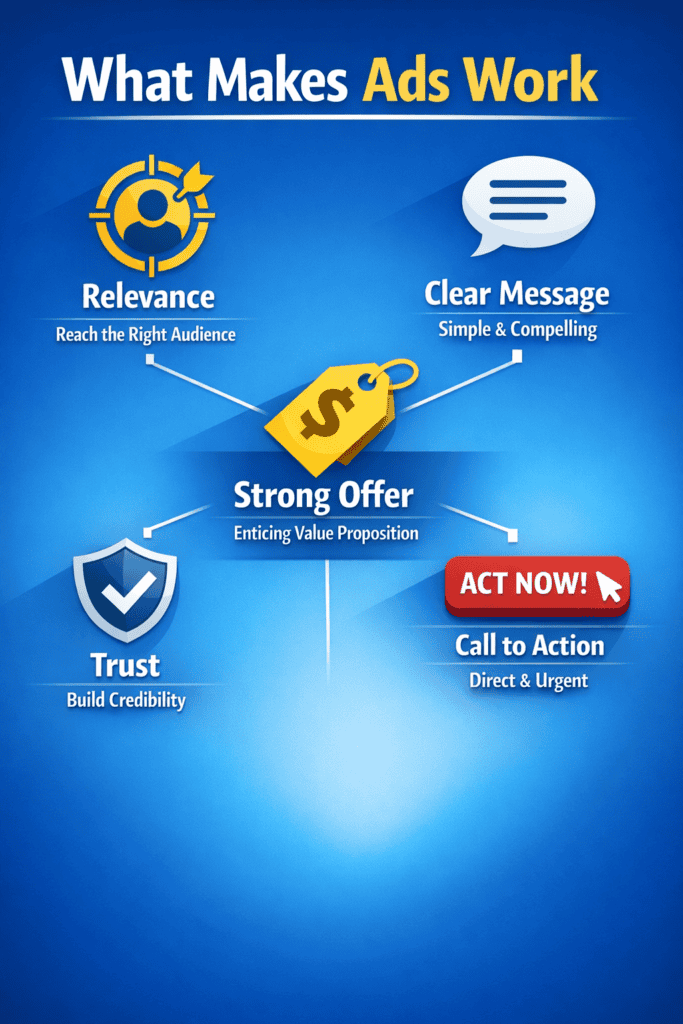
An advert catches attention when it feels relevant fast. It leads to action when the next step feels clear, useful, and worth taking. Most adverts fail because they do one of these badly. Some get noticed but do not persuade. Others explain too much, too slowly, and lose the buyer before the message lands.
The first job of an advert is to stop the scroll, pause the glance, or interrupt routine. That usually happens for one reason: the buyer quickly sees something that connects to their need, problem, or desire. It is rarely just about being loud or clever. Attention comes more from relevance than from noise.
This is why strong adverts usually start with a clear angle. They speak to a real problem, a specific result, or a recognisable situation. The buyer should be able to understand within seconds who the advert is for and why it matters. If the message is vague, overloaded, or too focused on the business itself, attention drops quickly.
Good advertising also uses simple language. Buyers do not want to decode what an advert means. They want to know what is being offered, why it helps, and what they should do next. Clear wording almost always performs better than complicated wording because it reduces friction. A strong advert does not try to sound impressive. It tries to make sense immediately.
The offer is another major factor. Even a well-written advert can fail if the offer is weak or unclear. People act when they can see practical value. That might be a product that solves a problem, a service that saves time, a discount, a trial, a free consultation, or a fast next step that feels low risk. The advert needs to make that value obvious, not hidden.
Trust also shapes response. Buyers are more cautious than many businesses realise. If the advert feels exaggerated, generic, or unsupported, people hesitate. Trust can be strengthened through tone, proof, specificity, and consistency between the advert and the landing page. A business does not always need to say more. It often needs to say things more clearly and more credibly.
The call to action matters as well. Many adverts lose momentum because they attract interest but do not guide the person forward. A strong call to action tells the buyer what to do next and makes that step feel manageable. It should match the level of intent. Someone ready to buy may respond to a direct action. Someone earlier in the process may respond better to a softer next step.
In practice, adverts that catch attention and lead to action usually have a few things in common:
- a clear message that is easy to understand quickly
- a strong link to a real buyer need or problem
- a relevant offer with visible value
- simple wording instead of vague or clever phrasing
- a credible tone that builds trust
- a clear next step that suits buyer intent
Visual design matters too, but it supports the message rather than replacing it. A clean layout, strong image, readable text, and focused structure can improve attention. But design alone will not rescue a weak offer or unclear message. The best adverts work because the message and presentation support each other.
It is also important to remember that attention and action are not the same thing. An advert can attract interest through humour, shock, or bold visuals and still fail to convert if the offer feels weak or the next step is confusing. That is why good advertising is not judged only by how noticeable it is. It is judged by whether that attention turns into meaningful response.
What makes an advert work, then, is not a single trick. It is alignment. The message fits the buyer. The offer feels useful. The tone feels credible. The next step is clear. When those parts work together, the advert has a much better chance of doing more than getting seen. It gives the buyer a reason to act.
How to set a realistic advertising budget without guessing
A realistic advertising budget should come from business numbers, not hope. Many businesses choose a figure based on what feels affordable, what a platform suggests, or what a competitor appears to be doing. That approach often leads to poor decisions. The budget ends up either too small to produce useful data or too large for the likely return.
The better starting point is the value of a customer. Before setting any budget, a business should know what a lead, sale, or new customer is worth in practical terms. That means looking at revenue, gross margin, repeat purchase behaviour, and the likely cost of fulfilment or service delivery. Without that context, it is hard to know what level of advertising spend is sensible.
The next step is to work backwards from the outcome you want. If the goal is ten qualified leads a month, or a certain number of product sales, the budget should reflect what it may realistically cost to produce those results. This is not about being exact from day one. It is about creating a reasoned estimate instead of picking a number at random.
For example, if a business knows that one in five qualified leads becomes a customer, and one new customer is worth a certain amount in profit, it can begin to judge how much it can afford to spend to acquire those leads. The same thinking applies to ecommerce. If the average order value is modest and margins are tight, the advertising budget must be controlled carefully. High revenue does not always mean strong room for ad spend.
A realistic budget also needs to match the stage of the campaign. New campaigns usually need a testing phase. At that point, the business is not only buying results. It is also buying learning. It needs enough budget to test audience targeting, messages, creative, and landing pages properly. If the budget is too low, the campaign may end before the business has enough data to make a fair judgement.
That said, testing does not mean overspending. A sensible budget starts small enough to protect cash flow but large enough to reveal patterns. The goal is to learn which combinations produce the best quality leads, strongest conversion rates, or lowest acquisition costs before increasing spend.
It also helps to separate budget by purpose. Some advertising is designed to generate immediate action. Some supports awareness or remarketing. These do not always perform in the same way or on the same timescale. If a business treats every pound as if it should create an instant sale, it may cut useful campaigns too early or keep weak campaigns running for the wrong reasons.
A practical budgeting approach usually includes:
- a clear business goal
- an estimate of customer value or profit per sale
- a target cost per lead or acquisition
- a test budget for early learning
- a review point for adjusting spend based on results
This makes decision-making stronger because the budget is tied to commercial reality. It also creates a better conversation internally. Instead of asking, “How much should we spend?” the business starts asking, “What result are we aiming for, what can we afford to pay for it, and what do we need to learn first?”
One of the biggest mistakes is treating advertising budget as a fixed monthly number that never changes. In reality, it should respond to performance. If a campaign is producing strong results at an acceptable cost, there may be a good case for increasing spend. If it is producing weak leads, low sales, or poor margin, increasing budget usually makes the problem bigger rather than better.
Seasonality, competition, and sales cycle length also matter. Some industries need heavier spending at certain times of year. Some offers take longer to convert. Some channels become more expensive when demand rises. A realistic budget takes those pressures into account instead of assuming the same spend will work the same way every month.
The main point is simple. Advertising budgets should be built on numbers, tested with discipline, and adjusted with evidence. Guessing feels quick, but it often leads to avoidable waste. A realistic budget gives the business a clearer way to protect cash, measure performance, and invest with more confidence.
Why targeting matters more than spending more
Many businesses assume better advertising results come from a bigger budget. In practice, that is often wrong. Spending more only helps when the advertising is already reaching the right people with the right message. If the targeting is weak, a larger budget usually increases waste rather than performance.
Targeting matters because advertising only works when it is relevant to the person seeing it. A business does not need everyone to notice the advert. It needs the right people to notice it. That includes people who are more likely to need the product, understand the offer, trust the business, and take action within a realistic timeframe.
When targeting is too broad, several problems appear quickly. The advert reaches people outside the service area, outside the ideal customer profile, outside the right income level, or outside the right stage of intent. That creates clicks, views, and impressions that look active on paper but add little commercial value. The campaign may appear busy while producing weak leads or low-quality traffic.
This is why a smaller, well-targeted campaign often outperforms a larger, poorly targeted one. Precision improves efficiency. It helps the business spend money on people who are more likely to respond in a useful way. That usually means better lead quality, stronger conversion rates, and more reliable data for future decisions.
Targeting also improves the message itself. When a business knows who it is speaking to, the advert becomes easier to write. The offer can be more specific. The language can reflect real buyer concerns. The call to action can feel more natural. Without clear targeting, businesses often fall back on generic advertising that tries to appeal to everyone and ends up connecting with no one strongly.
Good targeting is not only about demographics. It also includes behaviour, intent, geography, timing, and context. A local service business may need to focus on people in a specific area who are ready to enquire soon. A B2B company may need to target decision-makers in certain industries. An ecommerce brand may need to separate first-time visitors from returning users. These distinctions matter because different audiences respond to different messages and offers.
This is also why scaling too early can be risky. If a campaign has not yet shown that it can attract the right audience consistently, increasing the budget does not solve the underlying weakness. It simply pays for more of the same problem. Businesses often mistake low performance for low spend, when the real issue is poor audience selection.
In practical terms, strong targeting helps a business:
- reach people who are more likely to convert
- reduce wasted impressions and clicks
- improve lead quality
- make advert messaging more relevant
- learn faster from campaign data
- scale with more confidence later
It is important to remember that targeting and budget are not separate issues. Targeting determines whether the budget has a fair chance of working. A large budget with weak targeting can disappear quickly. A controlled budget with precise targeting can produce clearer results and a stronger foundation for growth.
That is why targeting matters more than spending more. Budget affects volume. Targeting affects quality. And in advertising, quality usually decides whether the spend turns into meaningful business results. Before increasing spend, businesses should first ask a more important question: are we actually putting this advert in front of the people most likely to care and act?
How to measure whether your advertising is actually working
Advertising is working when it produces useful business outcomes at a cost your business can support. That sounds obvious, but many businesses still judge campaigns by surface-level activity. They look at impressions, reach, clicks, or engagement and assume that visible movement means progress. Sometimes it does. Often it does not.
The first step is to decide what success actually means before the campaign starts. That depends on the type of business and the purpose of the advertising. For one company, success may be qualified leads. For another, it may be online sales, booked calls, store visits, or repeat purchases. Without a clear goal, it becomes too easy to focus on numbers that look good but say very little about commercial value.
Clicks, for example, can be helpful, but they are not proof that the campaign is working. A click only shows that someone showed enough interest to visit. It does not show whether that person was a good fit, whether they converted, or whether the sale was profitable. The same applies to impressions and reach. These numbers can show exposure, but exposure alone does not pay for the campaign.
What matters more is the path from advert to result. A business should be able to see what happens after the click or view. Did people fill in a form. Did they call. Did they buy. Did they book. Did they return later and convert. These actions are far more useful than vanity metrics because they show whether the advertising is moving people toward real outcomes.
Lead quality is especially important. A campaign can generate a high volume of enquiries and still perform badly if those leads are poorly matched to the offer. This is why businesses should not only count leads. They should assess whether those leads are relevant, qualified, and likely to become paying customers. Ten strong enquiries often matter more than one hundred weak ones.
Cost also matters. A campaign may generate results, but that does not automatically mean it is working well. The cost of those results has to make sense against margin, customer value, and business goals. If it costs too much to win each lead or sale, the campaign may be active but commercially weak. Measuring performance properly means looking at both result volume and result efficiency.
A practical measurement approach usually includes a few core questions:
- how many leads, sales, or enquiries did the campaign generate
- what did each result cost
- how good were those leads or customers
- what percentage converted
- did the campaign produce profit, not just activity
It also helps to measure performance at more than one stage. A campaign may attract good traffic but fail at the landing page. Or it may produce leads that the sales process fails to close. Looking at the full path helps the business see where the real weakness is. Without that, advertising often gets blamed for problems that exist elsewhere in the funnel.
Attribution can make this harder. People do not always convert the first time they see an advert. They may click, leave, return later through search, or come back after seeing the brand several times. That means advertising should not always be judged in an overly narrow way. Some campaigns help create awareness or support later action, even if they do not produce an instant conversion. The key is to be realistic about the campaign’s role and measure it against that purpose.
In practice, businesses should track:
- conversions, not just clicks
- lead quality, not just lead volume
- cost per result, not just total spend
- conversion rate, not just traffic
- profit impact, not just platform metrics
The strongest advertisers review performance regularly and make decisions based on evidence. They do not keep campaigns running just because they look active, and they do not kill useful campaigns too early because the platform numbers seem modest. They look at whether the advertising is helping the business win the right attention, from the right people, at the right cost.
That is how to measure whether your advertising is actually working. Start with the business outcome, follow the journey from advert to action, and judge success by commercial value rather than visible activity alone.
Common business advertising mistakes that reduce returns
Many advertising campaigns underperform for predictable reasons. The problem is not always the platform. In many cases, the return drops because the business makes avoidable mistakes before the campaign has a fair chance to work.
One common mistake is advertising without a clear objective. If the business does not know whether it wants leads, sales, bookings, awareness, or repeat purchases, the campaign becomes difficult to shape and even harder to measure. Different goals need different messages, audiences, and calls to action. When the objective is vague, the advertising usually becomes vague as well.
Another major mistake is targeting too broadly. Some businesses assume wider reach gives them a better chance of success, but broader exposure often brings weaker traffic and lower-quality leads. If the advert reaches people who are unlikely to care, buy, or enquire, the budget gets diluted quickly. More people seeing the advert is not the same as more of the right people seeing it.
Weak messaging is another reason returns fall. Many adverts say too little, too vaguely, or too slowly. They focus on the business rather than the buyer. They mention being trusted, experienced, or high quality without showing what that means in practical terms. Buyers respond better when they can quickly understand the offer, the value, and the reason to act.
Poor landing page alignment also reduces returns. A business may create a strong advert, then send people to a page that feels unrelated, cluttered, or difficult to use. When the page does not continue the same message or support the next step clearly, conversion rates suffer. Advertising performance is shaped by the full journey, not just the advert itself.
Another mistake is asking for too much too early. Some campaigns push hard for a sale even when the buyer is still in the awareness or comparison stage. That creates friction. Not every user is ready to buy immediately. Some need more context, more proof, or a smaller first step. Advertising works better when the ask matches buyer intent.
Many businesses also scale too early. They see a few encouraging signs, increase spend quickly, and assume that more budget will bring proportionally better results. Sometimes it does the opposite. If the audience, message, or funnel still needs refining, scaling simply increases the cost of the existing problem. It is usually better to improve efficiency first and expand second.
Ignoring measurement is another expensive error. Some businesses monitor impressions, reach, or clicks but do not track what happens after that. Others collect leads but never assess lead quality. Without proper measurement, it becomes hard to tell whether the campaign is actually helping the business or just creating activity. Visibility without commercial value is not a strong return.
There is also the mistake of changing too many variables at once. If a business adjusts targeting, creative, offer, and landing page all at the same time, it becomes difficult to see what caused the result. Good optimisation usually comes from controlled changes, not constant random adjustments.
In practical terms, common mistakes that reduce returns include:
- running campaigns without a clear goal
- targeting the wrong audience or targeting too broadly
- using vague or generic messaging
- sending traffic to weak landing pages
- pushing for action too early
- increasing spend before the campaign is ready
- tracking platform activity instead of business outcomes
- making too many changes without learning from the data
The deeper issue behind most of these mistakes is lack of alignment. The audience, message, offer, landing page, and measurement process are not working together. When that happens, even a well-funded campaign can produce poor returns.
Businesses improve advertising performance when they simplify the process and make each part more deliberate. Clear objective. Relevant audience. Strong message. Credible offer. Better landing page. Proper tracking. Those basics do not sound complicated, but they are often where returns are won or lost.
How small businesses can compete without the biggest budget
Small businesses do not need the biggest advertising budget to compete. They need a sharper approach. Large budgets can buy more visibility, but they do not automatically create better results. In many cases, smaller businesses win by being more focused, more relevant, and more disciplined with how they spend.
The first advantage a small business has is flexibility. Bigger companies often move slowly, rely on layers of approval, and use broader messaging designed to appeal to larger audiences. A small business can react faster, test faster, and speak more directly to a specific type of buyer. That focus can make the advertising feel more relevant, which often matters more than reach alone.
Competing without a large budget usually starts with narrowing the target. Instead of trying to reach everyone, small businesses do better when they focus on the customers most likely to buy. That might mean a tighter location, a clearer service niche, a defined product category, or a more specific customer problem. The narrower the targeting, the easier it becomes to write adverts that feel timely and useful.
Message quality matters here as well. A small business cannot afford vague advertising. The offer has to be clear. The value has to be obvious. The reason to choose the business has to come through quickly. This is where local knowledge, specialist experience, and strong customer understanding become real advantages. Small businesses often know their buyers more closely than larger brands do, and that can lead to better messaging.
Another important factor is channel choice. Small businesses usually perform better when they focus on a few channels that fit buyer behaviour instead of trying to appear everywhere. A local service company may get stronger returns from search advertising, local SEO, remarketing, and direct outreach than from broad social campaigns. A niche ecommerce brand may do better with targeted paid social, email follow-up, and product-specific search campaigns than with expensive awareness advertising.
Landing pages and follow-up also matter. A smaller budget becomes more effective when more of the traffic converts. That means the business should pay close attention to what happens after the click. If the page is clear, trustworthy, and easy to act on, the business can get more value from the same spend. Better conversion often protects budget more effectively than simply trying to buy cheaper clicks.
Small businesses also compete well when they use trust properly. A large brand may have stronger name recognition, but a smaller business can often feel more personal, more specialised, and more responsive. Reviews, case examples, local credibility, straightforward language, and clear proof of service quality can all make the advert and landing page stronger. Buyers do not only choose the biggest name. They often choose the option that feels most relevant and believable.
In practical terms, small businesses can compete by focusing on:
- a clearly defined target audience
- a specific offer or niche
- fewer channels with better execution
- stronger landing pages and follow-up
- clearer messaging and calls to action
- trust signals that reduce hesitation
- steady testing instead of scattered spending
There is also an advantage in patience and discipline. Small businesses cannot usually outspend larger competitors, but they can avoid waste more carefully. They can test small, learn what works, and build gradually. That approach often creates a healthier advertising system over time because each decision is tied more closely to real performance.
The goal is not to copy what larger businesses do. The goal is to use the strengths of being smaller. More focus. More relevance. More agility. Better understanding of the buyer. When those strengths are used well, a small business can compete effectively without needing the biggest budget in the market.
Building an advertising plan that supports long-term growth
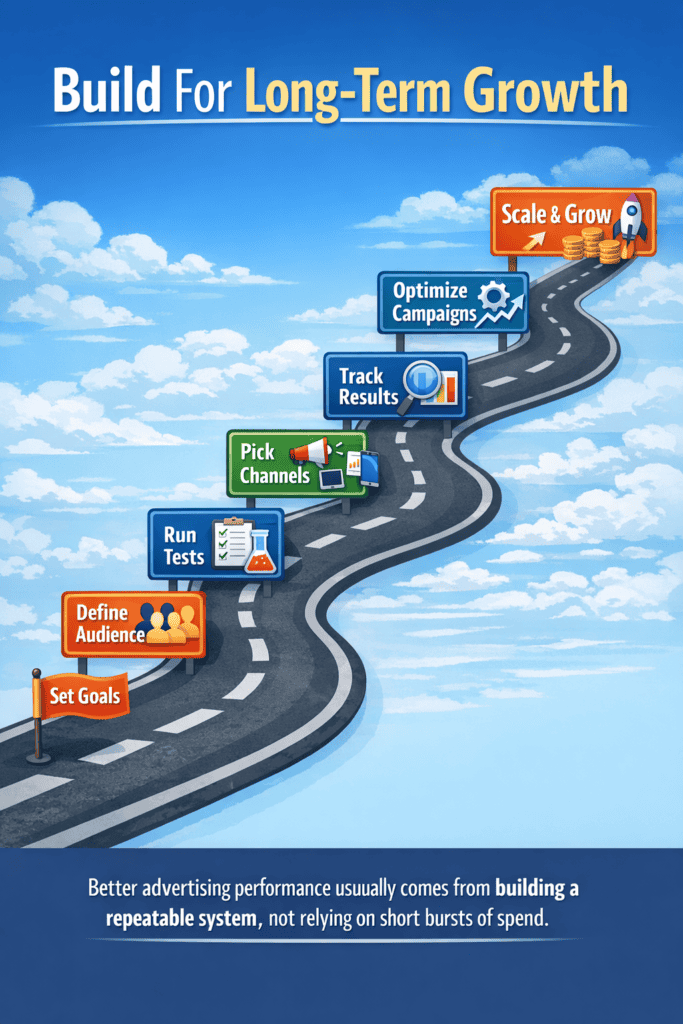
An advertising plan that supports long-term growth should do more than generate short bursts of activity. It should help the business attract the right audience consistently, learn what works, improve over time, and turn advertising into a repeatable part of growth rather than a series of disconnected campaigns.
Many businesses treat advertising as a reactive task. Sales slow down, so they launch ads. Leads dip, so they increase spend. That approach can create temporary movement, but it rarely builds a stable system. Long-term growth needs a plan that connects advertising to wider business goals, customer demand, and commercial reality.
The starting point is clarity. A business should know what advertising is meant to support over time. That may include lead generation, online sales, local visibility, market expansion, repeat purchases, or stronger brand awareness in a specific segment. Without that direction, campaigns tend to become tactical rather than strategic. They may create clicks, but they do not always move the business forward in a meaningful way.
A strong long-term plan also accepts that not every campaign has the same role. Some advertising is designed to capture demand that already exists. Some creates awareness earlier in the buyer journey. Some brings past visitors back. Some supports seasonal offers or product launches. When businesses understand those roles, they stop expecting every advert to do everything at once.
Consistency matters as well. Buyers often need more than one interaction before they act. They may see an advert, visit the website, leave, return later through search, and convert only after repeated exposure. That is why long-term advertising works best when it is steady, measured, and connected across touchpoints rather than switched on and off without much structure.
Planning for growth also means building in testing. Markets change. Buyer behaviour changes. Costs shift. A channel that worked well six months ago may weaken, and a message that once performed strongly may lose relevance. The best advertising plans leave room for learning. They include regular reviews, controlled tests, and clear decision points based on performance rather than assumption.
Budgeting should reflect this longer view. A business should not only ask what it can spend this month. It should ask what level of investment is sustainable, what part of that budget is for testing, what part is for proven campaigns, and what returns are needed to justify future growth. That helps the business avoid impulsive spending while still creating room to improve.
A practical long-term advertising plan usually includes:
- a clear business goal tied to revenue or growth
- a defined target audience
- a small number of priority channels
- messages matched to buyer intent
- landing pages that support conversion
- clear tracking for leads, sales, and cost per result
- regular reviews to improve performance over time
It also helps to think beyond the advert itself. Long-term growth is usually stronger when advertising works alongside other business assets. These may include a strong website, clear positioning, email follow-up, remarketing, customer reviews, and a sales process that handles leads properly. Advertising performs better when the wider system supports it.
This is especially important for businesses that want more than occasional wins. A good month of advertising is useful. A reliable process that can be repeated, measured, and improved is far more valuable. That is what long-term growth depends on. Not just visibility, but a stronger system for turning attention into revenue over time.
Building an advertising plan that supports long-term growth means thinking with more discipline. Set clear goals. Choose channels carefully. Match the message to the buyer. Measure outcomes properly. Keep learning. The businesses that grow most effectively through advertising are usually not the ones making the most noise. They are the ones building a system that keeps getting smarter.