Is ecommerce worth it in 2026?
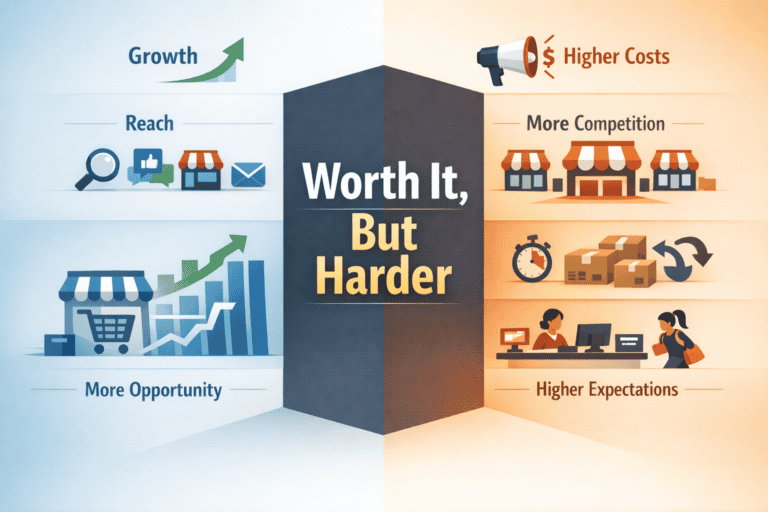
Ecommerce can still be worth it in 2026, but it is no longer an easy way to make money just because you launch a store. More sellers are competing for the same customers, ads cost more, and buyers expect fast delivery, clear pricing, and a smooth checkout before they trust a new brand. That means success depends less on simply being online and more on whether your business can attract the right traffic, protect its margins, and give customers a reason to come back.
For some businesses, ecommerce is still a smart move. It can lower the cost of opening a store, expand reach beyond one local area, and create more ways to sell through search, social media, marketplaces, and email. For others, it becomes expensive quickly because the product is weak, the niche is overcrowded, or the numbers do not work after shipping, returns, and marketing costs are added in. This article looks at what has changed, where ecommerce still makes sense, and how to decide whether it is worth your time and money in 2026.
What has changed in ecommerce in 2026, and why the answer is no longer simple
The answer is no longer a clear yes or no because ecommerce in 2026 sits in a more demanding middle ground. Online selling is still growing, but growth alone does not make every store a good business. In the United States, e-commerce sales for 2025 reached about $1.23 trillion and accounted for 16.4% of total retail sales, up from 16.1% in 2024, so the channel is still moving forward. At the same time, that growth is not so fast that weak stores can hide behind a rising market anymore.
What changed most is the standard buyers now expect. People compare prices faster, find alternatives more easily, and leave quickly when a store feels slow, confusing, or risky. Baymard says the average cart abandonment rate is about 70.19%, which shows how easy it is to lose a sale after doing the hard work of getting the visitor in the first place. That means the question is not just “Can you open an online store?” It is “Can you run one well enough to keep traffic, convert buyers, and protect margin?”
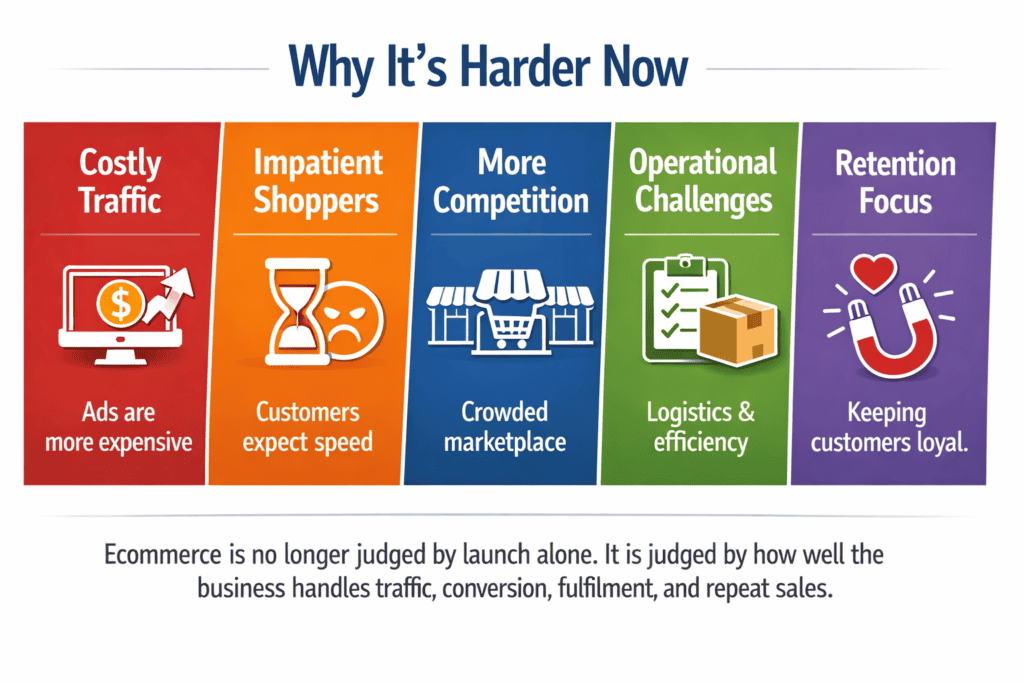
Several shifts have made ecommerce harder to judge than it was a few years ago:
-
Traffic is more expensive. Brands often need stronger SEO, better content, smarter ads, and repeat buyers to avoid depending on costly paid acquisition.
-
Buyers are less patient. Slow pages, weak product pages, hidden fees, and poor checkout flows now kill sales faster.
-
Competition is wider. A small store is no longer just competing with local sellers. It is competing with marketplaces, social commerce sellers, and large brands with stronger logistics.
-
Operations matter more. Shipping speed, stock accuracy, returns handling, and customer service now shape profit almost as much as product choice.
-
Retention is more valuable. One-time orders are rarely enough. Email, SMS, subscriptions, bundles, and repeat purchase strategy matter far more than before.
Another major change is how people discover products. DHL’s 2025 E-Commerce Trends Report, based on 24,000 shoppers across 24 markets, says consumer expectations are being reshaped by AI, social media, and changing delivery expectations. That creates more opportunity, but it also means sellers must be present across more touchpoints and keep the buying journey consistent from discovery to delivery.
So, is ecommerce worth it in 2026? For the right business, yes. But it is no longer simple because the real question is whether your product, pricing, margins, and operations can hold up in a market where customers have more choice and less patience. That is why some stores grow steadily while many others struggle even when online retail itself keeps expanding.
When ecommerce is still worth it: business models, niches, and products that can still make money
Ecommerce is still worth it when the business is built on more than hope. In 2026, the stores that still make money usually have a clear advantage: better margins, a sharper niche, stronger product knowledge, or a system that brings customers back without starting from zero every month. Selling online is not dead. Easy, undifferentiated selling is what has become harder.
From an experience-based business view, ecommerce tends to work best when the seller understands the buyer deeply enough to solve a specific problem. That is where E-E-A-T matters. Experience helps you choose better products and speak to real customer concerns. Expertise helps you explain features, fit, usage, quality, and comparisons in a way that builds confidence. Authoritativeness grows when the store shows clear policies, accurate product information, and useful content. Trust becomes stronger when pricing, shipping, returns, and contact details are all easy to find and easy to believe.
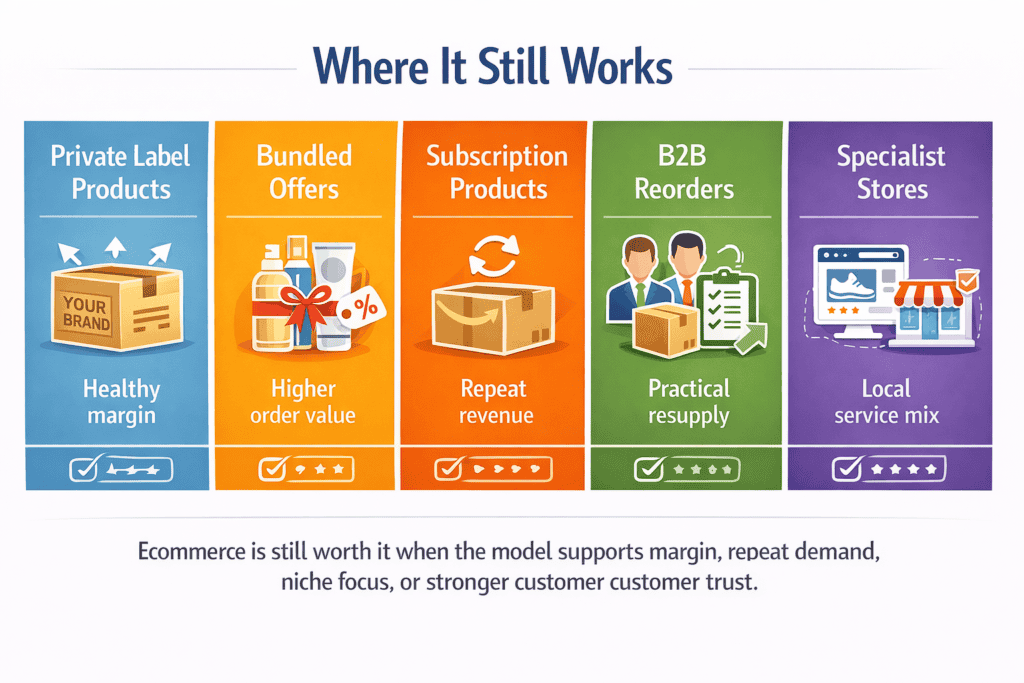
Some business models still make strong sense because they give the seller more control or better economics:
-
Private label products with clear demand and healthy margin
-
Bundled offers that increase average order value
-
Subscription-based products that create repeat revenue
-
B2B ecommerce stores selling practical items businesses reorder
-
Specialist stores built around one product category or one audience
-
Hybrid models that combine ecommerce with local service, showroom, or consultation
Niche stores also still perform well when they are built around a buyer type, not just a product list. A general store often looks weak because it tries to sell everything to everyone. A focused store has a stronger chance of ranking in search, building repeat buyers, and sounding more credible. A store that serves runners with foot pain, parents buying sensory toys, or small cafés buying supplies has a clearer message than a store that simply sells “many great items online.”
Products can still make money when they meet practical conditions such as:
-
Enough margin to absorb ads, shipping, returns, and payment fees
-
Clear value that can be understood quickly on a product page
-
Repeat demand or complementary upsell opportunities
-
Lower breakage, lower return risk, or simpler fulfilment
-
A reason for the buyer to choose your store instead of a marketplace
In real commercial terms, the strongest products are often not the most exciting ones. They are the ones that solve a problem clearly, ship without too much difficulty, and leave enough room for profit after all costs are counted. Many sellers lose money because they choose products based on trend appeal instead of margin reality. A product may look popular and still be a poor ecommerce choice if it is bulky, fragile, return-heavy, or easy to undercut.
Ecommerce is also still worth it for businesses that create trust through useful content and strong store presentation. A seller with buying guides, comparison pages, detailed product explanations, original photos, and clear after-sales support has a better chance of converting cautious buyers. This is another practical side of E-E-A-T. People are more willing to buy when the business looks informed, reachable, and honest. In 2026, that trust layer is often the difference between a store that gets traffic and a store that gets paid orders.
So yes, ecommerce is still worth it when the model is sound, the niche is focused, and the product economics make sense. It is less about chasing what is trendy and more about building a business that can survive real-world costs, real customer expectations, and real competition.
Why many ecommerce stores fail: rising costs, weak margins, and too much competition
Many ecommerce stores fail because sales alone do not mean the business is healthy. A store can bring in orders and still lose money once ad spend, shipping, returns, discounts, payment fees, and support time are added in. That is where weak margins become a serious problem. If there is not enough room between the selling price and the true cost of serving the order, growth only makes the problem bigger.
Competition makes this even harder. In 2026, shoppers can compare products, prices, delivery speed, and reviews in minutes. If a store sells the same thing as many others and offers no clear reason to buy from it, it becomes easy to ignore. Rising customer acquisition costs, price pressure, and marketplace competition leave little room for error. Many stores do not fail because ecommerce no longer works. They fail because the numbers were too weak, the offer was too easy to replace, and the business ran out of margin before it built trust or repeat demand.
What it really takes to make ecommerce work in 2026: traffic, operations, conversion, and retention
Making ecommerce work in 2026 takes more than launching a store and waiting for orders. You need qualified traffic, reliable operations, strong conversion, and a reason for customers to come back. Traffic brings people in, but that traffic has to match the product and buyer intent. Operations keep the business stable through accurate stock, clear shipping, and smooth fulfilment. Conversion depends on product pages, pricing clarity, trust signals, and an easy checkout. Retention turns one order into long-term value through email, service, repeat purchase offers, and a buying experience people remember for the right reasons.
The stores that last usually treat ecommerce as a full business system, not just a website. They watch margins closely, fix friction quickly, and build around repeat demand instead of chasing one-time sales. That is what makes ecommerce work now. It is not just about getting visits. It is about turning those visits into profitable orders and giving customers a reason to return.
Is ecommerce worth it for small businesses, solo founders, and first-time sellers?
Ecommerce can still be worth it for small businesses, solo founders, and first-time sellers, but only when they start narrow and stay realistic. The online channel is still large and growing. In the United States, ecommerce made up 16.4% of total retail sales in 2025 and reached about $1.23 trillion, which shows there is still strong buying activity online. But demand alone is not enough. Around 70% of shoppers still abandon their carts, which means small sellers cannot rely on traffic alone and need clear product pages, simple checkout, and strong trust signals from day one.
For first-time sellers, ecommerce is usually worth it when the product is focused, the costs are controlled, and the business does not depend on paid ads too early. Small operators often do better when they sell within one niche, keep stock manageable, and build repeat business instead of chasing scale too fast. So yes, ecommerce can still be worth it in 2026, but for smaller sellers it works best as a disciplined business model, not as an easy side hustle.
How to decide if ecommerce is worth it for you: a simple reality check before you invest time and money
Before you spend money on a store, ads, or stock, ask a harder question: does the business make sense without wishful thinking? Ecommerce is worth it when the product solves a real problem, the margin is strong enough to survive costs, and you have a realistic way to get customers. If the plan depends on “going viral” or copying what everyone else sells, the risk is much higher.
A simple reality check is to look at four things:
-
Product: Is there a clear reason someone would buy this from you?
-
Margin: Can you still make money after shipping, fees, returns, and discounts?
-
Demand: Are people already searching for, comparing, or needing this type of product?
-
Execution: Can you handle fulfilment, customer questions, and repeat marketing properly?
If most of those answers are weak, ecommerce may not be worth pursuing yet. If they are strong, you may have something worth building. The goal is not just to launch a store. It is to build one that can survive real costs, real competition, and real customer expectations.
Author Bio

With over 26 years of experience in SEO and e-commerce, I currently serve as the Director of Partnerships at OpenCart, where I focus on building strategic alliances with key stakeholders across the e-commerce ecosystem, including payment gateways, shipping providers, and merchants. My role is centered on enhancing platform capabilities to ensure seamless operations and exceptional service delivery, empowering businesses worldwide.
Equipped with extensive expertise in technical SEO, social media marketing, and link building, I collaborate with partners to drive growth and innovation in e-commerce solutions. My commitment to fostering valuable relationships and delivering impactful results has been instrumental in supporting merchants and organizations in achieving their goals through tailored strategies and cutting-edge solutions.