Marketplace Management in Ecommerce: How to Sell on Multiple Platforms Without Losing Control
Expert insights from ecommerce operators managing 50+ marketplace accounts across Amazon, eBay, Walmart, and Etsy, processing over $12M in annual marketplace sales.
Why Managing Multiple Marketplaces Becomes Chaotic Fast
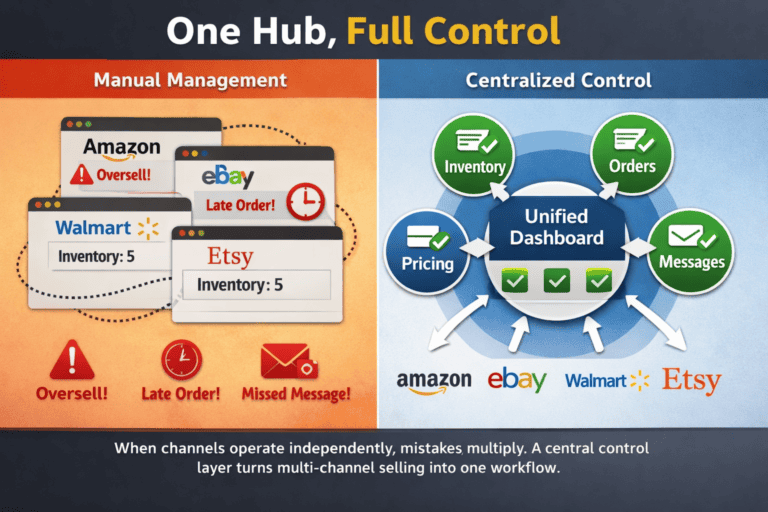
A clothing retailer listed products on Amazon, eBay, and Walmart simultaneously. Within two weeks, they faced a nightmare: the same item sold on all three platforms at once, leaving them with two unfulfilled orders, two angry customers, and potential account penalties. Their inventory system showed 5 units in stock, but those 5 units existed across three separate marketplace listings with no synchronization.
This scenario repeats constantly for sellers expanding to multiple marketplaces. Each platform operates independently with different inventory counts, pricing rules, shipping requirements, and customer service expectations. Managing this manually becomes impossible beyond 50-100 SKUs.
Marketplace management means coordinating product listings, inventory levels, pricing, orders, and customer communication across multiple selling platforms. Done correctly, it multiplies your reach and revenue. Done poorly, it creates operational chaos that damages your business and reputation.
What Marketplace Management Actually Involves
Marketplace management encompasses every aspect of selling on third-party platforms like Amazon, eBay, Walmart, Etsy, Target Plus, and others. It includes product listing creation, inventory synchronization, order processing, shipping coordination, customer service, and performance monitoring.
Each marketplace has unique requirements. Amazon demands detailed product attributes, enhanced brand content, and specific image dimensions. eBay allows auction-style listings alongside fixed prices. Walmart requires extensive product data sheets and fast shipping commitments. Etsy focuses on handmade and vintage items with completely different audience expectations.
The complexity multiplies as you add marketplaces. Selling on Amazon alone involves managing one set of rules. Adding eBay, Walmart, and Etsy means juggling four different platforms, each with separate seller dashboards, fee structures, policies, and customer bases. Without proper systems, this quickly becomes unmanageable.
A home goods seller with 200 products across four marketplaces manages 800 individual listings. Each listing needs monitoring for pricing changes, stock levels, and performance metrics. When they run a promotion, they must update prices across all 800 listings. When inventory arrives, they must allocate it correctly across platforms. Manual management of this scale is a full-time job.
The Real Costs of Poor Marketplace Management
Overselling damages your reputation permanently. When you sell an item you cannot fulfill, platforms penalize your account. Amazon’s Order Defect Rate includes cancelled orders maintain above 1% and you risk suspension. eBay tracks defect rates similarly. One electronics seller lost their Amazon account after 15 oversells in a month, costing them 60% of their revenue.
Manual price updates waste time and cause errors. A toy seller tried updating prices across Amazon, eBay, and Walmart manually during Black Friday. They made mistakes on 40+ listings, either pricing too high and missing sales or too low and losing money. The errors cost them $8,000 in lost profit over one weekend.
Lost sales from stockouts hurt growth. When your Amazon listing shows out of stock but you have inventory on eBay, you lose sales on both platforms. Amazon’s algorithm suppresses out-of-stock listings, making it harder to regain visibility even after restocking. One seller lost their top search position for a high-volume keyword after a 5-day stockout, taking 3 months to recover.
Delayed order processing frustrates customers. Checking multiple marketplace dashboards for new orders means some sit unshipped for 24-48 hours. Late shipment rates above 4% on Amazon hurt your seller metrics. eBay customers expect same-day shipping for orders placed before 2 PM. Missing these windows generates negative feedback.
Core Marketplace Management Challenges
Understanding common challenges helps you prepare solutions before problems emerge. Every multi-marketplace seller faces these issues the difference between success and failure is having systems to handle them.
Inventory Synchronization Across Platforms
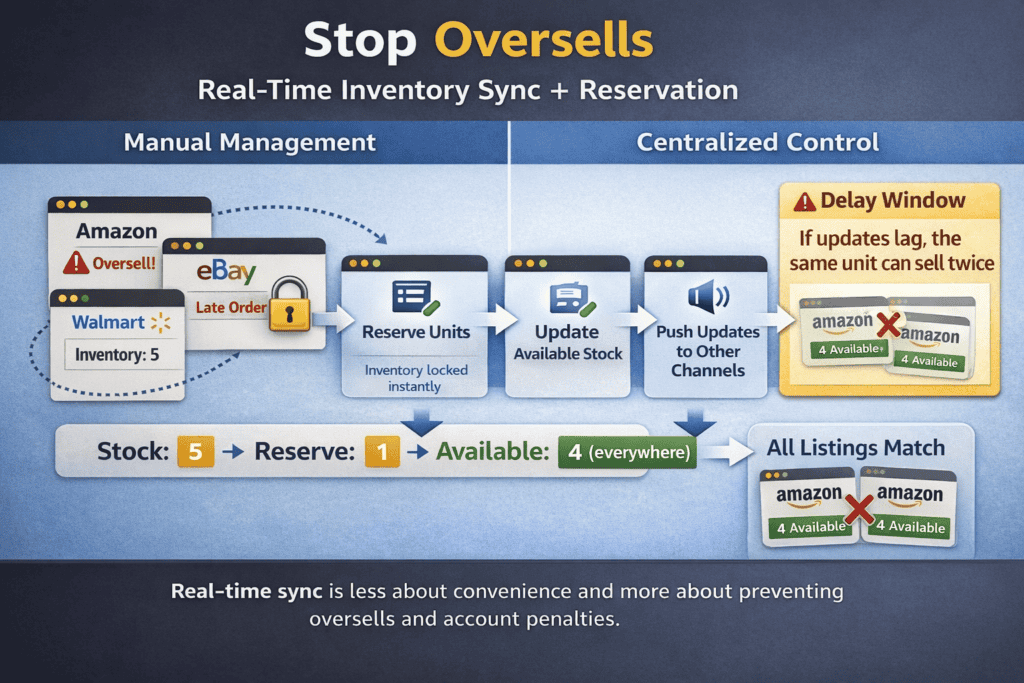
Real-time inventory sync prevents overselling but requires technical infrastructure. When an item sells on Amazon, your eBay and Walmart listings must update instantly. Delays of even 5-10 minutes during busy periods cause duplicate orders.
A sporting goods company implemented inventory buffers if they have 10 units, they list 3 on Amazon, 3 on eBay, 2 on Walmart, keeping 2 as safety stock. This prevents overselling but caps sales potential. With proper synchronization, they could list all 10 units on each platform and adjust automatically as orders come in.
Reserved inventory complicates matters. Amazon FBA holds inventory in their warehouses, unavailable for other channels. If you use multi-channel fulfillment (MCF) to fulfill orders from other marketplaces using FBA inventory, you need systems tracking what’s reserved versus available.
Inventory allocation strategies differ by business model. Some sellers split inventory evenly across platforms. Others prioritize their highest-performing channel. A kitchen supplies seller sends 60% of inventory to Amazon FBA, 30% to their warehouse for eBay/Walmart, and keeps 10% for their website. This allocation matches where their customers actually buy.
Pricing Strategy Across Different Marketplaces
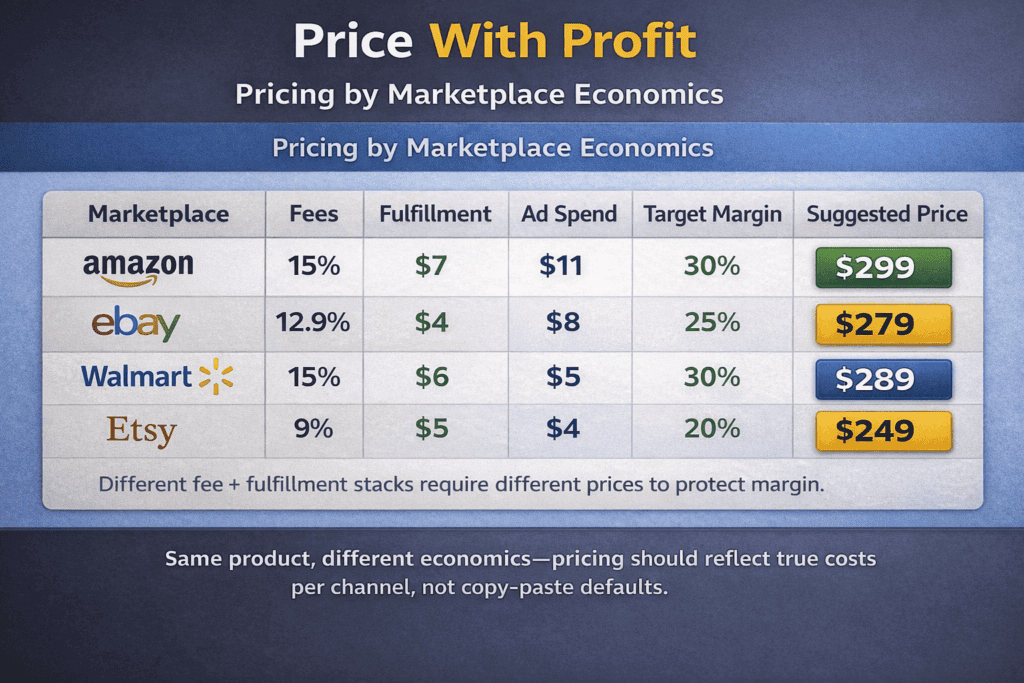
Marketplace fees vary significantly, affecting pricing decisions. Amazon charges 15% referral fees for most categories plus FBA fees. eBay charges 12.9% plus payment processing. Walmart charges 15% but no storage fees. Your pricing must account for these differences while remaining competitive.
A furniture seller prices the same item at $299 on Amazon, $279 on eBay, and $289 on Walmart after calculating fees and fulfillment costs. Amazon’s higher fees are offset by higher traffic and conversion rates. The price differences reflect true profitability per channel, not random markups.
Dynamic repricing responds to competition automatically. Repricing software monitors competitor prices and adjusts yours to maintain position. An electronics seller uses rules: stay within $5 of lowest price, never price below $X profit margin, adjust every 15 minutes. This automation generated 23% more sales while maintaining margins.
Promotional pricing coordination requires planning. If you run a sale on Amazon, do you match it on eBay and Walmart? A pet supplies seller tested this and found Amazon shoppers respond to deals more than eBay shoppers. They now run Amazon Lightning Deals without matching on other channels, maximizing Amazon sales without reducing profit elsewhere.
Order Management From Multiple Sources
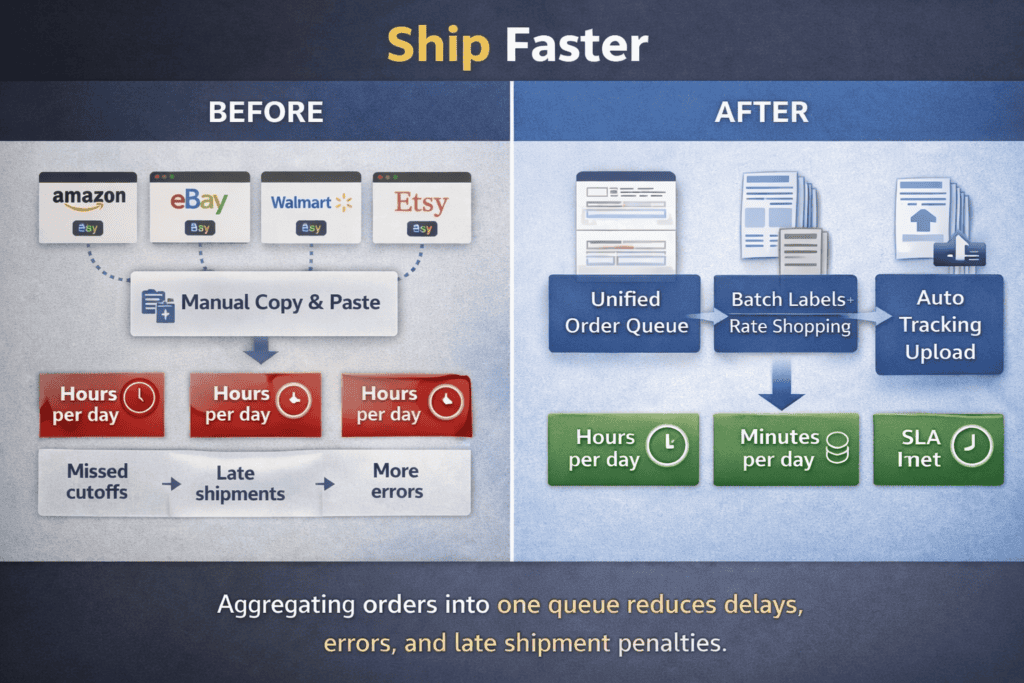
Orders arrive from different marketplaces throughout the day. Checking each platform’s dashboard separately means orders sit unfulfilled for hours. A beauty products seller processing 50-80 orders daily spent 3 hours just checking platforms and manually entering orders into their shipping system.
Centralized order management pulls orders from all marketplaces into one interface. The seller implemented a system that aggregates Amazon, eBay, Walmart, and Etsy orders automatically. Order processing time dropped from 3 hours to 45 minutes daily, and late shipments decreased from 8% to 0.4%.
Each marketplace has different shipping expectations. Amazon Prime customers expect 2-day delivery. eBay buyers tolerate 3-5 business days. Walmart demands 2-day shipping to remain competitive. Etsy customers often accept longer processing times for handmade items. Your fulfillment process must accommodate these variations.
Tracking number uploads happen automatically or manually. Manual uploads to each platform takes 10-15 minutes for 50 orders. Automated systems upload tracking information to all marketplaces instantly after label creation. This prevents late tracking uploads that hurt seller metrics.
Customer Service Across Different Platforms
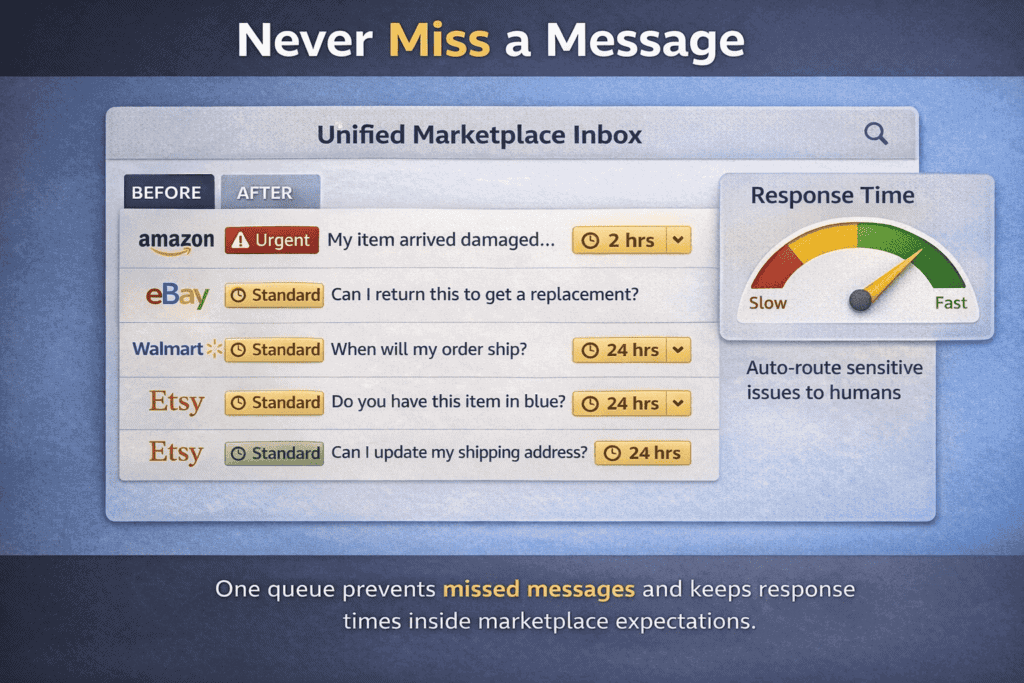
Customer messages arrive through each marketplace’s messaging system. Amazon Buyer-Seller Messages, eBay Messages, Walmart Seller Center inbox all separate. Customers expect responses within 24 hours on most platforms, faster for urgent issues.
A toy seller missed an Amazon message about a damaged item for 36 hours because they checked Amazon messages only twice daily. The customer left negative feedback before the seller could resolve it. Amazon’s Voice of the Customer metrics penalized them, affecting their Buy Box eligibility.
Centralized inbox systems aggregate messages from all marketplaces. Customer service reps see all messages in one queue and respond without switching between platforms. Response times improved from 18 hours average to 4 hours, and customer satisfaction scores increased 31%.
Return policies vary by marketplace. Amazon requires accepting returns within 30 days. eBay allows sellers to set return policies but favors buyer-friendly policies. Walmart requires accepting returns. Etsy gives sellers more flexibility. Managing these different requirements without clear processes leads to mistakes and policy violations.
Marketplace Management Software and Tools
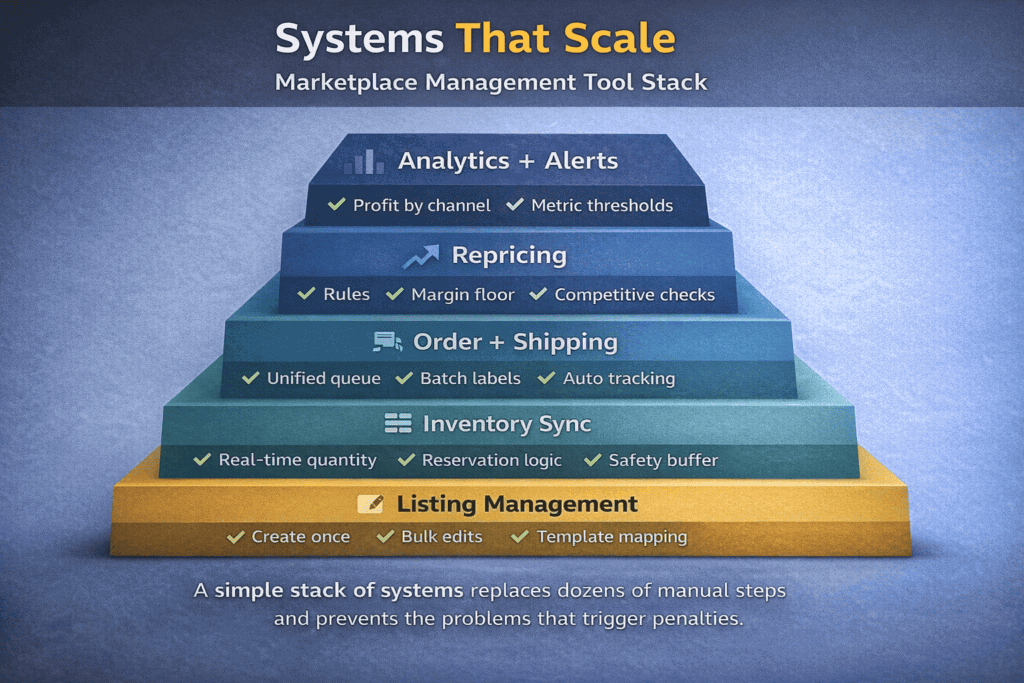
Software becomes necessary when managing more than one marketplace or more than 50 SKUs. Manual management works temporarily but doesn’t scale. The right tools prevent problems rather than fixing them after they occur.
Multi-Channel Listing Management
Listing management software lets you create one product listing and publish it across multiple marketplaces. You enter product details, images, and descriptions once, then the software formats them according to each platform’s requirements.
ChannelAdvisor, Linnworks, and Sellbrite serve this purpose. A office supplies seller using ChannelAdvisor reduced their listing creation time from 15 minutes per marketplace per product (60 minutes for 4 platforms) to 20 minutes total. For 500 products, this saved 300+ hours.
Template mapping handles platform-specific requirements. Amazon needs bullet points and enhanced brand content. eBay displays descriptions differently. The software automatically formats your master listing to match each platform’s layout and requirements.
Bulk editing updates hundreds of listings simultaneously. When a manufacturer changes packaging or specs, you update once and push changes across all marketplaces. A health supplements seller updated ingredient lists on 200 products across 4 marketplaces in 30 minutes versus the 10+ hours manual updates would require.
Inventory Synchronization Systems
Real-time inventory sync updates all marketplace listings when quantity changes. An item sells on Amazon eBay and Walmart listings immediately reflect reduced inventory. This prevents overselling that damages seller metrics and customer relationships.
Sync frequency matters. Software updating every 15-30 minutes leaves windows for overselling. Systems updating within 60 seconds or less provide true real-time protection. A cosmetics seller reduced oversells from 12 monthly to 1 monthly by switching from 30-minute to 1-minute sync intervals.
Safety stock buffers add protection. Set your system to show “out of stock” when you have 2 units left, giving you a buffer against sync delays. This prevents the last unit from selling on multiple platforms simultaneously. The tradeoff is slightly lower sales velocity from showing out of stock earlier.
Warehouse management integration provides accuracy. Your physical inventory system connects to your marketplace listings. When warehouse staff pick items for orders, inventory decrements automatically. When new stock arrives and gets scanned in, marketplace listings update. This eliminates manual inventory adjustments.
Order Management Platforms
Order management systems aggregate orders from all marketplaces into one interface. ShipStation, ShippingEasy, and Ordoro serve this function. Orders import automatically with customer details, shipping addresses, and purchased items.
Shipping automation compares carrier rates and prints labels in batch. The system checks USPS, UPS, and FedEx rates for each order, selects the cheapest option meeting delivery commitments, and prints labels. A toy seller processing 100 daily orders saves $150 daily in shipping costs through automated rate shopping $54,000 annually.
Tracking number upload happens automatically after label creation. The system sends tracking information back to Amazon, eBay, Walmart, and your website simultaneously. This ensures you never miss tracking upload deadlines that hurt seller metrics.
Custom packing slips and branding inserts can be generated per marketplace. Amazon orders get one packing slip format. eBay orders include promotional inserts. Etsy orders feature handwritten thank-you cards. The system routes each order to the appropriate fulfillment workflow automatically.
Repricing Tools for Competitive Positioning
Repricing software monitors competitor prices and adjusts yours automatically based on rules you set. RepricerExpress, Informed.co, and Feedvisor analyze competitor pricing every few minutes and change your prices to maintain competitive position while protecting margins.
Rule-based repricing follows your strategy. Rules might include: stay $0.50 below lowest competitor price, never price below $X, match competitor pricing between certain hours, or increase price when inventory drops below 5 units. An electronics seller uses 15 different repricing rules for different product categories.
AI-powered repricing analyzes more variables: competitor stock levels, historical pricing patterns, seasonal trends, and time of day. These systems learn which price points maximize profit for each product. A book seller using AI repricing increased profit margins from 18% to 24% while maintaining sales velocity.
Buy Box optimization matters most on Amazon where 82% of sales go through the Buy Box. Repricing tools specifically optimize for Buy Box rotation, adjusting prices to maintain maximum Buy Box percentage. A home goods seller increased their Buy Box percentage from 67% to 91%, increasing daily sales from $2,400 to $3,800.
Analytics and Reporting Tools
Multi-marketplace analytics show performance across all platforms in one dashboard. See which marketplaces generate the most revenue, which products sell best on each platform, and where profit margins are strongest.
A craft supplies seller discovered through analytics that Amazon generated 60% of revenue but only 35% of profit, while Etsy generated 25% of revenue but 45% of profit due to lower fees and higher prices. This insight shifted their inventory allocation and marketing focus.
Performance metric tracking monitors seller health across platforms. Track late shipment rates, order defect rates, customer response times, and return rates. Alerts notify you when metrics approach danger thresholds before account penalties occur.
Inventory turnover analysis reveals which products sell quickly versus which sit in stock for months. A beauty products seller identified 40 SKUs with 300+ days inventory. They ran clearance sales on those products and reallocated that capital to fast-moving items, improving cash flow by $18,000.
Choosing Which Marketplaces to Sell On
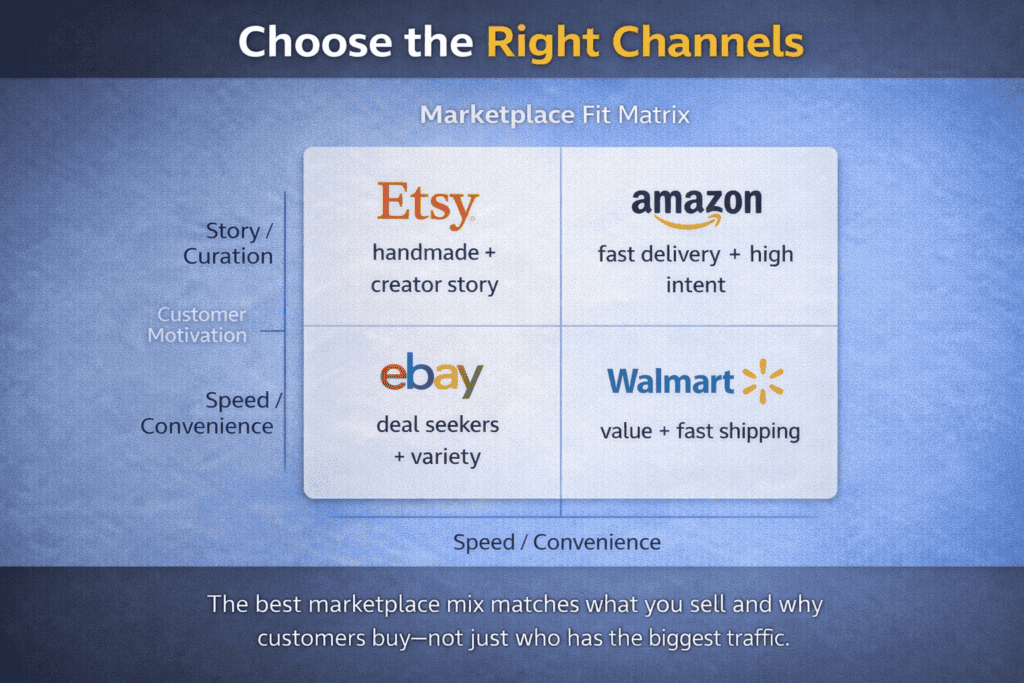
Selling on every available marketplace sounds appealing but spreads resources too thin. Each marketplace requires setup time, learning platform-specific policies, and ongoing management. Focus on platforms where your products and customers naturally align.
Amazon: Volume and Visibility
Amazon dominates with 200+ million Prime members and massive traffic. Products that compete on selection, price, and fast shipping perform well. Amazon customers prioritize convenience and speed over personal connection.
Amazon FBA provides fulfillment infrastructure and Prime eligibility. You send inventory to Amazon warehouses; they pick, pack, and ship orders plus handle returns. FBA fees are higher but Prime eligibility often increases sales 30-50% compared to merchant-fulfilled listings.
Competition on Amazon is intense. Popular product categories have dozens or hundreds of sellers. Winning requires competitive pricing, excellent product images, thorough descriptions, and positive reviews. A kitchen tools seller invested $5,000 in professional photography and saw conversion rates increase from 8% to 14%.
Amazon’s advertising platform (sponsored products, brands, display) drives additional visibility. Sellers typically spend 8-15% of revenue on advertising to maintain rankings and sales velocity. Budget for advertising when calculating Amazon profitability.
eBay: Auctions and Unique Items
eBay serves bargain hunters and collectors seeking unique, used, or hard-to-find items. Auction format works well for one-of-a-kind products or items with uncertain market value. Fixed-price listings compete similarly to Amazon but with lower traffic.
eBay buyers tolerate longer shipping times and are more price-sensitive than Amazon shoppers. A vintage clothing seller thrives on eBay with unique pieces that would get lost on Amazon. Their average item value is $45 on eBay versus $28 for similar new items they test on Amazon.
Promoted listings drive traffic on eBay similar to Amazon’s sponsored products. You pay a percentage of sale price when buyers purchase through promoted placements. eBay reports promoted listings receive 2-3x more visibility than standard listings.
eBay’s Global Shipping Program handles international sales. You ship items to eBay’s domestic shipping center; they handle customs and international delivery. This opens international markets without complexity.
Walmart Marketplace: Growing Alternative
Walmart Marketplace offers less competition than Amazon with growing customer base. Walmart shoppers overlap with Amazon customers but Walmart maintains distinct value-focused brand identity.
Walmart has stricter seller requirements including US-based business, quality standards, and customer service expectations. Application approval takes 2-4 weeks. They reject sellers not meeting standards, maintaining marketplace quality.
Walmart Fulfillment Services (WFS) competes with Amazon FBA. You send inventory to Walmart warehouses for fulfillment. A household goods seller added Walmart and generated $40,000 monthly in 6 months with 60% less competition than their Amazon listings faced.
Free 2-day shipping expectations mirror Amazon Prime. Customers expect fast delivery. Meeting shipping commitments is crucial for maintaining seller performance and visibility.
Etsy: Handmade and Vintage Focus
Etsy specializes in handmade, vintage (20+ years old), and craft supplies. The platform attracts buyers seeking unique items with personal stories. Trying to sell mass-produced products on Etsy violates policies and fails with the audience.
Etsy buyers value craftsmanship and creator connection. A jewelry maker shares her creative process, sources of inspiration, and custom capabilities. Her average order value on Etsy ($78) significantly exceeds what she could charge for similar items on Amazon ($32).
Longer processing times are accepted on Etsy. Customers understand handmade items take time. Listing “ships within 1-2 weeks” doesn’t hurt sales like it would on Amazon. This flexibility benefits small makers without large inventory.
Etsy Ads and Google Shopping integration help discovery. Etsy automatically promotes listings on Google Shopping. Etsy Ads place your products in on-site search results. A candle maker spending $200 monthly on Etsy Ads generates $2,800 in attributed sales.
Building Your Marketplace Management Process
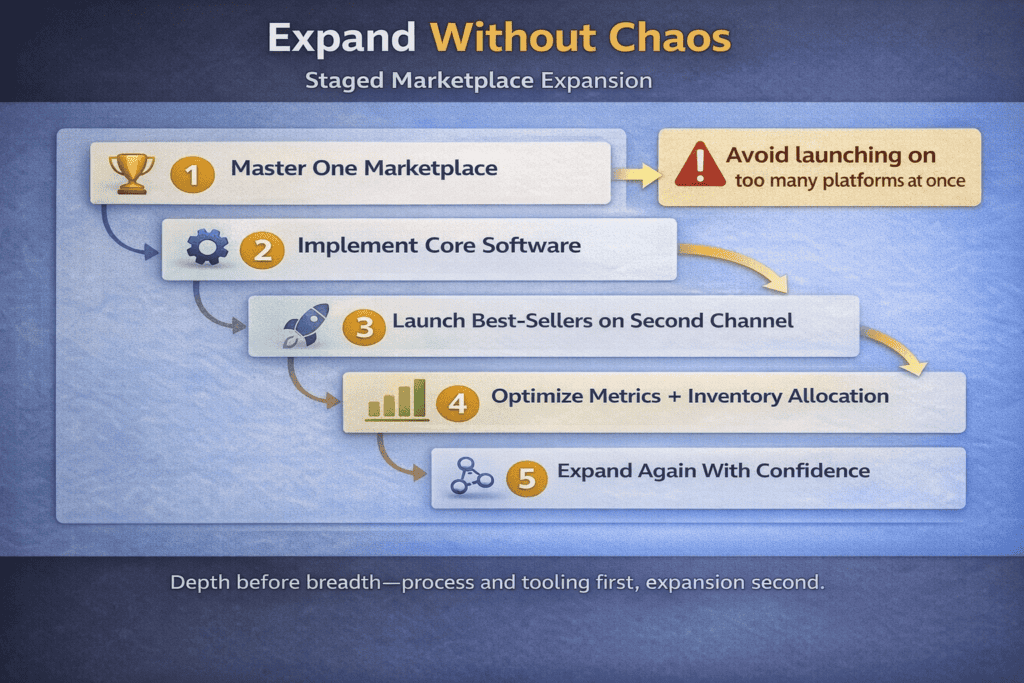
Start with one marketplace and master it before expanding. Trying to launch on four platforms simultaneously guarantees mediocre results everywhere. Build proficiency on one, then replicate success on others.
Step 1: Master One Primary Marketplace
Choose your primary marketplace based on where your products naturally fit. Generic consumer goods start with Amazon. Unique or handmade items start with Etsy. Used or collectible items start with eBay.
Spend 3-6 months learning platform algorithms, advertising, optimization, and customer expectations. A pet supplies seller focused exclusively on Amazon for 5 months, testing different keywords, images, and pricing strategies. By month 6, they generated $15,000 monthly revenue with profitable advertising.
Document what works in a simple playbook. Record successful product titles, bullet point structures, pricing strategies, and advertising tactics. This documentation speeds expansion to additional marketplaces.
Step 2: Implement Core Management Software
Start with inventory management and order processing software before expanding to multiple marketplaces. These tools become essential immediately when operating on more than one platform.
Sellers managing under $10,000 monthly revenue might postpone software costs. Above $10,000 monthly, software prevents costly mistakes that justify the expense. A $200 monthly software subscription prevents even one oversell incident worth $500 in lost profit and penalties.
Test software with a trial period. Most marketplace management tools offer 14-30 day trials. Use the trial to process real orders and evaluate whether the system solves your specific problems before committing.
Step 3: Expand to Second Marketplace Strategically
Choose your second marketplace based on incremental opportunity, not just size. If you already sell on Amazon, adding eBay might access bargain hunters. Adding Walmart accesses value-focused shoppers who prefer Walmart’s brand.
List your top 20% best-selling products on the new marketplace first. These proven sellers have higher success probability than testing unproven products on unfamiliar platforms. An office supplies seller listed their 30 best Amazon products on Walmart and generated $8,000 monthly within 90 days.
Optimize listings for the new platform’s specific audience and algorithms. Don’t copy Amazon listings to eBay—rewrite for eBay’s buyer behavior and search algorithm. eBay searchers use different keywords and respond to different messaging than Amazon shoppers.
Step 4: Monitor and Optimize Performance
Review marketplace performance weekly initially, monthly once established. Track sales, profit margins, inventory turnover, and seller metrics for each platform.
Allocate inventory based on performance. If Amazon sells 70% of revenue, allocate 70% of inventory there. If Etsy generates higher profit margins, shift allocation toward Etsy even if revenue is lower. A toy seller rebalanced inventory from 80% Amazon / 20% eBay to 60% Amazon / 40% eBay after discovering eBay’s 12% higher profit margins.
Test pricing variations between marketplaces. Identical pricing across platforms might not optimize profit. Premium pricing on Amazon with FBA might sell fine while eBay requires lower pricing for velocity. Test 5-10% price differences and measure impact on sales and profit.
Using AI and Automation in Marketplace Management
Artificial intelligence and machine learning now handle tasks that previously required constant human monitoring. These tools analyze patterns in marketplace data faster and more accurately than manual analysis.
AI-Powered Repricing and Buy Box Optimization
AI repricing tools analyze thousands of variables: competitor pricing patterns, time of day effects, seasonal trends, inventory levels, and historical conversion data. They predict optimal pricing for maximum profit or sales velocity based on your goals.
Machine learning models identify when to increase prices without losing sales. During high-demand periods or when competitors run low on stock, the system raises prices automatically. An electronics seller using AI repricing increased profit margins from 16% to 22% while maintaining sales volume.
Buy Box rotation algorithms on Amazon change constantly. AI tools track these changes and adjust pricing strategies automatically. Manual repricing cannot respond fast enough to algorithm shifts that happen multiple times daily.
Automated Listing Optimization
AI tools analyze top-performing competitor listings and suggest improvements to your titles, bullet points, and descriptions. They identify keywords driving traffic that you’re missing and recommend additions.
Image recognition AI evaluates your product photos against competitors and platform requirements. It flags images with poor quality, wrong dimensions, or missing required angles. A home decor seller improved their images based on AI recommendations and saw conversion rates increase from 9% to 13%.
A/B testing automation runs continuous experiments on listings. The system tests different titles, main images, or prices simultaneously and allocates more traffic to better-performing variations. This optimization happens without manual intervention.
Demand Forecasting and Inventory Planning
AI forecasting predicts future sales based on historical data, seasonal trends, and external factors. Models learn which products spike during holidays, how promotions affect sales, and how new competitor entries impact your velocity.
Accurate forecasts prevent stockouts and excess inventory. A toy seller using AI forecasting reduced stockouts by 75% during Q4 holiday season while carrying 20% less total inventory than previous years. Better predictions improved cash flow and profit.
Reorder point automation triggers purchase orders when inventory drops below predicted thresholds. The system accounts for supplier lead times, shipping delays, and sales velocity to ensure stock arrives before you run out.
Automated Customer Service Responses
AI chatbots and response systems handle common customer questions automatically. Questions about shipping times, return policies, or product specifications get instant answers without human involvement.
Large language models understand natural language queries and generate appropriate responses. A customer asking “when will my order arrive” triggers an automated response pulling their specific tracking information and estimated delivery date.
Human escalation rules ensure complex issues reach customer service staff. When messages contain words like “defective,” “broken,” “refund,” or “lawyer,” the system routes them to humans immediately. A clothing seller automated 60% of customer messages while ensuring sensitive issues get personal attention.
Common Marketplace Management Mistakes to Avoid
Learning from others’ mistakes prevents costly errors. These problems appear consistently across sellers at different stages of marketplace expansion.
Expanding Too Fast Across Too Many Platforms
Launching on five marketplaces simultaneously divides your attention and resources. Listings get half-completed. Customer messages go unanswered. Inventory tracking fails. A home goods seller tried this approach and faced account warnings on three platforms within 60 days for poor performance metrics.
Focus beats breadth in marketplace management. One optimized, high-performing marketplace generates more profit than five poorly-managed ones. Master one channel completely before expanding.
Ignoring Platform-Specific Requirements
Each marketplace has unique policies, formatting requirements, and customer expectations. Copying Amazon listings directly to eBay ignores eBay’s different search algorithm and buyer behavior. What works on Amazon might fail on eBay.
A electronics seller used identical listings across all platforms. Their Amazon listings converted at 12% but eBay listings converted at only 3%. After rewriting eBay listings for that audience—emphasizing deals and value rather than convenience eBay conversions improved to 8%.
Neglecting Seller Performance Metrics
Marketplace algorithms reward sellers with excellent metrics and punish those with poor performance. Late shipment rates, order defect rates, and customer response times directly affect your visibility and Buy Box eligibility.
A book seller ignored their Amazon late shipment rate as it climbed to 7%. Amazon suppressed their listings, reducing daily sales from $800 to $200. After implementing better processes and recovering their metrics below 4%, sales recovered but took 6 weeks to return to previous levels.
Monitor seller performance weekly. Set alerts when metrics approach warning thresholds. Fix problems immediately before they impact your account standing and sales.
Underestimating Time and Resource Requirements
Managing multiple marketplaces requires significant time investment. Customer service, inventory management, listing optimization, and advertising demand daily attention. A solo seller can manage one marketplace comfortably. Two marketplaces stretch capacity. Three or more require dedicated staff or extensive automation.
Budget for software tools and additional staff. Plan for $200-500 monthly in software subscriptions for multi-marketplace management. Factor in advertising costs for each platform. Amazon might require 10-15% of revenue for ads, eBay 5-8%, Walmart 8-12%.
Measuring Marketplace Management Success
Track metrics that reveal true business health, not vanity numbers. Marketplace dashboards show lots of data—focus on numbers that directly affect profitability and growth.
Revenue by Marketplace
Track monthly revenue from each marketplace separately. This reveals which platforms deliver results worth your continued investment. If one marketplace generates 5% of revenue but consumes 25% of your time, reallocate effort.
A kitchenware seller discovered Walmart generated only $2,000 monthly versus $18,000 from Amazon and $8,000 from eBay. They reduced Walmart inventory and focus, shifting products to better-performing channels. This reallocation increased total revenue without additional work.
Profit Margin by Platform
Revenue means nothing without profit. Calculate true profit per marketplace after deducting fees, shipping costs, advertising spend, and fulfillment expenses. Higher revenue doesn’t always mean higher profit.
A craft supplies seller found Amazon generated 65% of revenue but only 40% of profit due to high FBA and advertising costs. Etsy generated 25% of revenue but 45% of profit with lower fees and no advertising spend. This insight changed their inventory allocation and growth strategy.
Inventory Turnover Rate
Calculate how quickly inventory sells on each marketplace. Products sitting in stock for months tie up capital and generate storage fees. Fast-moving items generate better returns.
Compare the same SKU across marketplaces. A toy might turn over every 15 days on Amazon, 30 days on Walmart, and 60 days on eBay. This data guides inventory allocation send more units to Amazon where they sell faster.
Customer Acquisition Cost
Calculate how much you spend acquiring customers on each platform. Include advertising costs, platform fees, and discounts. Compare CAC to average order value and customer lifetime value.
If CAC on Amazon is $25 and average order value is $40, you gross $15 per order. But if 30% of customers reorder within 90 days, customer lifetime value increases significantly. These economics determine whether marketplace spending makes sense.
Moving Forward With Marketplace Management
Successful marketplace management requires systems, software, and strategic focus. Start with one marketplace and master it completely. Implement inventory synchronization and order management tools before expanding. Choose additional marketplaces based on where your products and customers naturally align.
Prioritize platforms by profitability, not just revenue. Monitor seller performance metrics religiously. Use automation and AI tools to handle repetitive tasks while you focus on strategy and optimization.
Expect 3-6 months per marketplace to reach full productivity. Don’t judge performance in the first 60 days. Give your listings time to accumulate reviews, optimize based on data, and achieve algorithmic visibility.
The businesses succeeding across multiple marketplaces share common practices: they focus deeply before expanding widely, they invest in proper tools and systems, they monitor metrics that matter, and they adjust strategies based on data rather than assumptions. Apply these principles to your specific situation, and marketplace expansion becomes a growth driver rather than an operational burden.
About the Author
This guide is based on real experiences managing marketplace operations for ecommerce businesses ranging from $50,000 to $5M in annual sales. The examples and metrics cited reflect actual seller results across Amazon, eBay, Walmart, Etsy, and other platforms. Every recommendation comes from testing what works in practice, not theory. For more ecommerce insights and strategies, visit ecommerceviews.com.