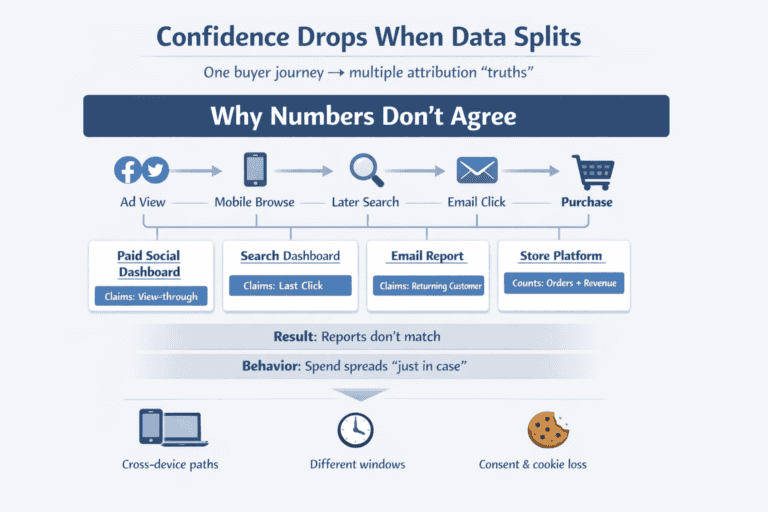
When a merchant says “I’m spending wisely,” they usually mean one thing: the budget is creating real profit, not just traffic and vanity numbers. That’s hard to prove in ecommerce, because the path from ad click to purchase is messy. People browse on a phone, buy later on a laptop, and come back through search or email. The sale looks “organic” in one report and “paid” in another.
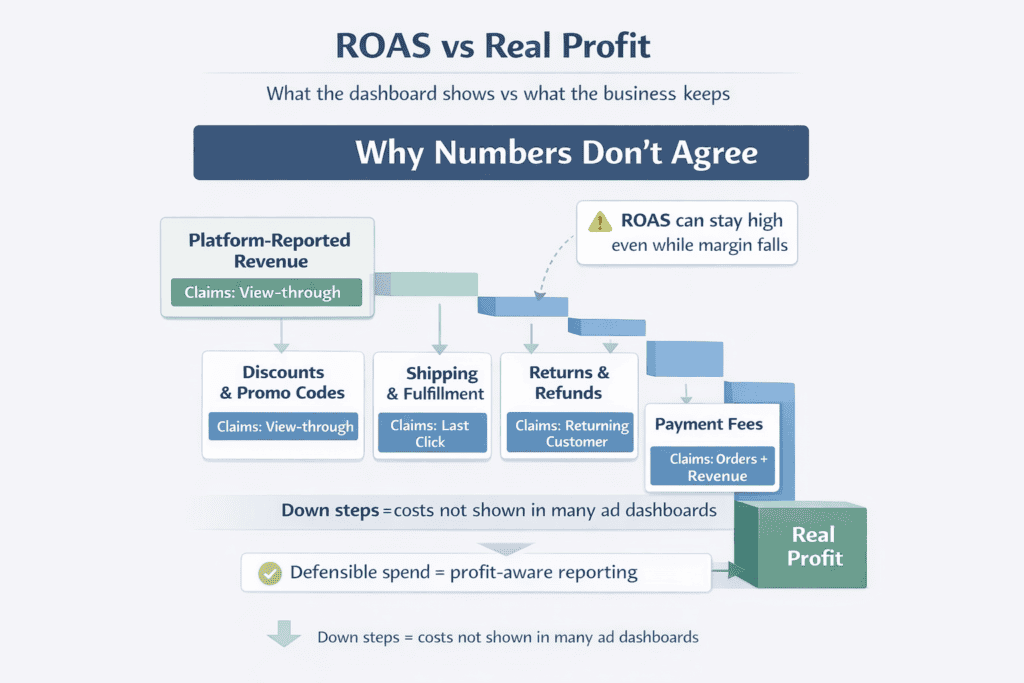
Confidence drops fast when the data doesn’t agree. Platform dashboards often count conversions differently, use different attribution windows, and include view-through sales that never had a click. Add discount codes, affiliates, marketplaces, and repeat buyers, and the picture gets even blurrier. A campaign can look strong on ROAS while your margin shrinks after shipping, returns, and promo costs.
Here are the most common reasons merchants don’t trust their spend:
-
Tracking breaks quietly (pixels, consent banners, iOS limits, blocked cookies), so reports undercount some channels and over-credit others.
-
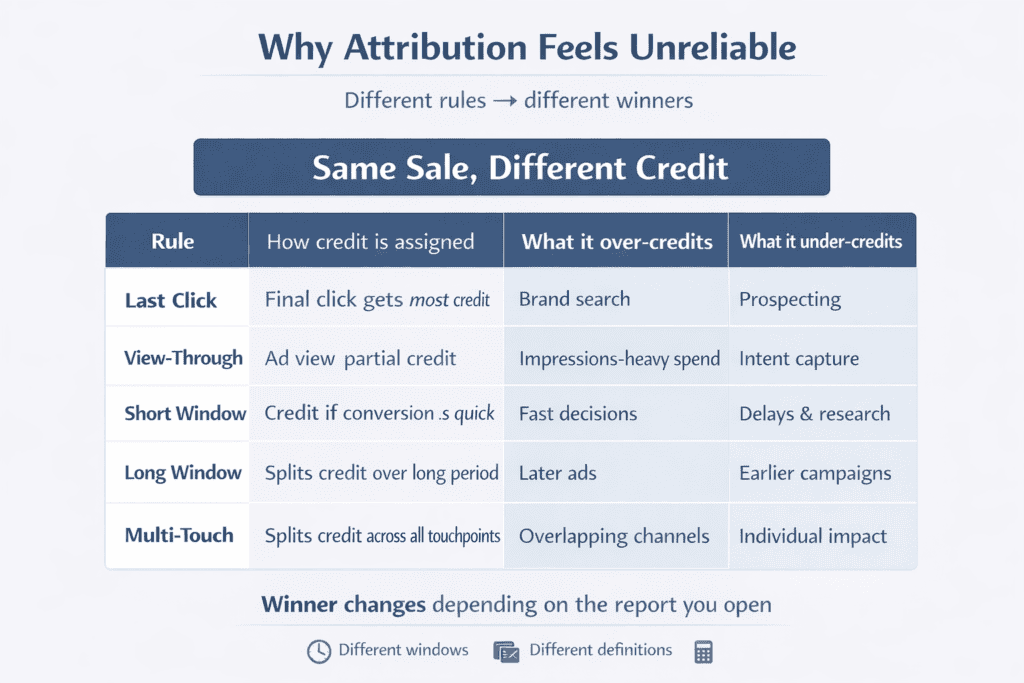
Attribution rules hide the truth (last click, short windows, or “credit for views”), so the winner changes depending on the report you open.
-
Revenue is easy to measure; incremental lift is not. Without a baseline, you can’t tell what ads truly added versus what would have happened anyway.
-
Goals are mismatched. Teams optimize for clicks or ROAS while the business needs margin, cash flow, or first-time buyers.
-
The catalog adds noise. Some products sell themselves, others need education, and seasonality can make any test look “successful” for a week.
-
Creative and audience fatigue is real. A channel can work, then slip, and the drop looks like a tracking issue.
A simple example: you run a weekend promo, Meta reports a spike, Shopify sales rise, and email revenue jumps too. Which one caused it? Without clean tracking, clear rules, and a shared definition of “good spend,” most teams are guessing. That’s why confidence stays low even when sales look fine.
What the “7% comfortable” stat really means for day-to-day budget decisions
The “7% comfortable” stat is a warning that most ecommerce teams are running budgets on uncertainty, not proof. Day to day, that shows up as small, defensive decisions: you keep spend spread across channels “just in case,” you hesitate to scale what looks like a winner, and you don’t cut losers fast because you’re not sure the tracking is telling the truth. The result is a budget that stays busy, but not always effective.
It also changes how teams talk about performance. Instead of asking “did this campaign make money?”, the conversation becomes “which report do we trust?” and “why don’t these numbers match?” That slows decisions down and pushes spending toward what feels measurable, not what is actually driving incremental sales. For many merchants, “comfortable” doesn’t mean perfect attribution it means they can explain where the next £1,000 should go, what outcome they expect, and what they’ll stop if the outcome doesn’t show up.
In practical terms, it means most merchants face the same daily budget trade-offs:
-
They rely on platform ROAS as a comfort blanket, even when margin, returns, and discounts change the real profit.
-
They keep “always-on” campaigns running because turning them off feels risky, even if they are mostly capturing existing demand.
-
They underfund testing, because tests look messy in the data and create short-term volatility in reports.
-
They chase short spikes (promos, flash sales) because results show up quickly, even if repeat buying doesn’t improve.
-
They move money late, after performance drops, because the early warning signals are unclear or ignored.
So the stat isn’t just about analytics. It’s about operating rhythm. When only a small group feels confident, the average merchant is stuck in reactive spend management topping up what seems to work, trimming what looks weak, and hoping the blended revenue line stays healthy. The goal isn’t to become “perfectly certain.” The goal is to build a budget process that makes uncertainty smaller each week, so decisions are based on consistent rules instead of gut feel.
Why ecommerce attribution feels unreliable across channels, devices, and time lags
Attribution feels unreliable in ecommerce because every platform counts sales in its own way, using its own rules. One dashboard credits the last click. Another gives credit to an ad view. A third spreads credit across several touches. When you look at the same week in three places and get three “truths,” it’s hard to move budget with confidence.
It gets worse once shoppers move between devices. Someone sees an Instagram ad on their phone, reads reviews later on a laptop, then buys through a branded Google search. Unless the shopper is logged in the whole time (or your tracking can connect those sessions), the sale often gets credited to whatever touchpoint happened last. That makes upper-funnel spend look weak and bottom-funnel channels look like heroes, even when they mostly capture demand that was created earlier.
Time lags add another layer. Many products don’t convert on the first visit. People wait for payday, compare options, check shipping costs, or ask someone else. If your attribution window is short (or the click-to-buy gap is long), earlier marketing gets ignored and the “winner” shifts toward retargeting, email, or brand search.
Common reasons your numbers don’t match across reports:
-
Different attribution windows (1 day vs 7 days vs 28 days) change who gets credit
-
Click-through vs view-through reporting makes some channels look bigger than they are
-
Consent prompts, browser limits, and ad blockers reduce tracked conversions
-
Cross-device journeys split one buyer into two “people” in the data
-
Channel overlap (retargeting + brand search + email) triple-counts the same demand
-
Returns, cancellations, and discounts change profit, but dashboards still show top-line revenue
What helps is not “perfect attribution,” but shared rules your team uses every week:
-
Pick one source of truth for revenue (usually your store platform), then compare channels to that
-
Use consistent UTMs so traffic is labelled the same way everywhere
-
Separate new vs returning customers, because returning buyers often distort ROAS
-
Track a blended efficiency metric (like marketing spend vs total revenue) alongside channel ROAS
-
Run simple holdout tests when you can (pause a small audience or region) to see what sales drop without ads
Where marketing budgets quietly get wasted
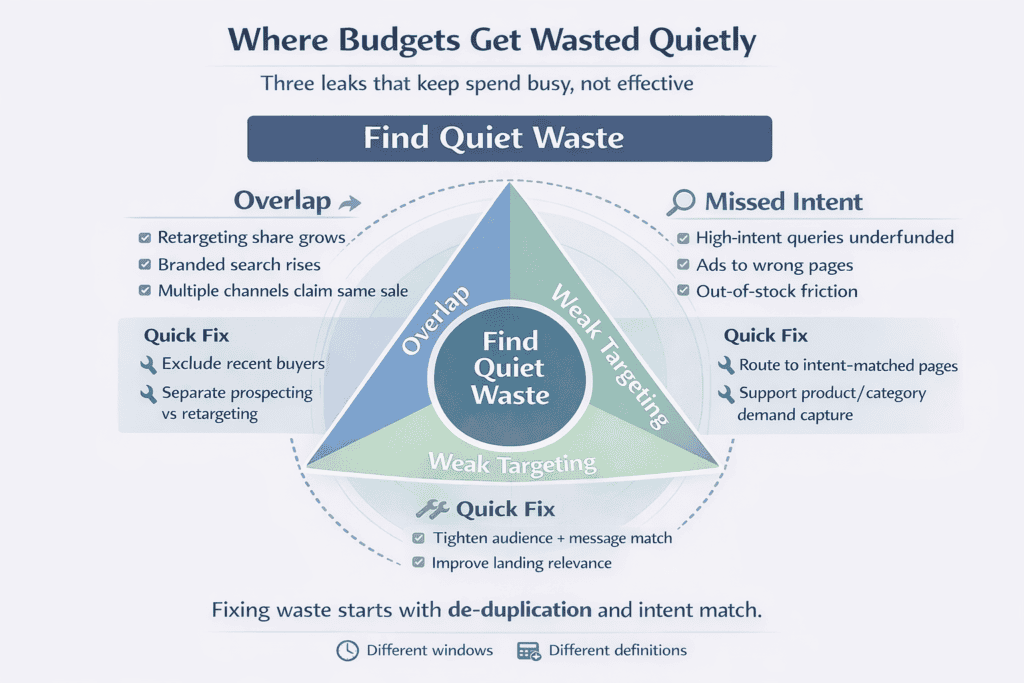
Marketing waste in ecommerce usually doesn’t look like a big mistake. It looks like “normal spend” that keeps running because no one can prove it’s wrong. The quiet losses come from three places: overlap, weak targeting, and missed intent. When these stack up, you can spend more each month while learning less about what actually drives new orders.
Overlap is the most common leak. The same shopper can be hit by retargeting on Meta, a branded search ad on Google, and an email offer in the same 24 hours. Each channel then claims the sale. In reality, you paid three times to “win” a customer who was already coming back. Overlap also shows up inside a single platform when multiple campaigns chase the same audience with similar creative, so you compete against yourself and push costs up without expanding reach.
Weak targeting wastes money in a different way. Broad audiences can work, but only if your creative and landing pages are tight. When targeting is loose and messaging is generic, you buy clicks from people who like the content but don’t have the problem you solve, don’t trust your brand yet, or can’t afford the product. You feel busy because traffic increases, but conversion rate stays flat and customer quality drops. That’s why some merchants see higher revenue but worse profit: the spend is bringing the wrong buyers.
Missed intent is the silent killer because it makes good channels look bad. High-intent shoppers often start with specific searches (“size 10 waterproof hiking boot wide fit”) or deep category browsing (“best protein meal prep for weight loss”). If your budget is heavy on awareness ads but light on capturing intent, you create demand you can’t collect. You also miss intent when you send paid traffic to the wrong page homepages, thin categories, out-of-stock products, or slow pages that fail on mobile. The audience might be right, but the path to purchase is broken.
Here are the patterns that usually signal quiet waste:
-
Retargeting budgets that grow while new-customer share stays the same
-
Branded search spend rising even though brand demand hasn’t grown
-
Multiple campaigns hitting the same people with the same offer
-
“Engagement” audiences driving clicks but not adding to cart
-
Ads sending traffic to pages that don’t match the promise (price, availability, delivery terms)
-
High-intent queries and product-page visits not being supported with enough budget
Fixing this isn’t about cutting spend across the board. It’s about removing duplication, tightening who you’re paying to reach, and matching budget to intent. When you do that, you usually get the same sales with less spend or more sales with the same spend because the budget stops paying for the same customer journey twice.
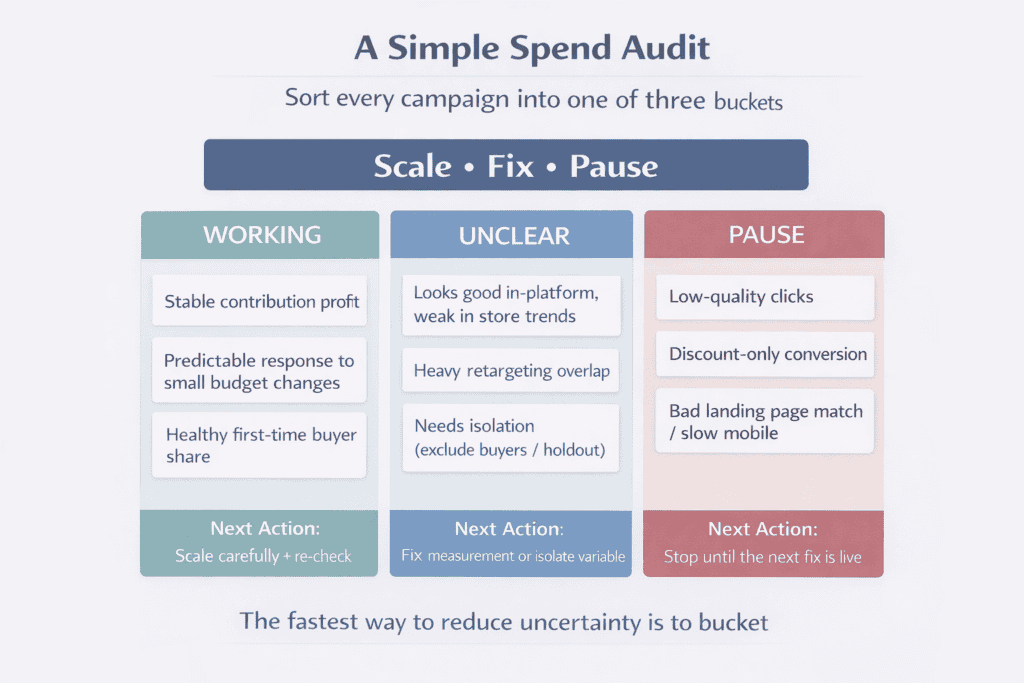
A simple “spend audit” to find what’s working, what’s unclear, and what to pause
A simple spend audit is a short, repeatable check that tells you three things: what’s clearly working, what’s unclear, and what should be paused until you can prove it earns its keep. The point is not to build a perfect dashboard. The point is to stop paying for confusion.
Start by pulling one clean week and one clean month of data. Use your store platform as the source of truth for revenue and orders, then line up each channel beside it (paid social, search, email, affiliates, marketplaces). If totals don’t roughly reconcile, treat channel ROAS as directional, not decisive, and focus on trends.
Then run every channel through the same three buckets:
1) Working (keep or scale)
A channel goes here when you see stable results and the business outcome matches your goal. That usually means: profitable contribution after discounting and shipping, acceptable return rates, and a healthy share of first-time customers if growth is the target. Working channels also behave predictably when you change budget by small steps.
2) Unclear (fix measurement or isolate it)
This bucket is for spend that might be helping, but you can’t prove it. Common examples are heavy retargeting, broad awareness campaigns, and anything that looks great in a platform report but doesn’t show up in store-level trends. Don’t cut these blindly. Instead, reduce overlap and isolate them so you can learn. That might mean excluding recent purchasers, separating prospecting from retargeting, or running a short holdout test in a small region or audience.
3) Pause (until it earns a spot back)
Pause spend when results are weak and the next fix is obvious but not done yet. Examples: ads pushing traffic to slow pages, campaigns driving low-quality clicks, keywords that only convert on deep discounts, or audiences that never produce first-time buyers. Pausing is a strategy, not a failure. It frees budget for what you can measure and improve.
Here’s a simple checklist to complete the audit fast:
-
List each campaign group with: spend, store revenue trend, first-time order share, margin proxy (AOV minus discount), and returns/refunds trend
-
Mark overlap risks: retargeting share, branded search share, email-heavy weeks, promo periods
-
Note the landing page for each major campaign and whether it matches intent (price, availability, delivery, trust cues)
-
Write one “next action” per bucket: scale, measure/fix, or pause
If you do this weekly, you’ll notice the biggest win: decisions become easier. You stop arguing about which dashboard is right and start managing the budget like an operator keep what performs, fix what’s fuzzy, and pause what drains spend without teaching you anything.
Measurement basics that make spend defensible
Marketing spend becomes defensible when your team agrees on three things: what “good” means, how you will track it, and how results will be reported every week. Without that, you end up with busy dashboards and unsure decisions.
Start with goals that match the business. “More sales” is too broad. Most ecommerce teams need one primary goal and one guardrail. A primary goal could be profit after ads, contribution margin, or first-time orders. A guardrail could be return rate, discount depth, or cash flow. This stops the common trap where campaigns look great on ROAS but hurt the business once shipping, promos, and returns are included.
Get the tracking basics right, then keep them stable. You don’t need fancy tooling to improve confidence. You need consistent tagging and fewer blind spots. Use UTMs on every paid link, keep naming rules the same across channels, and make sure your checkout success page tracking works. If consent settings reduce signal, accept that you will undercount some conversions and focus on direction and trends. The goal is reliable comparisons, not perfect totals.
Keep reporting clean and aligned to decisions. A defensible report is short, consistent, and tied to actions. It should answer: what changed, why it changed, and what we will do next week. If a report can’t drive a budget move, it doesn’t belong in the weekly view.
Here are the non-negotiables that make reporting usable:
-
One source of truth for revenue and orders (usually your ecommerce platform)
-
One agreed attribution view for decision-making (even if imperfect)
-
Split new vs returning customers in every channel report
-
A simple profit proxy (AOV, discount rate, shipping/handling assumptions, returns trend)
-
A channel overlap check (retargeting share, branded search share, promo weeks)
When goals, tracking, and reporting follow the same rules every week, you stop “defending” spend with opinions. You defend it with a process: clear targets, consistent measurement, and a repeatable review that shows exactly what you’ll scale, fix, or cut.
A weekly budget review rhythm that forces smarter choices
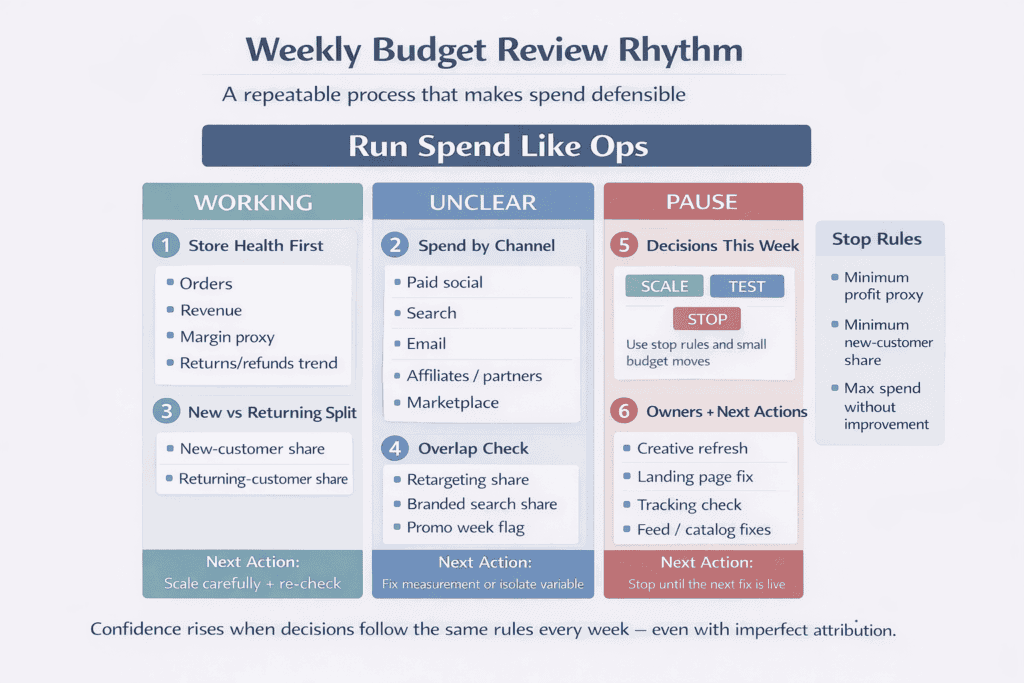
A weekly budget review works when it behaves like an operating rhythm, not a meeting to “look at results.” The goal is simple: every week you make a few clear choices what to scale, what to test, what to stop, and what to fix based on the same rules. That’s how you turn uncertain attribution into steady decision-making.
Start with a fixed agenda that stays the same each week. Review one clean set of numbers (store revenue and orders first, then channel spend and performance). Look for changes, not perfection: what moved up or down, what got more expensive, what stopped converting, and what improved. Then force decisions with three tools: small tests, stop rules, and next actions with owners.
Tests keep learning moving. Each week, run one or two controlled tests that answer a single question. Examples: a new landing page for a top product, a fresh creative angle for prospecting, a tighter audience, or a new keyword theme. Keep tests small enough that a “fail” doesn’t hurt the month, but real enough to teach you something you can reuse.
Stop rules protect the budget. Most waste comes from campaigns that “might work” if you leave them running long enough. Stop rules end that. Define simple thresholds tied to your business goal, not vanity metrics. If a campaign can’t hit the minimum after a reasonable amount of spend, you pause it or change one variable. This keeps you from throwing money at uncertainty.
Next actions turn insights into outcomes. Every finding should end with a concrete move: increase budget, reduce budget, change creative, change targeting, fix a page, or improve tracking. If you can’t name the next action, the insight wasn’t useful.
A practical weekly rhythm looks like this:
-
Check store-level health first: total revenue, orders, margin proxy, returns/refunds trend
-
Review spend by channel and split new vs returning customers
-
Identify 1–2 winners to scale carefully (small increases, then re-check)
-
Identify 1–2 problem areas and apply stop rules or isolate the variable
-
Choose 1–2 tests for next week with a clear success metric
-
Assign owners and deadlines for fixes (tracking, landing pages, feed issues, creative refresh)
This kind of rhythm doesn’t require perfect attribution. It requires consistency. When you review the same way every week, you stop reacting to noise and start building a record of what works for your store. Over time, confidence rises because decisions are based on repeatable rules not whoever has the loudest opinion in the room.