Written by Ben Eddine Ajenoui, Marketing Director at OpenCart and Founder of SEO HERO LTD, specializing in ecommerce SEO and organic growth strategies.
Essential Inventory Management Strategies for Small Retail Businesses
How Smart Inventory Management Boosts Cash Flow and Customer Satisfaction
Smart tracking amplifies cash flow, profit margins, and customer satisfaction by making sure products are there when needed and reducing losses from unsold goods.
By applying data-driven strategies like demand forecasting, ABC analysis, and reorder point accuracy, small retailers can improve stock levels, minimize storage costs, and increase profitability. Selecting the right software is a must look for solutions with strong integration capabilities, intuitive user experience, and the ability to scale as your business and sales channels grow.
When you face unique challenges limited storage space, cash flow issues, and supplier reliance you need specialized methods and adaptable buying plans. While technology is part of the secret to success, the other part is processes, training, team communication, and culture around data-driven decisions.
Future-proofing systems with automation, sustainable practices, and omnichannel readiness empowers small retailers to evolve with market demands and stay efficient.
What Is Inventory Management?
For small retailers, tracking means monitoring merchandise, maintaining control, and keeping things accessible and countable. Shopkeepers use basic tools or software to eliminate waste and prevent lost sales. The right system keeps out-of-stock and overstock at bay.
Good tracking equals more cash flow and fewer errors. To fill shelves and trim costs, savvy moves count. The sections below provide tips for stores to do this effectively.
Why Inventory Management Matters
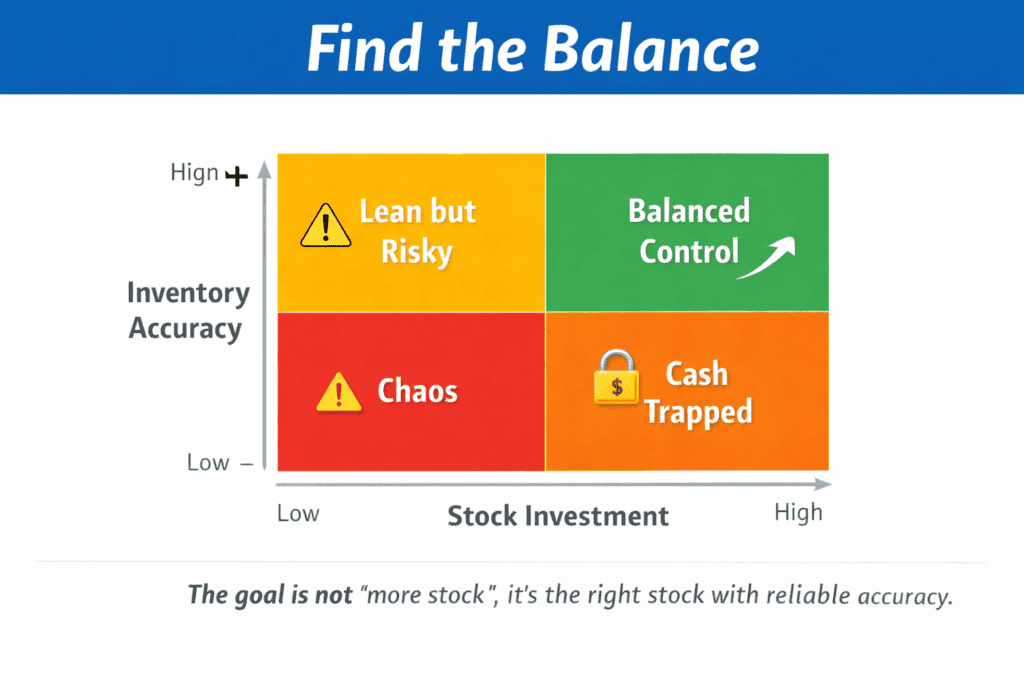
Small shops have a hard enough time trying to keep shelves full, satisfy customers, and ensure cash isn’t trapped in non-moving merchandise. It’s more than just knowing what’s in the back room it’s how shop owners remain agile, control expenses, and minimize risk when they decide what to purchase and when.
Every aspect of a retail business hinges on excellent tracking, from margins and customer satisfaction to waste reduction and scalability.
1. Unlocks Cash
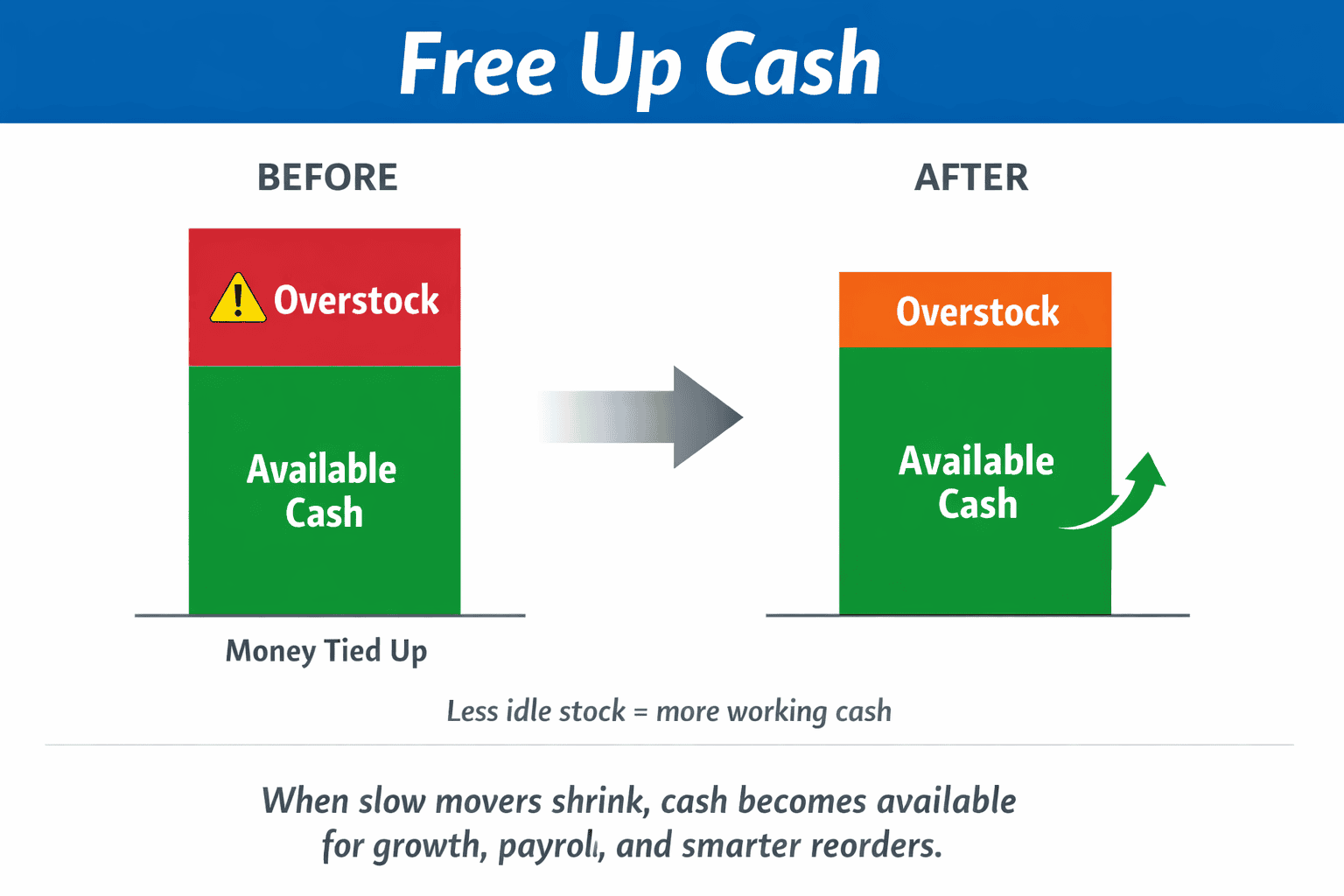
Excess stock can tie up cash needed elsewhere in the business. With turnover ratios, merchants can track the pace of stock movement and identify which products tie up cash. For instance, a turnover rate of 8–17 times per year indicates good management in most industries.
You can flag and discount slow-moving products, releasing cash for new buys or business purposes. With sales data to forecast demand, stores can purchase more intelligently, avoiding excess stock.
2. Boosts Profit
The connection between effective tracking and profit is obvious. By analyzing purchase habits and maintaining exactly the right stock to satisfy demand, retailers reduce costs associated with excess products or late reordering.
This allows shop owners to monitor which products provide the best margins, ensuring cash is spent where it counts most. Prices can be set according to actual data, not just a hunch. Reducing carrying costs like storage and insurance directly boosts profits.
Every dollar saved on idle stock translates to a dollar on your bottom line.
3. Improves Satisfaction
Customers want products on shelves when they need them. Bad records still an issue for 60% of retailers equal lost sales and frustrated customers. Stockouts drive 63% of customers to shop elsewhere or not purchase at all.
Tracking systems provide staff and shoppers with real-time information, simplifying order fulfillment. A fluid flow breeds faith and fosters sales. Sharing updates about product status helps keep customers in the loop and loyalty in the long run.
4. Prevents Waste
Excess stock can lead to significant loss, especially with perishable or fashion-based products. Frequent audits help identify unsold or expired products, reducing preventable waste.
Forecasting tools allow retailers to tailor stock to trends, ensuring they’re not stuck with excess. Safety stock just a bit without overdoing it lets stores avoid unexpected stockouts without building unnecessary surplus.
5. Enables Growth
Growth introduces new challenges, particularly for stores with multiple locations or online sales. Software that scales with the business makes it easier to monitor what’s in stock where.
Analysis identifies which individual items or product categories are primed for growth. By simplifying supply chains, stores can react more quickly to market and consumer demands. Investing in solid tools reveals new opportunities to delight customers and boost sales.
Unique Small Retail Challenges
Small retailers across the globe face specific and complicated challenges. Factors like space constraints, cash flow, vendor relationships, and shifting demand greatly influence how stock is monitored, stored, and transferred.
The pressure to stay current with e-commerce, combined with a lack of access to modern software, worsens these issues. Even a tiny mistake in data can lead to lost sales or overstock gathering dust. To navigate these obstacles, you need effective tactics that work at a small retail scale.
Limited Space
Making the most of minimal storage is an ongoing battle. With smaller storerooms or back offices, every square meter matters. Quality shelving and vertical storage, along with bins or stackable containers, can help you maximize space.
Software can display real-time levels, simplifying the process of identifying items that are depleting or occupying space excessively. Drop-shipping is another avenue to open up room. By shipping directly from suppliers to customers, retailers can reduce what they hold on-site.
This strategy is particularly beneficial for bulky or slow-moving products. Routine checking of reports exposes the slowest movers and allows retailers to mark down, donate, or ship back to the supplier, making room for speedier sellers.
Managing stock across multiple locations presents another challenge. It’s easy to end up with too much in one place and not enough in another. Manual tracking is slow and error-prone, which can lead to mistakes that waste valuable shelf space.
Cash Flow Constraints
Cash flow is a daily headache for small businesses. Buying too much can freeze up capital that could be put to better use elsewhere, while buying too little leaves you potentially facing empty shelves.
Matching purchases to actual sales projections even crude sales data prevents these pitfalls. Just-in-time approaches keep it lean, so you’re not wasting money on stock that sits. If you can negotiate longer payment terms with your suppliers, this can help stretch your cash further.
Monitoring stock turnover prevents cash from being tied up. Most small retailers don’t have access to advanced features to make this tracking easier, but even a basic app can help you spot problems before they become big issues.
Supplier Power
Suppliers typically have the advantage, particularly if you’re a small retailer or don’t order very often. Good working relationships paying on time, being dependable can get you better deals and more flexible terms.
Multi-sourcing is smart it means that retailers aren’t held captive to one supplier and can shop if prices go up or shipments are delayed. It’s important to keep an eye on supplier performance. Late deliveries or bad product quality can result in stockouts and unhappy customers.
Technology even basic apps can speed orders and reduce errors. This is particularly important in locations where carrier delays, increased fuel charges, or logistical issues can wreak havoc on shipping and distribution.
Seasonal Shifts
Demand can skyrocket or plummet with holidays, weather, or local events. Studying past sales data helps anticipate what to carry and when. Nimble planning lets you react fast when these trends shift or a sudden surge hits. Seasonal stocking early avoids rushes and empty shelves.
When the season is over, remnants fill storerooms. Promos and discounts are an effective way to clear this stock creating room and generating cash. Demand forecasts are hard more so for small retailers with limited resources but even bare-bones tracking makes a big difference.
Choosing Your Inventory Software
Selecting the appropriate software involves aligning your operational requirements with suitable features and tools, remaining cost-effective, and preparing for scalability. Many small retailers are still on spreadsheets like Excel.
This works if your stock turns at a snail’s pace and you have a handful of SKUs, but as your business scales, spreadsheets slow you down, introduce errors, and don’t update in real time. Software can fill these gaps by automating tracking, simplifying order management, and providing real-time visibility.
Essential features to consider:
- Real-time stock tracking and automatic updates
- Centralized order management
- Purchase and sales order management
- Forecasting and reporting tools
- Vendor and supplier management
- Compatibility with point-of-sale (POS) and eCommerce systems
- Mobile access for on-the-go management
- Multi-location support
- User permissions and role management
- Integration with accounting software
Assess Needs
Begin by outlining your existing workflow. For instance, if you have a storefront and an online shop, you’ll want software that syncs stock across channels. If you sell mostly in person, concentrate on POS integration and stock reporting.
The size of your operation counts 100 SKUs is a different beast than 1,000. Discuss it with your team. Staff working the floor might require simple barcode scanning, whereas managers may require more advanced analytics.
Their feedback can highlight oversights and prevent hiccups during the transition.
Prioritize Features
Create a checklist of must-haves and nice-to-haves. If you run flash sales or regular promotions, real-time tracking is essential to sidestepping stockouts. Integration with your current POS or eCommerce platform means less work and fewer errors.
Don’t discount the power of a nice, clean UI. While complex tools are often more capable, if your team can’t use them, you’ll lose in efficiency. For stores with mobile staff, mobile support allows you to update stock counts from anywhere on the floor.
Consider Integration
Software must slot into your tech stack without friction. Verify it integrates with your POS, accounting software, and any eCommerce platforms you use. For instance, if you’re using Shopify for online sales, ensure the software syncs product levels in real time.
If you warehouse stock at different sites, opt for functionalities that share information between all locations. This prevents overselling and keeps analytics accurate. Easy integration eliminates manual labor and data entry mistakes.
Test Usability
Free trials allow you to dive in and see how a system really functions. Add team members to your tests to see how they perform day-to-day work. A steep learning curve can slow adoption and cause errors.
See if the vendor provides good support channels live chat, email, or phone as getting an issue resolved quickly can save you hours. Read user reviews and case studies from businesses like yours to get a sense of the real-world experience.
Beyond the Software Tool
Small business tracking goes beyond just the tool it involves integrating with skilled personnel, structured processes, and a culture that embraces data-based decision-making. When these elements harmonize, retailers benefit from improved sales, better shopper satisfaction, and reduced out-of-stock issues.
These advantages are most prominent when management looks beyond merely acquiring the latest software and instead prioritizes building a flexible, innovative work environment.
The Human Element
Collaboration is equally as important as code. When employees provide updates on data at every location, they catch errors and correct them faster. Training is crucial workshops on methods, stock counting, and trend spotting enable employees to operate more quickly and with fewer mistakes.
Open discussions of issues, like supply chain delays or dead stock, allow the entire organization to help identify solutions. When a teammate discovers a new method to flag slow work or speeds cycle counts, they should be recognized.
Simple incentives, like public appreciation or modest bonuses, maintain enthusiasm and demonstrate that excellent tracking is important.
Data-Driven Culture
Numbers-driven decision-making has transformed retail. Retailers who monitor sales reports regularly know how fast products are moving and which require a little push. If a store in one city sells more shoes than another, transferring stock can prevent both overstock and lost sales.
Training employees to use historical information in demand planning ensures stores maintain the right quantity available, even with supply chain hiccups. Customer feedback can indicate which products are popular to be restocked or which should be discontinued.
Armed with this data, employees can implement major techniques like FIFO or JIT strategies that reduce waste and increase margins.
Process Over Platform
Systems love clear, solid processes behind them. Documenting receiving, returns, or cycle counting makes handovers easy and reduces errors. These SOPs need to be updated after every review, particularly following a major shift like moving to drop-shipping or using a 3PL.
Walking these steps through with staff, looking for gaps, and adjusting regularly keeps things tight. This ensures everyone, from sales to warehouse, is on the same page which is frequently more important than just the software alone.
Smart Inventory Control Techniques
Smart control in small retail requires careful planning, consistent oversight, and effective practices. Strategies like cycle counting, where a fraction of stock is audited at regular intervals, help catch problems before they grow.
FIFO and LIFO alter cost accounting for goods sold, influencing reported profits and thus tax. EOQ or Economic Order Quantity indicates how much to purchase to maintain ordering and storage costs at the minimum level.
The stock-to-sales ratio beginning of month stock divided by monthly sales is a quick way to identify overstock or shortfalls. Breaking stock up by value, purchasing source, and seasonality, while quarterly review meetings reveal performance shifts and keep teams aligned.
Key techniques:
- ABC analysis, cycle counting, and EOQ help sort items by value, predict order size, and catch stock errors
- Follow moves with data, checking sales and stock updates to determine order timing and size
- Key metrics like stock-to-sales ratio, fill rate, and days of supply indicate what’s working and what must change
- Remain adaptive, tweaking approaches as the market changes, demand surges, and supplier complications arise
ABC Analysis
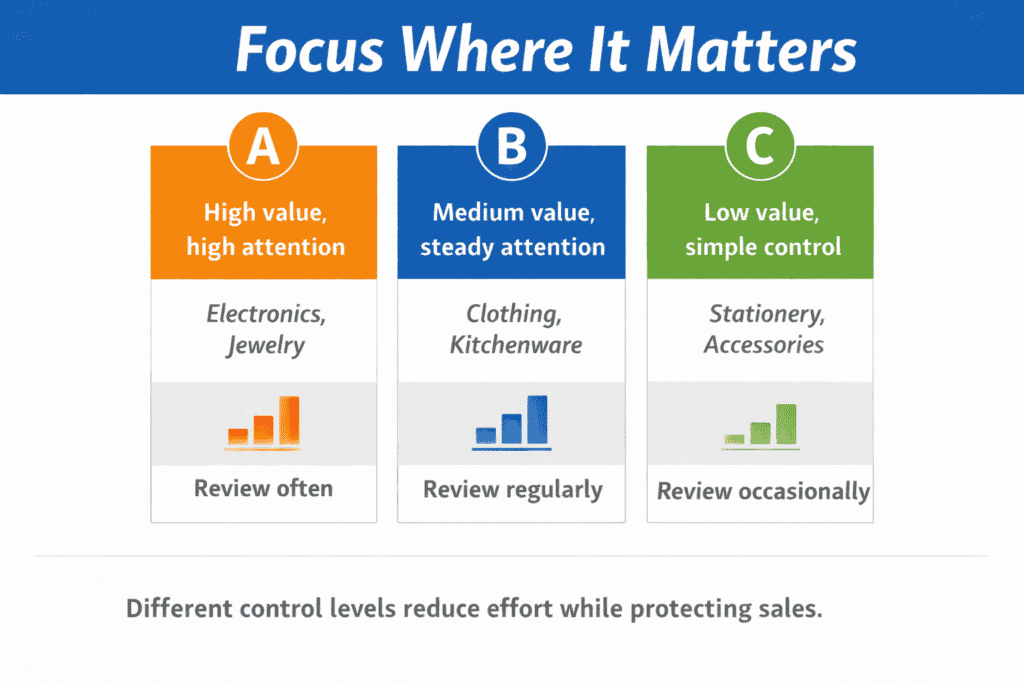
| Category | Usage Value | Example Items | Management Focus | Control Strategy |
|---|---|---|---|---|
| A | High | Electronics, Jewelry | Tight control, frequent reviews | Low safety stock, close watch |
| B | Medium | Clothing, Kitchenware | Regular checks, balanced orders | Moderate stock, review quarterly |
| C | Low | Stationery, Accessories | Simple tracking, bulk orders | Larger safety stock, less frequent checks |
A items require the most attention monitor every sale and order, use cycle counting, and adjust stock levels quickly to prevent out-of-stocks. B’s get checked less but still require regular review. C items, low cost or low use, can be tracked with simple techniques and ordered in bulk to save overhead.
Reorder Points
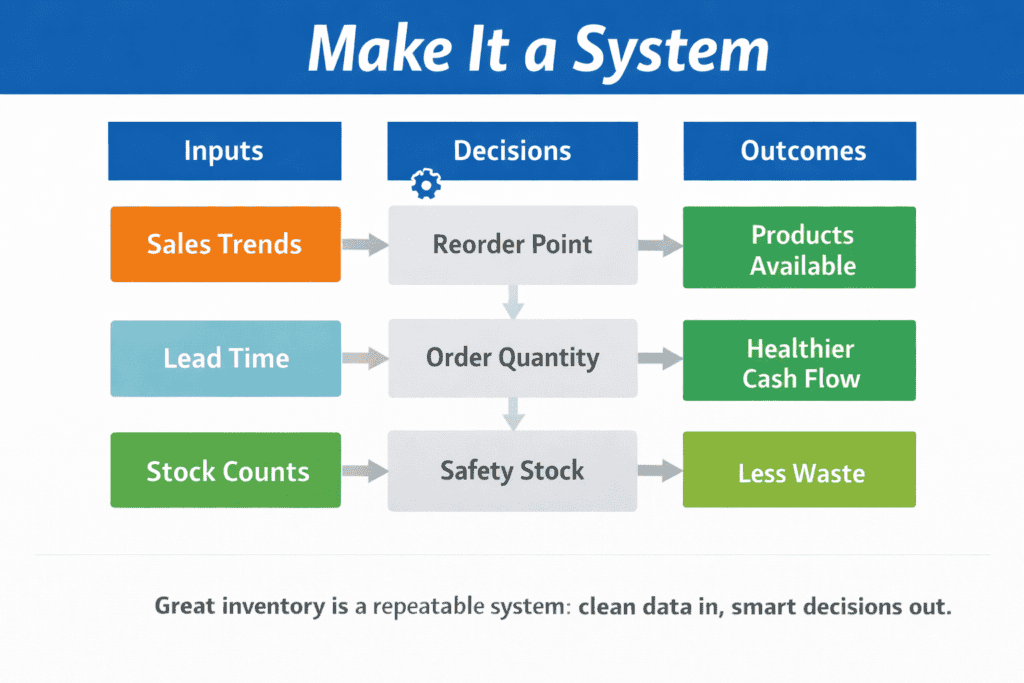
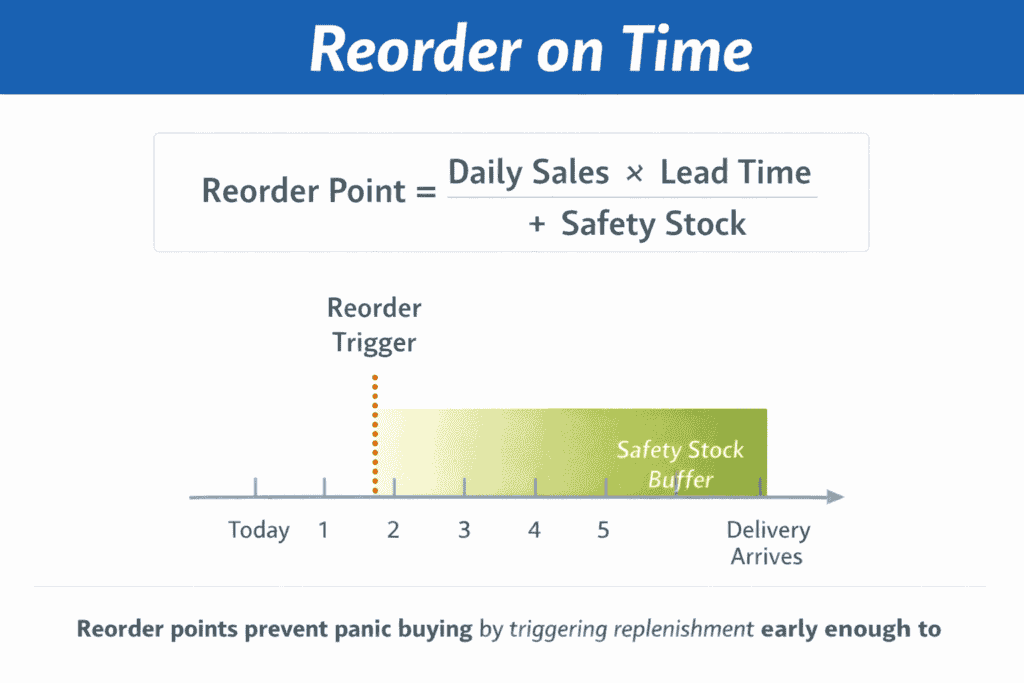
Establish reorder points so products don’t stock out. Use alert and reminder software, freeing staff from cumbersome manual checks. Know the supplier lead time how long it takes for a reorder to arrive and use a backup system like 2-bin, where the second bin kicks in only when the first is gone.
Track sales and seasonality and adjust reorder points accordingly. That keeps levels just right, even when things shift quickly.
Demand Forecasting
Focus on what’s selling now and will sell in the near future. Bring in some forecasting tools to help you map out busy periods, like the holidays, and align stock with marketing campaigns. Teams should meet frequently to refresh forecasts, taking into account real-time data and market trends.
Good forecasts equal orders on time, customers not waiting. If trends shift, immediately revise the forecast so you don’t miss an opportunity or end up with too much stock.
Safety Stock
Maintain sufficient safety stock for demand spikes or delayed shipments. Determine the right quantity by observing demand and lead time fluctuations. Review safety stock frequently, as business requirements change.
Smart control techniques prevent manual guesswork by responding to these numbers, and automated tools track them, ensuring safety stock remains at the right level.
Future-Proofing Your Inventory
Being one step ahead is about ensuring that systems are scalable, flexible, and able to handle rapid change. It’s a hard problem usually because you don’t have real-time visibility into stock or risk overestimating or underestimating demand.
It’s all about selecting the right strategies and tools. Below, a table shows some typical practices and their advantages for retailers big and small.
| Strategy | Benefit |
|---|---|
| Just-In-Time (JIT) | Reduces storage costs, lowers risk of overstock |
| ABC Analysis | Focuses resources on high-value items |
| First-In, First-Out | Minimizes spoilage, aligns with best-before dates |
| Dropshipping | Limits need for storage, lowers upfront investment |
| Safety Stock | Reduces risk of stockouts, protects against supply chain disruptions |
| Cycle Counting | Improves accuracy, finds issues early |
Being aware of industry shifts and emerging technology is crucial. Retailers must invest in solutions that scale, ones that can grow and evolve as their business does. Internal audits and updates to procedures are equally vital, particularly as customer demands evolve.
Training staff well can prevent many problems before they arise, providing an added layer of resilience to the system. Defining policies for stock levels, reorder points, and backorder allowances lets businesses future-proof their operations.
Having an emergency plan matters too, so teams can react quickly when demand or supply pivot.
Omnichannel Readiness
Omnichannel operations are about combining online and offline channels. To do this right, software needs to sync stock information across all selling channels. This keeps records updated and error-free.
Customers and staff both truly benefit from accurate data. A simple example: a customer orders online, but the item is available in-store real-time tracking ensures it’s not oversold. Syncing data means teams identify low or high stock sooner, reducing the chance of lost sales.
Smart cross-channel tracking means customers stay happy whether they shop online or offline. Technology, like cloud-based POS systems, simplifies this. It introduces greater clarity and allows you to manage orders from anywhere.
Sustainable Stock
Retailers can help the planet by picking better stocking habits. Tracking that identifies slow movers helps reduce waste. If it doesn’t sell for 6 to 12 months, then it’s time to pull it. Sourcing from green suppliers aligns with what many buyers are looking for these days.
Waste falls when stores recycle or donate unsold goods. Keep an eye on stock by setting minimum and maximum levels, so that goods don’t pile up. This not only helps the environment but keeps expenses under control.
Simple Automation
Automation is a game changer. Tools that refresh stock in real time reduce errors. Barcode systems make it easy to track goods quickly and easily. Auto-reorder points save you time and the risk of running out.
Employees require solid training to implement these tools effectively. With real-time insights, teams can rapidly identify trends and intervene before issues escalate. This blend of smart tech and talented staff eases tracking for all parties.
Wrapping Up
If you want to run a small retail shop well, use smart ways to track what you sell and what you keep in stock. Well-designed tools should make it easy to identify what flies off the shelves and what collects dust.
Know your numbers, check them often, and patch holes quick. Many shop owners use software, but clear steps and habits beat any screen. Experiment with new tools, but maintain easy records and communicate with your crew.
Stores that get smart with tracking spend less, lose less, and make customers smile. Identify trends, observe bottlenecks, and choose tools appropriate to your shop size. To catch up and grow, experiment with small changes and celebrate successes with your team.
Frequently Asked Questions
What is inventory management in small retail?
Tracking involves monitoring, ordering, and storing products effectively. Software ensures you stay stocked with just the right items, minimizing waste.
Why is inventory management important for small retailers?
Smart tracking keeps you from stockouts and overstocking. It improves your cash flow and boosts sales while ensuring products are in stock when desired.
What challenges do small retailers face with inventory management?
Small retailers often struggle with space, budget, and limited staff. Apps can help automate tracking and minimize errors.
How do I choose the best inventory software for my small retail store?
Search for software that matches your store size, is intuitive, and provides real-time tracking. Think about price, customer support, and how it integrates with your other systems.
Can I manage inventory without software?
Sure, but it’s tougher. Manual tracking is tedious and error-prone. Using software simplifies tasks and minimizes mistakes, helping you manage stock more precisely and efficiently.
What are some smart inventory control techniques for small retailers?
Apply techniques like reorder points, ABC analysis, and periodic stock audits. These ensure you don’t stock out on hot items while minimizing overstocks.
How can small retailers future-proof their inventory management?
Embrace flexible software, educate employees, and re-evaluate processes. Be aware of technology trends to quickly adapt as your business expands or your market needs shift.