Case study · EntityMap × Bing Copilot
A 19-week analysis suggests that structured entity signals can influence not only how often AI systems cite a site, but which pages they choose when intent becomes more commercial.
The setup
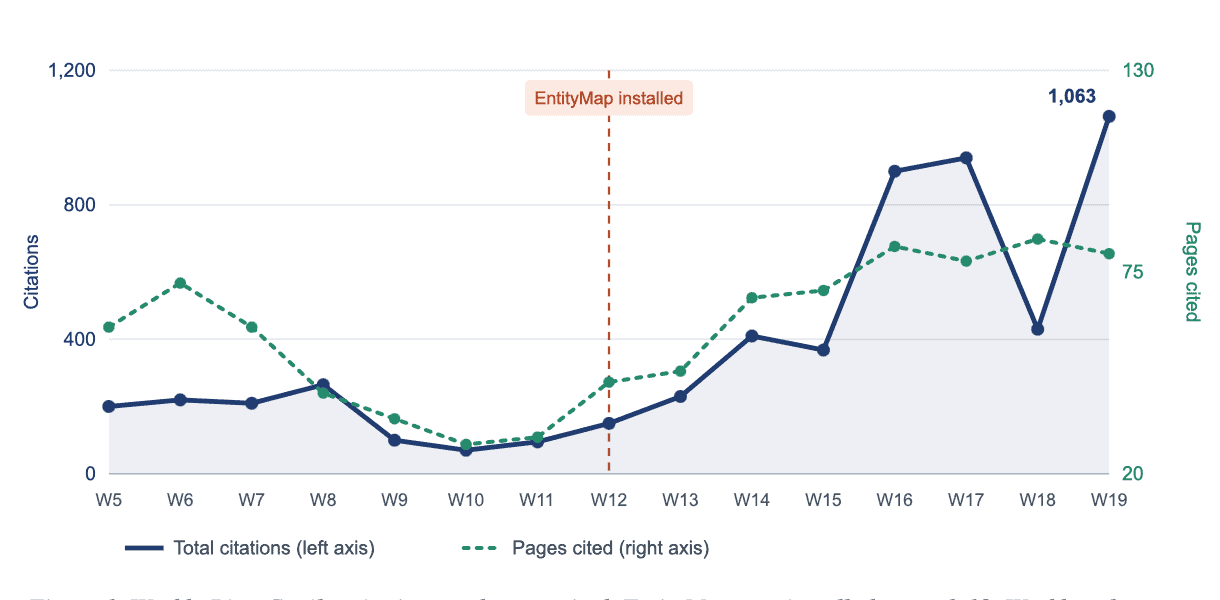
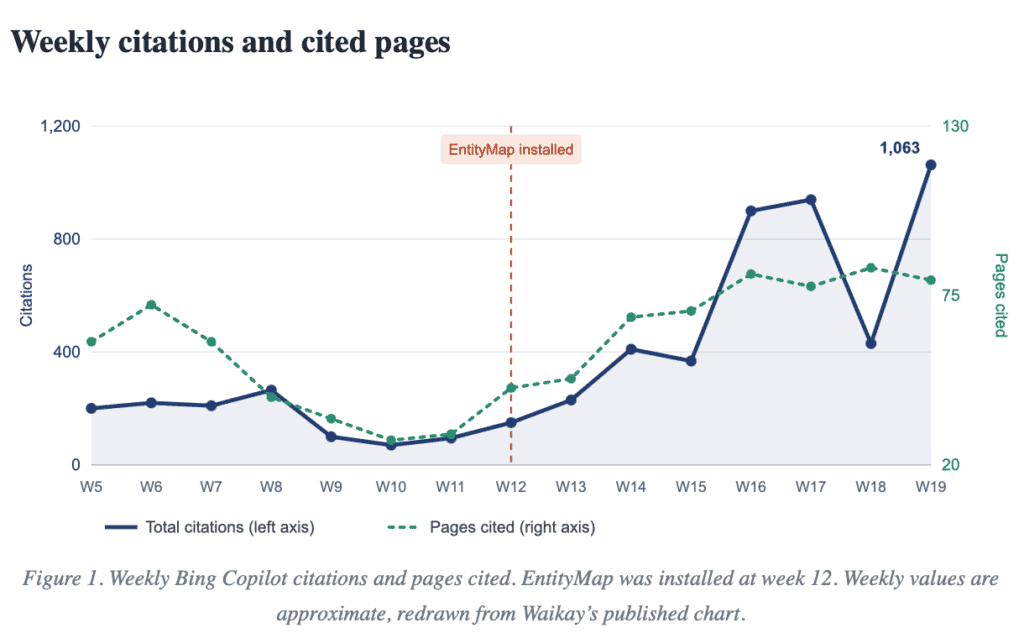
EntityMap was installed on waikay.io in week 12. During the measurement window, the study reports no new content, no backlink campaign and no other deliberate site changes. The analysis uses Bing Webmaster Tools data for Copilot & Partners, with the headline comparison based on matched pre- and post-install periods.
The important nuance
The headline lift is not the whole story. Most of the aggregate citation growth came from multilingual URLs. On English pages, raw citation volume was roughly flat to slightly lower – but citations shifted sharply from broad guides toward product, feature and evaluation pages.
01 / The experiment
One change, then a measurable shift
The test is useful because the installation date is easy to identify and the surrounding site activity was intentionally quiet. EntityMap went live in week 12, creating a natural pre/post breakpoint for Bing citation data.
Across the matched seven-week comparison used for the headline numbers, average weekly Copilot citations rose from 167 before the install to 614 afterwards. At the same time, the number of distinct pages being cited grew much more slowly, by 54%.
Why the ratio matters
More cited pages can simply mean better discovery. More citations per already-cited page suggest something different: Bing is finding more reasons to reuse the same URLs across a broader set of prompts. In the study, the average citation-to-page ratio climbed from 3.65 to 8.55.
02 / Commercial visibility
English citation volume barely moved. The destination of those citations did.
When multilingual URLs are removed, the picture looks very different from the 3.7× aggregate headline. The study reports English citations moving from roughly 627 before installation to 577 afterwards – an 8% decline. That sounds unimpressive until the pages are grouped by funnel stage.
The mix moved down the funnel
Before EntityMap, Copilot leaned heavily on broad explanatory pages. After installation, far more citations pointed to pages that help a buyer evaluate a product, understand a feature or make a decision. BOFU citations increased from 46 to 233, while TOFU citations fell from 398 to 81.
That changes the commercial meaning of an AI citation. A generic guide citation creates awareness. A citation to an audit, feature or product page can place the brand directly inside an evaluation journey. The value of the citation depends on where the user lands, not simply on whether the brand is mentioned.
A better KPI than “more citations”
Track citation quality by intent. If citations move from broad content hubs to feature, product, trial or demo pages, raw volume can stay flat while commercial relevance improves substantially.
03 / Page-level evidence
The biggest gains appeared on specific, high-intent pages
The page-level data supports the funnel story. Several product and evaluation pages became much more prominent after installation, while a number of previously uncited URLs entered Bing Copilot’s cited set without any content update.
| Page | Stage | Before → after | Change | Why it matters |
|---|---|---|---|---|
/ai-audit/ |
BOFU | 29 → 114 | +293% | High-intent audit page |
/brand-visibility-tracker/ |
BOFU | 1 → 107 | +10,600% | Core product feature |
/prompt-tracking/ |
MOFU | 48 → 110 | +129% | Evaluation-stage feature |
/factual-accuracy/ |
MOFU | 0 → 64 | New | Previously uncited deep page |
/features/ |
BOFU | 0 → 12 | New | Core commercial page |
/brand-reputation-management/ |
MOFU | 8 → 17 | +113% | Adjacent use case |
Some declines are healthy redistribution
The homepage and broad guide hubs lost citations as more specific pages gained them. For example, the AIO guide fell sharply, while targeted product and feature pages rose. If an AI system can match a prompt to the precise page that answers it, fewer citations to a catch-all hub can be a positive sign rather than a loss.
One drop deserves attention
The /source-tracker/ BOFU page fell from 16 citations to zero. The study treats this as a configuration clue: the relevant EntityMap entity existed, but the source URL mapping may not have pointed to the intended page. High-intent pages that disappear should be audited first.
04 / Why the pattern matters
The evidence points to a retrieval effect, not simply a discovery effect
The strongest argument in the study is not the headline growth rate. It is the shape of the change. Three patterns line up with what an entity-oriented retrieval layer would be expected to do.
1. Citations grew much faster than the cited-page count
Unique cited pages increased, but citation frequency increased far more. That suggests Bing was not merely discovering extra URLs; it was reusing known pages across more answer contexts.
2. Previously invisible pages entered the citation set
Six English pages that had received no citations before the installation were cited afterwards, despite no reported content changes. That is consistent with a change in how the site’s structure and entities were represented to the retrieval system.
3. The winners aligned with explicitly represented entities
Pages associated with clearly defined product concepts and source-linked chunks gained visibility, while broader content hubs became less dominant. The redistribution followed semantic specificity rather than a uniform site-wide lift.
EntityMap’s role in the pipeline
EntityMap does not make the language model “smarter.” Its intended job is upstream: describe entities, relationships and supporting source passages so the retrieval layer has a clearer map of what each page or chunk is about. Better retrieval gives the model better evidence to cite.
A useful mental model
- HTML/CSS helps people read a site.
- robots.txt and sitemaps help crawlers find it.
- Schema.org describes page-level facts and entities.
- EntityMap aims to describe site-wide entities, their relationships and the source passages that support them for AI retrieval.
05 / The multilingual effect
Most of the headline growth came from French and Spanish pages
The 3.7× aggregate result needs context. Waikay reports that roughly three quarters of the post-install volume lift came from multilingual URLs. Those pages were not explicitly described in the English-language EntityMap, so their surge is unlikely to be a direct entity-to-page matching effect.
/es/A plausible crawl-depth explanation
After deployment, entitymap.html was submitted directly to Bing Webmaster Tools. The study’s hypothesis is that this may have prompted a deeper crawl of the domain, causing underweighted translated pages to surface more often in Copilot. That explanation is plausible, but it remains a hypothesis rather than a proven mechanism.
Why this distinction matters
The multilingual surge and the English page redistribution may reflect two different effects: broader crawl discovery on one hand, and more precise semantic routing on the other. Treating them as separate signals makes the case study more useful – and less likely to overstate what EntityMap alone can prove.
06 / Limits of the evidence
Promising signal, not a controlled proof
This is a single-site pre/post case study. The timing and page-level pattern are suggestive, but they cannot eliminate every alternative explanation. The original analysis is unusually explicit about those constraints.
| One domain | waikay.io is a content-heavy B2B SaaS site. Other site types may behave differently. |
| No control group | A live site cannot be observed in parallel with and without EntityMap, so causal attribution remains probabilistic. |
| Short post-install window | Only seven post-install weeks are used in the matched comparison, and week-to-week volatility remains visible. |
| English volume did not rise | The commercial mix improved, but a publisher measuring English citation count alone would not see growth. |
| Multilingual mechanism is unconfirmed | The deeper-crawl explanation fits the data but needs replication. |
| Replication is still needed | A standard becomes convincing through repeated results across different domains, not one successful case. |
Balanced conclusion
The study does not establish a universal causal law. It does show a coherent before/after pattern: higher aggregate citation activity, deeper reuse of cited pages, newly surfaced English URLs and a major shift toward commercial-intent pages. Those are exactly the outcomes worth measuring in further EntityMap tests.
07 / A practical replication plan
How to run your own EntityMap test
The most valuable next step is replication. A clean measurement window makes it easier to separate the effect of EntityMap from content, links, seasonality and technical changes.
- 1
Build a baseline
Capture at least eight weeks of Bing Webmaster Tools AI citation data before changing anything. The Waikay study had an 11-week pre-install baseline. - 2
Deploy both EntityMap files
Publishentitymap.jsonandentitymap.htmlat the domain root, with the recommended discovery hints. - 3
Submit entitymap.html to Bing
Use Bing Webmaster Tools URL Inspection and record the submission date. This gives you a precise install marker. - 4
Freeze other variables
Avoid publishing new content, launching link campaigns or making major technical changes during the post-install measurement window. - 5
Measure intent, not only volume
Separate TOFU, MOFU and BOFU URLs. Watch product, feature, demo and trial pages individually, and investigate any high-intent page that drops to zero.
What to watch first
The most meaningful result may not be a larger citation total. Look for a higher citations-per-page ratio, new pages entering the cited set, and a shift toward URLs with stronger commercial intent.
Useful links
- Original Waikay Bing case study
- EntityMap open specification
- Bing Webmaster Tools
- Related EntityMap study on Gemini and Sonar
- Waikay
Data source and attribution: Bing Webmaster Tools data as published by Waikay. Based on Waikay’s original analysis, published 17 June 2026. This is a rewritten editorial version, not an independent experiment. All interpretations are based on the original Waikay case study and its stated methodology and limitations.