Amazon flexible financing: options, eligibility, and how to choose the lowest-cost plan
Amazon flexible financing is Amazon’s way of letting you split a purchase into smaller payments instead of paying the full amount on day one. It can be useful for big-ticket items, but it’s also where people overpay without noticing. This guide breaks down the common financing options, what usually affects eligibility, and a simple method to pick the lowest-cost plan for your situation.
What Amazon flexible financing is and when it’s offered at checkout
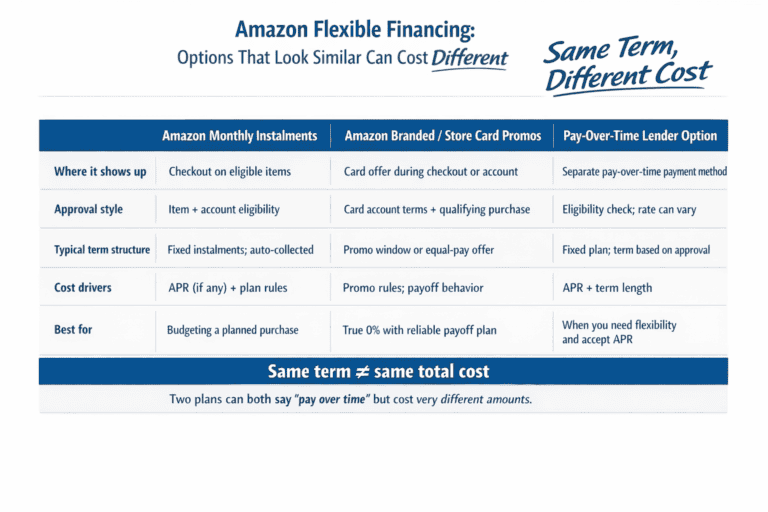
On Amazon, financing is not one single product. “Flexible financing” usually shows up as one of these experiences:
-
Monthly instalments offered directly by Amazon for certain items and accounts (you’ll see it as a monthly payment option during checkout).
-
A financing plan tied to an Amazon-branded card, where a qualifying purchase can be paid over time under a promotional offer.
-
A third-party “pay over time” lender shown as a separate payment method, depending on your country and checkout flow.
Whether you see financing depends on the item, basket size, seller (Amazon vs marketplace), your Amazon account history, and sometimes your location.
The main financing types Amazon uses
Most “Amazon flexible financing” falls into three buckets.
-
Monthly instalment plans (Amazon monthly payments)
These are structured instalments collected automatically over a set term (for example, 3, 5, or 12 payments in some regions). -
Amazon Store Card / branded card promotional financing
If you use the relevant Amazon card, you may see promotional financing offers such as “no interest if paid in full within X months” or equal-pay offers, depending on the card and current terms. -
Third-party lender pay-over-time options
In some checkouts, Amazon (or Amazon Pay) may show a lender option that offers a fixed plan and an APR range based on eligibility.
The key point: two plans can look similar (“pay over 12 months”) but cost very different amounts once APR, fees, and promo rules are factored in.
Eligibility and approval basics: what affects offers, limits, and decisions
Financing offers are usually driven by a mix of purchase rules and account rules.
Purchase rules (what you’re buying):
-
Minimum basket size or item price thresholds (often higher for longer terms).
-
Eligible product categories (some plans focus on devices/electronics; others cover broader catalog items).
-
Seller eligibility (items sold by Amazon are more likely to qualify than some marketplace offers).
Account rules (who is buying):
-
Whether you already have an eligible card or account-linked instalment feature enabled.
-
A credit/eligibility check for lender-based plans, with the APR tied to the lender’s decision.
If you don’t see financing at checkout, it doesn’t always mean “rejected.” It can simply mean the item, seller, or basket doesn’t qualify.
Costs that matter: APR, fees, promo terms, and the true price of “easy” payments
To choose the lowest-cost plan, you need to focus on the parts that change the total you pay.
APR (interest rate)
APR is the price of borrowing. Some plans advertise 0% APR, while others can range up to much higher rates depending on eligibility.
Deferred interest vs true 0%
This is where people get hit. With deferred interest promotions, interest can accrue “in the background.” If you don’t pay the full promotional balance by the deadline, you may owe interest back to the original purchase date.
Fees and penalties
Some lenders focus on “no late fees,” while traditional credit products may charge interest and other fees depending on terms. Always read the checkout disclosures and the account agreement for your exact plan.
Returns and refunds
If you return an item, the refund path can differ by plan type (card promo vs instalments vs lender). This matters because you don’t want to keep paying for something you returned.
How to compare financing offers quickly
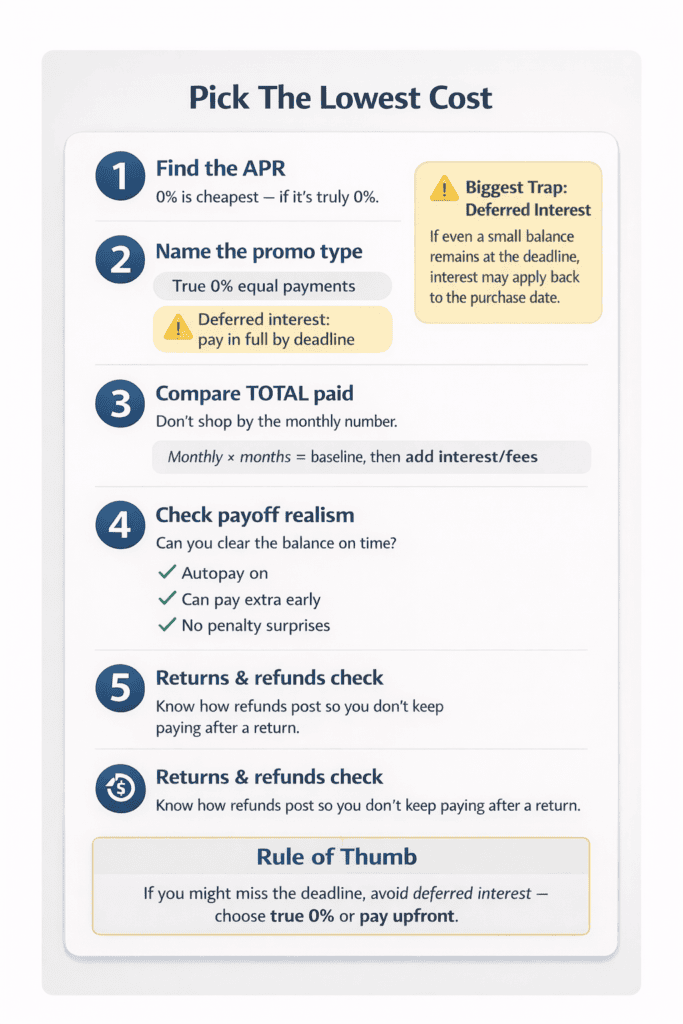
Use this quick checklist before you click “Place order.” It turns a confusing choice into a simple comparison.
-
Total cost: What is the total you’ll pay over the full term (not just the monthly amount)?
-
APR: Is it 0% APR, or a range based on approval?
-
Promo rule: Is it “0% with equal payments,” or “no interest if paid in full” (deferred interest risk)?
-
Term length: What term is offered, and does a longer term add interest?
-
Down payment: Is there an upfront payment or higher first payment?
-
Payment flexibility: Can you pay extra early without penalty, and will that actually reduce total interest?
-
Autopay control: Can you manage the schedule and see upcoming charges clearly inside your account?
-
Plan match: Does the plan fit the time you realistically need, or are you stretching it “because you can”?
Rule of thumb: if you can pay it off before the promo ends, a true 0% plan is often the cheapest. If you might miss the deadline, avoid deferred interest offers unless you have a payoff plan you can stick to.
Common pitfalls to avoid: missed payments, deferred interest, returns, and disputes
A few common mistakes show up again and again.
Paying attention to the monthly number, not the total
£40/month feels “small,” but over 24 months it’s £960 before interest. Always check the total cost.
Missing a promo deadline by a small amount
With deferred interest promotions, leaving even a small amount unpaid at the end can trigger a large interest charge.
Assuming returns cancel the plan automatically
Returns can take time to process, and the financing plan may keep charging until the refund is posted correctly. Keep records of return confirmations and refund timestamps.
Using financing for fast-depreciating items without a payoff plan
If the item loses value quickly (like some electronics), paying interest can turn a “deal” into an expensive purchase.
Smart use cases: when financing makes sense vs when you should pay upfront
Financing can be sensible when it reduces risk or helps you buy something you already planned for.
Financing can make sense when:
-
You get a true 0% offer and you can pay it off within the term.
-
The purchase is time-sensitive (replacement phone, essential work device) and you need to spread cash flow.
-
You’re using instalments to keep an emergency fund intact, not to increase spending.
Pay upfront (or wait) when:
-
The plan has a high APR and you’d be paying meaningful interest for convenience.
-
The promotion is deferred interest and you’re not confident you’ll clear the full balance in time.
-
You’re using financing to justify buying a bigger model than you planned.
A simple self-check helps: if the item disappeared tomorrow, would you be relieved or stressed because you’re still paying for it?
What to do if you’re not offered financing: alternatives and next steps
If financing doesn’t appear at checkout, you still have options.
-
Adjust the basket: Some plans only show above certain price levels or on eligible items.
-
Check if the item is sold by Amazon: Eligibility can change based on seller type.
-
Look for instalment features in your account settings or payment options: Some instalment programs are account-based.
-
Compare with your existing credit card plan: If you can pay it off quickly, a card you already manage well can be cheaper than a new lender plan.
-
Consider saving for one more pay cycle: Waiting two or four weeks can be the lowest-cost financing of all.
If you want, paste a sample checkout scenario (item price, term offered, APR/promo language shown), and I’ll help you decide which option is likely the lowest-cost based on the terms displayed.