Disclosure: the founder of EcommerceViews is Marketing Director at OpenCart.
Shopify, WooCommerce, PrestaShop and OpenCart in 2026
Updated October 2026 | Based on StoreLeads platform data
More than 13 million online stores are now tracked across hundreds of ecommerce platforms. Four of them come up again and again when merchants compare options: Shopify, WooCommerce, PrestaShop and OpenCart. They are heading in very different directions. This article looks at where each one stands, what the numbers say, and who each platform suits.
The numbers: where the platforms stand in 2026
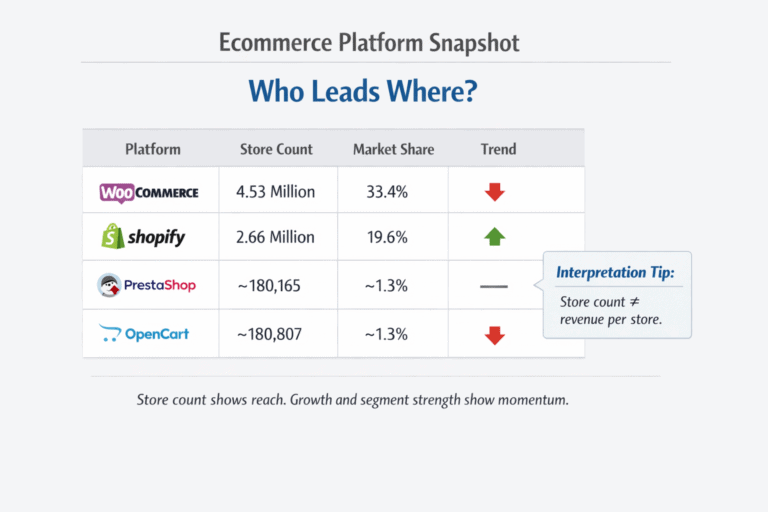
StoreLeads data, which tracks more than 13 million active ecommerce stores, puts the four platforms here in early 2026:
| Platform | Store Count | Market Share | YoY Trend |
| WooCommerce | 4.53 million | 33.4% | ▼ -3.2% YoY |
| Shopify | 2.66 million | 19.6% | ▲ +8.2% YoY |
| OpenCart | ~180,807 | ~1.3% | ▼ -14% YoY* |
| PrestaShop | ~180,165 | ~1.3% | Stable |
Year-on-year trends are StoreLeads figures for 2025.
Two platforms are growing or holding steady (Shopify and PrestaShop) and two are shrinking (WooCommerce slightly, OpenCart sharply). The rest of this article looks at why.
WooCommerce: still the largest, losing ground slowly
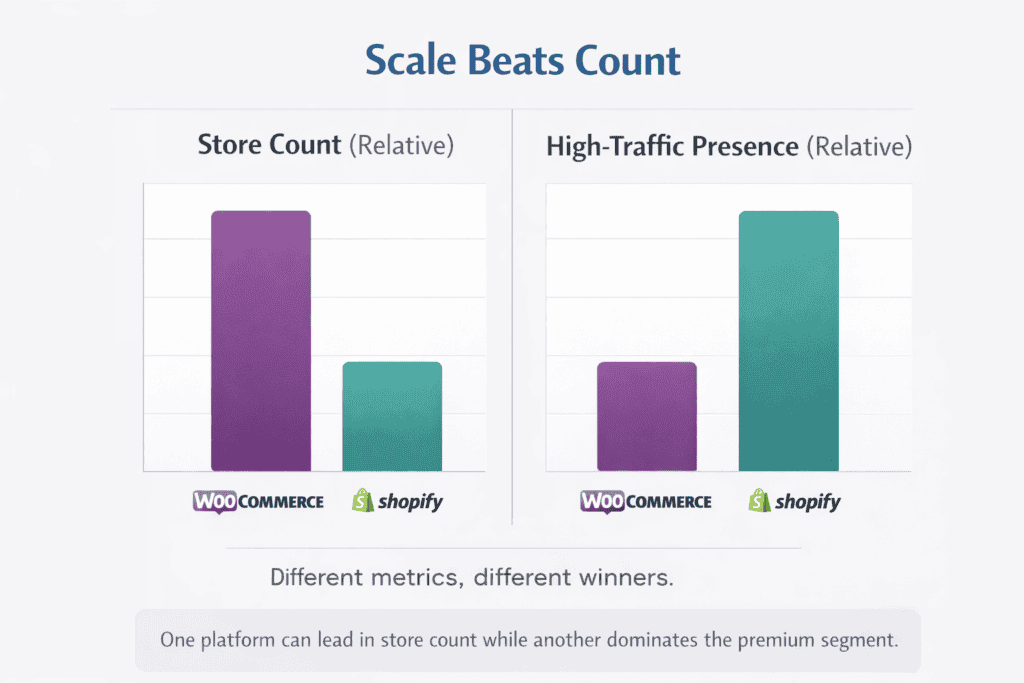
WooCommerce powers about 4.53 million stores, around a third of the stores StoreLeads tracks. It runs as a plugin on WordPress, which powers around 43% of all websites, and that connection is still its biggest advantage.
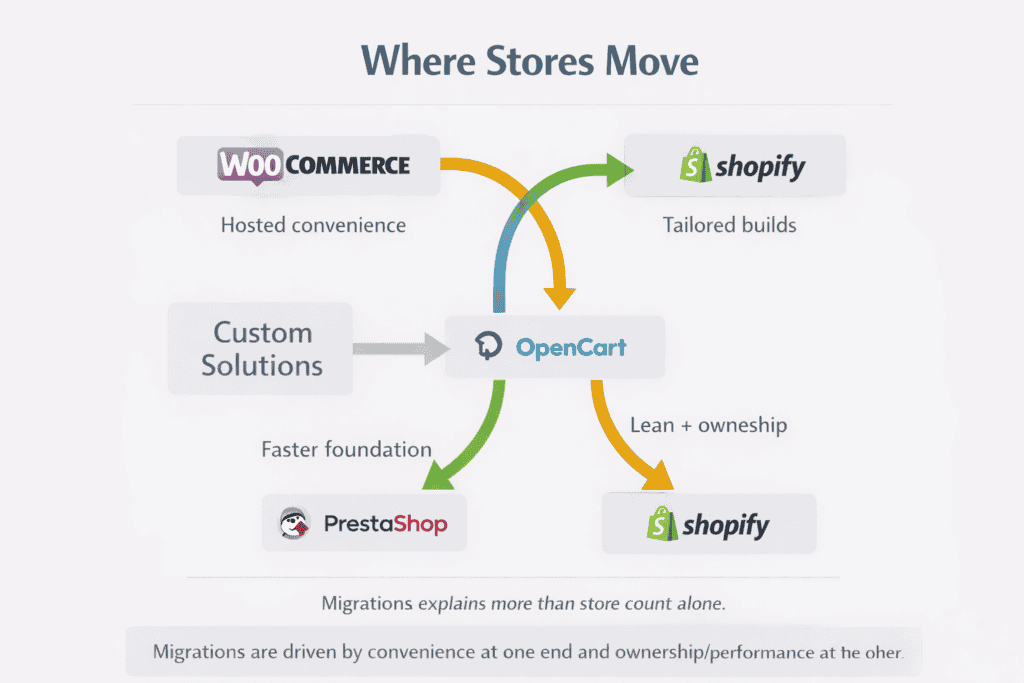
Its store count fell by about 3.2% in 2025, with most leavers moving to Shopify. That decline is modest for a platform of its size, and it mostly reflects merchants who want a hosted service rather than one they have to maintain.
WooCommerce suits:
- Businesses already running WordPress
- Stores that rely on content marketing and SEO
- Owners who want to avoid monthly platform fees and are happy to manage hosting and updates
- Stores with unusual requirements that need a large plugin ecosystem
Watch out for: plugin conflicts, ongoing maintenance, and performance that depends heavily on your host and how many plugins you add.
Shopify: the growth and revenue leader
Shopify powers about 2.66 million stores, fewer than WooCommerce, but it grew by about 8.2% in 2025 and leads on gross merchandise volume. Among the highest-traffic ecommerce sites, Shopify’s share is far ahead of WooCommerce’s.
Shopify suits:
- Merchants who want a fully hosted store with no servers or updates to manage
- Brands that need to launch quickly and scale without a development team
- Businesses selling across several channels (social, marketplaces, in person)
- Larger brands, through Shopify Plus
Watch out for: monthly fees, app costs that add up, transaction fees if you do not use Shopify Payments, and less control over the underlying code.
PrestaShop: steady in Europe
PrestaShop hosts around 180,165 stores, concentrated in France, Spain and other European markets, and its store count was stable in 2025. It is open-source and self-hosted, with strong built-in support for multiple languages, currencies and European tax rules.
PrestaShop suits:
- European merchants selling across several countries
- Businesses with a technical team or an agency partner
- Merchants who want open-source control without WordPress
Watch out for: paid modules that add up, a learning curve in the admin, and higher hosting needs than the lightest platforms.
OpenCart: a shrinking platform with a technical niche
OpenCart hosts around 180,807 stores, roughly the same as PrestaShop, but its store count fell by about 14% in 2025, the sharpest decline of the four platforms here. StoreLeads also records stores moving to OpenCart (around 1,000 every 90 days, mostly from custom carts and WooCommerce), but more stores are leaving than arriving.
The most likely reasons are the ones merchants raise most often: self-hosting and security are the owner’s responsibility, major releases are infrequent, the move from version 3.x to 4.x broke many themes and extensions, and the pool of developers and maintained extensions is much smaller than for WooCommerce or Shopify.
Where OpenCart is still strong:
- Low running costs: the software is free and it runs on inexpensive hosting.
- Lightweight code: a simple PHP/MySQL MVC codebase that a PHP developer can learn quickly.
- Multi-store in the core: several storefronts from one admin without extra plugins.
- Full ownership: no platform fees or lock-in.
Where it falls short:
- Extensions: the marketplace lists thousands, but many target older versions and quality varies.
- Support: no included support; help comes from forums, paid support or your own developer.
- Updates and security: slow release cycle, and upgrades between major versions can be painful.
- Talent: far fewer developers and agencies than WooCommerce, Shopify or PrestaShop.
OpenCart can suit: technical owners or agencies who want a simple, low-cost codebase they fully control, and businesses running several small storefronts from one admin.
OpenCart is not a good fit for: non-technical owners, stores that need a wide range of maintained integrations, fast-growing brands, or anyone who wants a smooth, supported upgrade path.
Conclusion: choosing a platform in 2026
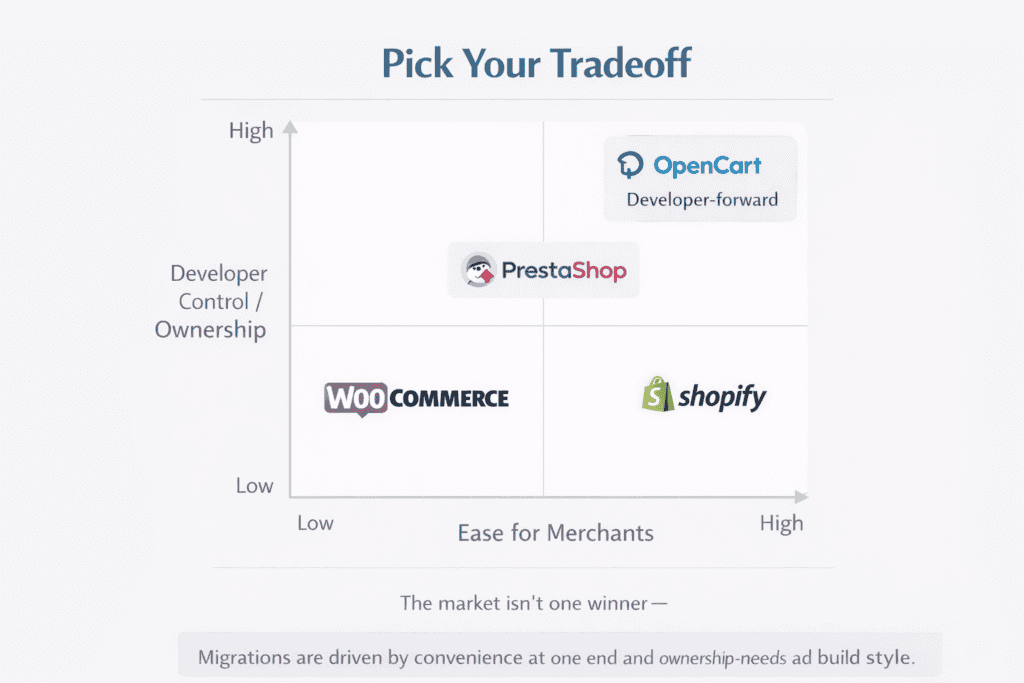
There is no single winner, but the data does show clear direction.
- Shopify is the safest choice for most merchants who want to sell without managing technology, and it is growing fastest.
- WooCommerce remains the best open-source option for most stores, especially content-led ones, despite a slow decline.
- PrestaShop is the strongest open-source option for European multi-country selling.
- OpenCart is a niche choice for technical teams who value low cost and code ownership above ecosystem size, and its shrinking store count is a real risk to weigh.
Match the platform to your team’s skills, your budget and where you sell, not to which platform is cheapest on day one.
Sources: StoreLeads platform reports 2025–2026, StoreLeads OpenCart and WooCommerce state reports, StoreLeads ecommerce platform comparison 2026.
Keep reading: see our full guide to ecommerce platform reviews, or read about WooCommerce vs OpenCart and Magento vs OpenCart.