Seller guide
Payments for UK Sellers: Methods, Gateways & Google Pay
Everything you need to understand how taking money online works, from choosing a payment gateway and the right mix of payment methods to adding open banking, mobile wallets and buy now, pay later at checkout. Independent guidance for merchants, with a free tool to compare the real cost.
The basics
How online payment processing works
A payment method is how your shopper chooses to pay. A payment gateway is the service behind your checkout that makes it work, and a payment processor (often called an acquirer) moves the money through the card networks or the interbank systems. You need a gateway for payment processing whichever methods you decide to offer, so choosing well means looking at both: which methods people expect, and which service can accept them at a price that suits your order values.
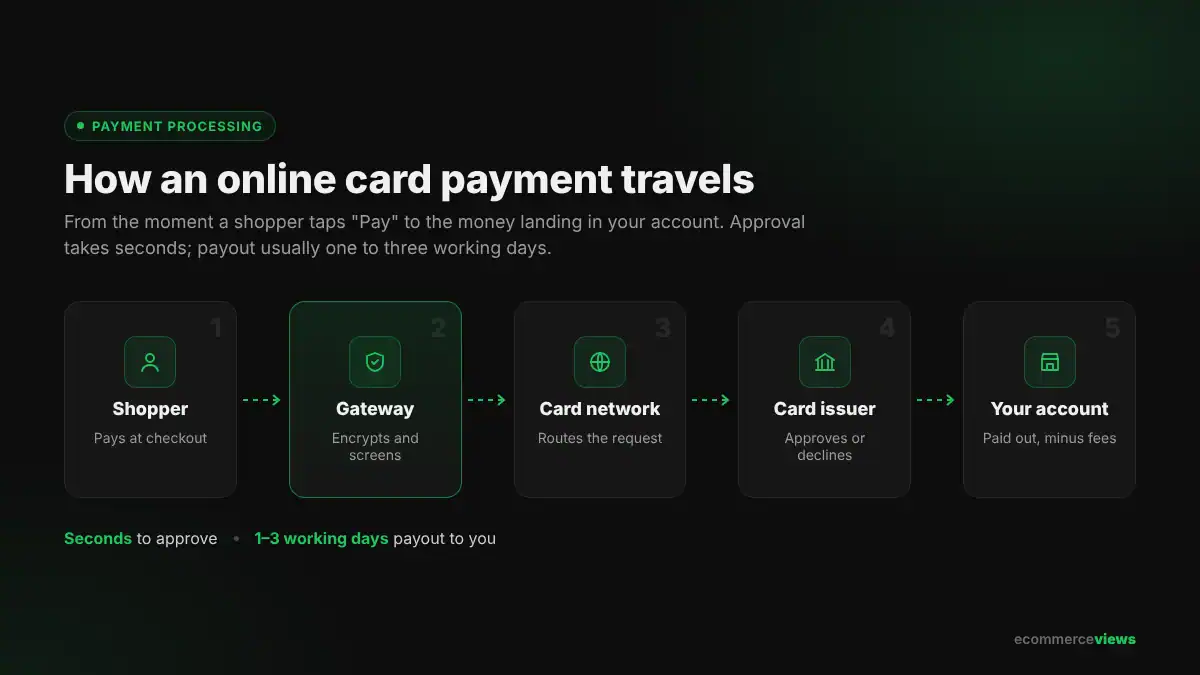
The shopper chooses a method
A debit or credit card, a mobile wallet like Apple Pay or Google Pay, PayPal, buy now, pay later, or a direct transfer approved in their banking app.
The gateway passes it on
The gateway encrypts the details, screens them for fraud, asks for Strong Customer Authentication where needed and sends the request on for approval. The result comes back in a few seconds.
You get paid
The money is settled to you, minus fees. Payout timing depends on the service: a day or two is common for card payments, while open banking transfers can arrive in seconds.
What shoppers use
Online payment methods shoppers expect
Offering the right options is one of the easiest ways to stop people abandoning a purchase online. Cards still carry most ecommerce spending here, but wallets and other digital payments are growing quickly, especially on mobile. These are the options worth knowing.
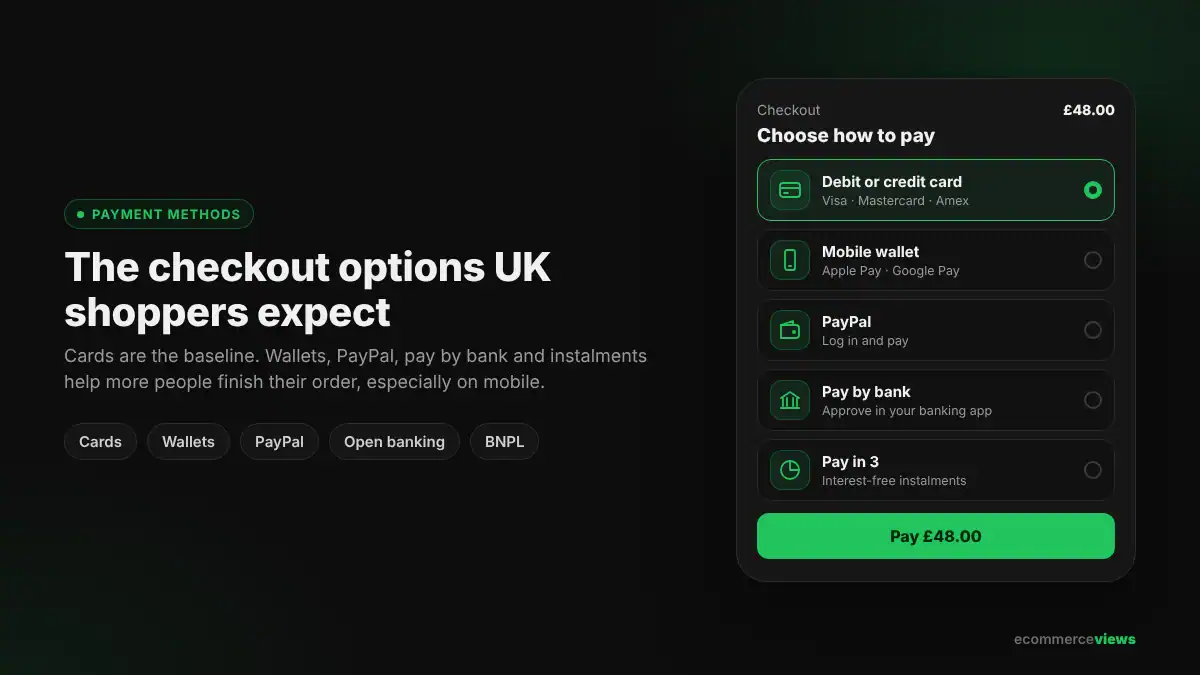
Debit and credit cards
Visa and Mastercard are the baseline for any checkout, and Amex is worth adding if you sell higher-value goods. Debit is used far more often day to day, but credit remains popular for bigger purchases because of the extra protection under Section 75 consumer credit law.
Mobile wallets
Apple Pay and Google Pay let shoppers pay with a fingerprint or face scan on their phone, using a card already saved on the phone. They run on the card networks, so most gateways price them like any other card transaction, and they tend to lift mobile conversion because there is no long form to fill in.
Digital payment accounts: PayPal and Skrill
PayPal is the best-known account-based option, and many shoppers trust it for a first order with a new store. The other is a digital wallet more common in gaming, trading and cross-border sales than in mainstream retail.
Open banking transfers
The shopper picks their provider, approves the payment in their banking app and the money moves over Faster Payments. There is no card number to steal, fees are often lower than card processing, and settlement can be near-instant.
Buy now, pay later
Klarna, Clearpay and PayPal Pay in 3 let shoppers split a purchase into instalments while you are paid up front, less a fee. Interest-free BNPL lending has been regulated by the FCA since 15 July 2026, so lenders now need authorisation and must check that borrowers can afford to repay.
Direct Debit for repeat billing
For subscription billing, memberships and instalment plans, Direct Debit collects money automatically on a set date. It runs on the Bacs system, is cheap per collection and protects the payer through the Direct Debit Guarantee.
Behind the scenes
How the UK payments industry fits together
You don’t need to know every acronym in the payments industry to take money online, but knowing which system carries it helps explain fees, payout times and why some transactions can be reversed while others cannot.
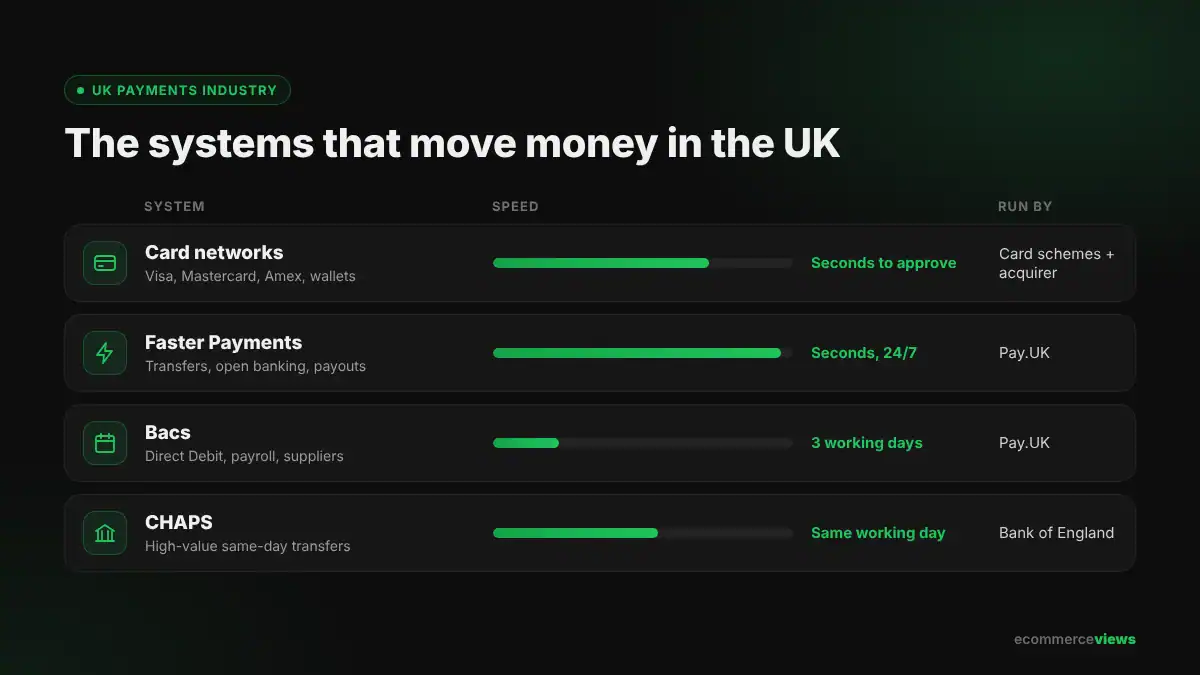
| System | What it carries | Typical speed | Who runs it |
|---|---|---|---|
| Card networks | Visa, Mastercard and Amex purchases, plus Apple Pay and similar | Approval in seconds, payout usually in one to three working days | The card schemes, working with your acquirer and the shopper’s card issuer |
| Faster Payments | Instant transfers, open banking checkout and payouts | Usually seconds, 24/7 | Pay.UK |
| Bacs | Direct Debit collections, payroll and supplier runs | Three working days | Pay.UK |
| CHAPS | High-value transfers that must arrive the same day | Same working day, during business hours | Bank of England |
Every online card purchase also passes through an acquirer, the institution that holds your merchant account. Modern payment platforms such as Square and SumUp bundle gateway and acquiring into one sign-up, which is why small sellers rarely have to deal with a high-street lender directly. Firms that handle merchant payments must be authorised or registered with the Financial Conduct Authority, so check any new name on the FCA register before you sign up.
Start here
Gateways and open banking
Gateways and open banking are the two topics merchants ask about most when setting up or improving how they accept payments.
Gateways explained
A payment gateway sits between your online store and the card networks. Services differ in their fees, the countries and currencies they support, how quickly you are paid, how well they connect to your ecommerce platform, and what happens when a shopper disputes a charge.
Hosted checkout pages and embedded card fields keep card numbers off your own site, which makes security compliance far simpler for a small team.
Open banking
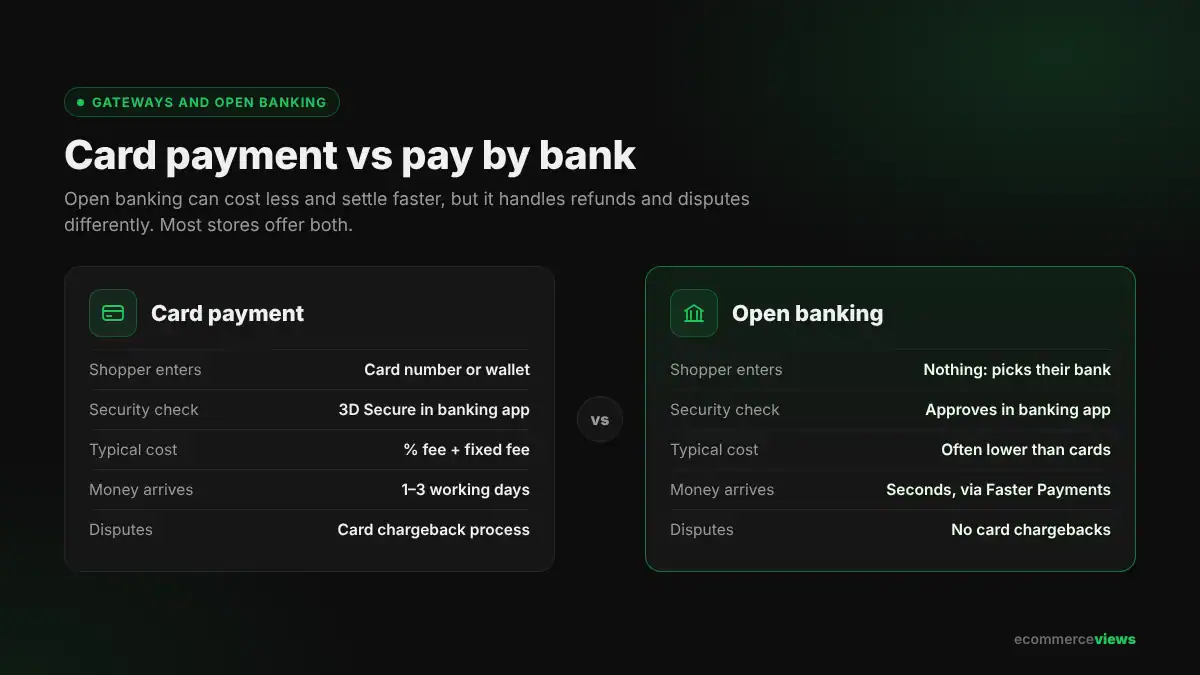
Open banking lets a shopper pay directly from their current account instead of entering card details. They approve the payment in their own banking app or website, and the money moves to you through a regulated payment initiation service. Merchants often look at it because it can cost less than card fees, although the details depend on who you use.
It handles refunds and disputes differently, without the card chargeback process, so check how your chosen service deals with them before you switch it on. It tends to suit larger baskets and repeat orders better than very small ones, and works best alongside cards and wallets.
Who to shortlist
Comparing providers by business type
There is no single best choice among payment solutions. The right setup depends on how you sell, where your shoppers are and how much you process each month. These are the names that come up most often for merchants here.
Stripe for custom-built stores
A developer-friendly platform with strong APIs, a long list of local payment options and good fraud tools. It suits start-ups and growing brands that want control over the checkout and plan to sell in several countries.
Acquirers and enterprise gateways for growing merchants
Worldpay is one of Britain’s longest-established acquirers and suits businesses that want one contract for online and in-store sales. Mollie and Checkout.com both offer modern APIs with European reach: Mollie is popular with small and mid-sized shops, while Checkout.com is built for enterprise volumes and negotiated pricing.
Shopify, Square and SumUp for all-in-one selling
If you already sell on Shopify, its built-in processor is the simplest route and avoids Shopify’s extra transaction fee. Square and SumUp combine an online checkout with card readers, which suits sellers who also trade at markets, events or in a shop.
GoCardless and Finexer for open banking collections
GoCardless specialises in Direct Debit and recurring open banking collections, a natural fit for subscription boxes and memberships. The second is an FCA-authorised open banking platform for UK businesses and software platforms that want to build instant transfer checkout into their own flows.
PayPal and Amazon Pay for trust at checkout
Adding a familiar button reassures first-time shoppers. Both let people check out with details they have already saved, which shortens the process on a phone and can recover sales from people who would not type in a card number for an unfamiliar store.
FreshBooks and QuickBooks GoPayment for invoices
If you bill clients rather than run a shop, invoicing software can collect money for you. The first adds online payment links to invoices. Intuit’s card reader app is only offered in the US; UK QuickBooks users get paid through pay-enabled invoices, or through connections with PayPal and GoCardless.
Compare the costs before you choose
Fees are where payment services differ most, and the cheapest option depends on your average order value and how many transactions you take each month. Our free calculator compares what the big names, including Square, PayPal, SumUp and Shopify, would cost you per order, per month and per year.
Before you commit
Questions to ask before you pick a setup
Work through these six and the shortlist usually gets a lot shorter.
Which methods do shoppers expect?
Cards are the baseline, and many shoppers also look for wallets, PayPal and, for bigger baskets, a way to spread the cost.
What is your typical order value?
Fixed per-transaction fees hurt smaller orders more, while percentage fees add up on large ones.
How fast do you need the money?
Payout timing varies between services and can affect your cash flow, especially in your first few months.
Does it work with your platform?
Check for a supported integration with your store before you commit, rather than relying on a third-party plugin.
What happens with refunds and disputes?
Look at the fees, the process and the time limits, and whether you can respond to chargebacks from your dashboard.
Where do you sell?
International sales bring currency conversion costs and different local habits, such as iDEAL in the Netherlands or Bancontact in Belgium.
Stay compliant
Security and the rules to follow at checkout
Taking money online comes with a few obligations. Your gateway handles most of the heavy lifting, but you are still responsible for setting things up correctly.
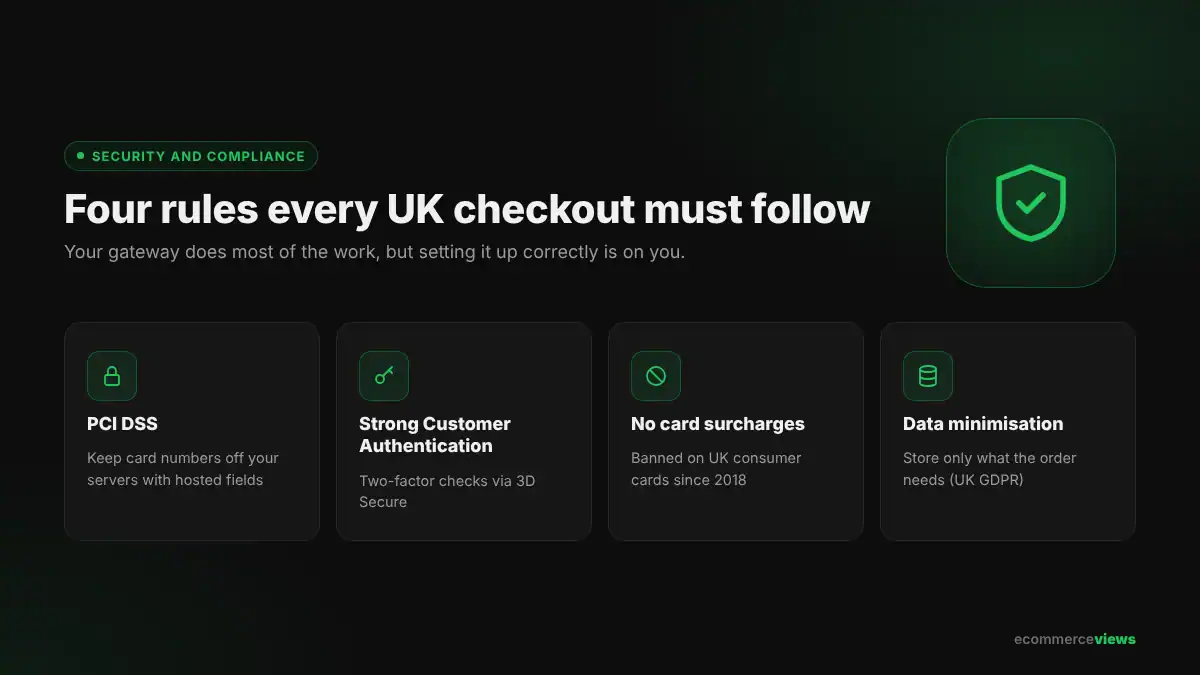
- PCI DSS. Card data must be handled to the Payment Card Industry Data Security Standard. Using a hosted checkout or your gateway’s embedded fields keeps card numbers off your servers and usually reduces your obligations to a short self-assessment questionnaire.
- Strong Customer Authentication. Most online card purchases need a two-factor check, usually 3D Secure approved in the shopper’s banking app. Your gateway applies exemptions for low-value and low-risk purchases. Read our guide to SCA and fraud data.
- No card surcharges. UK merchants cannot charge shoppers extra when they use a consumer card, so processing costs have to be built into your prices. See how the card surcharge ban affects pricing.
- Keep only the data that is required. Under UK GDPR you should collect and store only what is needed to complete and support an order, and let your payment service hold card details rather than keeping them yourself.
- Clear BNPL wording. If you offer instalments, present them clearly and fairly alongside your other options. Lenders are now FCA-regulated, and anything you say about instalments at checkout should not be misleading. More on how shoppers use buy now, pay later.
Getting set up
Setting up checkout in five steps
Ready to accept online payments? This is the order most merchants follow, whether they are launching a new store or switching services.
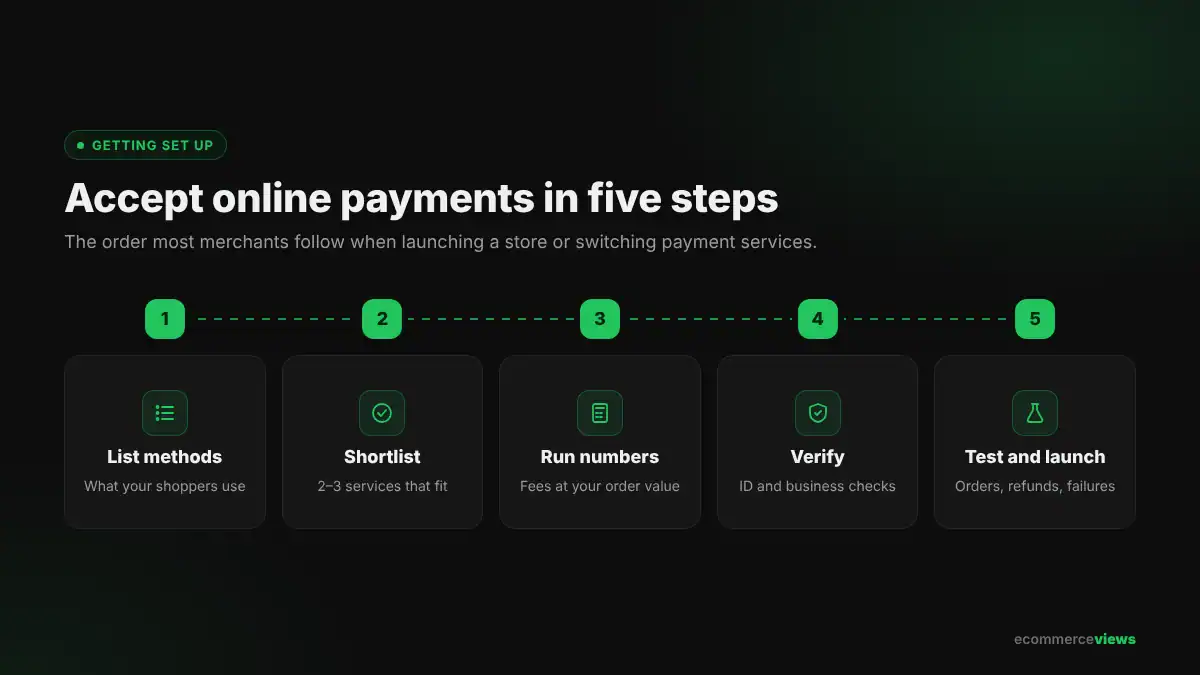
- List what your shoppers want. Check your analytics and look at competitors to see which online payment methods your audience uses, particularly on mobile.
- Shortlist two or three services. Make sure each supports your ecommerce platform, your currencies and every method on your list.
- Run your numbers. Put your average order value and monthly volume into the fee calculator to see the real cost per order and per year.
- Apply and verify. Expect identity and business checks before payouts start. Have your company details, ID and proof of address ready to avoid delays.
- Test, then launch. Use test mode to place orders, refunds and failed attempts, and check the confirmation emails shoppers receive before you go live. Our checkout solutions guide covers the next step.
Quick answers
Common questions
Short answers to the questions merchants and shoppers ask us most often.
What is another word for payment?
Common alternatives are remittance, settlement, transaction or instalment, depending on the context. In ecommerce, a charge or transaction is what happens when a shopper pays, and a payout or settlement is when the money reaches the seller.
Which system does Britain use for transfers?
There is no single system. Card purchases run on the Visa, Mastercard and Amex networks, while transfers between people and businesses use Faster Payments for instant transfers, Bacs for Direct Debit and payroll, and CHAPS for large same-day sums. Pay.UK runs both of those, and the Bank of England runs CHAPS.
What does an order confirmation need to show?
It is the message that proves a transaction went through: usually an on-screen receipt plus an email showing the order number, amount, date and method used. A clear confirmation cuts down on “did my order go through?” emails and helps if a shopper later disputes the charge.
Do I need a separate merchant account?
Usually not. All-in-one services such as PayPal, Square and SumUp include one as part of sign-up. A dedicated arrangement with a traditional acquirer tends to make sense only at higher volumes, when you can negotiate your rates.
How long do payouts take?
It depends on the service and the method. Card sales are commonly paid out within one to three working days, open banking transfers can settle in seconds, and new accounts may face a short holding period while the service gets to know your business.
Can I add a card surcharge?
No. Surcharges on consumer debit and credit cards are banned here, so build your processing costs into your prices instead. You can still offer a discount for a cheaper method, such as open banking.
Keep reading
More guides and reviews
Go deeper with provider comparisons, practical checkout advice and our free tool.
Provider reviews
Side-by-side comparisons of the gateways sellers here use most.
Checkout guides
Practical articles on taking money, one-click checkout and reducing failed orders.
Fee calculator
Compare real costs side by side for your own order values.
Our content is independent. You can read how we test and score providers on our review process page, and see how we handle affiliate links in our affiliate disclosure.