Buy Now, Pay Later sells itself to online stores with a simple promise: show shoppers that a $120 jacket is four payments of $30, and more of them will buy. Payment providers have pushed it into almost every checkout, and many stores have added it without much thought about who uses it, for what, or what happens afterwards.
New data from the Federal Reserve should change that. Its latest analysis of BNPL, published in August 2026, shows a product that is growing steadily, used most by people with the least savings, and increasingly used for everyday essentials. Among BNPL users who paid for groceries or food delivery with it, 43% were charged a late fee or an overdraft fee in the past year.
My view is that online stores should keep offering BNPL, but stop treating it as a default for every product and every order. The data says it works best for considered, discretionary purchases, and causes the most harm, to customers and eventually to the store’s reputation, when it finances essentials. Regulators in the UK and the EU have already reached the same conclusion.
Key points
- 16% of US adults used BNPL in 2025, up every year from 10% in 2021, according to the Federal Reserve’s Survey of Household Economics and Decisionmaking.
- Use is highest among people with no financial cushion: 31% of adults who could cover an emergency expense of less than $100 from savings used BNPL, against 8% of those who could cover $2,000 or more.
- One in five BNPL users used it for groceries or food delivery, rising to 29% among users with incomes under $50,000.
- 26% of BNPL users paid late at least once, and 11% had a BNPL payment trigger an overdraft or non-sufficient funds fee.
- BNPL costs merchants about twice as much as a card payment. Stripe’s published US rates are 6% plus 30 cents for Affirm and Afterpay and 5.99% plus 30 cents for Klarna.
- Regulation has arrived. The UK began regulating BNPL on 15 July 2026, and the EU’s revised Consumer Credit Directive brings it into scope from 20 November 2026.
BNPL keeps growing
The Federal Reserve has asked about BNPL in its annual household survey since 2021, and use has risen every year:
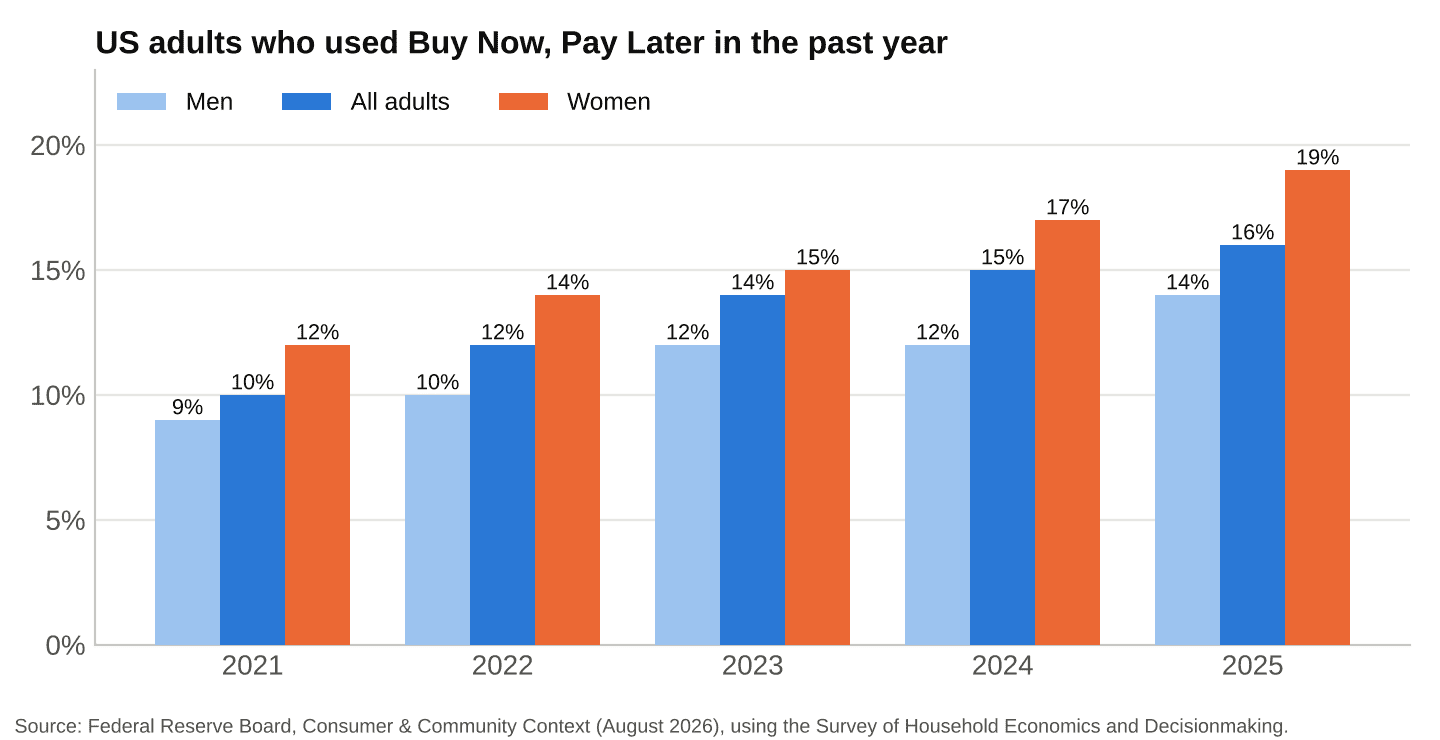
US adults who used Buy Now, Pay Later in the past year, by gender, 2021 to 2025
The Fed’s August 2026 Consumer & Community Context, based on a nationally representative survey of nearly 13,000 adults, found that 16% of adults used BNPL in 2025, up from 10% in 2021. Women are consistently more likely to use it than men: 19% against 14% in 2025, a gap that holds even after accounting for income, education and age. Use is also higher among younger adults and adults without a bachelor’s degree.
The lender side shows the same growth. The Consumer Financial Protection Bureau’s market report, cited by the Fed, estimates that the number of BNPL loans grew from 19.8 million in 2019 to 335.8 million in 2023, and dollar volume from $2.7 billion to $45.2 billion. The average loan was $135, and the average user took 6.3 loans from a single lender in 2023, up from 5.7 the year before.
Who uses it most
BNPL is often marketed as a smart budgeting tool for people who could pay in full but prefer not to. The Fed’s data shows a different core user:
| Largest emergency expense the person could cover from savings | Used BNPL in 2025 |
|---|---|
| Less than $100 | 31% |
| $100 to $499 | 28% |
| $500 to $999 | 21% |
| $1,000 to $1,999 | 16% |
| $2,000 or more | 8% |
Federal Reserve Board, 2025 Survey of Household Economics and Decisionmaking. Among all adults.
Adults with almost no savings are nearly four times as likely to use BNPL as those with a comfortable cushion. The Fed notes that over time, the growth in BNPL has been concentrated among people experiencing credit and liquidity constraints.
What people buy with it
Clothing remains the most common BNPL purchase, but the list is broader than the marketing suggests:
| Purchase type | Income under $50,000 | $50,000 to $99,999 | $100,000 or more | All BNPL users |
|---|---|---|---|---|
| Clothing or accessories | 51% | 50% | 44% | 49% |
| Electronics | 33% | 32% | 32% | 32% |
| Furniture or appliances | 25% | 28% | 27% | 26% |
| Groceries or food delivery | 29% | 19% | 9% | 20% |
| Travel expenses | 13% | 23% | 24% | 19% |
| Medical or veterinary procedures | 9% | 8% | 7% | 8% |
Share of BNPL users who used it for each type of purchase in the prior year. Users could choose more than one.
The income split is the important part. Higher-income users lean towards travel; lower-income users are three times as likely as high-income users to put groceries or food delivery on BNPL. A product designed for spreading the cost of a jacket or a sofa is being used, by a meaningful share of its users, to pay for food. Everyday consumables are a strong category for small online stores, as we argued in sell what people run out of, not what’s trending, but they are also where BNPL does the most damage.
Where it goes wrong
BNPL is interest-free only if every payment is made on time. The Fed found that 26% of BNPL users paid late at least once in the prior year and 17% were charged extra for paying late. Because most payments are taken automatically from a checking account, 11% of users had a BNPL payment trigger an overdraft or non-sufficient funds fee, rising to 18% among users with savings of less than $100.
The problems concentrate in exactly the categories that look most like essentials:
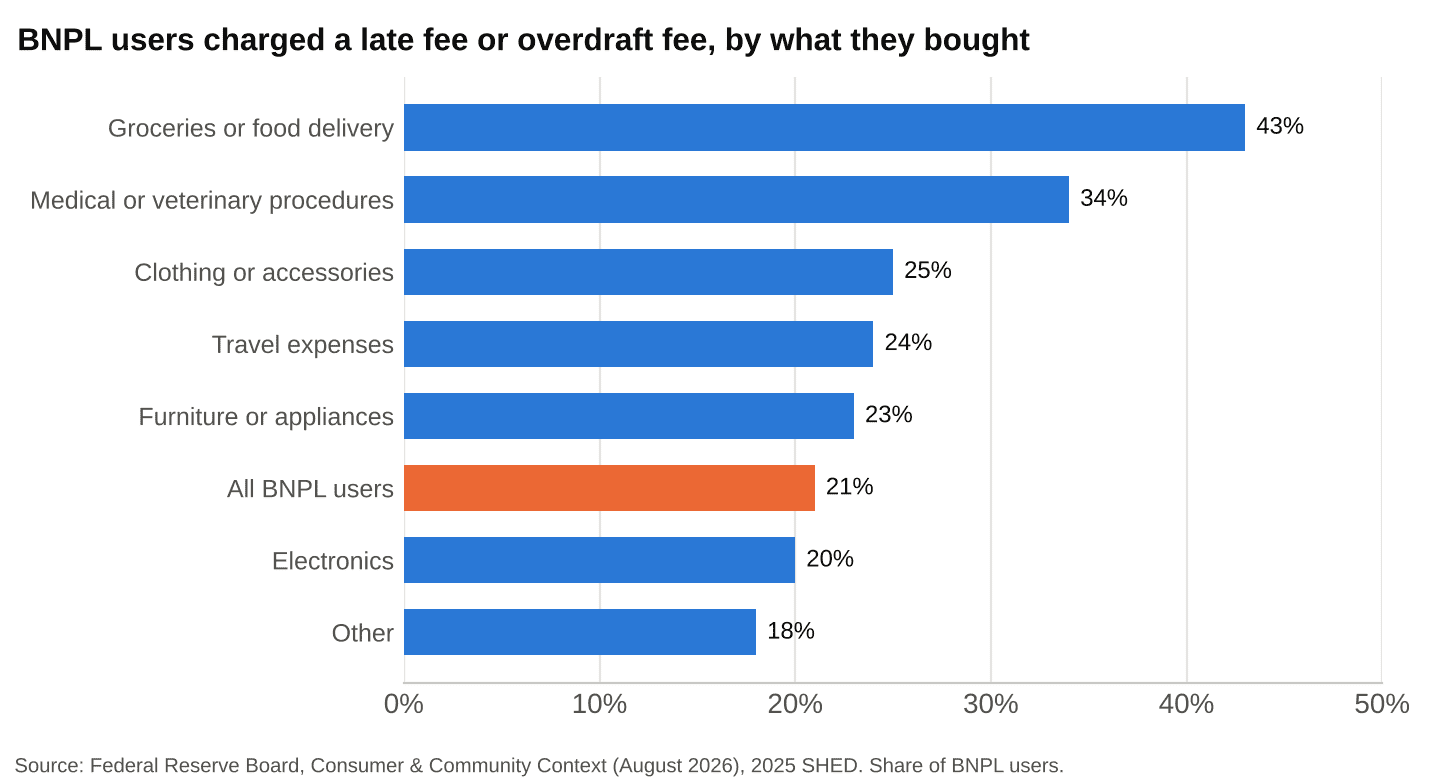
Share of BNPL users charged a late fee or overdraft fee, by purchase type
43% of people who used BNPL for groceries or food delivery were charged a late fee or an overdraft fee, more than twice the rate of those who used it for electronics (20%). Medical and veterinary purchases followed at 34%. The Fed notes that the link between groceries and repayment problems holds even among people with similar incomes, and concludes that the three remaining installments over six weeks are not enough to keep financially constrained consumers from missing payments.
Why shoppers choose it anyway
None of this means BNPL is simply a last resort. When the Fed asked users why they chose it, the top reasons in 2025 were wanting to spread out payments (87%) and convenience (82%). “It was the only payment method I had” was the least common answer. Most users choose BNPL because they like it, which is why it can lift conversion for stores that offer it.
That is the core of the case for BNPL at checkout: it reduces the friction of paying for a considered purchase, and shoppers who prefer it may go elsewhere if it is missing. For stores selling higher-priced items, where the decision to buy is heavier, that effect is real, and payment options are one of the levers covered in our guide on how to increase ecommerce sales in 2026.
What it costs the store
BNPL is not free for merchants either. On Stripe’s published US pricing, Affirm and Cash App Afterpay cost 6% plus 30 cents per successful charge, and Klarna 5.99% plus 30 cents, roughly double the standard card rate on the same platform. On a $50 order, a 6% plus 30 cents fee is $3.30, or 6.6% of the sale.
For a store with healthy margins selling a $400 item that might not otherwise sell, that cost can be worth paying. For a store selling $25 everyday items on thin margins, it can wipe out the profit on the order.
Regulators are catching up
Two of the largest markets outside the US have already decided that BNPL needs consumer credit rules:
- United Kingdom. The Financial Conduct Authority began regulating deferred payment credit on 15 July 2026. Lenders must now check whether customers can afford to repay, and customers can take complaints to the Financial Ombudsman Service. The rules cover BNPL where the lender and the seller are different businesses, which is the usual checkout setup.
- European Union. The revised Consumer Credit Directive, (EU) 2023/2225, brings interest-free credit and loans below €200, the core of pay-in-four BNPL, into consumer credit law, with most changes applying from 20 November 2026.
For stores, the practical effect is that BNPL checkouts in the UK and EU will involve more checks, more disclosures and potentially more declined applications. Stores that relied on BNPL as an instant, frictionless option for every shopper should expect that to change.
Where BNPL fits, and where it does not
Putting the evidence together, BNPL makes the most sense for:
- Considered, discretionary purchases such as furniture, electronics, appliances and travel, where splitting the cost helps a shopper commit and repayment problems are lower.
- Higher order values, where the merchant fee is a smaller share of the margin and the conversion benefit is larger.
- Stores whose customers already ask for it, where its absence is a reason to leave.
Before deciding, run the numbers per order: our ecommerce profit calculator shows how a higher payment fee changes what each order earns.
It makes the least sense for:
- Groceries, food delivery and everyday consumables, where the Fed’s data shows the highest rates of late and overdraft fees.
- Low-value orders, where the fixed 30-cent fee and the high percentage rate eat most of the margin.
- Subscriptions and repeat purchases, where stacking several BNPL plans for the same essentials creates exactly the pattern that leads to missed payments.
The case for offering it everywhere
The strongest counterargument is commercial: if competitors offer BNPL on every order and you do not, some shoppers will buy elsewhere. BNPL providers also take on the credit risk, so the merchant is paid in full upfront whatever the customer does later. And most users repay: the CFPB reports that only 1.83% of BNPL loans were charged off in 2023.
Those points are fair, but they look only at the first order. A customer who ends up with a late fee or an overdraft charge after buying from your store does not blame the BNPL provider alone, and the categories where that happens most are the ones built on repeat purchases. Offering BNPL selectively, where it helps shoppers make a considered decision, keeps most of the conversion benefit without tying the store to the products where it does most harm. For most shoppers, the bigger conversion lever is a fast checkout, as our overview of one-click checkout solutions shows.
What online stores should do
- Set a minimum order value for BNPL. Many providers allow it. A threshold keeps BNPL off small, frequent orders where it costs the most and helps the least.
- Show BNPL where it helps the decision. Display installment messaging on higher-priced product pages, not on every cart.
- Do not push BNPL on essentials. If you sell groceries, baby products or household consumables, consider not offering it on those categories at all.
- Check your real cost per order. Compare BNPL fees with any measured lift in conversion and order value, using your own data rather than provider averages. Our guide to payment gateway fees explains the cost structure.
- Keep checkout simple for everyone else. Fast card and wallet payments matter more to most shoppers than another payment logo.
- Prepare for UK and EU rules. If you sell in those markets, check with your BNPL provider how affordability checks will change approval rates.
The bottom line
BNPL has grown into a mainstream payment method used by one US adult in six, and most of them choose it for convenience. But the Federal Reserve’s data shows its fastest growth among people with the least savings, and its worst outcomes when it is used for food and other essentials. Online stores that offer BNPL everywhere are subsidizing those outcomes with fees of around 6% per order. Stores that offer it where it fits, on considered purchases above a sensible order value, get most of the benefit at a fraction of the cost, and stay on the right side of where regulation is clearly heading.