For more than a decade, the share of Europeans selling things online barely moved. Between 2013 and 2022 it hovered between 17% and 19.5% of adults, as eBay-style selling settled into a steady niche. Then, in three years, it jumped. In 2025, almost one European in four sold goods or services online in a single three-month period, the highest share Eurostat has ever recorded.
The driver is resale. Platforms built for selling secondhand clothing, shoes and household items have made it easy enough for ordinary people to list an item from their phone and drop it at a parcel point. Vinted alone handled €10.8 billion of transactions in 2025, up 47% in a year.
Most online fashion and lifestyle stores treat this as a threat: every secondhand jacket sold is a new one not bought. My argument is that this is the wrong reading of the data. Resale is now a mainstream channel with its own customers, growth rate and regulation pushing it forward, and stores that build it into their business will do better than stores that ignore it.
Key points
- 23.9% of EU residents aged 16 to 74 sold goods or services online in the three months before Eurostat’s 2025 survey, up from 18.4% in 2022 and 18.0% in 2019.
- The growth came after a decade of stagnation. The share was 17.6% in 2013 and stayed within a narrow band until 2022.
- Young adults lead. 33.8% of 25 to 34-year-olds sold online in 2025, up from 27.3% in 2019.
- The jump is widest in markets that were late to start. In Austria the share rose from 12.1% in 2019 to 29.9% in 2025, in Italy from 8.0% to 19.6%, and in Lithuania from 8.9% to 21.9%.
- Resale platforms are growing faster than fashion. Vinted’s revenue rose 38% in 2025 to €1.1 billion, and ThredUp reports that US secondhand apparel grew nearly four times faster than retail clothing overall.
A decade of flat, then a sudden jump
Eurostat’s household survey asks people whether they used the internet to sell goods or services in the previous three months. The series for the EU27 goes back to 2007:
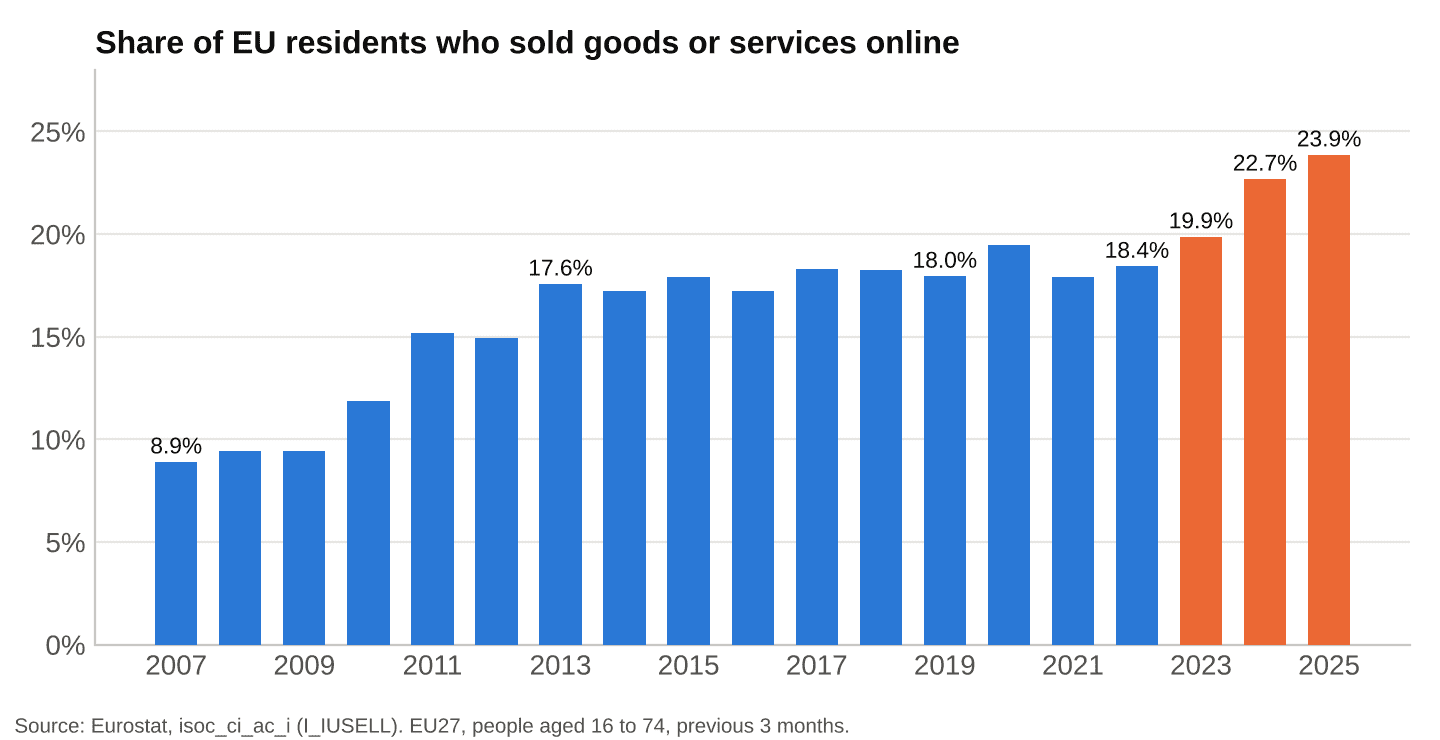
Share of EU residents who sold goods or services online, 2007 to 2025
The share doubled between 2007 (8.9%) and 2013 (17.6%), the years when online marketplaces spread across Europe. Then it stopped. For nine survey rounds it stayed between 17.2% and 19.5%, including during the pandemic, when people had more time and more reason to clear out their homes.
The break came after 2022:
| Survey year | Sold goods or services online | Among internet users |
|---|---|---|
| 2019 | 18.0% | 21.0% |
| 2021 | 17.9% | 20.1% |
| 2022 | 18.4% | 20.5% |
| 2023 | 19.9% | 21.7% |
| 2024 | 22.7% | 24.4% |
| 2025 | 23.9% | 25.5% |
EU27, people aged 16 to 74 who sold online in the previous three months. Eurostat, isoc_ci_ac_i.
A gain of 5.4 percentage points in three years, after nine years of no growth, is not a trend in buying habits catching up. It is a new behavior arriving at scale. The indicator covers all goods and services sold by individuals, but the timing and the shape of the increase line up closely with the expansion of secondhand fashion platforms across the EU.
Who is selling
The rise in selling happened in every age group, but it was strongest among younger adults:
| Age group | 2019 | 2025 | Change |
|---|---|---|---|
| 16 to 24 | 18.5% | 27.1% | +8.7 points |
| 25 to 34 | 27.3% | 33.8% | +6.5 points |
| 35 to 44 | 24.5% | 31.9% | +7.4 points |
| 45 to 54 | 18.2% | 24.6% | +6.4 points |
| 55 to 64 | 11.1% | 16.8% | +5.7 points |
| 65 to 74 | 6.6% | 9.5% | +2.9 points |
EU27, share of each age group that sold goods or services online in the previous three months.
The gender gap also narrowed. In 2019, 19.5% of men and 16.5% of women sold online; by 2025 the figures were 24.5% and 23.3%. Women’s selling grew faster, by 6.8 points against 5.0 for men, which fits a boom led by clothing and accessories.
One in three Europeans aged 25 to 44 now sells online in any given quarter. These are the same people that fashion and lifestyle stores most want as customers. Many of them now think of a purchase as something they will resell later, which changes what they buy and how much they are willing to pay.
Where selling has grown fastest
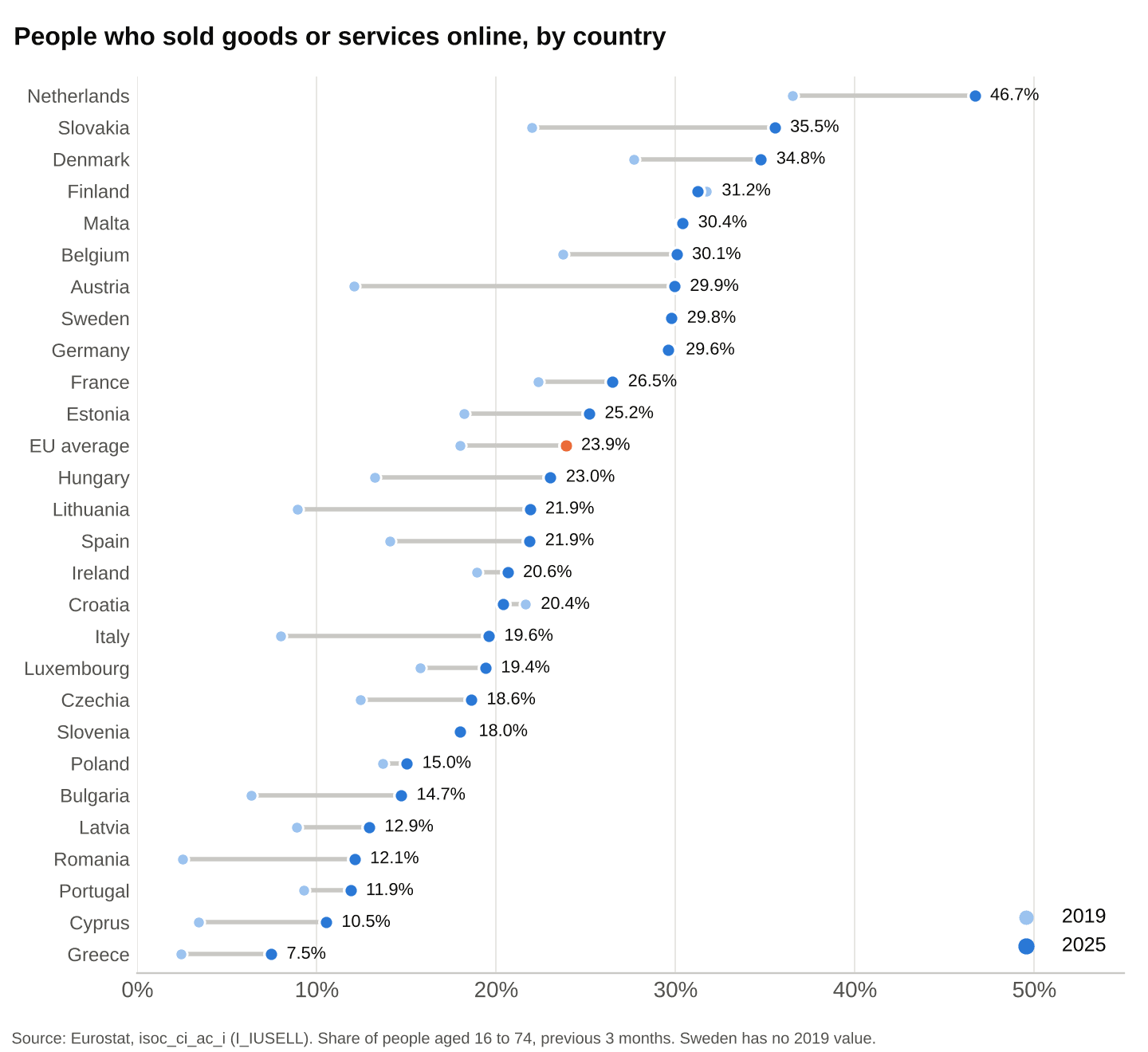
People who sold goods or services online by EU country, 2019 and 2025
The Netherlands leads, with 46.7% of adults selling online in 2025, up from 36.5% in 2019. Slovakia (35.5%), Denmark (34.8%), Finland (31.2%) and Malta (30.4%) follow.
The biggest jumps came in countries where online selling had been rare:
- Austria: from 12.1% to 29.9%
- Italy: from 8.0% to 19.6%
- Lithuania: from 8.9% to 21.9%
- Slovakia: from 22.0% to 35.5%
- Romania: from 2.5% to 12.1%
- Bulgaria: from 6.3% to 14.7%
Germany, by contrast, was flat at 29.6% against 29.7% in 2019, and Croatia slipped from 21.6% to 20.4%. Markets where marketplace selling was already established saw less change; the boom was largely about new sellers in markets that had few. How selling patterns differ from what Europeans buy online is covered in our study of what Europeans buy online.
Resale platforms are outgrowing fashion
The platform data points the same way. Vinted’s 2025 results, reported in April 2026, showed:
- Transaction volume of €10.8 billion, up 47% on 2024
- Revenue of €1.1 billion, up 38%
- Net profit of €62 million, down 19% as the company invested in growth
- More than 500,000 pick-up and drop-off points across Europe for its delivery network
Growth of 47% in transaction value is far beyond anything the new-clothing market is doing.
The US picture points the same way
In the US, ThredUp’s 2026 Resale Report, produced with GlobalData, found that secondhand apparel grew nearly four times faster than the broader retail clothing market in 2025, and projects the global secondhand apparel market at $393 billion by 2030, about 10% of all apparel spending. It also expects 71% of the market’s growth to come from Gen Z and Millennials, and found that nearly half of shoppers discover secondhand items through social media and creators rather than search.
Regulation is pushing in the same direction
The economics of new clothing in Europe are about to change too. On 9 September 2025, the European Parliament gave final approval to the revised Waste Framework Directive, which requires extended producer responsibility for textiles. As SGS summarizes the new rules, producers of clothing, accessories, footwear and home textiles, including those outside the EU and those selling through ecommerce platforms, will have to pay for collecting and treating textile waste, with member states required to set up schemes within 30 months. The EU generates about 5.2 million tonnes of clothing and footwear waste a year.
When every new garment carries a fee for its end of life, products that are reused, resold or repaired become relatively cheaper to put on the market. Resale stops being only a consumer trend and becomes part of how compliance costs are managed.
Why most stores get resale wrong
The instinctive response from a fashion retailer is that resale cannibalizes new sales. There is some truth in it: a shopper who buys a used coat on a resale app may not buy a new one. But the evidence suggests the bigger effect is different:
- Resale value supports full-price sales. Shoppers who know they can resell an item are more willing to pay full price for brands that hold their value. Durable, well-made products gain an advantage over disposable ones.
- The competition is already there. Resale platforms exist whether or not a brand participates. Staying out means letting others capture the second sale of your products and the customer relationship that comes with it.
- Ultra-cheap new fashion is the bigger threat. Resale competes most directly with the cheapest new clothing, the market where cross-border platforms are strongest, as our comparison of Amazon vs Temu shows. Brands with quality to stand on have more to gain from secondhand demand than to lose.
The case against joining in
There are real reasons to be cautious, and they explain why many stores hold back:
- Margins are thin. Even Vinted made a smaller profit in 2025 than in 2024 despite fast growth. Inspecting, cleaning, photographing and listing single items is labor-intensive.
- Quality control is hard. Selling used goods under your own brand means taking responsibility for their condition.
- Operations are different. Every item is unique, which breaks the processes built for selling many units of the same SKU.
These are reasons to choose the right model, not to stay out. Few small stores should run a full resale operation themselves. Partnering with an existing platform, or offering trade-in credit and passing the items to a specialist, captures most of the benefit without the operational cost. Our guide to marketplace management covers how to run several selling channels at once.
How an online store can work with resale
Practical options, from lightest to heaviest:
- Show resale value. Mention durability and how well your products hold their value on resale platforms. It is a selling point for the customers most likely to resell.
- Offer trade-in credit. Let customers send back used items for store credit, then resell them through a partner. It brings customers back and keeps your products circulating under your name.
- List refurbished and returned stock. Returned items that cannot be sold as new can go into a “pre-loved” section rather than being written off.
- Reach resale shoppers where they look. Nearly half of secondhand shoppers discover items through social media and creators, the channel trends we covered in social and livestream commerce.
Use the delivery habits resale created
Resale has also changed how millions of Europeans send and receive parcels. Vinted’s network alone has more than 500,000 pick-up and drop-off points, and resale users are used to dropping a parcel at a locker or shop rather than waiting for a courier. Offering the same points as a delivery and returns option is cheaper than home delivery and matches habits these shoppers already have, a model covered in our guide to last-mile delivery.
The bottom line
For years, the number of Europeans selling online was flat enough to ignore. It no longer is. Almost one adult in four now sells online in any three-month period, one in three among 25 to 44-year-olds, and the platforms they use are growing several times faster than the fashion market. Regulation is about to raise the cost of new textiles and favor reuse. Stores that see resale only as lost sales will spend the next few years competing with their own products on someone else’s platform. Stores that build resale into their offer will keep the customer, the second sale and the data that comes with it.