For most of the last fifteen years, every extra dollar Americans spent online needed more people to move the goods. Warehouses hired, parcel carriers hired, and logistics became one of the fastest-growing sources of work in the US economy. Ecommerce growth and logistics jobs rose together so reliably that one could almost be used to forecast the other.
That link has broken. Since March 2022, sales at US nonstore retailers, the Census Bureau’s category for businesses that sell mainly online and by mail order, have risen by a third. Over the same period, employment in warehousing has fallen by 5.5%, and courier jobs are below their peak too.
My view is that this is not a pause in hiring. It is the moment US ecommerce moved from growing by adding people to growing by adding machines and squeezing more out of the networks it already built. That shift has consequences for every online store, because it changes who can fulfill orders cheaply and why.
Key points
- Warehousing employment peaked at 1.94 million in March 2022 and stood at 1.83 million in September 2026, down 5.5%.
- Courier and messenger jobs peaked at 1.14 million in December 2021 and stood at 1.09 million in September 2026, down 4.5%.
- Nonstore retail sales rose 33.6% over the same period after March 2022, or about 14% after adjusting for consumer price inflation.
- Sales per logistics worker have jumped. Annual nonstore sales per warehouse and courier job rose from $342,000 in 2019 to about $499,000 in 2026.
- The largest retailer is automating at scale. Amazon deployed its millionth warehouse robot in July 2025, and internal plans reported by The New York Times aim to automate 75% of its operations.
The decade when online sales meant jobs
Between 2010 and 2019, the relationship between online sales and logistics work was plain in the data. Using annual averages of the monthly figures:
| 2010 | 2019 | Change | |
|---|---|---|---|
| Nonstore retail sales, monthly average | $26.7 billion | $58.6 billion | +119.6% |
| Warehousing and storage jobs | 637,900 | 1,227,600 | +92.4% |
| Courier and messenger jobs | 528,300 | 828,200 | +56.8% |
Sources: US Census Bureau and Bureau of Labor Statistics, via FRED. Seasonally adjusted.
Sales more than doubled and warehouse employment almost doubled. Fulfillment was labor-intensive, and the main way to ship more orders was to hire more people to pick, pack and deliver them.
The pandemic pushed this to an extreme. With stores closed and online orders surging, warehousing employment rose from about 1.32 million in February 2020 to its peak of 1.94 million in March 2022, according to the Bureau of Labor Statistics’ warehousing and storage employment series. That was a gain of more than 600,000 jobs in two years.
Then the lines split
After early 2022, sales and jobs went in different directions.
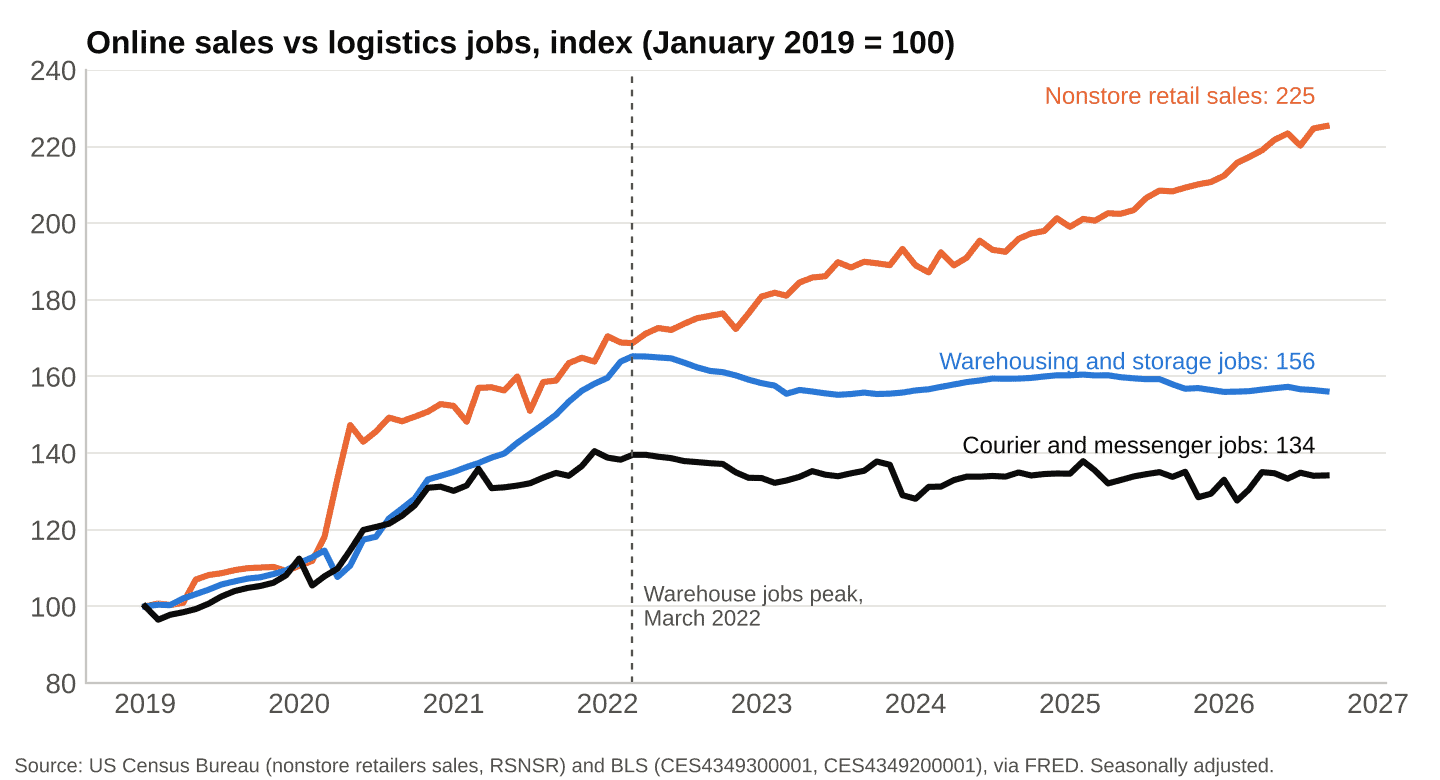
Online sales vs logistics jobs, index January 2019 = 100
Indexed to January 2019, nonstore retail sales stood at 169 in March 2022 and 225 in September 2026. Warehousing jobs went from 165 to 156 over the same period, and courier jobs from 140 to 134. Online sales kept climbing at roughly their pre-pandemic pace, while the workforce that handles them shrank slightly and then flattened.
| March 2022 | September 2026 | Change | |
|---|---|---|---|
| Nonstore retail sales, monthly | $93.0 billion | $124.3 billion | +33.6% |
| Warehousing and storage jobs | 1,939,300 | 1,831,800 | -5.5% |
| Courier and messenger jobs | 1,133,200 | 1,089,600 | -3.8% |
Seasonally adjusted. Courier jobs peaked earlier, at 1,141,100 in December 2021.
Part of the sales growth is inflation. Consumer prices rose 16.9% between March 2022 and September 2026, so in real terms nonstore sales grew about 14%. That still means more goods moved by fewer people, largely because more of the work inside warehouses is now done by machines, as our article on warehouse automation in integrated supply chains explains.
Sales per worker tell the story
Dividing annual nonstore sales by the number of warehouse and courier jobs gives a rough measure of how much online business each logistics worker supports:
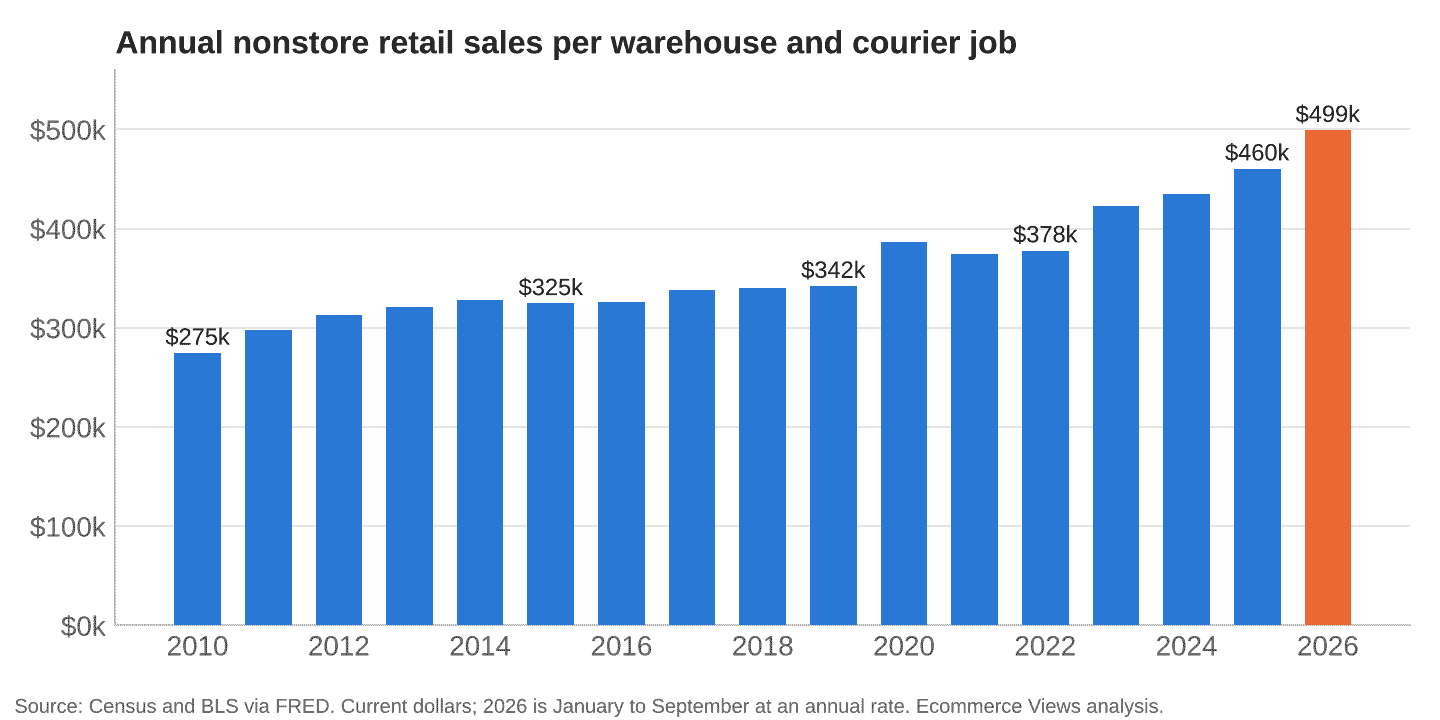
Annual nonstore retail sales per warehouse and courier job, 2010 to 2026
From 2010 to 2019, sales per logistics job rose from about $275,000 to $342,000, an increase of about 25% over nine years. From 2022 to 2025 alone, it rose from about $378,000 to $460,000, an increase of about 22% in three years, and the 2026 figure so far is about $499,000.
This is a blunt measure. Not every warehouse serves ecommerce and not every nonstore sale is an online order, and the figures are in current dollars. But the shape of the series is clear: the amount of online business per logistics worker is now rising several times faster than it did before the pandemic.
Year by year
The annual averages show how sharp the turn was. Logistics employment grew in every year from 2019 to 2022, then fell in 2023 and has moved sideways since, while sales kept rising every year:
| Year | Nonstore retail sales, monthly average | Warehousing jobs | Courier jobs |
|---|---|---|---|
| 2019 | $58.6 billion | 1,227,600 | 828,200 |
| 2020 | $76.3 billion | 1,404,700 | 964,200 |
| 2021 | $86.9 billion | 1,702,100 | 1,084,700 |
| 2022 | $95.3 billion | 1,908,600 | 1,118,400 |
| 2023 | $103.0 billion | 1,831,300 | 1,089,500 |
| 2024 | $106.7 billion | 1,861,900 | 1,081,000 |
| 2025 | $113.2 billion | 1,865,300 | 1,085,000 |
| 2026 (January to September) | $121.3 billion | 1,836,100 | 1,080,400 |
Annual averages of seasonally adjusted monthly data. Census Bureau and Bureau of Labor Statistics, via FRED.
Between 2022 and 2025, average monthly nonstore sales rose by $17.9 billion, or 18.7%. Average warehousing employment fell by 43,300 and courier employment by 33,400. In the previous three-year stretch, from 2019 to 2022, the same sales increase would have come with hundreds of thousands of new jobs.
Why this is happening
Three forces explain most of the change, and they reinforce each other.
Force one: the industry overbuilt
The 2020 to 2022 boom led retailers and logistics companies to hire and lease for growth that did not continue at pandemic speed. Much of the hiring since has simply been absorbed by the capacity built then. Cushman & Wakefield reported US industrial vacancy at 6.9% in the second quarter of 2026, back below 7% after a period above it, which shows how much space came onto the market.
Force two: automation finally works at scale
Amazon Robotics announced its millionth robot in July 2025, along with an AI model, DeepFleet, that it said improves the travel time of its robot fleet by 10%. In October 2025, The New York Times reported internal Amazon documents showing a goal to automate 75% of operations, avoid hiring more than 160,000 US workers by 2027 and more than 600,000 by 2033, and save about 30 cents on each item picked, packed and delivered.
Force three: software is doing more of the planning
Better demand forecasting, slotting and routing mean fewer wasted movements in the warehouse and fewer empty miles on delivery routes. Our overview of AI in ecommerce operations and inventory explains what these tools solve in practice.
Why this matters for online stores
It would be easy to read this as a story about labor markets that has nothing to do with running an online store. It matters because it changes fulfillment economics in three ways.
Scale advantages are growing. An automated network gets cheaper per order as volume rises, and a 30-cent saving per item is the kind of advantage that compounds across billions of items. Small stores that pick and pack by hand are now competing with fulfillment costs that are falling for the largest players, which makes the cost picture we described in selling online is no longer cheaper than running a store harder for small sellers, not easier.
Building your own warehouse is rarely the answer. For most small and mid-sized stores, the way to access automation is to rent it: third-party logistics providers and marketplace fulfillment programs spread the cost of robots and software across many clients. Owning a warehouse made sense when fulfillment was mainly labor that could be hired as needed; it makes less sense when it is capital equipment.
Speed is becoming cheaper to offer. Automated networks with stock close to customers make one-day and two-day delivery more affordable. That raises the baseline shoppers expect, which a small store can match by placing inventory with a fulfillment partner rather than shipping everything from one location.
The counterargument
The case that the jobs story is temporary deserves to be stated fairly:
- Hiring follows cycles. Logistics employment fell in 2023 as the industry digested pandemic over-hiring. If online sales keep growing at their current pace, hiring may resume once spare capacity is used up.
- Some work moved rather than disappeared. Gig drivers, temporary agency staff and seasonal workers are not all counted in the warehousing and courier series, so part of the workforce may be hidden in other categories.
- Automation is uneven. Most warehouses outside the largest networks still rely heavily on manual work, and many small 3PLs have not automated at all.
These are real caveats, and the employment figures are not a perfect measure of ecommerce work. But four and a half years of falling or flat logistics employment, alongside online sales growing by a third, is a long time for a cyclical explanation. The largest operator in the market has also said publicly, through its robot deployments and its reported plans, which way it is going.
What to do about it
For an online store, the practical response is to treat fulfillment as a cost to buy well rather than a job to staff:
- Compare 3PL quotes on cost per order, not per hour. Automated providers price around throughput. Ask for a per-order figure that includes picking, packing materials and storage.
- Keep inventory data clean. Automated fulfillment depends on accurate stock counts, dimensions and SKUs. Errors that a person would catch become exceptions a system cannot handle.
- Standardize packaging. Fewer box sizes and consistent product packaging make automated packing cheaper and faster.
- Design the order flow end to end. From the moment an order is placed to the moment it ships, every manual step is a cost. Our overview of order processing and management maps the stages to review.
- Place stock closer to customers. Splitting inventory across two or three fulfillment locations can cut delivery times and shipping costs at the same time.
The bottom line
The last time online retail grew this fast, it hired hundreds of thousands of people a year. This time, it is growing with fewer. The data from the Census Bureau and the Bureau of Labor Statistics shows that the industry has moved into a phase where scale, automation and software, rather than headcount, decide who can fulfill orders cheaply. For small online stores, the response is not to compete on warehouse labor, but to buy access to the same efficiencies, and to spend their own effort on the products and customer experience that automation cannot provide. The wider picture of how goods move from supplier to customer is covered in our guide to what logistics is.