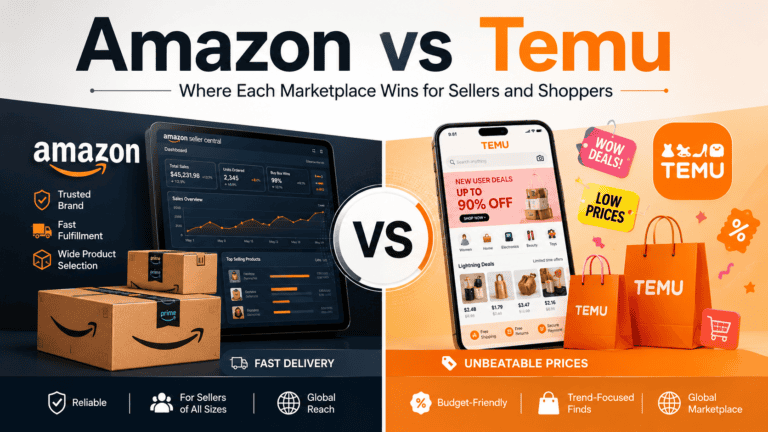
Amazon and Temu both sell high volumes of products online, but they operate on completely different models. Amazon is a marketplace where third-party sellers list products alongside Amazon’s own retail operation. Temu is a direct-from-manufacturer platform backed by PDD Holdings, the company behind Pinduoduo, that connects Chinese factories directly to international consumers. The experience for sellers, the experience for shoppers, and the economics underneath are different in ways that matter.
This comparison covers the practical differences between the two marketplaces from both the seller and buyer perspective, including fees, logistics, product quality, audience reach, and the strategic considerations for ecommerce businesses deciding where to sell or source.
Quick comparison table between Amazon and Temu Marketplaces
| Factor | Amazon | Temu |
| Business model | Third-party marketplace + first-party retail | Direct-from-factory marketplace |
| Parent company | Amazon (US-based) | PDD Holdings (China-based) |
| Seller base | ~2 million active sellers globally | Primarily Chinese manufacturers and wholesalers |
| Average price point | Wide range, $10-$500+ typical | Ultra-low, $1-$30 typical |
| Fulfilment | FBA (Fulfilled by Amazon) or seller-fulfilled | Shipped from manufacturer, some regional warehousing |
| Delivery speed | 1-2 days (Prime), 3-7 days (standard) | 7-15 days typical, improving with local warehouses |
| Seller fees | Referral fees (8-15%) + FBA fees + subscription | Commission-based, platform sets pricing |
| Product quality | Variable, brand-name and generic mix | Variable, primarily unbranded/white-label |
| Buyer trust | High, established brand with buyer protection | Growing but less established outside China |
| Markets served | 20+ country-specific sites | 60+ countries, rapidly expanding |
Table of contents
- Business model and how each platform works
- Seller fees and cost structure
- Logistics and delivery speed
- Product quality and brand presence
- Audience and buyer demographics
- Seller experience and control
- Marketing and discoverability
- Regulatory landscape and tariffs
- Search and marketplace SEO
- When to sell on Amazon
- When to sell on Temu
- Why some sellers skip both and run their own store
- The verdict
Business model and how each platform works
Amazon operates a hybrid model. It sells products directly through its own retail arm and allows third-party sellers to list alongside those products. Third-party sellers handle their own sourcing and pricing, and can choose between fulfilling orders themselves or using Fulfilment by Amazon (FBA), where Amazon stores, packs, and ships products from its warehouses. The result is a very large catalogue with a mix of brand-name products, generic alternatives, and Amazon’s own private labels.
Temu works differently. The platform connects manufacturers, mostly based in China, directly with international consumers. Sellers on Temu are typically factories or wholesalers selling white-label or unbranded products at extremely low margins. PDD Holdings subsidises shipping and promotions aggressively to acquire customers. The model prioritises volume at low prices rather than brand development or margin per unit.
For sellers, the difference is significant. On Amazon, you build your brand presence within the marketplace. On Temu, the platform controls the pricing, promotion, and customer relationship more tightly, and the seller functions more like a supplier than a brand.
Amazon Seller fees and Temu cost structure
Amazon’s fee structure has multiple layers. A Professional seller account costs $39.99 per month. Referral fees range from 8% to 15% depending on the product category. FBA fees add per-unit charges for storage and fulfilment that vary by product size and weight. Monthly storage fees increase during Q4. Returns processing fees apply in some categories. A product selling for $25 on Amazon might net the seller $10-$14 after all fees, depending on category and fulfilment method.
Temu’s fee model is less transparent to outside observers because the platform often negotiates pricing directly with suppliers. Temu takes a commission and in some cases sets the retail price itself, giving the seller a wholesale price. The platform’s approach compresses margins for sellers but guarantees volume. Sellers on Temu report thin margins per unit, with profitability depending on high volume and low production costs.
For ecommerce businesses evaluating where to sell, the fee comparison only tells part of the story. Amazon’s higher fees come with higher average selling prices, a more affluent buyer base, and the FBA infrastructure that handles logistics. Temu’s lower barrier to entry comes with lower margins and less seller control. The real question is whether your product economics work at Temu’s price points or whether you need Amazon’s ability to sustain higher prices.
Logistics and delivery speed
Amazon’s logistics network is one of its strongest competitive advantages. FBA offers next-day or two-day delivery for Prime members across the US and most of Europe. This speed sets buyer expectations and gives FBA sellers a meaningful conversion advantage over non-Prime offers. Amazon operates hundreds of fulfilment centres globally, and the reliability of its delivery network is a major reason buyers return to the platform.
Temu’s delivery times are longer, typically 7-15 days for standard shipping from China. The platform has been investing in regional warehouses in the US and Europe to reduce delivery times, and some products now ship domestically with 3-5 day delivery. But for most of the catalogue, cross-border shipping from Chinese warehouses remains the default. For buyers who are price-sensitive and willing to wait, this is acceptable. For buyers who expect next-day delivery, it is a dealbreaker.
Shipping cost is another difference. Amazon Prime includes free delivery, which is built into the annual membership cost ($139/year in the US). Temu offers free shipping on most orders above a low threshold, subsidised by the platform. For last-mile delivery, Amazon’s infrastructure is decades ahead. Temu is narrowing the gap but is not close to matching it yet.
Product quality and brand presence
Amazon carries products across the entire quality spectrum, from premium brands like Apple and Nike to generic white-label products from no-name sellers. The presence of brand-name products and Amazon’s buyer protection policies (A-to-Z Guarantee, easy returns) create a baseline of trust. That said, quality issues exist on Amazon too, particularly with counterfeit concerns and misleading product listings in certain categories.
Temu’s product quality is more variable. The platform specialises in low-cost, unbranded goods. Some products are perfectly fine for the price. Others fall short of what the listing images suggest. Because most products come directly from factories selling at minimal margins, quality control is less consistent than on platforms with brand accountability. Temu does offer buyer protection and returns, but the experience of returning a $5 item that shipped from China is different from returning an Amazon purchase to a nearby drop-off point.
For sellers, this distinction matters strategically. Building a brand on Amazon is possible and many sellers have done it successfully. Building a brand on Temu is harder because the platform’s design focuses attention on price rather than seller identity. If brand equity is part of your long-term strategy, Amazon gives you more room to invest in it.
Audience and buyer demographics
Amazon’s buyer base is broad, affluent, and global. In the US alone, over 200 million people have Prime memberships. Buyers on Amazon are accustomed to paying standard retail prices and value convenience, speed, and reliability. The platform attracts buyers across all income levels, but its core strength is with consumers who have spending power and want reliable delivery.
Temu’s buyer demographic skews younger and more price-sensitive. The platform’s growth has been driven by aggressive social media marketing, gamified shopping experiences, and ultra-low prices that attract deal-seeking consumers. Temu has seen rapid adoption in the US, Europe, and developing markets where price sensitivity is a primary purchase driver. The platform’s user base is growing quickly but the average order value is much lower than Amazon’s.
For sellers deciding between platforms, the audience difference affects pricing strategy, product selection, and marketing approach. Products with healthy margins and brand value tend to perform better on Amazon. Commodity products where price is the deciding factor can move volume on Temu, but at margins that only work for manufacturers with direct cost control.
Seller experience and control
Amazon gives sellers significant control over their listings, pricing, branding, and fulfilment choices. Sellers can create branded storefronts, run sponsored product campaigns, access detailed analytics through Seller Central, and choose between FBA and self-fulfilment. Amazon’s ecosystem is mature, with extensive documentation, seller forums, and a large community of third-party tools for listing optimisation, inventory management, and repricing.
Temu’s seller experience is more restrictive. The platform exercises stronger control over pricing, often requiring sellers to accept lower prices to stay competitive within the marketplace. Product presentation follows Temu’s templates rather than seller-controlled branding. The analytics available to sellers are more limited than what Amazon provides. For suppliers who are comfortable acting as a fulfilment source rather than a brand builder, this model works. For sellers who want to control their customer relationship, it can be frustrating.
Both platforms handle buyer disputes and returns, but Amazon’s resolution process is better documented and more predictable. Temu’s dispute process is newer and still being refined as the platform scales internationally.
Marketing and discoverability
Amazon’s advertising platform is sophisticated. Sponsored Products, Sponsored Brands, and Sponsored Display campaigns give sellers granular control over how their products appear in search results and on competitor listings. Amazon’s ad platform has become a meaningful revenue stream for the company and a necessary expense for competitive sellers. Without advertising, visibility on Amazon is difficult to achieve in crowded categories.
Temu’s marketing is primarily platform-driven. The company spends heavily on social media advertising, influencer partnerships, and referral programmes to attract buyers. Individual sellers have less ability to promote their specific products within the platform. Discoverability on Temu depends more on price competitiveness and platform algorithms than on seller-controlled marketing campaigns.
For sellers who invest in understanding where their ad budget goes furthest, Amazon’s mature advertising tools offer more control and better data. Temu’s platform-level marketing drives traffic to the marketplace as a whole, but individual sellers have fewer levers to pull.
Regulatory landscape and tariffs
The regulatory environment around cross-border ecommerce is shifting. In the US, the de minimis exemption has allowed packages valued under $800 to enter the country with minimal customs duties and inspection. Temu has benefited from this policy because most of its shipments fall below this threshold. Changes to de minimis rules are being discussed, and any tightening would directly affect Temu’s cost structure and pricing advantage.
Amazon operates within established trade frameworks in each country. Products sold through FBA are already imported and warehoused domestically, so they clear customs at the bulk import level. This makes Amazon less vulnerable to de minimis changes but also means sellers bear the cost of tariffs and import duties upfront.
Product safety and compliance standards also differ. Amazon requires sellers to provide documentation for certain product categories (electronics, toys, food) and removes listings that fail compliance checks. Temu’s compliance infrastructure is still catching up, and reports of products that do not meet local safety standards have raised regulatory concerns in several markets. For sellers, being on a platform with strong compliance processes protects your brand reputation. For buyers, it affects the trustworthiness of what they receive.
Search and marketplace SEO
Amazon’s internal search engine (A9/A10) is well-studied, and optimising listings for Amazon search is a established practice. Title structure, bullet points, backend keywords, image quality, reviews, and sales velocity all influence ranking within Amazon’s search results. Amazon listings also appear in Google search results, giving sellers an external traffic source.
Temu’s search algorithm is less transparent. Product visibility appears to depend heavily on price competitiveness, conversion rates, and platform-curated collections. For sellers who are used to optimising for marketplace SEO, Temu offers fewer documented levers to influence ranking. For businesses that care about appearing in organic Google results, Amazon listings are more likely to rank than Temu listings for most product queries. Understanding how ecommerce stores appear in AI search results is also becoming relevant as both Google and other search engines change how they present product information.
When to sell on Amazon
- You have a branded product with healthy margins. Amazon’s buyer base pays standard retail prices. If your product supports $15+ margins after fees, Amazon gives you the audience and logistics to scale.
- Fast delivery is important for your product category. FBA’s next-day and two-day delivery creates buyer expectations that drive conversion. If your competitors offer Prime, you need to match it.
- You want to build a recognisable brand within a marketplace. Amazon Brand Registry, A+ Content, and branded storefronts give you tools to build brand equity alongside sales.
- You sell in multiple countries. Amazon’s country-specific marketplaces let you expand internationally with localised listings and fulfilment infrastructure already in place.
- You want mature seller tools and analytics. Seller Central, advertising dashboards, and third-party tool integrations give you granular control over your marketplace business.
When to sell on Temu
- You are a manufacturer with direct cost control. If your production costs are low enough to profit at Temu’s price points, the volume can be substantial.
- You sell unbranded or white-label products. Temu’s buyers are price-first shoppers. If your product competes on price rather than brand, it fits the platform’s audience.
- You want access to price-sensitive markets quickly. Temu’s aggressive marketing brings buyers to the platform. If you can supply at the right price, the platform delivers the traffic.
- You already sell on similar Chinese cross-border platforms. If you have experience with AliExpress, 1688, or Pinduoduo, Temu’s model will be familiar and adding it as a channel is straightforward.
Why some sellers skip both and run their own store
Marketplace dependency is a real risk. Amazon can suspend accounts, change fee structures, or introduce competing private-label products with little warning. Temu controls pricing and margins more tightly than most marketplace sellers are comfortable with. Both platforms own the customer relationship, meaning you build the marketplace’s audience rather than your own.
Running your own ecommerce store, whether on platforms like OpenCart, WooCommerce, or Shopify, gives you control over pricing, branding, customer data, and the long-term relationship with your buyers. You pay for traffic through SEO and advertising, but you own what you build. Many successful ecommerce businesses use a hybrid approach: selling on Amazon for volume and discoverability while running their own store for margin, brand building, and customer ownership.
For sellers evaluating the full picture, understanding the tools available for ecommerce SEO can help you decide whether building your own organic traffic is a viable alternative or complement to marketplace selling.
The verdict
Amazon and Temu serve different ends of the ecommerce spectrum. Amazon is the established marketplace for sellers with branded products, healthy margins, and a need for fast logistics. Temu is the emerging challenger for manufacturers and wholesalers who can compete on price and volume at razor-thin margins.
For most ecommerce businesses based in Western markets, Amazon is the more practical marketplace to sell on. The buyer base is larger, the tools are more mature, the margins are sustainable, and the logistics infrastructure is unmatched. Temu is relevant as a channel for manufacturers who are already selling through Chinese cross-border platforms and want to add another distribution point.
The smartest approach for many sellers is to avoid putting all their volume on any single marketplace. Use Amazon for reach and FBA logistics. Consider Temu if your cost structure supports it. And invest in your own store for the margin, data, and brand equity that no marketplace will ever hand you. Sellers who have already explored why merchants move away from platform dependency understand this tradeoff well.
Author Bio

With over 26 years of experience in SEO and e-commerce, I currently serve as the Director of Partnerships at OpenCart, where I focus on building strategic alliances with key stakeholders across the e-commerce ecosystem, including payment gateways, shipping providers, and merchants. My role is centered on enhancing platform capabilities to ensure seamless operations and exceptional service delivery, empowering businesses worldwide.
Equipped with extensive expertise in technical SEO, social media marketing, and link building, I collaborate with partners to drive growth and innovation in e-commerce solutions. My commitment to fostering valuable relationships and delivering impactful results has been instrumental in supporting merchants and organizations in achieving their goals through tailored strategies and cutting-edge solutions.