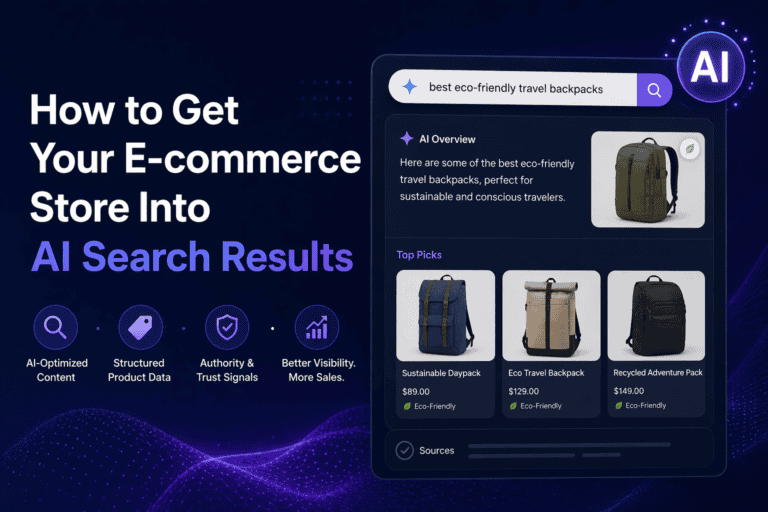
One in five Americans now use AI platforms to search for products while shopping. According to McKinsey’s AI commerce forecast, up to $750 billion in online sales is expected to flow through generative engines by 2028. Traditional search engine volume is predicted to drop 25% by 2026, replaced by traffic from AI-powered discovery tools like ChatGPT, Perplexity, and Google’s AI Overviews.
For e-commerce stores, this is not a distant trend to monitor. It is a shift happening right now that determines whether your products get recommended when a shopper asks an AI assistant what to buy.
This article covers what AI search actually looks at when deciding which e-commerce brands to cite, and the specific steps you can take to make sure your store shows up.
How AI Search Decides Which Products to Recommend
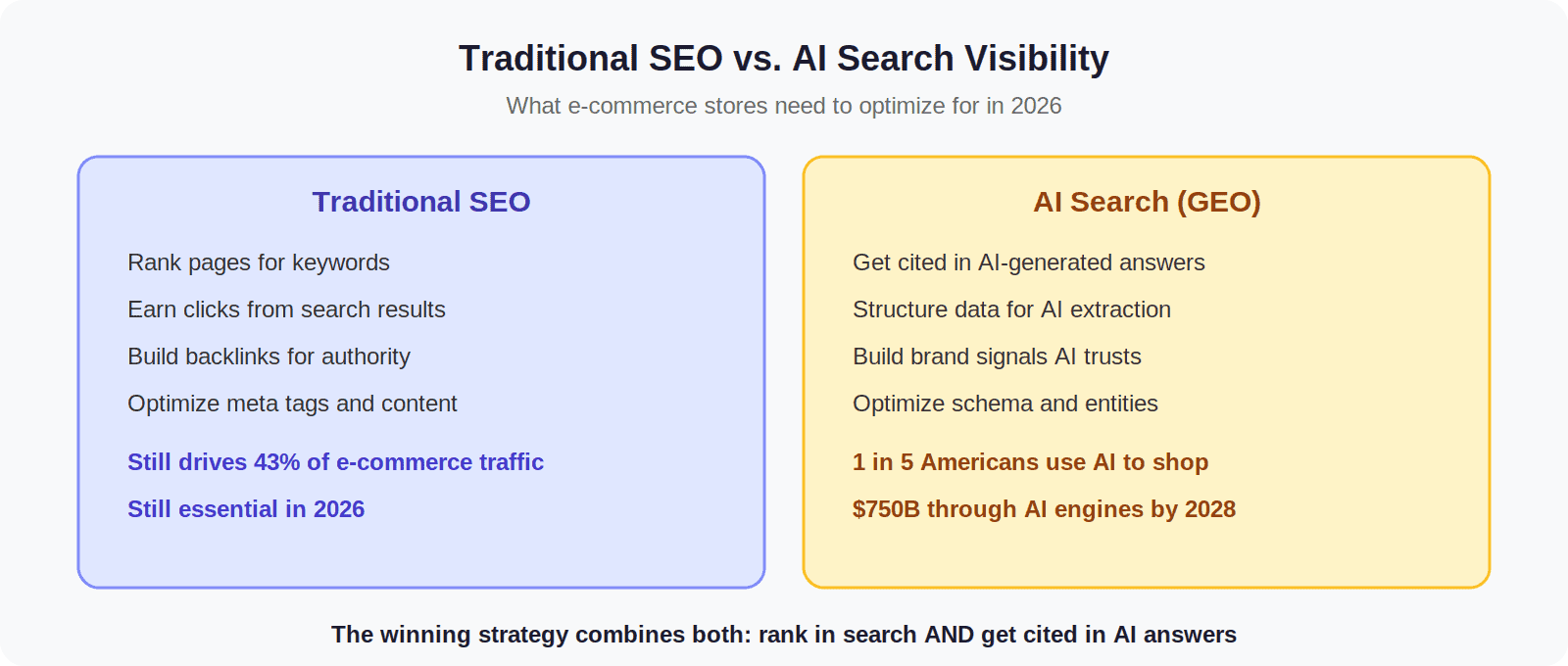
Traditional SEO and AI search visibility (GEO) serve different functions but the winning strategy combines both.
When someone asks ChatGPT “what are the best noise-canceling headphones under $300” or uses Google’s AI Overview for a product query, the AI does not rank pages the way traditional search does. It retrieves information from multiple sources, evaluates credibility, and assembles a synthesized answer. According to BigCommerce’s GEO research, generative engines favor pages with clear structure, rich schema markup, accurate product data, and visible sourcing. Pages that already surface as rich snippets in traditional search are more likely to be referenced in AI-generated summaries.
This means the foundational E-E-A-T and AEO principles are not just about Google’s traditional algorithm anymore. They are the same signals AI engines use to decide which brands are trustworthy enough to recommend.
Structured Data: The Language AI Actually Reads
According to Searchmetrics research, only 30% of websites implement structured data. For e-commerce, this gap is a massive competitive advantage for stores that do it right.
AI Overviews and generative engines pull product prices, availability, ratings, and specifications directly from schema markup. If your competitors have proper Product, Review, AggregateRating, and FAQ schema and you do not, the AI will cite them and skip you.
At minimum, every product page needs:
- Product schema with price, availability, SKU, and brand
- AggregateRating schema if you have customer reviews
- FAQ schema for question-and-answer content on the page
- Organization schema on your homepage with logo, contact info, and social profiles
Stores that fix their product page foundations with proper schema, original content, and reviews are the ones AI engines consistently reference.
Brand Signals: Why AI Recommends Some Stores and Ignores Others
The 2025 AI Visibility Report found that domain authority, backlink profiles, and brand mention frequency collectively account for approximately 35% of citation likelihood in AI responses. But the strongest single predictor is brand search volume, the number of people searching for your brand by name. Building that brand recognition through digital PR and link building directly increases your chances of being cited.
AI engines trust brands that other credible sources reference. A store mentioned in industry publications, cited in roundup articles, and reviewed on authoritative sites sends stronger trust signals than a store with a great website but zero external presence.
This is where traditional link building and AI visibility converge. The activities that earn backlinks for Google rankings (original research, digital PR, expert commentary) also build the brand authority that AI engines use to decide which stores to recommend.
Content That Gets Cited vs. Content That Gets Ignored
According to Ahrefs’ analysis of AI citation patterns, “best X” listicles account for 43.8% of all pages cited by ChatGPT. Pages above 20,000 characters average 10.18 AI citations versus 2.39 for shorter pages.
For e-commerce stores, the implication is that comprehensive buying guides, detailed product comparisons, and in-depth category content are far more likely to be cited by AI than thin product descriptions. As Search Engine Journal’s analysis of AI citation patterns confirms, structure this content with clear headings, specific claims backed by evidence, and clean formatting that AI can easily parse. Generative engines treat well-structured content as more extractable and therefore more citable.
Structure this content with clear headings, specific claims backed by evidence, and clean formatting that AI can easily parse. Generative engines treat well-structured content as more extractable and therefore more citable.
Reviews: The Trust Signal AI Values Most
Customer reviews serve triple duty in AI search. They add unique, keyword-rich content to your product pages. They provide social proof that influences the AI’s trust assessment. And they contain the kind of natural language and specific product feedback that AI engines use to generate detailed, helpful answers.
A product with 200 genuine reviews discussing fit, quality, durability, and comparison to alternatives gives the AI a wealth of real-world information to draw from. A product with zero reviews gives it nothing. Stores that optimize their conversion rate through review collection are simultaneously building the content that makes them visible in AI search.
The Practical Checklist
Getting your e-commerce store into AI search results is not a separate strategy from good SEO. It is an extension of it. The stores appearing in AI answers are the ones that already do the fundamentals well. Specifically:
- Implement Product, Review, FAQ, and Organization schema across your site
- Write comprehensive buying guides and comparison content that AI can cite
- Build brand authority through digital PR, backlinks, and mentions on credible sites
- Collect genuine customer reviews on every product page
- Keep product data accurate, complete, and consistently updated
If your store was built on the right platform, many of these elements can be implemented through native features or plugins. The technical barrier is low. The competitive advantage is high, because most stores have not started.

About the Author
Matija Konjić is the founder of Link Inbound, a link building and content marketing agency working with B2B and B2C brands. He has built campaigns across 40+ industries and obsesses over the data behind what actually moves rankings.