What is SEO (Search Engine Optimization)?
SEO (Search Engine Optimization) is the work you do to help your webpages show up in search results when people look for something you sell, solve, or explain.
Think of it as making your site easy to understand for two audiences at the same time: real visitors and search systems. A page with strong SEO matches a clear need, answers it well, loads fast, and is simple to crawl and index. It also earns signals of trust, like links and mentions from relevant sites.
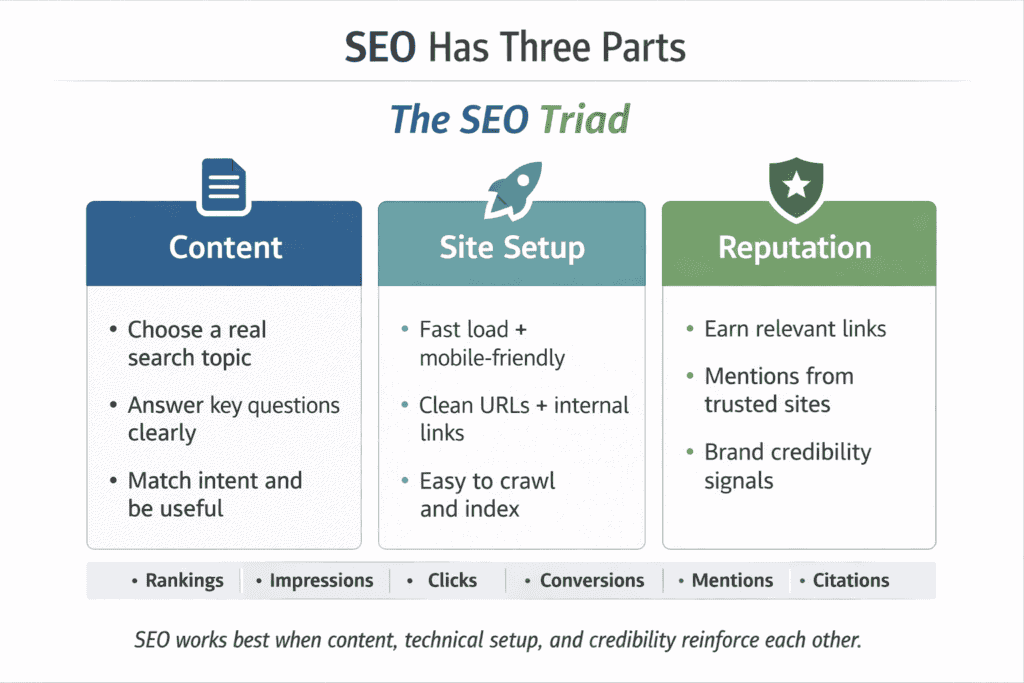
SEO usually includes three parts:
-
Content: choose a topic people search for, explain it clearly, and cover the key questions.
-
Site setup: make pages load quickly, work on mobile, and use clean URLs plus internal links.
-
Reputation: build credibility through helpful content that others reference and share.
Example: if you sell “stainless steel water bottles,” SEO is creating a category page that explains sizes and features, adding clear product info, and writing a guide that answers “which bottle keeps water cold longest,” then linking it back to the products.
What is AEO?
AEO (Answer Engine Optimization) is the work you do to help your content get selected as the direct answer when someone asks a question in search, voice assistants, or AI tools.
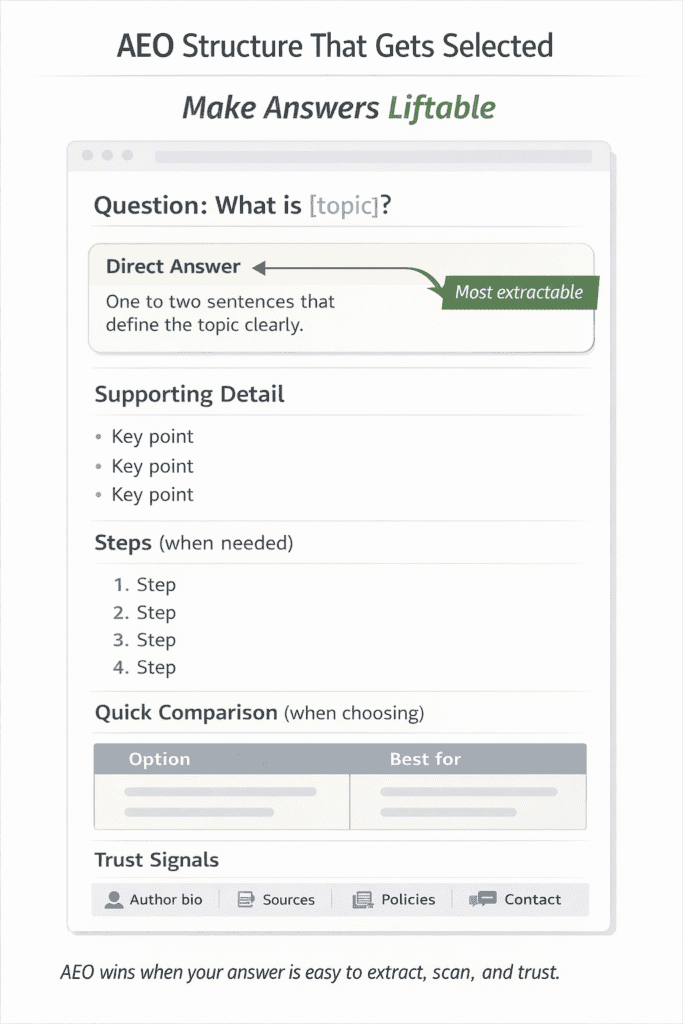
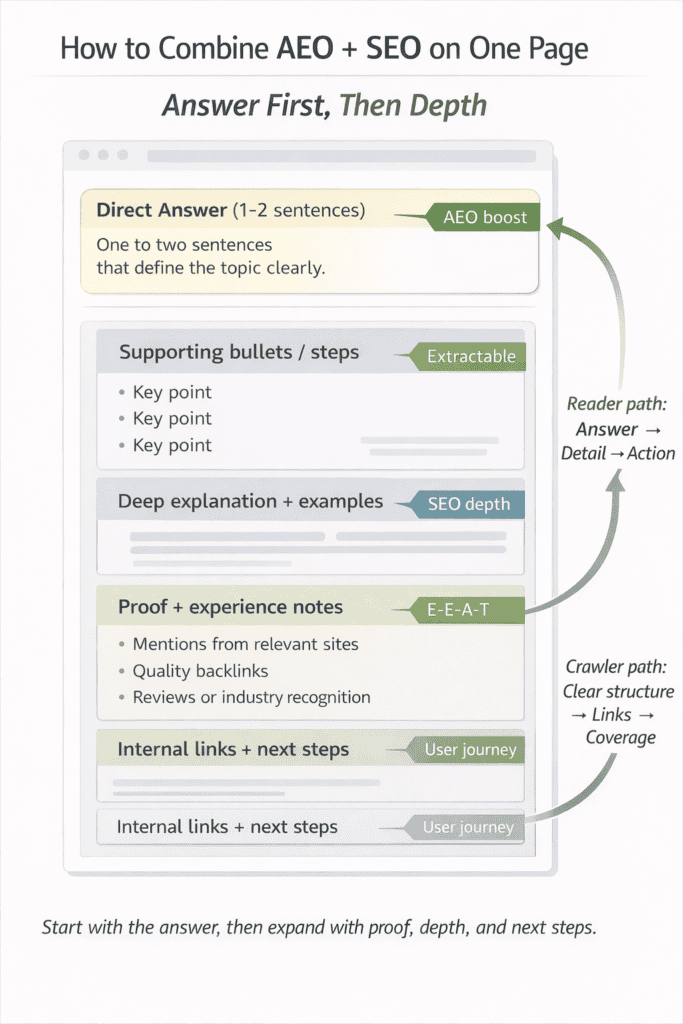
Instead of only competing for clicks, AEO competes for clarity. The goal is to make it easy for a system to extract the best response from your page, with the least confusion. That usually means writing in a clean “question → best answer → supporting detail” structure, using simple language, and keeping your definitions, steps, and comparisons easy to scan.
Strong AEO content typically includes:
-
A short definition near the top (one or two sentences)
-
Clear subheadings that match real questions people ask
-
Step-by-step instructions when the user wants a process
-
Tables or quick comparisons when the user wants to choose
-
Trust signals like sources, author details, and updated policies when relevant
Example: if you publish a page on “how to choose running shoes,” AEO would include a direct checklist, a quick sizing guide, and common mistakes so the answer can be lifted cleanly into an answer box or assistant response.
What is E-E-A-T?
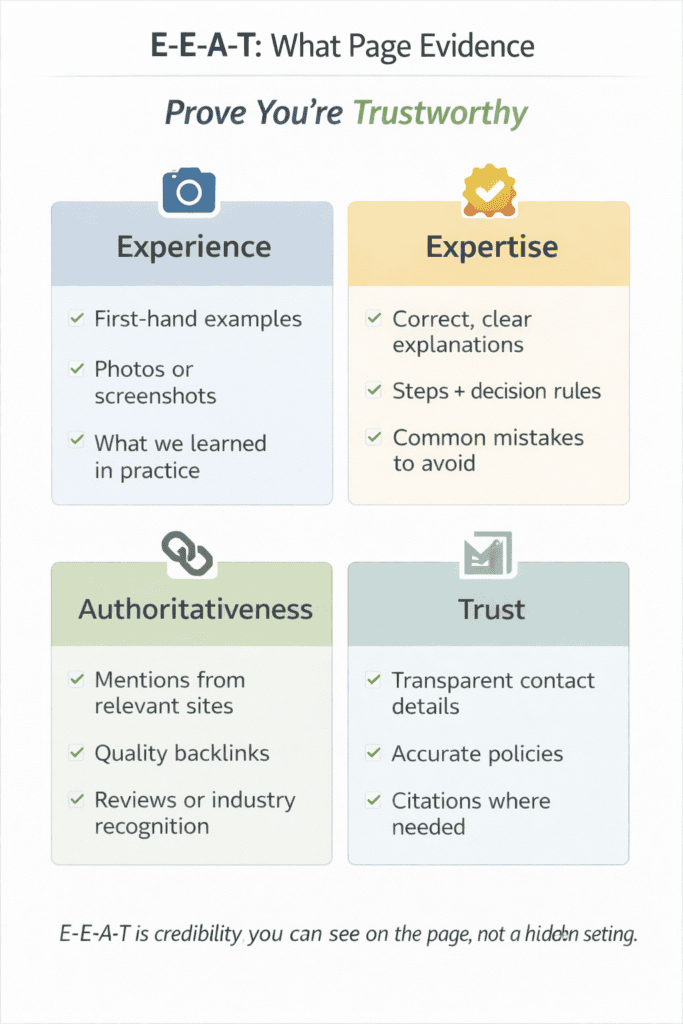
E-E-A-T stands for Experience, Expertise, Authoritativeness, and Trust. It’s a way to think about why a page deserves to be shown to people especially when the topic affects money, health, safety, or major life decisions.
E-E-A-T is not a single “ranking factor” you switch on. It’s the evidence your site provides that the content is accurate, created by someone who knows the topic, and backed by a real, accountable business or author.
Here’s what each part means on a webpage:
-
Experience: you show first-hand use, real examples, screenshots, photos, or specific lessons learned.
-
Expertise: the content is correct, well explained, and goes beyond surface-level tips.
-
Authoritativeness: your brand or author is recognized through mentions, links, reviews, or industry credibility.
-
Trust: the site is transparent and safe clear contact details, policies, citations where needed, and no misleading claims.
A simple rule: if a reader asked “Why should I believe you?” E-E-A-T is what your page uses to answer that question without hype.
What is the difference between SEO and AEO?
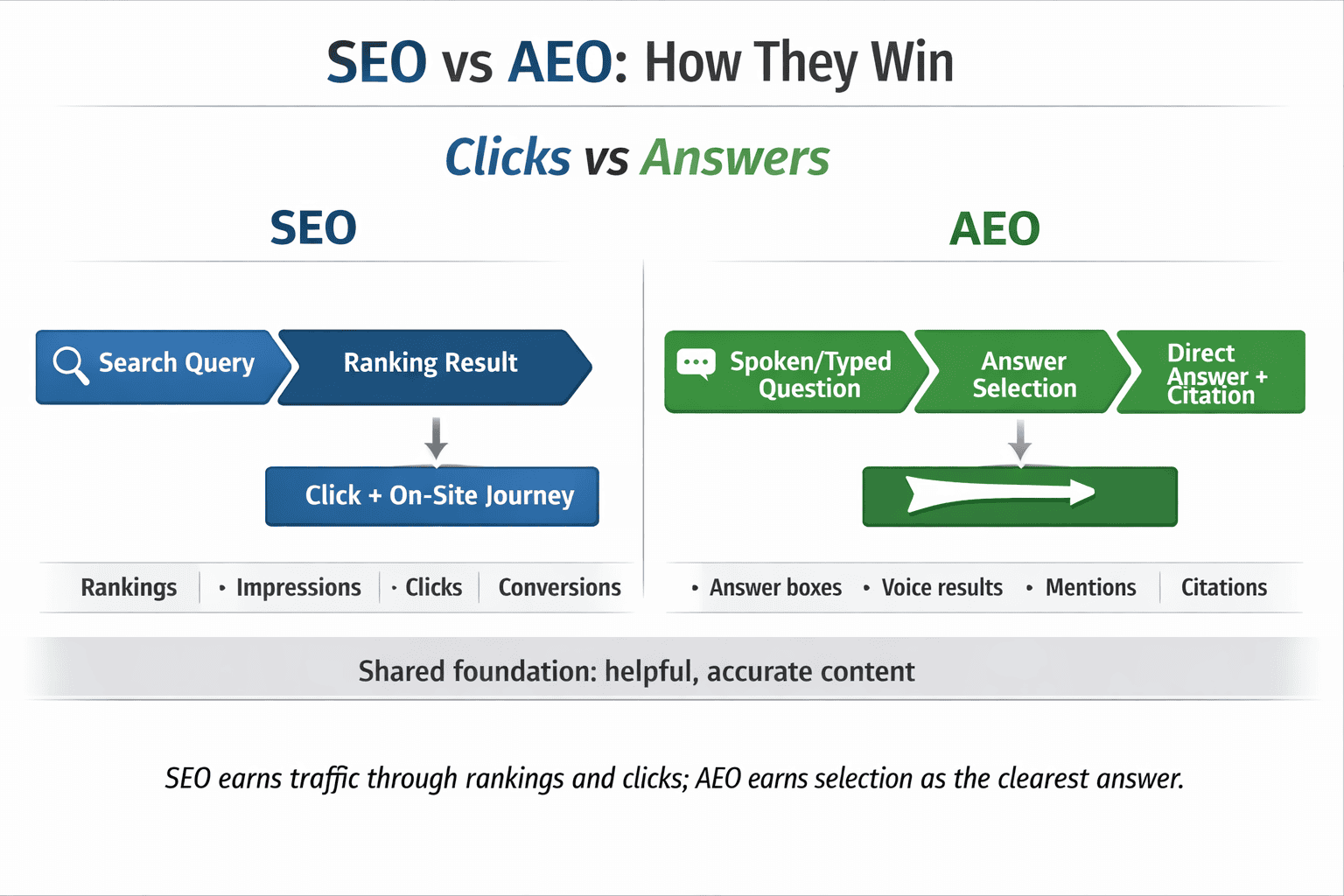
SEO and AEO both aim to make your content visible when people search, but they win in different ways.
SEO (Search Engine Optimization) is focused on earning traffic. You optimize pages to rank well for keywords, attract clicks, and guide visitors toward the next step (read more, sign up, buy). Success is often measured by rankings, impressions, clicks, and conversions.
AEO (Answer Engine Optimization) is focused on earning the answer. You optimize content so a search result, voice assistant, or AI tool can pull a clear response directly from your page. Success is often measured by visibility in answer boxes, “People also ask,” voice results, and citations or mentions inside AI-generated answers.
The biggest practical differences come down to format and intent:
-
SEO content can be broader and built to keep a reader exploring (supporting sections, internal links, deeper examples).
-
AEO content must be extractable, with definitions, steps, and short summaries written in a way that can stand alone.
-
SEO wins clicks by matching intent and proving relevance.
-
AEO wins selection by being the clearest, most complete answer in the fastest format.
In real terms, the best pages do both: they lead with a direct answer (AEO), then expand with detail, proof, and next steps (SEO).
What is the best way to apply E-E-A-T to SEO and AEO content?
The best way to apply E-E-A-T to SEO and AEO content is to treat it like page evidence, not “extra words.” Your goal is to make your answer easy to trust and easy to verify.
Start with the content itself:
-
Lead with the best answer first. Put a clear definition or summary near the top (this supports AEO), then expand with supporting detail (this supports SEO).
-
Add experience proof. Use real examples, screenshots, short case notes, before/after results, or “what we saw in practice” statements. Avoid vague claims.
-
Show expertise through specificity. Give steps, thresholds, decision rules, and common mistakes. If you recommend something, explain when it does not apply.
-
Build author signals. Use a visible author name, a short bio, and “why you can trust this” details (years in the field, role, relevant work). For businesses, add an About page and real contact details.
-
Protect trust on every page. Keep pricing, policies, disclaimers, and dates accurate. Fix broken links, remove outdated advice, and cite sources when you reference facts or stats.
Then make it easy for “answer engines” to lift your content cleanly:
-
Write question-matching subheads (the exact phrases people ask).
-
Use short paragraphs, bullets, and step lists.
-
Include simple comparisons and definitions that can stand alone.
-
Add structured data only where it genuinely matches the page (don’t spam FAQ).
A good rule: if the page lost its logo, would it still look credible? If the answer is yes, you’ve applied E-E-A-T in a way that strengthens both SEO (rank + clicks) and AEO (selection + citations).
What is the best way to measure success for SEO, AEO, and E-E-A-T?
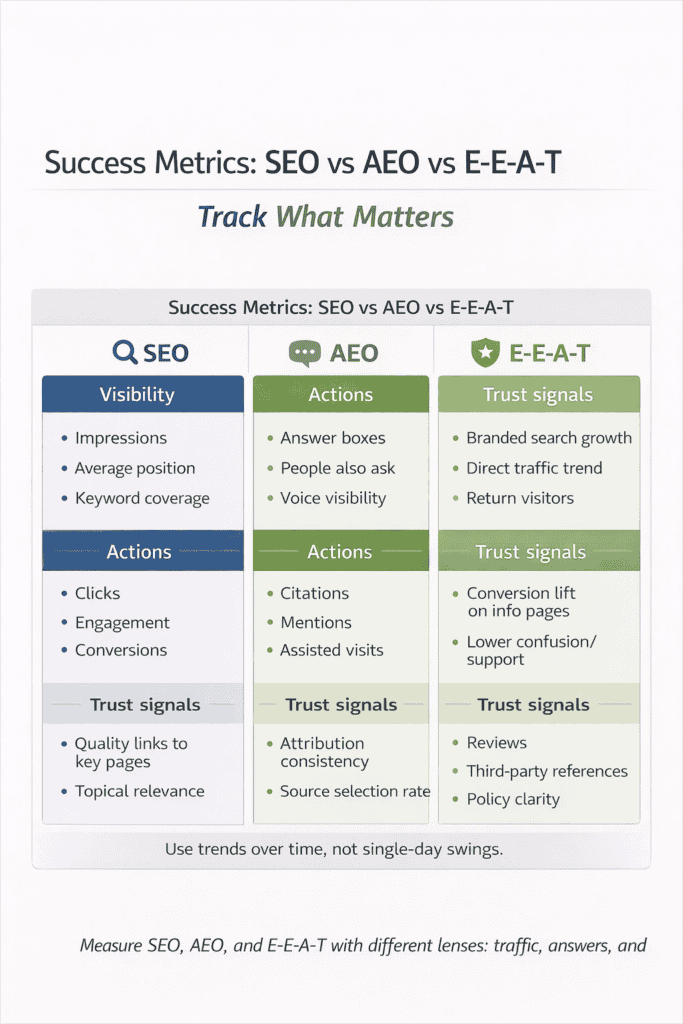
The best way to measure success for SEO, AEO, and E-E-A-T is to track three different outcomes: visibility, actions, and trust. They overlap, but they are not the same.
For SEO, measure whether you are earning qualified traffic and turning it into results:
-
Search visibility: impressions and average position for your target queries (Google Search Console).
-
Traffic quality: clicks, landing page engagement, and assisted conversions (GA4).
-
Business impact: leads, sales, sign-ups, and revenue tied to organic landing pages.
For AEO, measure whether your content is being chosen as the direct answer:
-
SERP features: featured snippets, “People also ask,” and other answer-style placements (Search Console + rank tracking).
-
Question coverage: growth in impressions for “how/what/why” queries and long-tail questions.
-
Citations and mentions: where your brand or pages are referenced as the source inside AI answers (track manually at first, then with monitoring tools).
For E-E-A-T, you don’t measure it with one number. You measure trust signals that correlate with it:
-
Brand demand: growth in branded searches and direct traffic.
-
Reputation signals: high-quality links/mentions, reviews, and third-party references.
-
On-page trust: stronger conversion rates on informational pages, fewer bounces on “money pages,” and fewer support questions caused by unclear or misleading content.
A simple operating rule: SEO = clicks and conversions, AEO = answer visibility, E-E-A-T = trust that lifts both.Track monthly trends, not single-day changes, and tie every report back to outcomes your business actually cares about.