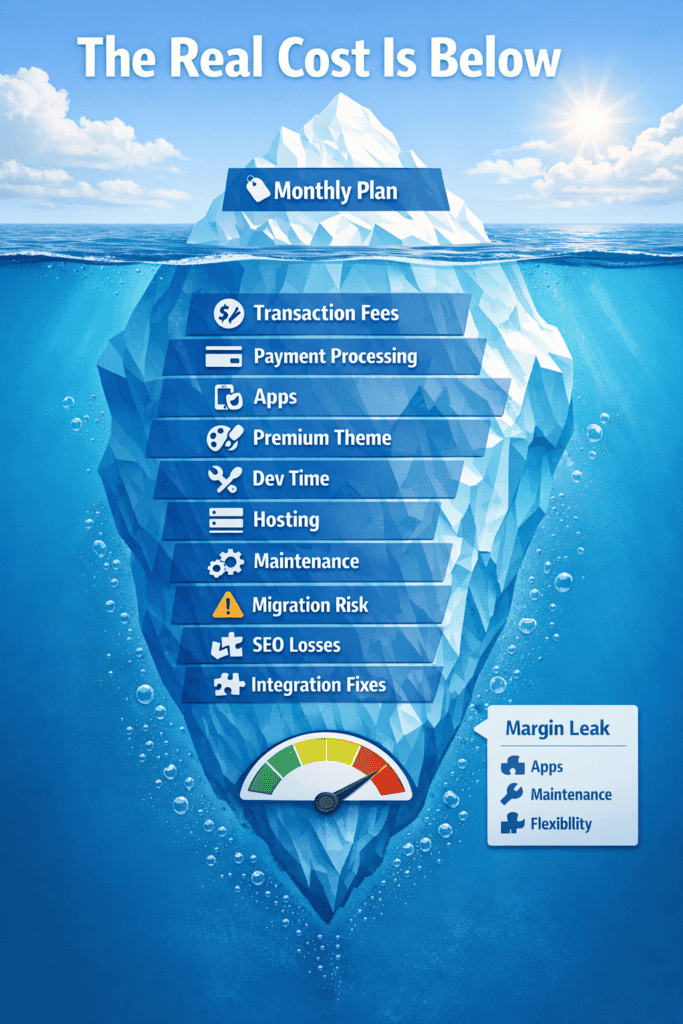
Picking the wrong ecommerce platform costs more than the monthly fee. It shows up in transaction charges that eat margins, migrations that break SEO rankings, and integrations that never quite work whether you’re running a custom-built store or relying on a WordPress plugin like WooCommerce to handle the heavy lifting.
In this guide we compare the 10 best ecommerce platforms for 2026, we break down true costs at different revenue levels, and match each platform to specific business types so you can choose based on real operational tradeoffs rather than marketing claims. From dedicated ecommerce solutions to WordPress-powered storefronts, every major option is covered.
What Is an Ecommerce Platform
An ecommerce platform is software for building, managing, and scaling an online store. It handles product catalogs, payments, and customer experience from one central dashboard. A candle maker, for example, lists 50 products on Shopify, accepts credit card payments, and prints shipping labels without switching between tools. One system. Everything connected.
Here’s what an ecommerce platform typically manages:
- Product catalog: where you add items, descriptions, images, and pricing
- Shopping cart: tracks what customers select during their browsing session
- Checkout and payments: collects payment information and processes transactions securely
- Order management: tracks purchases from payment through delivery
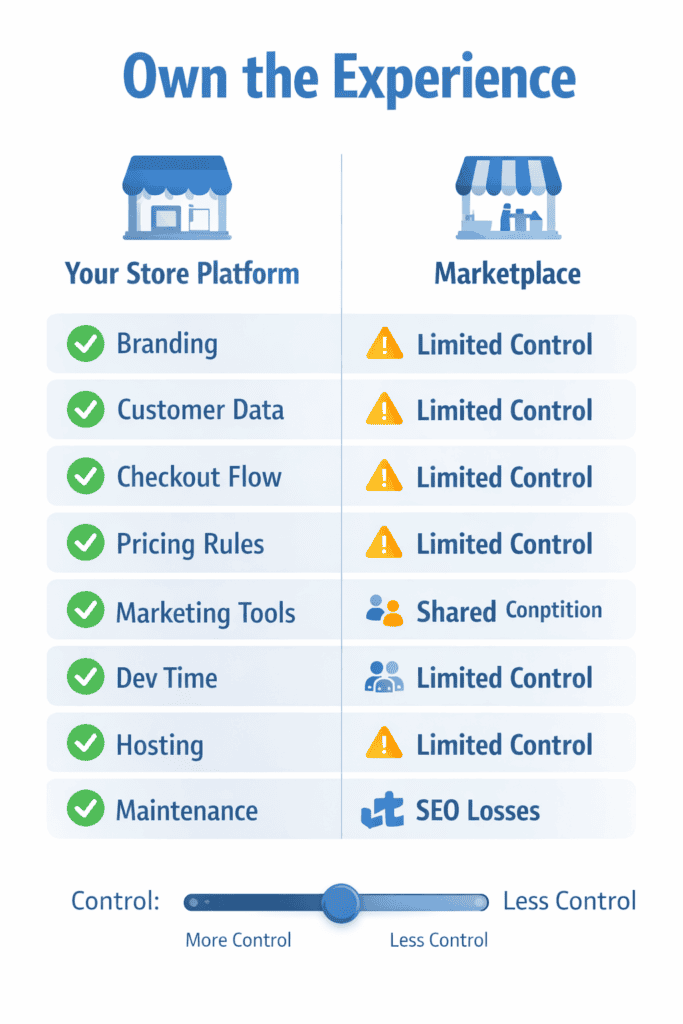
Worth noting: an ecommerce platform differs from a marketplace like Amazon or eBay. On your own platform, you control branding, customer data, and the entire shopping experience. On a marketplace, you’re one seller among thousands, competing on someone else’s site.
Types of E-commerce Platforms
The type of platform you choose affects how much control you have, what technical skills you’ll bring to the table, and where your monthly costs land.
SaaS Ecommerce Platforms
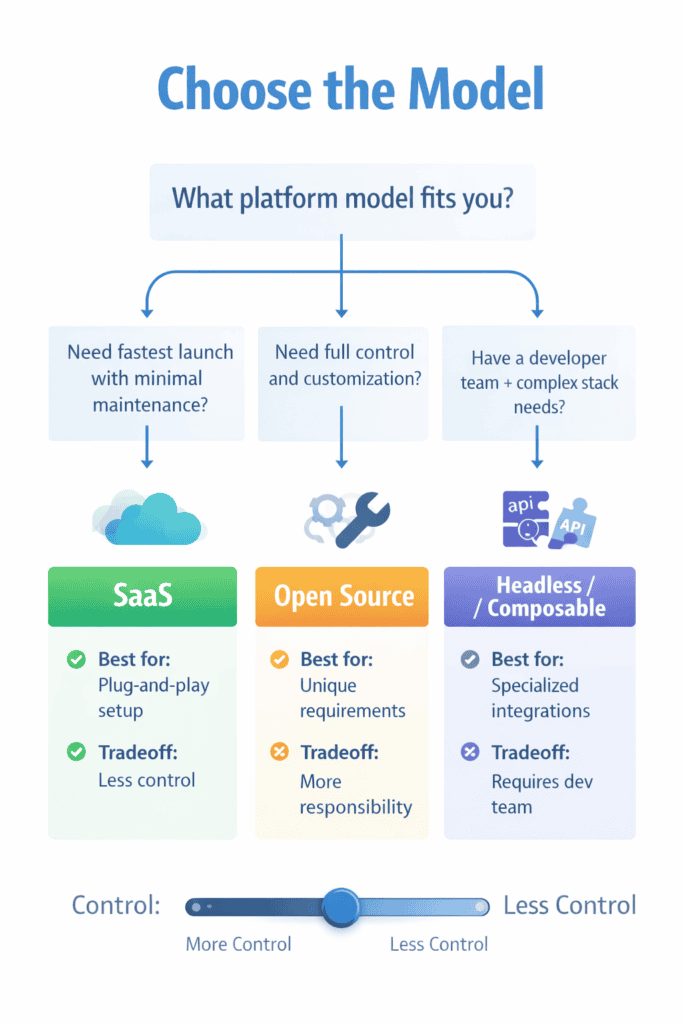
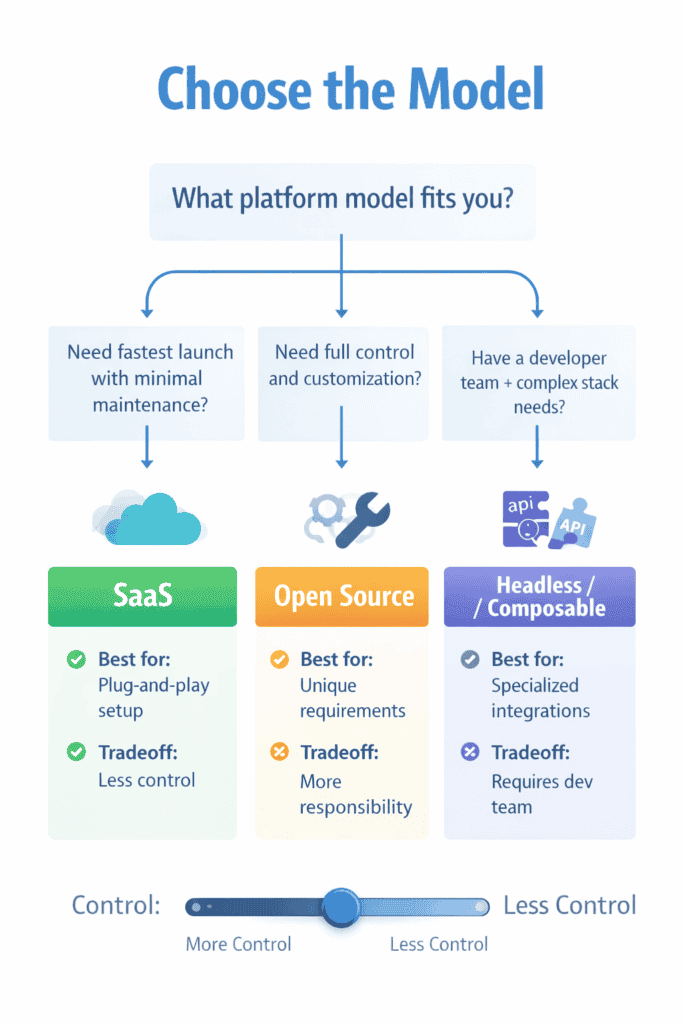
SaaS stands for Software-as-a-Service. The ecommerce provider hosts everything on their servers and handles security updates, backups, and technical maintenance. Shopify, BigCommerce, and Wix operate this way.
The tradeoff is straightforward: easier setup, less control. You pay monthly fees, and the platform manages infrastructure. For operators who want to sell products rather than manage servers, SaaS removes significant technical burden.
Open Source Ecommerce Platforms
Open source means free software you download and host yourself. WooCommerce, PrestaShop, and Magento Open Source fall into this category.
A WordPress blogger adding WooCommerce to sell digital downloads pays nothing for the plugin itself. However, hosting runs around $20/month, and security updates become the blogger’s responsibility. Full customization control comes with full responsibility.
Headless and Composable E-commerce platform
Headless architecture separates the front-end (what customers see) from the back-end commerce engine. Composable commerce takes this further, letting you mix-and-match specialized tools via APIs.
This approach typically suits larger businesses with developer teams. For most sellers under $1M in annual revenue, headless adds complexity without proportional benefit.
Which Ecommerce Platform Is Best for Beginners?
Beginners usually do best with a platform that is quick to set up, has predictable costs, and does not need technical work to keep running. For most people starting out, that means a hosted platform such as Shopify, Wix or Squarespace: hosting, security and updates are handled for you, and setup guides walk you through adding products and taking payments. The trade-off is a monthly fee and paid apps, which add up over time.
Self-hosted platforms such as WooCommerce, PrestaShop or OpenCart have no platform fee, but you pay for hosting and take on installation, updates, security and backups yourself, or pay someone to. They suit beginners who are comfortable with technical tasks or already have a developer. Whichever route you choose, work out your first-year costs in full (plan or hosting, apps or extensions, themes, payment fees and your own time) before committing.
How to Choose the Best Ecommerce Platform for Your Business
Picking a platform involves weighing several factors against your specific situation. What works for a jewelry maker selling 50 items won’t suit a wholesaler with 10,000 SKUs.
Pricing and Total Cost of Ownership
Monthly subscription fees are just the starting point. Apps, premium themes, and transaction fees add up quickly.
A “free” platform like WooCommerce still requires hosting, SSL certificates, and paid plugins for essential features. Before committing, calculate what you’ll actually pay at your expected sales volume.
Ease of Use and Time to Launch
How quickly can someone without coding experience get a store live? Drag-and-drop builders differ dramatically from platforms requiring developer involvement.
A jewelry seller launched on Squarespace in one weekend using templates. That same seller on Magento would likely require a developer and roughly three months. Speed to market matters when you’re testing a product idea.
Scalability for Growing Businesses
A platform handling 10 orders daily might struggle at 500. Page load speed, checkout capacity, and inventory sync often break at scale.
Sellers typically outgrow starter platforms around $250K-$500K in annual revenue. Knowing the upgrade path before you start saves painful migrations later.
Payment Processing and Transaction Fees
Transaction fees are percentages taken per sale beyond what your payment processor charges. Some platforms, like Shopify, charge additional fees if you don’t use their native payment system.
On $10,000 monthly revenue, a 2% transaction fee costs $200/month. That’s $2,400 annually, which directly affects your margins.
Multichannel and Marketplace Integration
Selling on Amazon, eBay, Walmart, Facebook, and your own site simultaneously requires inventory sync. Without it, you risk overselling products you don’t have.
Strong multichannel integration means one dashboard controls inventory across all channels. No manual updates. No spreadsheet reconciliation.
SEO and Marketing Tools
Built-in SEO features like custom URLs, meta tags, sitemaps, and blog functionality drive organic traffic over time. Email marketing integrations and abandoned cart recovery directly impact revenue.
A store recovering even 10% of abandoned carts at $80 average order value sees meaningful revenue gains without additional ad spend.
App Ecosystem and Third Party Integrations
No platform does everything natively. Apps fill gaps for shipping, accounting, reviews, and email marketing.
Consider availability, cost, and whether critical tools integrate smoothly. Heavy app dependency can push monthly costs from $79 to $300+ quickly.
Customer Support and Documentation
Support quality varies dramatically across platforms. Some offer 24/7 chat while others provide email-only or community forums.
When checkout breaks at 2am on a Saturday, response time matters. Some platforms reserve better support for higher pricing tiers, so know what you’re getting before problems arise.
True Cost of Ecommerce Platforms Including Fees and Apps
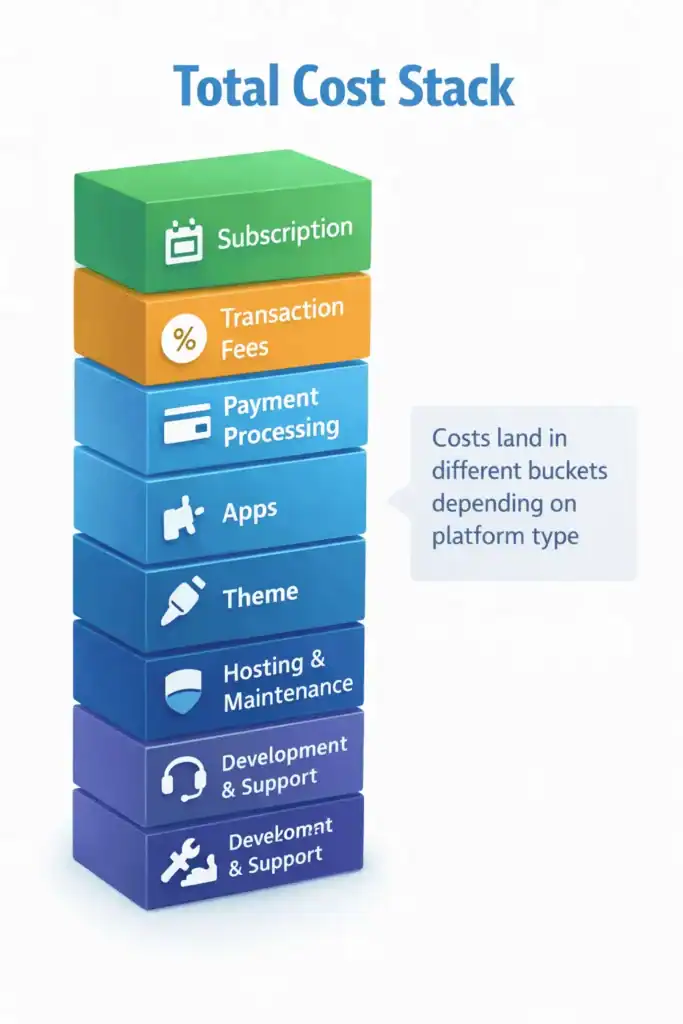
Advertised pricing rarely tells the full story. Understanding total cost requires looking at subscriptions, transaction fees, themes, and apps together.
Monthly Subscription Pricing
| Platform | Starter Plan | Mid-Tier Plan | Enterprise |
|---|---|---|---|
| Shopify | $39/mo | $105/mo | $399/mo+ |
| BigCommerce | $39/mo | $105/mo | Custom |
| Wix | $29/mo | $49/mo | $159/mo |
| Squarespace | $33/mo | $65/mo | N/A |
| Square Online | Free | $29/mo | $79/mo |
Advertised prices often require annual commitment. Monthly billing typically costs 20-30% more.
Transaction Fees and Payment Processing
Payment processor fees (Stripe, PayPal) run around 2.9% + $0.30 per transaction regardless of platform. Platform transaction fees stack on top.
BigCommerce charges zero platform transaction fees. Shopify waives its fees only if you use Shopify Payments. WooCommerce charges nothing beyond your processor.
Theme and App Costs
Free themes exist, but premium themes run $150-$350 one-time. Apps range from free to $50+/month each.
A typical store runs 5-10 apps. Seven apps averaging $20/month adds $140 monthly on top of your platform fee.
Total Platform Cost at Different Revenue Levels
| Annual Revenue | Shopify Basic (est.) | BigCommerce (est.) | WooCommerce (est.) |
|---|---|---|---|
| $50,000 | $150/mo | $120/mo | $80/mo |
| $250,000 | $350/mo | $280/mo | $150/mo |
| $1,000,000 | $800/mo | $500/mo | $300/mo |
Estimates include typical app costs and transaction fees. WooCommerce costs assume managed hosting and essential plugins.
Ecommerce Platform vs Ecommerce Hosting
SaaS platforms include hosting in your subscription. Shopify manages the servers. Open source platforms require separate hosting purchases.
- SaaS platforms (Shopify, BigCommerce): hosting included, platform manages servers
- Open source (WooCommerce, Magento): you arrange and pay for hosting separately
- Managed WooCommerce hosting: specialized hosts handle WordPress optimization for $30-$100/month
WooCommerce being “free” while Shopify is “paid” obscures the real comparison. Both cost money. The costs just land in different buckets.
10 Best Ecommerce Platforms Compared
The e-commerce industry has never been more competitive or more full of opportunity. Global online retail sales are projected to surpass $8 trillion by 2027, and for entrepreneurs, small businesses, and enterprise brands alike, choosing the right e-commerce platform to power your store is one of the most critical decisions you’ll make. Whether you’re searching for the top ecommerce solution for a startup or an enterprise-grade system to scale an existing operation, the stakes have never been higher.
But with dozens of options on the market, the choice isn’t always straightforward. Should you go with a hosted solution that handles the technical heavy lifting, or an open-source platform that gives you full control? Do you need a simple storefront, or a feature-rich system capable of managing thousands of SKUs across multiple regions? With so many top e-commerce contenders competing for your attention, the answer depends entirely on your business goals, technical resources, and budget.
To cut through the noise, we’ve done the research for you. In this article, we break down the 10 best e-commerce platforms available today evaluating each on ease of use, standout features, customisation, scalability, pricing, and overall value. Standout features are what truly separate good platforms from great ones, and you’ll find we pay close attention to what makes each solution uniquely powerful. Whether you’re launching your very first online store or looking to migrate to a more capable e-commerce platform, this guide will help you find the right fit.
From industry giants like Shopify and WooCommerce to powerful open-source contenders like OpenCart and Magento, the top ecommerce platforms cover a wide spectrum of needs, budgets, and technical requirements. No matter your niche, there’s a top e-commerce solution built for you. Let’s dive in.
Here’s a compact table of all 10 platforms from that page:
| # | Platform | Type | Best For | Starting Price |
|---|---|---|---|---|
| 1 | Shopify | SaaS | Beginners to mid-size businesses | $39/mo |
| 2 | BigCommerce | SaaS | Scaling businesses & B2B | $39/mo |
| 3 | WooCommerce | Open Source | WordPress users, budget-conscious | Free (+ hosting) |
| 4 | Opencart | Open Source | Worldwide merchants, Medium and Large Businesses | Free |
| 5 | Wix eCommerce | SaaS | Small businesses, design-focused | $29/mo |
| 6 | Squarespace Commerce | SaaS | Creatives, brands prioritising aesthetics | $33/mo |
| 7 | Ecwid | SaaS | Adding a store to an existing website | Free tier |
| 8 | Adobe Commerce / Magento | Open Source / Enterprise | Large businesses with developer teams | Free / Custom |
| 9 | Shift4Shop | SaaS | US-based sellers wanting no monthly fees | Free (with Shift4 payments) |
| 10 | PrestaShop | Open Source | European merchants | Free (+ hosting) |
Shopify
The most popular SaaS ecommerce platform globally, powering millions of stores. Best for beginners to mid-size businesses wanting fast setup with room to grow.
Strengths include an enormous app ecosystem, intuitive interface, and 24/7 support. Limitations: transaction fees apply unless you use Shopify Payments, and costs grow substantially as you add apps.
BigCommerce
A SaaS platform built for growth and B2B selling. Best for scaling businesses and high-volume sellers who want built-in features without app dependency.
No transaction fees regardless of payment processor. Strong multichannel capabilities. The learning curve runs steeper than Shopify, and theme selection is more limited.
WooCommerce
A free open source plugin for WordPress powering over 5 million stores. Best for WordPress users, budget-conscious operators, and those wanting full control.
Unlimited customization with no transaction fees. However, you’re responsible for hosting, security, and updates. Technical comfort required.
Opencart
OpenCart is a free, open-source ecommerce platform that gives merchants full control over their online store without any monthly subscription fees. It features a clean admin dashboard, supports multiple stores from a single backend, and has a marketplace of over 13,000 extensions and themes to extend its functionality.
OpenCart is particularly popular with small to medium-sized businesses, electronics retailers, fashion brands, and niche product stores that want a lightweight, self-hosted solution without the overhead of larger platforms like Magento. It’s also widely used by entrepreneurs and startups in Asia, Europe, and the Middle East, where it has a strong developer community. Best of all, OpenCart is completely free to download and use you only need to budget for web hosting and any premium extensions you choose to add.
Wix eCommerce
A website builder with ecommerce capabilities. Best for small businesses prioritizing design flexibility and beginners wanting all-in-one simplicity.
Drag-and-drop design with attractive templates. Less scalable for high-volume stores and limited B2B features.
Squarespace Commerce
Design-focused website builder with ecommerce. Best for brands prioritizing aesthetics, creatives, and service providers selling products.
Stunning templates and strong branding tools. Fewer integrations and less suited for large catalogs or complex operations.
Ecwid
Embeddable ecommerce that adds to existing websites. Best for businesses with established sites who want shopping functionality without rebuilding.
Add a store to any website, Facebook, or Instagram. Affordable entry with a free tier. Dependent on host site capabilities.
Adobe Commerce and Magento
Enterprise-grade platform with extreme customization potential. Best for large businesses with developer resources and complex B2B requirements.
Handles massive catalogs and traffic. Magento Open Source is free; Adobe Commerce Cloud runs into six figures annually. Implementation takes months, not days.
Shift4Shop
SaaS platform with a free plan for US merchants using Shift4 payments. Best for US-based sellers wanting zero monthly platform fees.
Built-in features without subscription costs if you commit to their payment processing. Interface feels less modern than competitors.
PrestaShop
Open source platform popular in Europe. Best for European merchants wanting open source without WordPress dependency.
Free core software with strong EU compliance features. Requires hosting and technical setup. Paid modules add up for essential functionality.
Best Ecommerce Platform for Each Business Type
Best Ecommerce Platform for Beginners
Shopify or Wix offer the fastest path from zero to selling. Templates handle design decisions, and support resources are extensive.
Squarespace works well if visual presentation matters most. Beginners benefit from quick wins and available help rather than maximum flexibility.
Best Ecommerce Platform for Small Business
The answer depends on priorities. Shopify balances simplicity with growth potential. BigCommerce offers more built-in features and no transaction fees. WooCommerce provides budget control for WordPress-comfortable teams.
Best Ecommerce Platform for Dropshipping
Shopify dominates due to app integrations like DSers and Spocket that automate supplier connections. WooCommerce with AliDropship offers a budget alternative.
The key requirement: seamless supplier integration and automated order forwarding to vendors.
Best Ecommerce Platform for B2B and Wholesale
BigCommerce includes native B2B features. Adobe Commerce handles complex pricing and catalogs. Shopify Plus serves enterprise B2B operations.
B2B operations require customer-specific pricing, quote requests, purchase orders, and net payment terms, which are features missing from basic plans.
Best Ecommerce Platform for Service Based Businesses
Square Online integrates appointments with product sales. Squarespace combines portfolios, booking, and shopping. Wix offers service business templates.
Service providers typically benefit from scheduling integrated with any physical product sales.
Best Free Ecommerce Platform
“Free” means no monthly platform fee. Other costs still exist. Square Online’s free tier, Ecwid’s free plan, and Shift4Shop (with Shift4 Payments) offer zero-subscription options.
WooCommerce is free software but requires paid hosting. Free tiers typically limit features, products, or transaction volumes.
How to Migrate Between Ecommerce Platforms
Platform migrations happen when you’ve outgrown your current solution or costs have become unsustainable. A structured approach prevents lost data and SEO damage.
1. Audit Your Current Store Data and Integrations
Document everything that requires migrating: products, images, customer data, order history, reviews, and URL structures. List current integrations like payment processors, shipping software, and email marketing tools.
Some data won’t transfer automatically. Knowing gaps upfront prevents surprises.
2. Select Your Migration Approach
Options range from manual export/import (cheapest, slowest) to migration apps like Cart2Cart (faster, moderate cost) to developer assistance (expensive, handles complexity).
A 50-product store can migrate manually in a weekend. A 5,000-SKU catalog with custom integrations likely requires professional help.
3. Configure Your New Platform
Set up the new platform completely before switching: payment processing, shipping zones, tax settings, email notifications. Test checkout with real transactions by processing an order and refunding yourself.
4. Transfer Products and Customer Information
Use CSV exports/imports or migration tools. Verify images transferred correctly. Check product variants, pricing, and inventory counts.
Customer passwords typically don’t migrate. Plan for a password reset flow and communicate the change to existing customers.
5. Implement Redirects and Complete Testing
Critical for SEO: implement 301 redirects from old URLs to new URLs. Without redirects, search rankings built over months or years can disappear.
Test all pages, checkout flow, and email triggers before going live. Schedule cutover during low-traffic periods.
Choosing the Right Platform for Long Term Ecommerce Success
Platform selection matters, but execution matters more. The best platform poorly implemented loses to an adequate platform run well.
Evaluate total cost of ownership rather than just monthly fees. Consider where you’ll be in two years, not just today. A platform matching current requirements with a clear upgrade path prevents painful migrations later.
FAQs About Ecommerce Platforms
What is the difference between an ecommerce platform and a marketplace?
An ecommerce platform is software for building your own branded online store, while a marketplace like Amazon is a third-party site where you list products alongside competitors. You control branding and customer relationships on your platform; marketplaces control the customer experience.
Can I switch ecommerce platforms without losing SEO rankings?
Yes, with proper 301 redirects from old URLs to new URLs implemented before switching. Without redirects, rankings and traffic built over time can disappear within weeks.
Which ecommerce platform has the lowest transaction fees?
BigCommerce and WooCommerce charge zero platform transaction fees. You only pay your payment processor. Shopify waives its transaction fees only when using Shopify Payments.
Do I need separate web hosting for my online store?
SaaS platforms like Shopify and BigCommerce include hosting in your subscription. Open source platforms like WooCommerce require purchasing and managing hosting separately.
Which ecommerce platform integrates best with Amazon and eBay?
BigCommerce offers strong native multichannel integration with Amazon, eBay, and Walmart. Shopify requires third-party apps for similar marketplace connections.
What is the best ecommerce platform for international selling?
Shopify and BigCommerce both support multi-currency, multiple languages, and international payment gateways. Platform availability in target countries and local payment method support vary by region.
How long does it take to launch an online store on an ecommerce platform?
A simple store on Shopify or Wix can launch in a few days using templates. Complex stores with custom designs, large catalogs, or integrations typically require several weeks to months.
Keep reading: see our full guide to best ecommerce sites, or read about best ecommerce platform for small business and best platform for digital products.