What International Shipping Really Includes
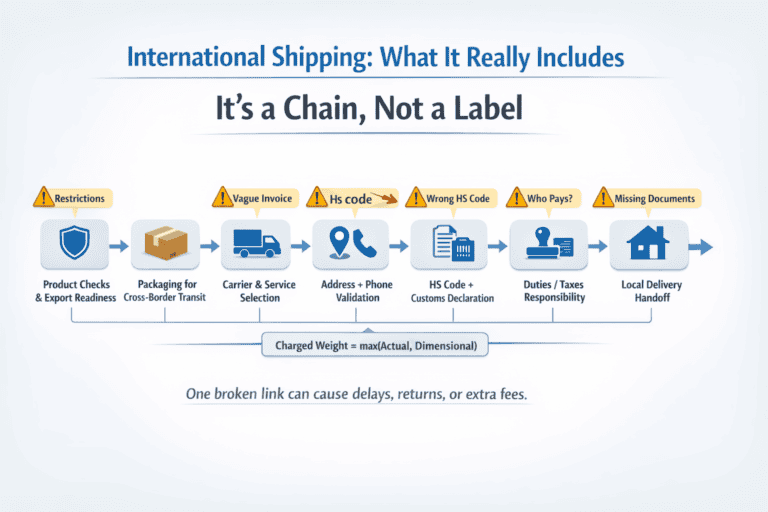
International shipping is not just “sending a box overseas from the United States or any other country.” It is a chain of steps, people, form documents, information and rules that start before you print a label and end only when the buyer can actually receive the parcel.
If one link breaks, the shipment can get delayed, returned, or hit with surprise fees. Knowing what is inside the process helps you price correctly, set the right delivery promise, and avoid customs problems.
Here’s what international shipping normally includes.
- Product checks and export readiness
- Before anything moves, you need to confirm the item can legally ship to the destination. Some goods need permits, testing reports, or special handling. Batteries, liquids, food, cosmetics, and branded items often fall into extra rules.
- Packaging for cross-border transit
- International routes involve more handling points: hubs, airlines, trucks, and local delivery partners. This usually means stronger outer cartons, better void fill, and clear labels. Poor packaging is one of the fastest ways to turn a sale into a claim.
- Carrier selection and service level
- You choose between postal networks, express couriers, freight forwarders, or a mix. The “best” option depends on weight, value, delivery speed, tracking needs, and how strict the destination is on customs paperwork.
- Address, phone, and contact details
- Many countries require a phone number for delivery. Some carriers also reject addresses that do not match local formats. A correct address can be the difference between a smooth handoff and a return.
- Export documents and shipment data
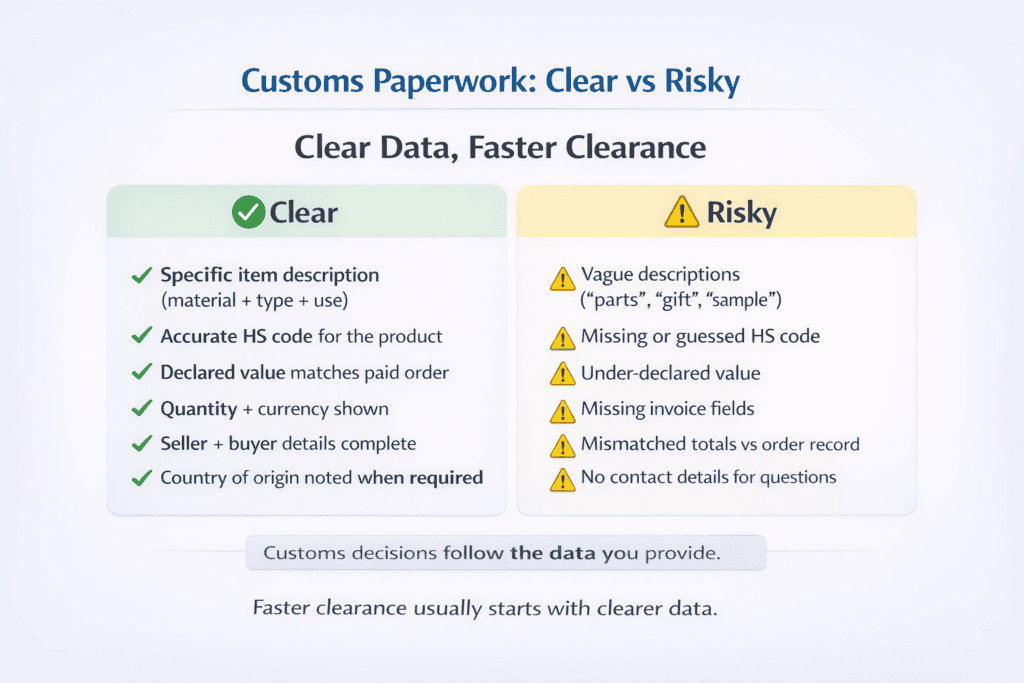
- Most cross-border orders need at least a commercial invoice (even for low-value goods), plus item descriptions, quantities, and values. You may also need a packing list, certificate of origin, or product-specific documents. Customs uses this data to decide what can enter and what fees apply.
- Comprehensive Writing Guideline…
- Customs declaration and HS codes
- Each product should be classified with an HS code, then declared with an accurate description. “Gift” or “sample” labeling can backfire if the values and descriptions do not match the real sale.
- Duties, taxes, and import charges
- Fees are not random. They are based on declared value, HS code, shipping cost rules, and local tax systems (like VAT). The key detail is who pays: you, the buyer, or the carrier collecting at the door.
- Clearance and border inspection
- Customs may clear the shipment automatically, request more info, or inspect it. When they ask questions, they want fast and complete answers. Slow responses often create long holds.
- Local delivery and last-mile handoff
- After clearance, the package switches into domestic delivery. Tracking can change formats, and delivery attempts may depend on local rules like signature requirements, collection points, or ID checks.
A simple example shows how many parts are involved. A UK seller ships skincare to Germany. The carton needs compliant labeling. The commercial invoice must match the order value. The HS code and item description must be specific. VAT rules decide the tax handling. If any detail is missing, the parcel can sit in a customs warehouse while the courier asks for documents.
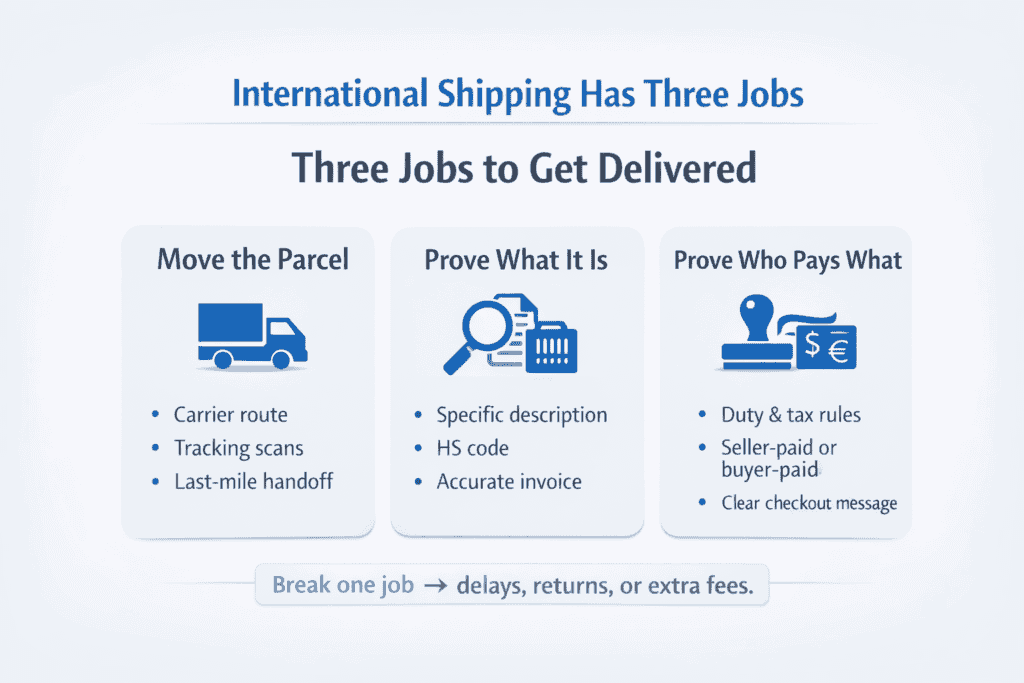
A practical way to think about it is this: international shipping has three jobs. Move the parcel, prove what it is, and prove who should pay what.
Common Shipping Terms You Must Understand Before You Quote Prices Comprehensive Writing Guideline…
International shipping quotes go wrong for one main reason: people use the same words to mean different things. A carrier might be talking about “transport only,” while you are thinking “all-in delivered price.” Customs might charge based on values and codes you never included. The customer may assume taxes are included, even when they are not.
These terms keep everyone aligned. If you understand them, you can price accurately, write clearer delivery promises, and avoid “surprise fee” complaints.
Landed cost
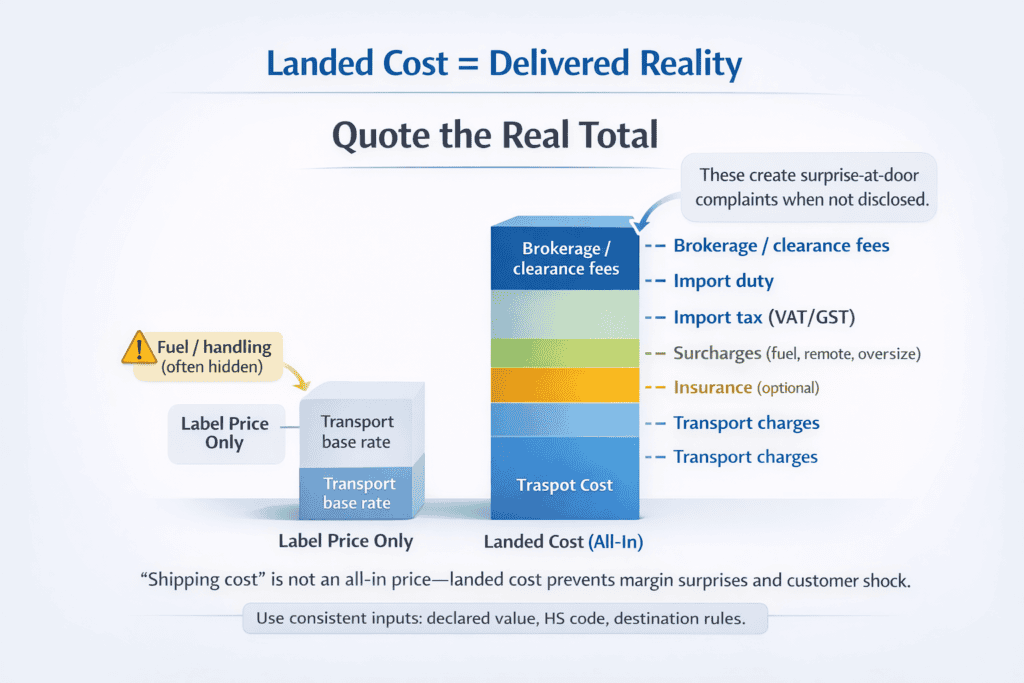
Landed cost is the true total cost to get the order to the buyer’s country and into their hands. It usually includes:
- product cost
- shipping and fuel surcharges
- insurance (if used)
- duties and import taxes
- handling and clearance fees (when applicable)
If you only quote “shipping cost,” but ignore duties and taxes, you are not giving a landed cost. Landed cost is the number that protects your margins and prevents customer shock at delivery.
Comprehensive Writing Guideline…
Duties and taxes (including VAT/GST)
These are the charges applied by the destination country, based on the product classification and declared value.
- Duty is commonly linked to the HS code and origin rules.
- VAT/GST is a consumption tax that may apply even when duty is low or zero.
Many disputes happen because customers don’t separate these from “shipping.” They are not the same thing.
DDP and DDU (and why you should be careful)
These terms are often used in ecommerce conversations to describe who pays import charges.
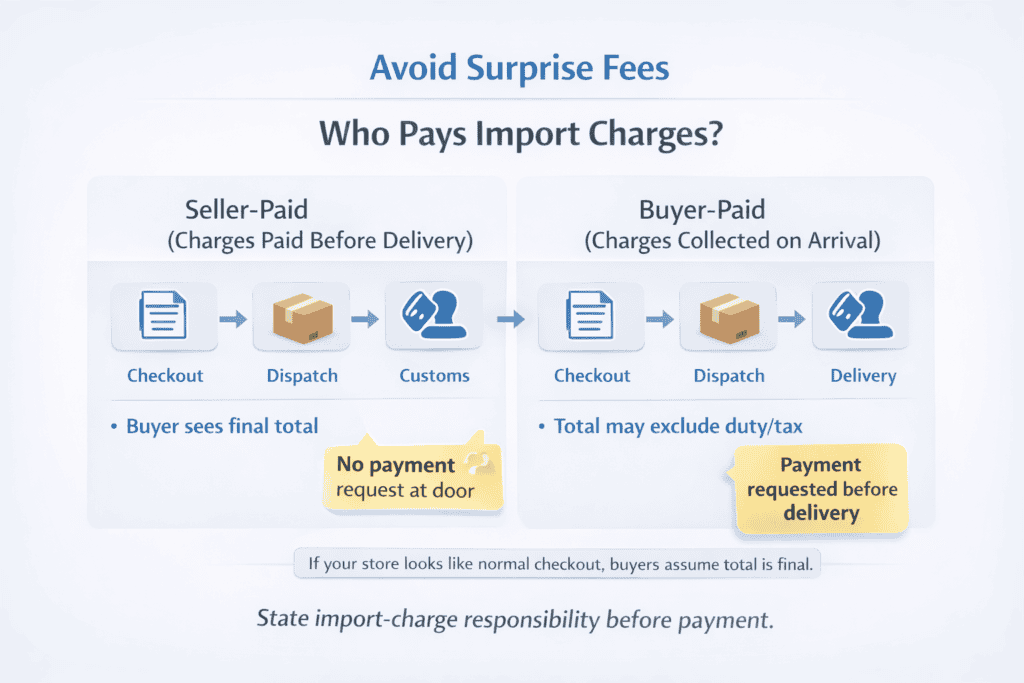
- DDP (Delivered Duty Paid) means the seller arranges delivery with duties/taxes paid (buyer shouldn’t pay on arrival).
- DDU (Delivered Duty Unpaid) is an older phrase people still use to mean the buyer pays import charges at delivery. Many carriers now use DAP instead of “DDU.”
The risk is customer expectation. If your store looks like a normal checkout, buyers often assume the total is final. If you ship in a “buyer pays on arrival” way, you need to say that clearly before they pay.
Incoterms (the responsibility rules)
Incoterms are international trade rules that define who is responsible for shipping, risk, insurance, and import clearance. In ecommerce, the big takeaway is:
- Some terms place import responsibility on the seller
- Some place it on the buyer
- Some are not a good fit for direct-to-consumer at all
You do not need to memorise every Incoterm to ship parcels, but you do need to choose a responsibility model and apply it consistently in your checkout, invoice, and customer messages.
Comprehensive Writing Guideline…
HS code (harmonised system code)
The HS code is the product classification number used by customs to decide:
- duty rates
- restrictions and licensing requirements
- what paperwork might be needed
If the HS code is wrong, everything downstream can be wrong: duty amount, clearance speed, and even whether the product is allowed in.
Declared value
Declared value is the value you report on customs paperwork. It must be truthful and match the commercial invoice and the customer’s payment record.
Under-declaring to “help the customer” can lead to:
- seizures or penalties
- delayed clearance
- insurance issues (claims may be limited to declared value)
Commercial invoice
This is the core customs document that describes what is being shipped, its value, quantities, currency, and parties involved. Customs uses it to assess charges and confirm legitimacy.
Even when the order is low value, missing or vague invoices are a common reason for delays.
Clearance and brokerage
Customs clearance is the process of getting the shipment released into the country. Brokerage is the service of handling that clearance (often done by the carrier or a broker).
Important detail: some services include brokerage, others add it as a fee. If you don’t know which you’re buying, your quote may be too low.
Dimensional weight (volumetric weight)
Many carriers charge based on whichever is higher:
- actual weight
- dimensional (volumetric) weight
A lightweight but bulky box can cost more than you expect. This is why packaging decisions directly affect profit.
Surcharges (fuel, remote area, oversize)
International quotes often change because of add-ons such as:
- fuel surcharges
- remote area delivery
- oversize handling
- address correction
- residential delivery fees (depending on carrier)
If you’re comparing carriers, compare the total with realistic surcharges, not just the base rate.
Delivery promise vs delivery estimate
A promise is what the customer hears as “guaranteed.” An estimate is what is likely under normal conditions. International shipping involves customs, weather, capacity, and inspections so many sellers use estimates unless a premium service includes a guarantee.
Common Shipping Terms You Must Understand Before You Quote Prices
International shipping prices go wrong when you and the buyer are talking about different things. You might be quoting “shipping,” while they assume it includes tax, duty, and delivery to the door. One missing definition can turn a normal order into a refund request.
These terms help you quote accurately and set the right expectations.
Landed cost
Landed cost is the real total to get an order delivered across borders. It usually includes the product price, transport charges, import fees, and any handling costs added by the carrier or broker. If you want a quote that protects margin, this is the number that matters.
A quick example: a £40 item with a £12 shipping charge is not a £52 delivered order if the destination adds VAT, duty, and a clearance fee.
Duties, taxes, VAT, and GST
Duty and tax are not the same as postage.
- Duty is commonly based on the product type and its HS code.
- VAT or GST is a sales-type tax charged by many countries on imported goods, even when duty is low.
If you do not say who pays these charges, customers will guess. They usually guess wrong.
DDP, DAP, and “DDU”
These letters decide who pays import charges and who handles import steps.
- DDP means you arrange delivery with import charges paid before delivery.
- DAP means the item is delivered, but the buyer often pays duty and tax when it arrives.
- “DDU” is an older label people still use for the buyer-paying approach, but many carriers and sellers now use DAP wording.
If you ship with buyer-paid import fees, say it before checkout, not after dispatch.
Incoterms
Incoterms are the rules that define who is responsible for transport, risk, and import clearance. In ecommerce, the key point is responsibility, not the full list of terms.
If you sell direct to consumers, pick one approach and keep it consistent in your policy, invoices, and customer emails.
HS code
The HS code is a product classification number used by customs. It influences duty rates, restrictions, and what paperwork may be required.
“Clothing” is not a helpful description. “Men’s cotton T-shirt” plus the correct HS code is far safer.
Declared value
Declared value is the amount you put on customs paperwork. It should match the invoice and the paid order value.
Lowering value to help the buyer can create delays, penalties, and claim problems if a parcel is lost.
Commercial invoice
The commercial invoice is the main customs document. It tells customs what the goods are, how many units are inside, what they cost, where they came from, and who is buying.
A vague invoice is a common cause of a customs hold. “Parts” can trigger questions. “Stainless steel kitchen faucet, 1 unit” answers them.
Brokerage and clearance
Customs clearance is the process of getting goods approved to enter a country. Brokerage is the service of doing that paperwork and communication.
Some carrier services include brokerage in the rate. Others add it later. If you do not check, your quote may be too low.
Dimensional weight
Carriers often charge based on whichever is higher: actual weight or box size converted into “dimensional” weight. A big, light package can cost more than a smaller, heavier one.
This is why packaging choices change profit, not just damage rates.
Surcharges and extra fees
International rates can include add-ons that appear after you buy the label.
- Fuel surcharges can change month to month.
- Remote area fees apply in some regions.
- Oversize handling fees can appear when a box crosses size limits.
- Address correction fees may be charged if the label data is wrong.
A quote is only “accurate” if it accounts for the fees you commonly hit.
Delivery estimate vs delivery promise
An estimate is a typical range. A promise sounds guaranteed. Customs inspections, holiday backlogs, and flight capacity can all affect cross-border delivery.
Choosing the Right Shipping Method for Speed, Cost, and Reliability
The “right” shipping method is the one that matches what you sell, what your customer expects, and what you can afford to absorb when something goes wrong. If you pick the wrong service, you usually pay twice: once in shipping costs, and again in support time, refunds, or resends.
A simple way to choose is to balance three forces:
- speed (how fast it arrives)
- cost (what you and the buyer pay in total)
- reliability (tracking, delivery success, and customs smoothness)
Start with the product, not the carrier
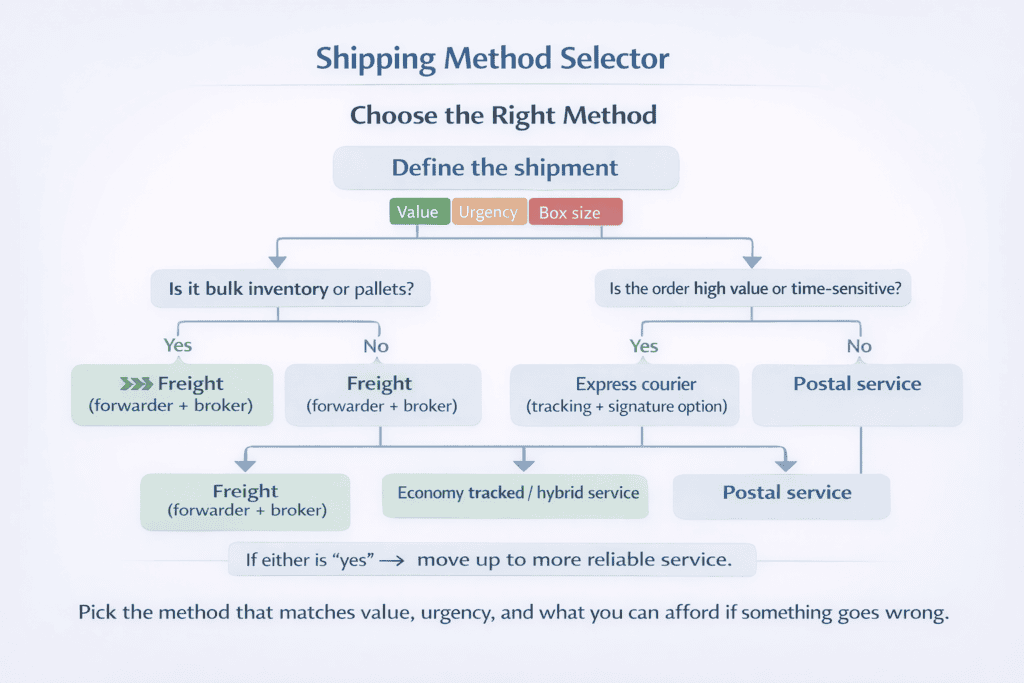
Before you compare services, define what you are shipping. These factors change the best method:
- value (low-value items can’t carry high shipping costs)
- weight and box size (dimensional weight can push you into expensive brackets)
- fragility (breakable goods need stronger handling and insurance options)
- restrictions (batteries, liquids, food, cosmetics, and branded goods may need special services or documents)
- urgency (last-minute gifts need different choices than replacement parts)
If the item is cheap, heavy, and not urgent, express delivery can destroy margins. If the item is expensive or time-sensitive, the cheapest method can create more losses than it saves.
Understand the main shipping options
Most businesses use one of these routes. Each one wins in a different situation.
Postal services (national post networks)
Best for: low-cost parcels, lower value items, simple fulfillment
- usually the lowest headline price
- delivery speed can vary widely by country and season
- tracking quality depends on destination and service level
- customer support and investigations can be slower
Use postal when you can tolerate longer delivery windows and the order value is not high enough to justify premium shipping.
Express couriers (DHL, FedEx, UPS, etc.)
Best for: high-value orders, urgent deliveries, strong tracking, fewer “where is my parcel” tickets
- faster delivery and more predictable scans
- better end-to-end tracking and proof of delivery
- often smoother customs handling because they clear shipments every day
- higher base rates and more surcharges
Use express when reliability and customer confidence matter more than the cheapest possible cost.
Economy courier and hybrid services
Best for: mid-range parcels where you want tracking without full express prices
- often cheaper than express, better tracking than basic post
- delivery times are usually a middle ground
- may hand off to local partners for last-mile delivery
Use hybrid services when you want a reasonable delivery window and fewer support issues, but you still need to protect margin.
Freight (air freight, sea freight, road freight)
Best for: B2B orders, bulk shipments, pallets, and replenishment stock
- lowest cost per unit at volume
- longer lead times (especially sea freight)
- requires stronger planning, paperwork, and a broker or forwarder
- best for replenishment, not single consumer parcels
Use freight when you are moving inventory, not individual consumer orders.
Choose based on customer expectation
Shipping method is a promise. Match the method to what your buyer believes they are buying.
- If you sell premium products, slow untracked shipping can feel like low quality.
- If you sell bargain items, a high shipping charge can reduce conversion.
- If you market “fast delivery,” your fulfillment and service level must support that claim.
A useful rule: the more your customer cares about the delivery date, the more they will care about tracking and predictability.
Compare the total cost, not the label price
A cheap label can become expensive after:
- dimensional weight charges
- fuel surcharges
- remote area fees
- repeated delivery attempts
- customs delays caused by weak paperwork
- refund rates from slow delivery
When you compare methods, compare what happens after 100 real orders, not one perfect shipment.
Build a simple decision framework you can reuse
You do not need a complicated model. You need a consistent policy.
Here is a practical way to decide:
- Low value + not urgent → postal or economy tracked (if available)
- Medium value + standard urgency → tracked courier or hybrid
- High value or time-sensitive → express courier with strong tracking and signature
- Bulk replenishment or B2B pallets → freight via a forwarder
Then pressure-test your decision with two questions:
- If this parcel is delayed by a week, do I lose the customer?
- If this parcel goes missing, can I afford the worst-case outcome?
If the answer is yes, move up to a more reliable service.
Offer shipping choices without creating confusion
Most ecommerce stores do best with 2–3 options. More choices often reduce conversion.
A strong setup is:
- “Standard tracked” (clear delivery range)
- “Express” (clear faster range)
- Optional: “Economy” only if it does not create excessive support problems
Use plain language and show what matters: delivery range, tracking level, and whether duties/taxes may be collected on arrival.
Know when to standardise
Once you identify a method that works for a region, standardise it. Standardisation reduces:
- training time for staff
- label mistakes
- exceptions and support tickets
- inconsistent customer expectations
You can still test alternatives, but your default method should be stable.
How to Calculate Landed Cost (So You Don’t Lose Money)
Landed cost is the real “all-in” cost of an international order, not just the shipping label. It combines what the item costs you, what it costs to transport, and what it costs to legally enter the destination country. If you only look at product cost + postage, you can price an item profitably on paper and still lose money once duties, VAT/GST, brokerage, and carrier surcharges show up. A good landed-cost habit also prevents customer disputes, because you can decide upfront whether you will ship with charges paid (seller-paid) or collect-at-delivery (buyer-paid).
To calculate it, add up the parts in a consistent order: Product cost (including packaging) + outbound shipping charges (including fuel/remote/oversize) + insurance (if used) + import duty + import tax (VAT/GST) + brokerage/clearance and handling fees. Use the same inputs every time: declared value, HS code, and destination rules, then save your assumptions so your quotes stay consistent. The goal is not perfection on the first order, it is control if you can estimate landed cost within a tight range, you can set pricing, free-shipping thresholds, and delivery promises without guessing.
Duties, Taxes, and VAT: What Gets Charged and When
When a parcel crosses a border, the destination country may charge import fees before it can be released for delivery. The three charges people confuse most are duty, taxes, and VAT (or GST). Duty is often tied to the product type and its HS code, and can also be influenced by where the goods were made. VAT/GST is a consumption tax charged on many imports, even when duty is low or zero. On top of those, some shipments also pick up processing or clearance fees from the carrier or broker for handling customs paperwork and collecting money.
What gets charged, and when, depends on the shipping arrangement you choose. If you ship with seller-paid import charges (often described as DDP), the buyer should see a “final price” at checkout and the carrier clears the parcel using your setup. If you ship with buyer-paid import charges (often described as DAP), customs may assess fees as the parcel arrives, and the buyer is asked to pay before delivery or at the door. This is where frustration happens: the customer thinks they already paid in full, then gets a message asking for more money. To avoid that, state clearly at checkout whether duties and VAT are included, and make sure your invoice values and product descriptions match what you sold, so customs can assess charges quickly and correctly.