Businesses with blogs get 55% more website visitors than those without. That stat from HubSpot’s marketing research gets cited constantly, and it is true. But here is the part nobody mentions: for most e-commerce stores, that extra traffic never touches a product page, never enters a checkout flow, and never generates a dollar of revenue.
The blog gets visitors. The store does not get sales. And the owner concludes that content marketing does not work for e-commerce.
The problem is almost never the blog itself. It is how the blog connects (or fails to connect) to the rest of the store. This article breaks down the specific reasons e-commerce blogs underperform and what to change so that content actually drives revenue.
The Traffic Trap: Visitors Who Never See a Product
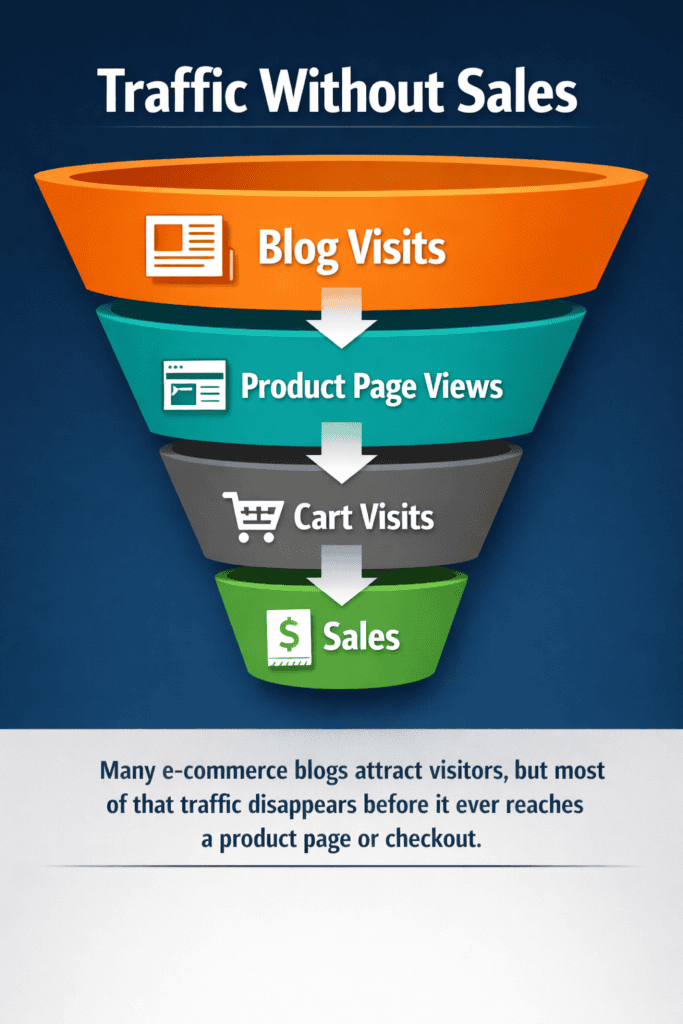
Most e-commerce blogs drive traffic that never reaches product pages. The difference is internal linking and buyer-intent content.
According to a Blend Commerce analysis of Shopify store funnels, blog visitors who land on informational content have a significantly lower conversion rate than visitors who land directly on product or category pages. That is expected. But the gap widens dramatically when the blog has no internal links connecting readers to relevant products.
The issue is structural. Most e-commerce blogs publish content that answers questions but never bridges to a purchase. A post about “how to choose running shoes” that does not link to your running shoe category page is a dead end. The reader gets their answer and leaves. As covered in the e-commerce link building guide on this site, the entire value of content that earns backlinks depends on internal links funneling that authority to commercial pages.
Writing for Search Volume Instead of Purchase Intent
According to Semrush’s e-commerce content research, 43% of all e-commerce traffic comes from organic search. But that traffic is only valuable if the content matches where the reader is in their buying journey.
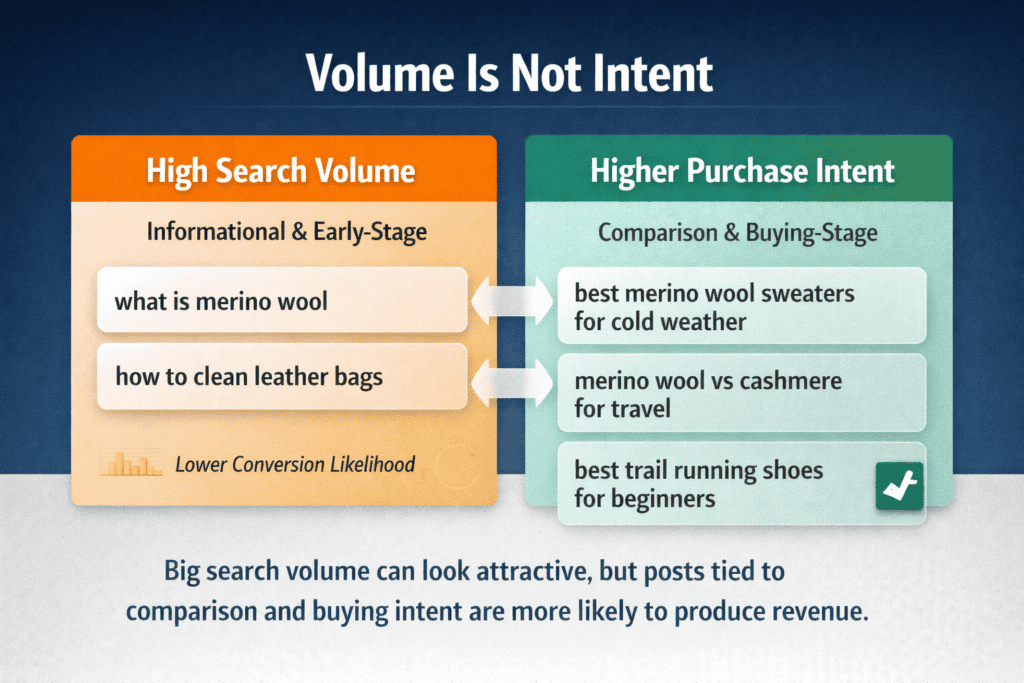
Most e-commerce blogs chase high-volume informational keywords because the numbers look impressive in a keyword tool. “What is merino wool” gets thousands of searches. But someone searching that phrase is not ready to buy a merino wool sweater. They are learning. They are months away from a purchase, if they ever make one.
The content that actually drives sales targets the middle and bottom of the funnel. “Best merino wool sweaters for cold weather” has less volume but far higher purchase intent. “Merino wool vs cashmere for travel” brings in someone actively comparing options before buying. These are the posts that convert.
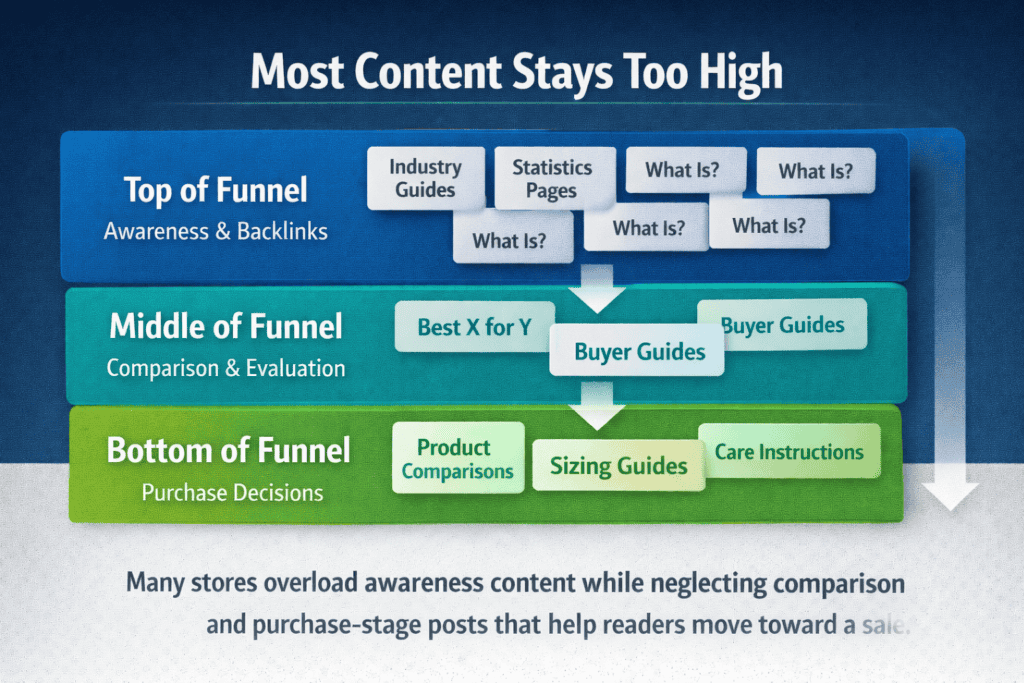
Map your blog content to three tiers. Top-of-funnel for awareness and backlinks (statistics pages, industry guides). Middle-of-funnel for comparison and evaluation (“best X for Y” posts, buyer guides). Bottom-of-funnel for purchase decisions (product comparisons, sizing guides, care instructions). Most stores have 90% of their content in the top tier and almost nothing in the middle or bottom.
No Internal Links From Blog to Product Pages
According to Reboot Online’s technical audit of e-commerce sites, 86% of e-commerce sites lack optimized internal linking. For blogs specifically, the number is almost certainly higher because most store owners treat the blog as a separate entity from the store rather than an integrated part of the sales funnel.
Every blog post should include at least two to three contextual links to relevant product or category pages. Not forced, not a banner ad at the bottom. Contextual links woven into the content where a reader would naturally want to see the product being discussed.
A buying guide for “best trail running shoes for beginners” should link to your trail running shoe category. A care guide for leather bags should link to your leather bag collection. A post about seasonal fashion trends should link to the specific products you carry that match those trends.
This is the mechanism that turns product pages from invisible to ranked. Backlinks land on your blog. Internal links pass that authority to your product pages. Without step two, the authority stays trapped.
Publishing Without a Content Calendar Tied to Revenue
The most common e-commerce blogging pattern: publish whenever someone has time, about whatever topic seems interesting, with no connection to product launches, seasonal demand, or revenue goals.
According to Siege Media’s 2026 content marketing survey, 97% of content marketers say their program is successful to some degree, up from 73% in 2025. The difference between the ones seeing real results and the ones publishing into a void is almost always a documented strategy tied to business outcomes.
For e-commerce, your content calendar should be built around three things:
- Product launches and seasonal inventory (content goes live 3 to 4 months before peak season to give it time to rank)
- Keywords with purchase intent mapped to specific product categories
- Gaps in your internal linking architecture where product pages need more authority
Ignoring the Blog as a Link-Earning Asset
According to SearchLab’s 2026 research report, publishers of original data report 64% higher conversion rates. Original research, statistics pages, and data-driven content are the formats that naturally earn backlinks from other websites.
Most e-commerce blogs publish generic advice that exists on a thousand other sites. Nobody links to the 500th article about “how to style a white t-shirt.” But a post compiling “average return rates by clothing category in 2026” with original data from your own store? That gets cited. That earns links. And those links improve your entire domain’s authority, which lifts the rankings of every product page on your site.
Not Measuring Blog Impact on Revenue
If you are tracking blog success by pageviews and time on page, you are measuring the wrong things. Those metrics tell you whether people read your content. They do not tell you whether your content makes money.
Set up assisted conversion tracking in GA4 to see which blog posts appear in the path to purchase, even if they are not the last click. Track internal link clicks from blog posts to product pages. Monitor whether landing pages receiving blog traffic convert at a higher rate than those that do not.
The stores that turn their blog into a revenue channel are the ones that measure it like one. And the stores that combine content with proper A/B testing of their conversion paths see the fastest improvement.
The Blog That Sells
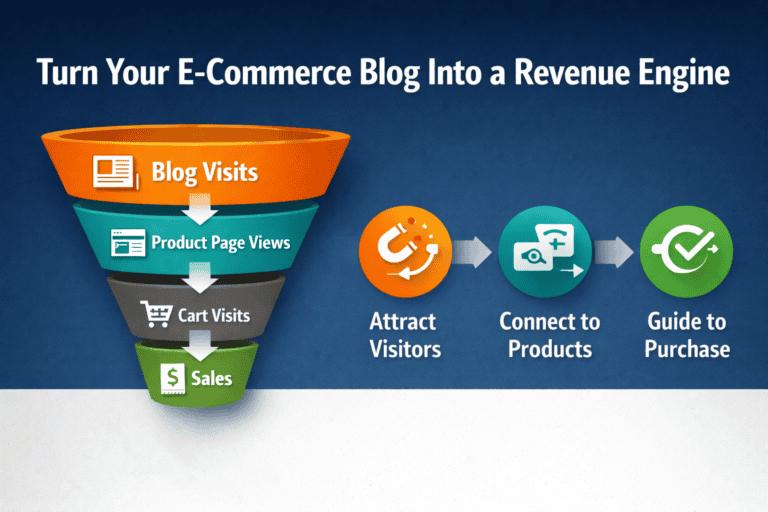
An e-commerce blog that drives sales is not a magazine. It is not a thought leadership platform. It is a system that attracts visitors through search, connects them to products through internal links, and converts them through content that matches their purchase intent.
Every post should have a reason to exist: it targets a keyword with buyer intent, it earns backlinks that strengthen your domain, or it fills a gap in your internal linking architecture. Ideally all three. Posts that do none of these are content for content’s sake, and they will not move your revenue.

About the Author
Matija Konjić is the founder of Link Inbound, a link building and content marketing agency working with B2B and B2C brands. He has built campaigns across 40+ industries and obsesses over the data behind what actually moves rankings.