By Matija Konjić
The average e-commerce brand ranks for just 1,783 organic keywords, pulling in roughly 9,625 monthly visits from search. That is the baseline Reboot Online found when studying the organic footprint of typical online stores. For brands in their first year, the number is almost always lower.
Most of the time, the problem is not complexity. It is that new stores repeat the same preventable mistakes in their first 12 months, then spend year two undoing the damage. The technical debt piles up quietly: duplicate pages bloating the index, product content copied from manufacturers, internal links that go nowhere, and a site structure that confuses Google as much as it confuses shoppers.
This article covers the mistakes I see most often when auditing stores that launched within the past year, and what to do differently.
Pouring the Entire Budget Into Ads
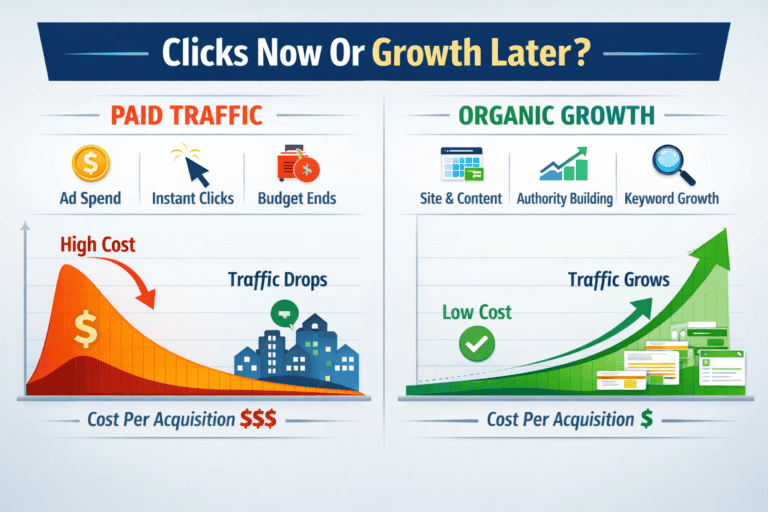
New stores default to paid advertising because the feedback loop is instant. Spend money, see clicks. The problem is that ad costs keep climbing while the traffic vanishes the moment the budget runs out.
According to First Page Sage’s e-commerce ROI data, e-commerce SEO ROI grows substantially between months 6 and 18 as content and authority compound. But that compounding only kicks in if you start early. Every month you delay organic investment is a month you push back the inflection point where SEO starts outperforming paid channels on a cost-per-acquisition basis.
You do not have to choose one or the other. A 60/40 split favoring ads makes sense in the early months while you build organic foundations. But that 40% needs to be working on site architecture, content, and keyword research from day one. Understanding how SEO and paid ads compare on cost-per-acquisition over time makes it easier to justify that early organic investment to anyone holding the budget.
Letting Duplicate Content Bloat the Index
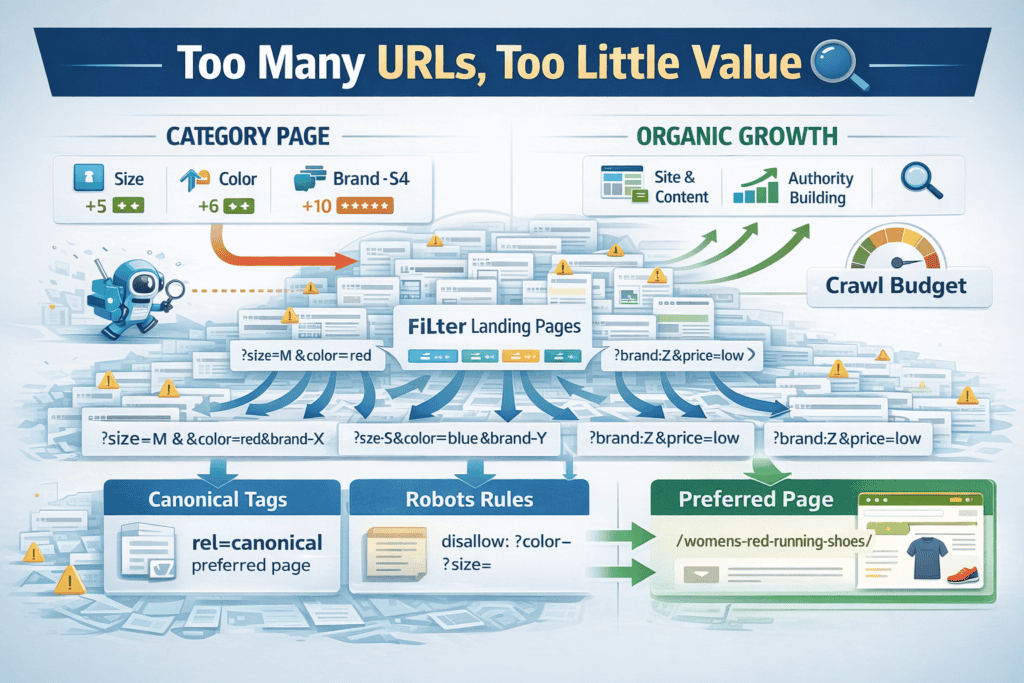
A study from Raven Tools found that 29% of all websites have duplicate content issues. For e-commerce stores, the rate is almost certainly higher because of how product variants, filters, and URL parameters generate pages automatically.
A single product category with 10 filter options for size, color, brand, and price can produce over 10,000 unique URL combinations. Each one looks like a separate page to Google, most with nearly identical content. The result is that Google wastes its crawl budget indexing thousands of low-value filter pages while your actual product and category pages get visited less frequently by its crawlers.
According to Reboot Online’s technical audit of e-commerce sites, 53% of e-commerce sites are missing canonical tags entirely. Without them, every filter combination and variant URL competes against your real pages for indexing priority.
The fix involves three changes:
- Canonical tags: Point every duplicate URL to the preferred version so Google knows which page to index.
- Robots.txt: Block crawling of common filter parameters like ?color= and ?size= to stop Google wasting crawl budget on low-value pages.
- Dedicated landing pages: For filter combinations with genuine search volume (like “women’s red running shoes”), create a real page rather than relying on parameterized URLs.
Copying Manufacturer Product Descriptions
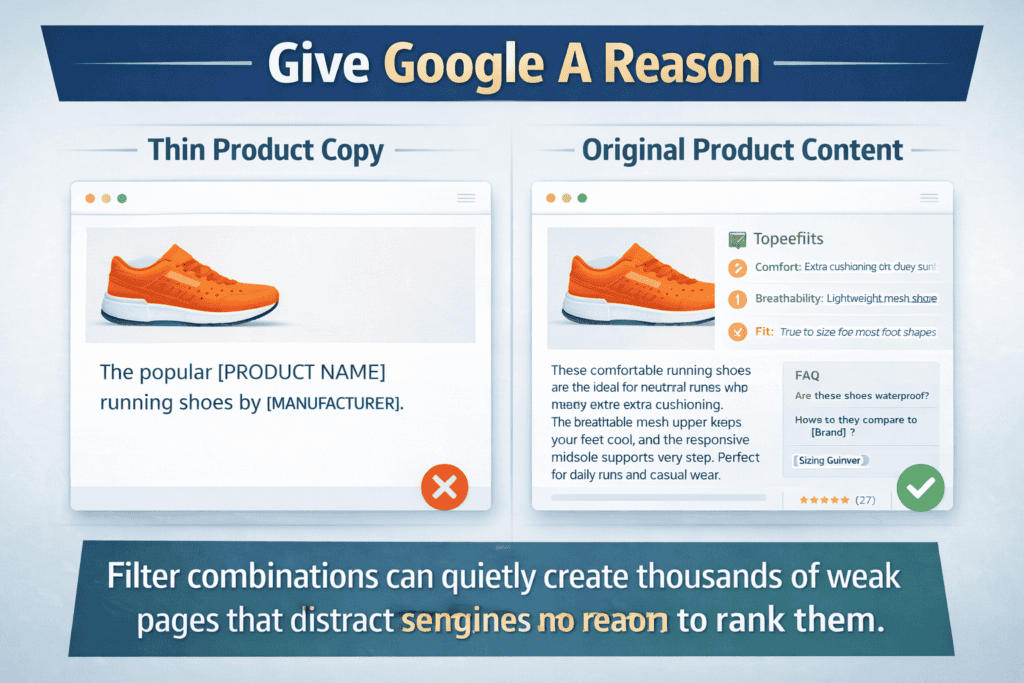
When 50 stores sell the same product with the same manufacturer description, Google has zero reason to rank your version over anyone else’s. You are handing the search engine duplicated content and hoping it picks you. It will not.
According to a Backlinko analysis of search ranking factors, content depth and originality are among the strongest on-page signals. For product pages, that means 300 to 500 words of original description focused on who the product is for, what problems it solves, how it compares to alternatives, and why someone should buy it from your store. Add FAQ sections answering real customer questions. Include sizing guides, care instructions, or compatibility notes where relevant.
This is the single most common issue I find on stores under a year old, and it compounds with other problems like missing schema and zero reviews. Stores that fix content depth alongside those elements are the ones whose product pages actually start ranking within the first six months.
Building a Site Structure Google Cannot Follow
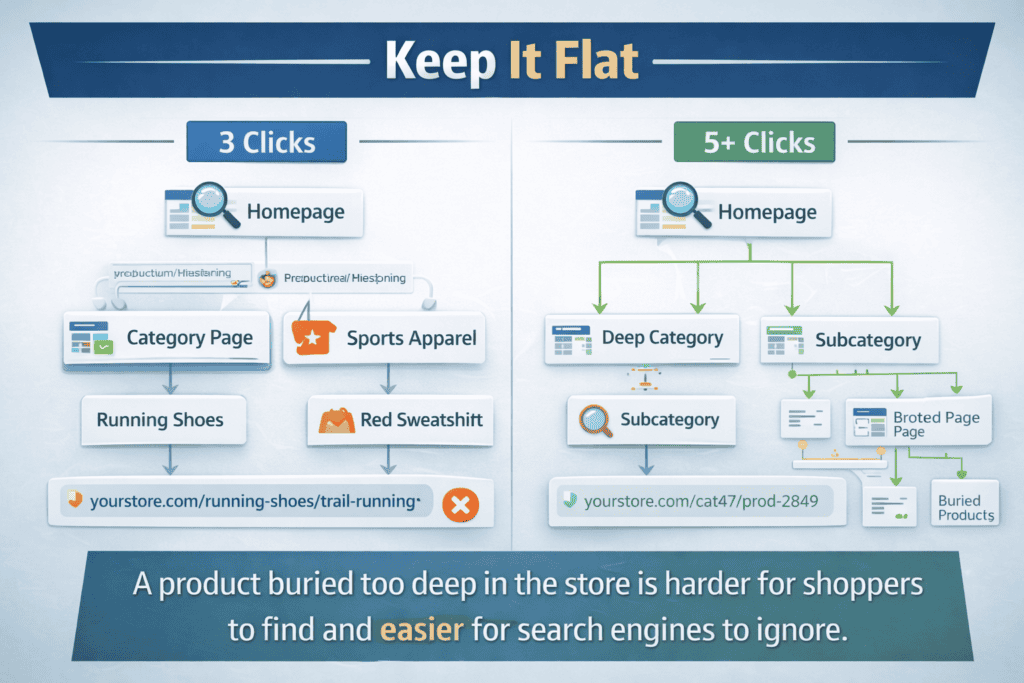
New store owners typically organize products around how they think about inventory, not how customers search. The result is categories nested five or six levels deep, URLs stuffed with parameters, and product pages that require too many clicks to reach.
Research from Princeton University found that pages requiring more than three clicks to access from the homepage receive 89% fewer crawl visits compared to pages linked directly from high-authority sections of a site. For an e-commerce store, that means products buried deep in the hierarchy are effectively invisible to search engines.
Plan your category structure before launch:
- Keep it flat: homepage to category to product in three clicks or fewer.
- Use breadcrumb navigation so both users and Google understand the hierarchy.
- Keep URLs clean and descriptive. yourstore.com/running-shoes/trail-running communicates clearly. yourstore.com/cat47/prod-2849 communicates nothing.
Choosing the right e-commerce platform matters here too. Some handle URL structure and breadcrumbs well out of the box. Others require significant manual configuration to get right.
Ignoring Internal Links Entirely
Harvard Business School research found that 71% of websites have broken or inefficient internal linking structures that limit crawl depth and dilute page authority. For new e-commerce stores, the percentage is likely higher because internal linking is something most founders never think about at all.
The most damaging version of this mistake: publishing blog content that earns backlinks but never linking that content to product or category pages. The blog accumulates authority that sits there doing nothing for the pages that actually generate revenue.
Build internal linking into your workflow from day one:
- Every blog post should link to at least one relevant product or category page.
- Every product page should link to related products.
- Every category page should link to its top subcategories and featured items.
This is the internal half of a two-layer e-commerce link building strategy where external authority gets earned through content and then deliberately funneled to commercial pages.
Chasing Head Keywords Against Amazon
New stores almost always target the biggest keywords first. They want to rank for “running shoes” or “coffee maker” because the search volume is impressive. The problem is that Amazon, Walmart, and other mega-retailers have millions of backlinks and decades of domain authority on those terms.
A Garrett Digital study of 379 commercial product keywords found that Reddit appears in the top five organic results for 49% of commercial searches, and Google’s Popular Products carousel shows in 90% of product SERPs. The competition for head terms is not just other stores. It is platforms and features that did not exist five years ago.
The smarter approach: target long-tail, high-intent keywords from the start. Instead of “running shoes,” target “best trail running shoes for wide feet under $150.” The volume is smaller, but the searcher is much closer to buying and the competition is dramatically lower. Use Ahrefs Keywords Explorer to filter for keywords with lower difficulty scores and clear commercial intent. Build content around those terms first, then move up to more competitive queries as your domain grows.
Skipping Structured Data and Missing Rich Results
According to Searchmetrics, only 30% of websites implement structured data at all. Columbia University research found that pages with proper schema markup receive 30% higher click-through rates than standard results at comparable rankings. That is free visibility most new stores leave on the table.
In 2026, structured data is not just about traditional rich snippets. AI Overviews pull product information directly from schema markup. If your pages lack Product, Review, and FAQ schema, you are invisible to both the rich result features and the AI-powered answers that are increasingly replacing them. Schema is one piece of a larger E-E-A-T and answer engine optimization framework that determines how search engines and AI systems evaluate your store’s credibility.
Waiting Too Long to Collect Reviews
According to Semrush’s e-commerce research, 73% of top e-commerce brands use user-generated content on product pages, but that drops to 28% for mid-sized brands. New stores almost always fall into the latter group, planning to “add reviews later.”
Every week without reviews is lost content. Google treats customer reviews as unique, keyword-rich text that helps product pages rank. They also answer the long-tail questions shoppers actually search for, things like “does this jacket run small” or “is this blender loud.” Beyond SEO, products with reviews simply convert better.
Set up automated post-purchase review request emails before you launch. Even five genuine reviews per product make a measurable difference. Combined with solid conversion rate optimization, reviews become one of the highest-impact elements on any product page.
The First Year Sets the Trajectory
Every mistake on this list has the same root cause: treating SEO as something you will get to later rather than building it into the foundation from day one.
The stores that grow organic traffic in year two are the ones that fixed their site architecture, wrote original content, built internal links, implemented schema, and started collecting reviews during year one. They targeted realistic keywords instead of competing with Amazon on head terms. And they set aside budget for organic even when paid ads felt more urgent.
None of these fixes require massive investment. They require intention. The difference between a store pulling 10,000 organic visits per month after two years and one stuck at 200 is rarely about money. It is about whether SEO was part of the plan from the beginning. If you are still evaluating whether starting an e-commerce business is worth it in 2026, factor in the cost of fixing these mistakes in year two versus doing them right from the start.
About the Author

Matija Konjić is the founder of Link Inbound, a link building and content marketing agency working with B2B and B2C brands. He has built campaigns across 40+ industries and obsesses over the data behind what actually moves rankings.