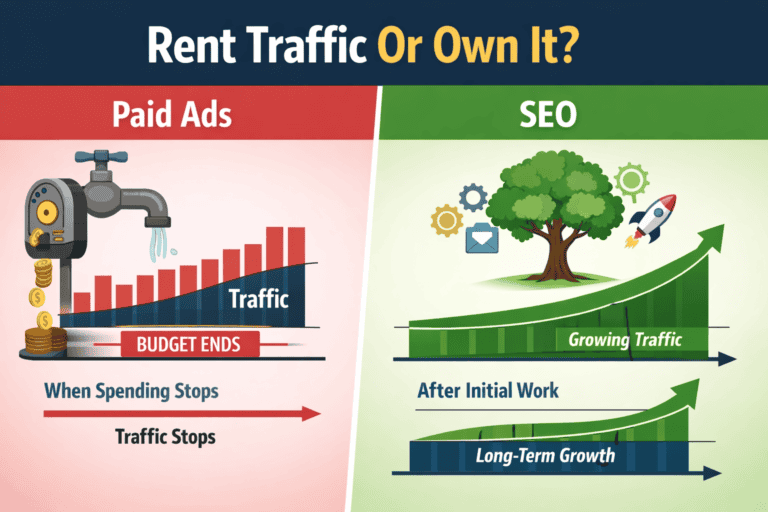
Every e-commerce store faces the same budget question: do you invest in SEO or paid advertising? The honest answer is that most successful stores do both. But the split matters enormously, and most brands get it wrong by over-investing in paid channels and under-investing in organic search.
Here is what the numbers actually say, and why understanding the difference between rented traffic and owned traffic should change how you allocate your marketing budget.
The ROI Gap
According to First Page Sage’s 2026 E-Commerce SEO ROI Report, SEO delivers an 8x return on investment over time, compared to PPC’s 4x. That gap alone should get your attention. But the more important detail is how those returns behave over time.
Paid ads deliver immediate results. You spend $1,000 today, you get clicks today. But the moment you stop spending, the traffic stops. There is no residual value. No compounding. Every customer acquisition requires another dollar.
SEO works the opposite way. You invest today and see minimal returns for the first few months. But once pages start ranking, they continue generating traffic without additional spend. A product category page that reaches page one of Google keeps bringing in customers month after month. According to First Page Sage, e-commerce SEO ROI grows significantly between months 6 and 18, where content and backlink acquisition compound on each other.
For stores thinking about long-term profitability rather than just this month’s revenue, that compounding effect is the entire argument.
Where the Traffic Actually Comes From
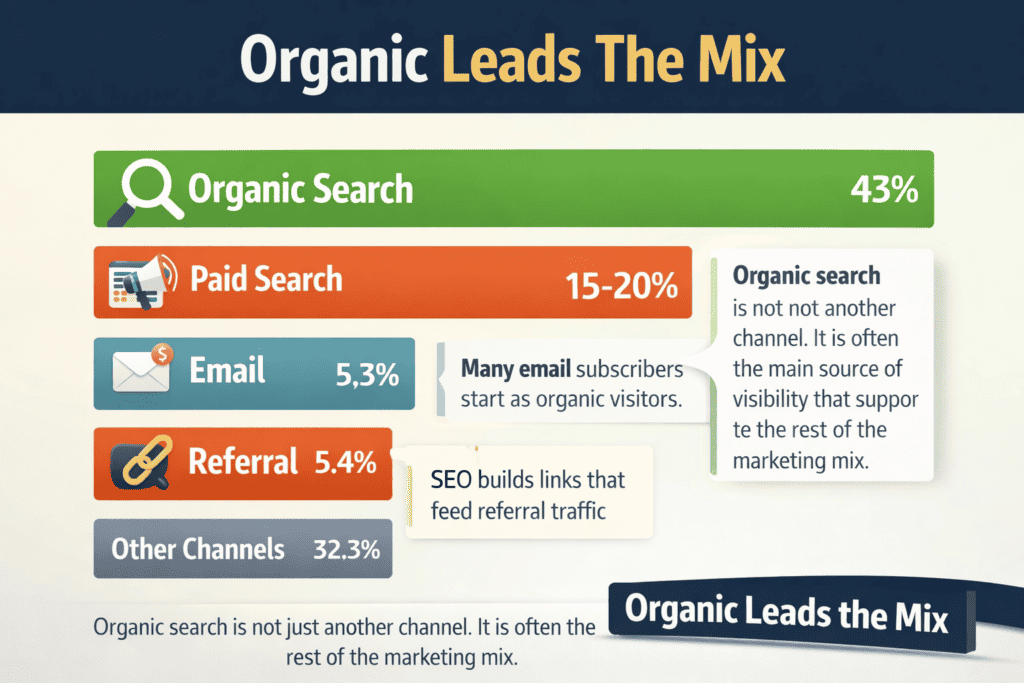
Organic search drives 43% of all e-commerce traffic, making it the single largest traffic source for online retail. By comparison, paid search typically accounts for 15 to 20% of total e-commerce traffic.
But volume alone does not tell the full story. The quality of that traffic matters just as much.
Ecommerce SEO: SEO vs Paid Ads
According to Semrush’s analysis of e-commerce traffic patterns, organic search traffic converts at approximately 2 to 4%, which is competitive with most paid channels. More notably, 23.6% of all e-commerce orders come directly from organic traffic. SEO-driven customers also tend to have higher average order values because they arrive with research-based purchase intent rather than impulse-click behavior from an ad.
Referral traffic converts highest at 5.4%, but it depends on upstream visibility, which is often built through SEO in the first place. Email marketing converts at 5.3%, but again, email lists are filled by capturing organic visitors. The channels do not operate in isolation. SEO is frequently the engine that feeds the other high-converting channels.
Understanding how to get your e-commerce store found on Google is the foundation that makes every other marketing channel more effective.
The Cost Per Acquisition Breakdown
Here is where the math gets uncomfortable for paid-heavy strategies.
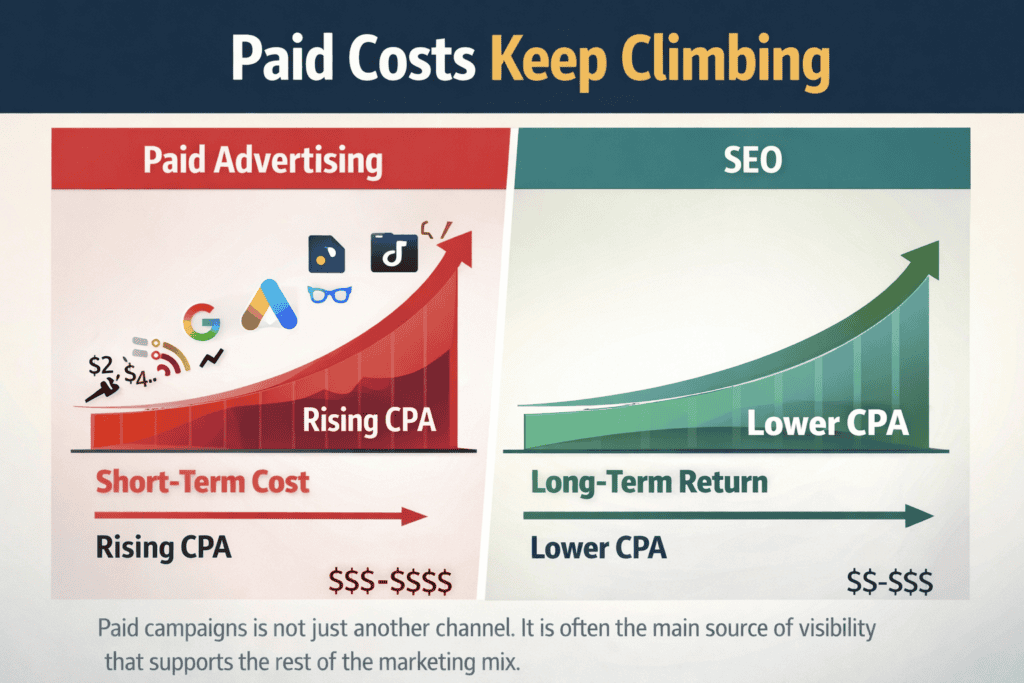
Customer acquisition costs through paid ads have been rising steadily. According to global e-commerce analysis, increasing competition and privacy changes have pushed CPCs higher across Google Ads, Meta, and TikTok. For many e-commerce verticals, the cost per click on commercial keywords now exceeds $2 to $5, with competitive categories like finance, insurance, and legal pushing well above $10.
SEO has its own costs, including content creation, technical optimization, and link building. But the fundamental economics are different. When you invest $5,000 in a month of SEO work, the pages you optimize and the links you build continue generating traffic for months or years. When you spend $5,000 on Google Ads, the traffic stops the day the budget runs out.
Most mature SEO programs produce customer acquisition costs in the $50 to $200 range per lead, which is often lower than PPC in competitive verticals where cost-per-click keeps climbing. The difference only widens over time as organic rankings strengthen and paid costs continue to rise.
The Zero-Click Problem
Here is a factor that changes the equation for both channels in 2026.
According to Search Engine Journal’s reporting on search behavior, roughly 60% of Google searches now end without a click to any website. Google’s AI Overviews, featured snippets, and knowledge panels answer queries directly in the search results.
This affects paid and organic differently.
For paid ads, zero-click searches mean fewer opportunities to appear in front of searchers at all. Google is increasingly pushing ads below AI Overviews, reducing visibility for the placements you are paying for.
For organic search, zero-click creates a new opportunity. When your brand is cited within an AI Overview, you earn 35% more organic clicks and 91% more paid clicks compared to brands that are not cited. The goal is no longer just ranking. It is becoming the source that Google’s AI reaches for when generating answers.
This is where SEO and brand authority intersect. Stores with strong backlink profiles, comprehensive content, and genuine expertise signals are the ones getting cited in AI Overviews. Stores that rely purely on paid ads have no presence in this space.
The shift toward AI-powered search makes understanding SEO, AEO, and E-E-A-T essential for any e-commerce brand planning its 2026 strategy.
ROI by E-Commerce Vertical
Not all e-commerce categories see the same SEO returns. First Page Sage’s data shows clear patterns across verticals.
Home goods and specialty retail see the highest SEO ROI because customers in these categories do extensive product research before purchasing. When someone searches “best stand mixer for bread dough,” they are deep in the buying process. Ranking for that query delivers a customer who is ready to buy.
Fashion and beauty see more moderate SEO ROI because influencer content and paid social compete more directly for attention in these categories. The purchase journey often starts on Instagram or TikTok rather than Google.
Niche e-commerce stores consistently see higher SEO ROI than general retailers. Long-tail keywords have less competition, and the specificity of the products means organic searchers have very high purchase intent. A store selling specialty hiking gear will see better SEO returns than a department store selling everything.
The takeaway is that your vertical should influence your budget split. Stores in research-heavy categories should lean more heavily into SEO. Stores in impulse-driven, visually-led categories may need a higher paid allocation, but should still invest in organic as a long-term foundation.
The Compounding Advantage
The most important difference between SEO and paid ads is what happens over 12, 24, and 36 months.
With paid advertising, your cost to acquire a customer stays roughly the same, or more likely increases as competition intensifies and CPCs rise. Your month-12 cost per acquisition is rarely better than your month-1 cost. You are renting the same shelf space every month at an increasing price.
With SEO, month 12 looks fundamentally different from month 1. Pages that took months to rank are now generating traffic for free. Blog content that earned backlinks is passing authority to product pages through internal links. The domain authority you built in the first year makes it easier to rank new pages in the second year.
Ahrefs’ research on ranking velocity shows that top-ranking pages continue to acquire new backlinks at a pace of 5 to 14.5% per month. Pages that rank well attract more links, which helps them rank better, which attracts more links. That flywheel effect does not exist with paid advertising.
After 18 months of consistent SEO investment, most e-commerce brands reach a point where organic traffic significantly exceeds what paid channels deliver at equivalent cost. After 36 months, the gap becomes a chasm.
So Where Should Your Budget Go?
There is no universal answer, but the research points to a clear framework.
If you are a new store with zero organic visibility, start with a 60/40 split favoring paid ads. You need immediate revenue to survive while SEO builds momentum. But set aside that 40% from day one, because the earlier you start building organic authority, the sooner you reach the compounding phase.
If you are an established store with some organic traffic, shift toward 50/50 or even 40/60 favoring SEO. Your paid campaigns should focus on high-intent, bottom-of-funnel keywords where immediate conversion justifies the cost. SEO should target the broader category and informational queries that build long-term authority.
If you have been investing in SEO for 12 or more months and seeing results, consider shifting to 30/70 favoring SEO. At this stage, organic traffic is compounding, and every dollar invested goes further than a dollar in paid ads.
Regardless of your split, make sure your landing pages and conversion rate optimization are dialed in. Driving traffic to a page that does not convert wastes money whether that traffic comes from organic search or paid ads.
The Bottom Line
Paid ads get you customers today. SEO builds an asset that gets you customers for years.
The best e-commerce brands treat paid advertising as a tool for immediate cash flow and testing, and SEO as the long-term infrastructure that reduces their cost per acquisition over time. They do not choose one over the other. They understand when each one earns its place in the budget.
The stores that over-invest in paid channels and neglect organic search are building on rented ground. Every algorithm change, every CPC increase, every new competitor bidding on your keywords erodes the return. The stores that build real organic authority, through great content, strong link building, and technical excellence, own their traffic instead of renting it.
In a market where e-commerce is getting harder and more competitive, owning your traffic is the only sustainable advantage.
About the Author

Matija Konjić is the founder of Link Inbound, a link building and content marketing agency working with B2B and B2C brands. He has built campaigns across 40+ industries and obsesses over the data behind what actually moves rankings.