E-Commerce Link Building: What the Data Says Works (and What Doesn’t)
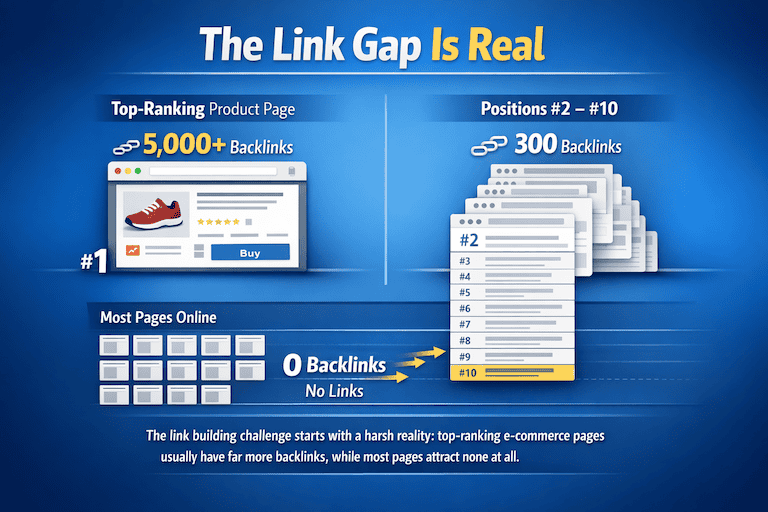
About 95% of all pages on the internet have zero backlinks. For e-commerce sites, the situation is even worse: product pages rarely attract links naturally because nobody wants to editorially endorse a commercial listing. Meanwhile, the pages that rank at the top of Google for product searches have 3.8x more backlinks than those sitting in positions two through ten (Backlinko, 11.8 million search results study).
That gap is the entire e-commerce link building problem in two numbers.
If you run an online store, you already know that getting found on Google takes more than solid product descriptions and clean site architecture. Backlinks remain one of the strongest signals Google uses to decide which stores deserve page-one visibility, even as the algorithm evolves.
This guide breaks down what actually works for e-commerce link building in 2026, what the data says you should stop doing, and how to build authority on a realistic budget.
The E-Commerce Link Problem: Why It’s Harder Than Other Industries
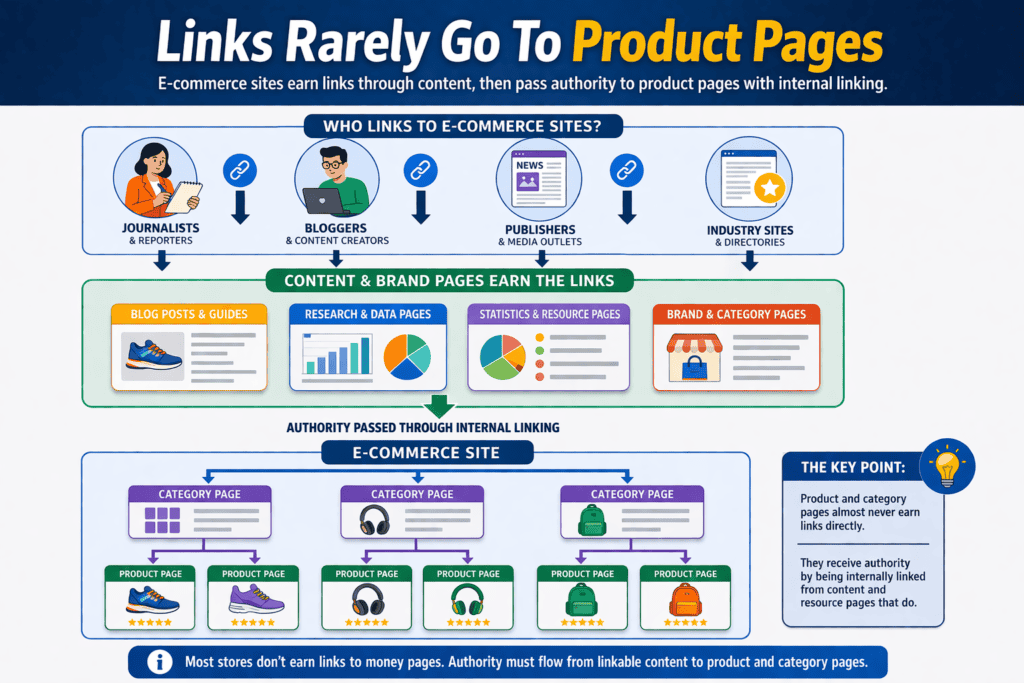
E-commerce stores face a unique structural challenge. Writers, journalists, and bloggers will happily link to an insightful research study or a useful tool. They will not link to a product page for a pair of running shoes or a coffee grinder.
According to a Reporter Outreach analysis of e-commerce link building patterns, nearly all external backlinks earned by online stores point to blog content, guides, or brand pages. Product and category pages, the ones that actually generate revenue, almost never receive direct links from outside sites.
This creates a two-layer problem. First, you need to earn links to your domain. Second, you need to move that authority to the pages that make you money through internal linking. Skip the second step and you can earn 100 backlinks to a buying guide while your product pages sit on page three.
That is why e-commerce brands that invest in link building but ignore their internal linking and site architecture are leaving rankings and revenue on the table.
What the Data Says Works
Not every link building tactic delivers equal results. The strategies below are backed by industry research and real campaign data. They range from high-budget options for funded brands to zero-cost methods for bootstrapped stores. What they all share is that they produce links a real editor would be willing to place, which is the only standard that matters after Google’s recent updates.
Digital PR: Expensive but Highest Impact
In Editorial.Link’s 2025 survey of 518 SEO professionals, 48.6% named digital PR as the most effective link building tactic. Guest posting came in at just 16%.
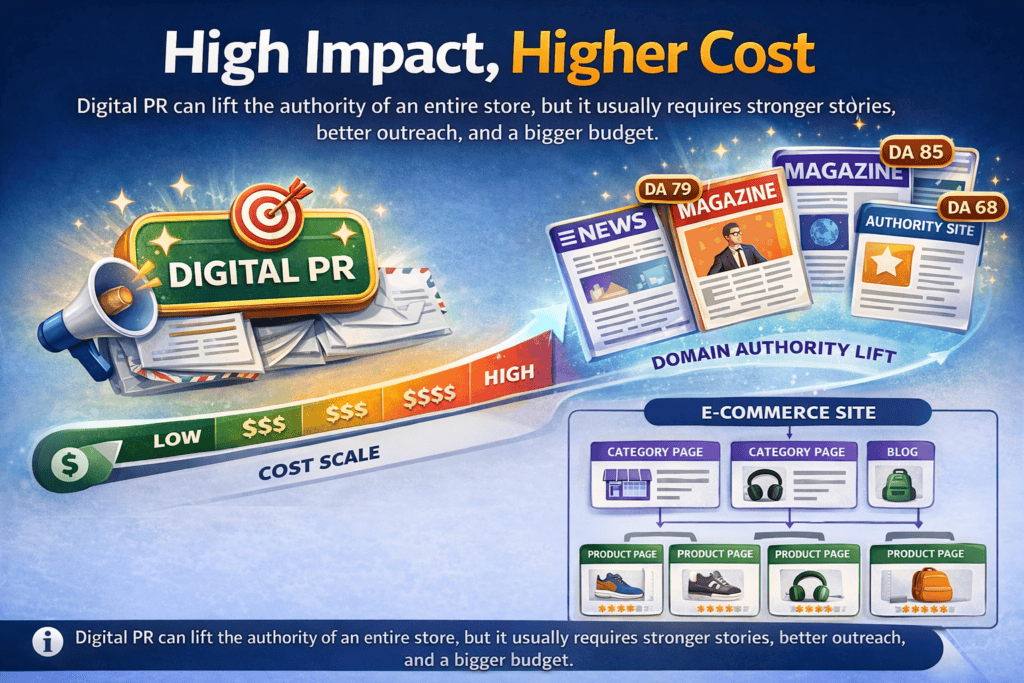
For e-commerce brands specifically, digital PR works because it builds domain-wide authority through editorial coverage on news sites and industry publications. A single campaign that lands coverage in five or six publications lifts your entire domain, not just one page.
The cost is real: BuzzStream’s pricing data puts digital PR links at roughly $1,250 to $1,500 per unique linking root domain. A full campaign typically runs $5,000 to $10,000. But what you get in return are editorial, dofollow links from sites with genuine readership. Publications like Forbes have highlighted how digital PR has replaced traditional outreach as the gold standard for earning high-authority links. These are exactly the kind of links that Google’s algorithm leak confirmed are weighted most heavily.
How e-commerce brands make this work on a smaller scale:
Seasonal data angles are the entry point. If you sell outdoor gear, a data-driven story around “spending trends for summer gear in 2026” gives journalists something to write about. You don’t need a $10K agency for this. You need interesting data from your own customer base, a clear angle, and direct outreach to relevant journalists.
Expert commentary platforms like Qwoted and Featured let you respond to journalist queries for free. You provide a useful quote, they publish it with a mention and often a link. It is not scalable like a full campaign, but it costs nothing and gets you links from real publications.
Linkable Assets: The Best Long-Term ROI
Creating content that earns links passively over time is where e-commerce brands with limited budgets get the most value.
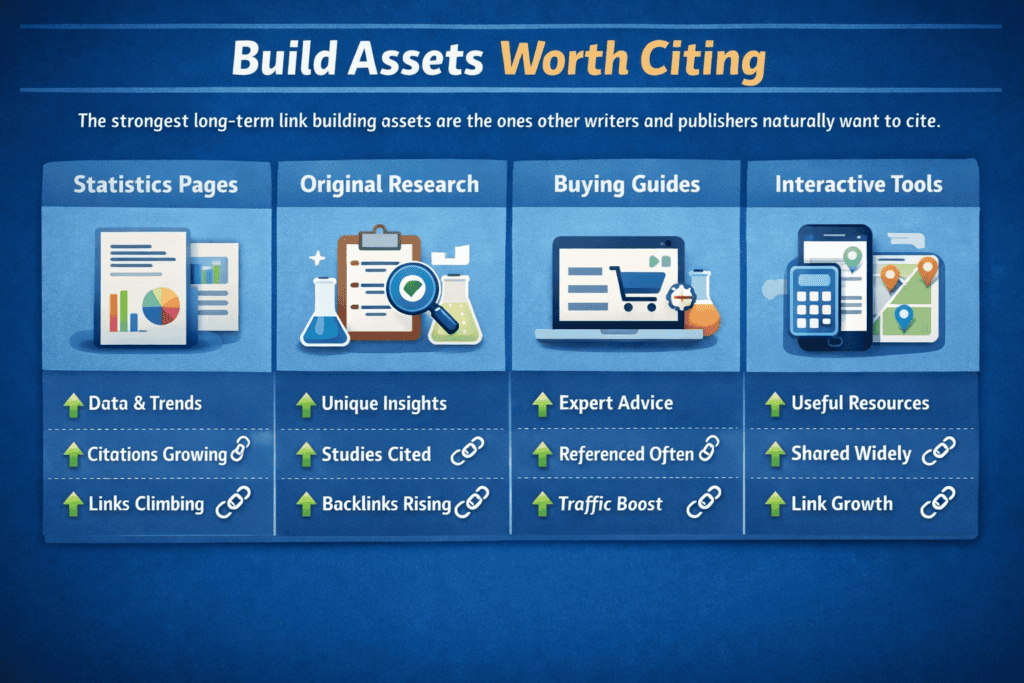
The playbook is straightforward. A statistics page, a comprehensive buying guide, or an interactive comparison tool becomes a resource that other content creators reference when writing their own articles. Each reference earns you a backlink.
BuzzStream documented a case where a “ChatGPT Statistics” post targeting a keyword with just 300 monthly searches earned over 350 backlinks organically. The production cost was modest relative to the value: at even a conservative $500 per link, that is over $175,000 in link value from a single page.
For e-commerce, the most effective linkable assets include:
Industry statistics pages. Compile every relevant stat about your product category, cite your sources, and keep the page updated. Writers researching articles in your niche will find and cite it.
Original research from your own data. You have customer purchase data, return rate data, seasonal trend data. Survey your customers, analyze purchase patterns, publish the findings. Original data gets cited by journalists, bloggers, and competitors.
Interactive tools. Size calculators, product comparison tools, cost estimators. These earn links because they provide utility that other sites want to reference for their readers.
The critical step most stores miss: every content asset that earns external links must contain strong internal links to your product and category pages. A buying guide for “best running shoes for beginners” should link directly to your running shoe category page. Without this, the authority you build never reaches the pages that drive sales.
Unlinked Brand Mentions: The Highest-Efficiency Tactic
If your store has any brand recognition at all, people are already mentioning you online without linking to you. Finding these mentions and sending a polite email asking for the link produces close rates above 30%.
Use Ahrefs Content Explorer to search your brand name and filter out pages that already link to you. For free, Google Alerts works.
This tactic costs nothing but time and is the single most efficient link acquisition method available. If you are a newer brand without many mentions yet, skip this for now and revisit in six months.
Broken Link Building: Free and Genuinely Useful
Find pages in your niche that link to broken (404) URLs. Create content that covers the same topic. Email the site owner letting them know about the broken link and offering your resource as a replacement.
Response rates are lower than unlinked mentions, but you are providing genuine value by helping someone fix their site. The goodwill goes a long way, and it costs nothing but your time.
What the Data Says You Should Stop Doing
Google has gotten significantly better at identifying manipulative link patterns. The March 2026 core update was the clearest signal yet: tactics that worked even two years ago are now actively penalized. As Search Engine Journal reported, each successive core update has tightened the screws on low-quality link schemes, and the latest round hit e-commerce sites especially hard.
Cheap Guest Posts on Irrelevant Sites
BuzzStream analyzed a database of over 26,000 guest post sites and found that only 7.6% met basic quality standards when filtered for sites above 65 DR/DA with at least 10,000 monthly organic traffic. Out of 897 sites on a major vendor list, only 68 passed.
Google’s March 2026 core update specifically devalued sponsored guest posts on general news sites, niche edits on thin-content aged domains, and PBN links. If your link building strategy relies on any of these, you are paying for links that Google is actively discounting.
The quality problem is severe. Most guest post content is AI-generated with a light human edit, placed on sites with no connection to your niche, using exact-match anchor text pointing to product pages. This is the kind of footprint Google’s algorithms are built to detect.
Low-Quality Niche Edits
Link insertions (niche edits) average just $141 per placement, making them look like a bargain. But when BuzzStream analyzed 174 sites offering insertions, only one met quality thresholds for both traffic and domain authority.
One out of 174.
The sites willing to sell link insertions are overwhelmingly low-quality. High-traffic, high-authority sites do not need to sell link placements because they generate enough revenue from ads and genuine partnerships.
If you do use niche edits, ignore domain-level metrics and focus on page-level data. A link on a page that actually receives 500+ monthly visitors is worth far more than one on a zero-traffic page, regardless of the domain’s overall authority.
How Much Should E-Commerce Stores Spend?
The most common budget range for link building is $1,000 to $5,000 per month, according to Editorial.Link’s survey where 38.4% of businesses fell in this bracket. The average cost of a quality backlink sits at roughly $509, up 20 to 35% since 2022 due to AI content saturation and tighter editorial standards.
But the real question is not what a link costs. It is what a link is worth in your niche.
Siege Media and BuzzStream developed a framework for calculating Monthly Lifetime Link Value: take your site’s monthly organic traffic value (from Ahrefs or Semrush), divide by referring domains, then multiply by 24 months.
In competitive e-commerce verticals like personal finance, lifetime link values exceed $5,000 per link. In less competitive product niches, they may be closer to $500 to $1,500. The higher the number, the more justified it is to invest aggressively.
For stores just starting out, the free tactics (unlinked mentions, broken link building, expert commentary) should be your foundation. Once revenue justifies the spend, layer in digital PR campaigns and invest in linkable assets that earn links passively. Evaluating whether e-commerce is worth the investment in 2026 means factoring in these organic visibility costs from the start.
The AI Search Factor: Why Links Now Matter Beyond Google
Here is something most e-commerce link building guides miss: your backlink profile now influences whether AI platforms like ChatGPT, Perplexity, and Google’s AI Overviews cite your store.
According to Editorial.Link’s survey, 73.2% of SEO professionals believe backlinks influence the chance of appearing in AI search results. The 2025 AI Visibility Report found that domain authority, backlink profiles, and brand mention frequency collectively account for about 35% of citation likelihood in LLM responses.
Understanding SEO, AEO, and E-E-A-T is becoming essential for e-commerce brands that want to show up not just in traditional search results but in AI-generated product recommendations.
The data on what gets cited is revealing. “Best X” listicles account for 43.8% of all pages cited by ChatGPT. Pages above 20,000 characters average 10.18 AI citations versus 2.39 for shorter pages. As Search Engine Journal’s analysis of AI visibility confirms, comprehensive, well-structured, authoritative content on well-linked domains is what LLMs want to reference.
Digital PR and linkable assets do not just earn you links for Google. They build the brand authority that determines whether ChatGPT mentions your store when someone asks for product recommendations in your category.
A Realistic Timeline
Link building is a compounding investment, not a quick fix. Based on campaign data and industry research, here is what to expect:
Months 1 to 2: Links get indexed. Minimal ranking movement. This is normal.
Months 3 to 4: Keyword positions start shifting. Pages move from deep results toward page two.
Months 4 to 6: Meaningful ranking improvements. Pages start hitting page one for long-tail product terms.
Month 6 and beyond: The compound effect kicks in. Pages that now rank well earn organic links naturally, accelerating growth.
If someone promises page-one rankings in 30 days from link building alone, find a different provider.
For e-commerce specifically, this timeline is painful because it means you need to start campaigns months before peak selling seasons. If Q4 is your biggest revenue quarter, your link building needs to begin in Q1 or Q2.
Once rankings improve, converting that traffic effectively depends on having your conversion rate optimization and landing pages dialed in. Driving traffic to a poorly converting page is wasted investment.
The Bottom Line
E-commerce link building in 2026 comes down to a simple principle: create things worth citing, then make sure the authority flows to the pages that generate revenue.
The tactics that survive every algorithm update, digital PR, original research, genuinely useful tools and guides, all share one trait. They provide enough value that a real editor would choose to link to them without being paid.
The cheap shortcuts (bulk guest posts, low-quality niche edits, PBN links) are being systematically destroyed. Costs are rising. Quality standards are tightening. And the brands that invest in earning real editorial links are building a competitive advantage that gets wider every year.
Start with what you can afford. Use the free tactics. Build linkable assets. And when budget allows, invest in digital PR that builds both backlinks and the brand signals that AI search engines increasingly rely on.
About the Author
Matija Konjić is the founder of Link Inbound, a link building and content marketing agency working with B2B and B2C brands. He has built campaigns across 40+ industries and obsesses over the data behind what actually moves rankings.