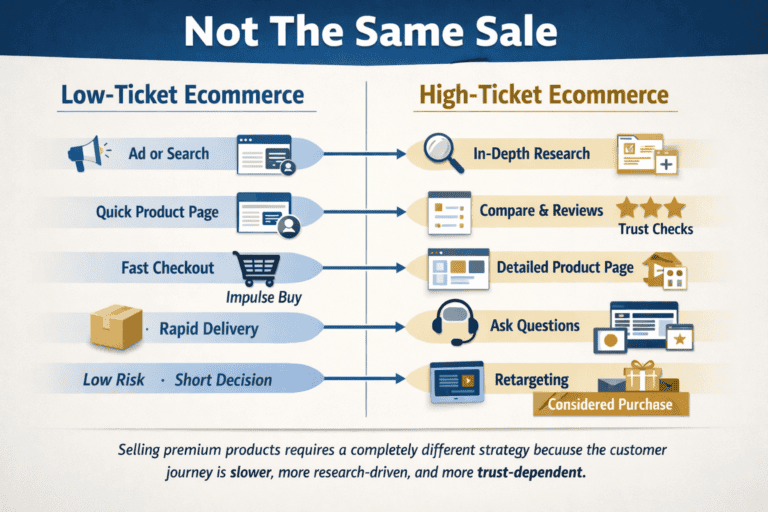
Selling a £30 phone case and selling a £3,000 piece of furniture are both ecommerce. But they are almost nothing alike.
High-ticket ecommerce selling products priced at several hundred to several thousand pounds or dollars operates by a fundamentally different set of rules. The traffic strategies are different. The conversion psychology is different. The customer service expectations, the margins, the returns process, the trust signals all of it is different.
And yet many online sellers try to apply low-ticket, volume-based thinking to premium products, and then wonder why the numbers don’t work.
This article is for sellers who are either already operating in the premium space or considering a move upmarket. What follows are the strategic principles that separate high-ticket ecommerce businesses that scale profitably from those that generate impressive revenue with very little to show for it at the end of the year.
1. Understand What Actually Makes a Product “High-Ticket”
Before getting into strategy, it’s worth defining the territory clearly. High-ticket ecommerce isn’t just about price. It’s about the nature of the buying decision.
A high-ticket purchase typically involves a longer consideration period, multiple touchpoints before conversion, higher emotional stakes, and a buyer who is doing serious research before committing. Whether you’re selling luxury yachts where a single transaction can run into six figures and the sales cycle spans months or bespoke roman curtains at £400 a window, the underlying dynamic is the same: the customer needs to trust you deeply before they will buy.
This distinction matters because it reshapes your entire marketing and operations strategy. You are not optimising for impulse. You are optimising for considered, confident purchasing decisions.
2. Margin Architecture Matters More Than Revenue
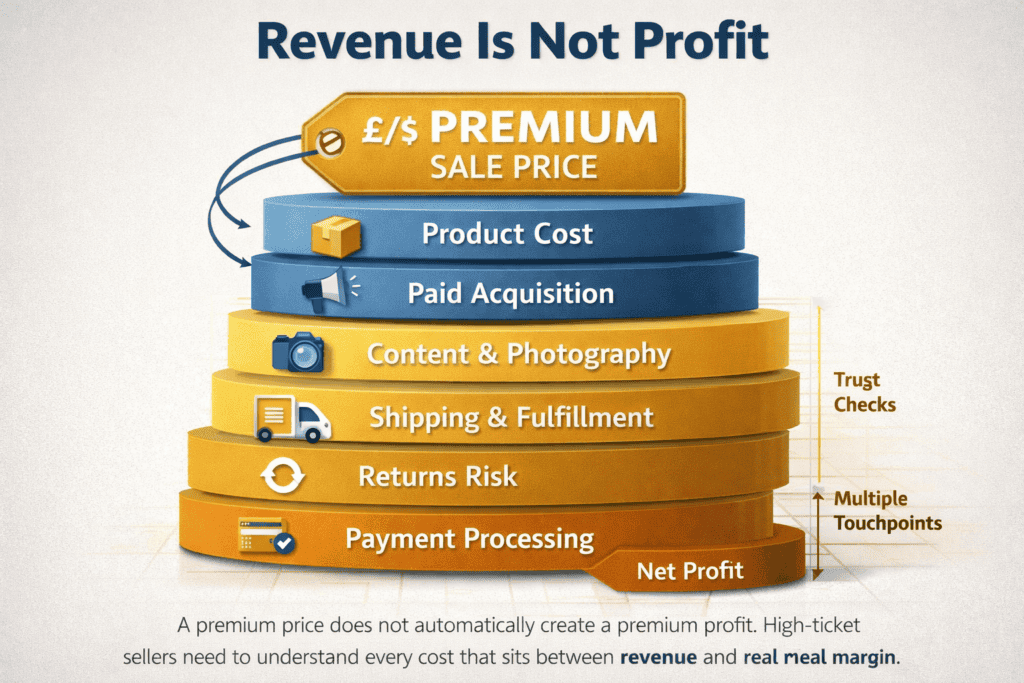
One of the most common mistakes in high-ticket ecommerce is treating high prices as a proxy for high profit. They are not the same thing.
Premium products often carry significant associated costs: longer customer acquisition cycles (meaning higher marketing spend per conversion), elevated return and customer service expectations, specialist photography and content production, white-glove fulfillment requirements, and often, substantial platform and payment processing fees.
According to Shopify’s commerce research, high-ticket sellers need to map their full cost-to-serve before setting prices factoring in not just product cost and shipping, but the entire customer acquisition and retention journey.
Build your pricing from the margin backwards, not the market forwards. Know exactly what gross margin you need to remain profitable before a single unit ships.
3. Your Product Pages Need to Do the Work of a Salesperson
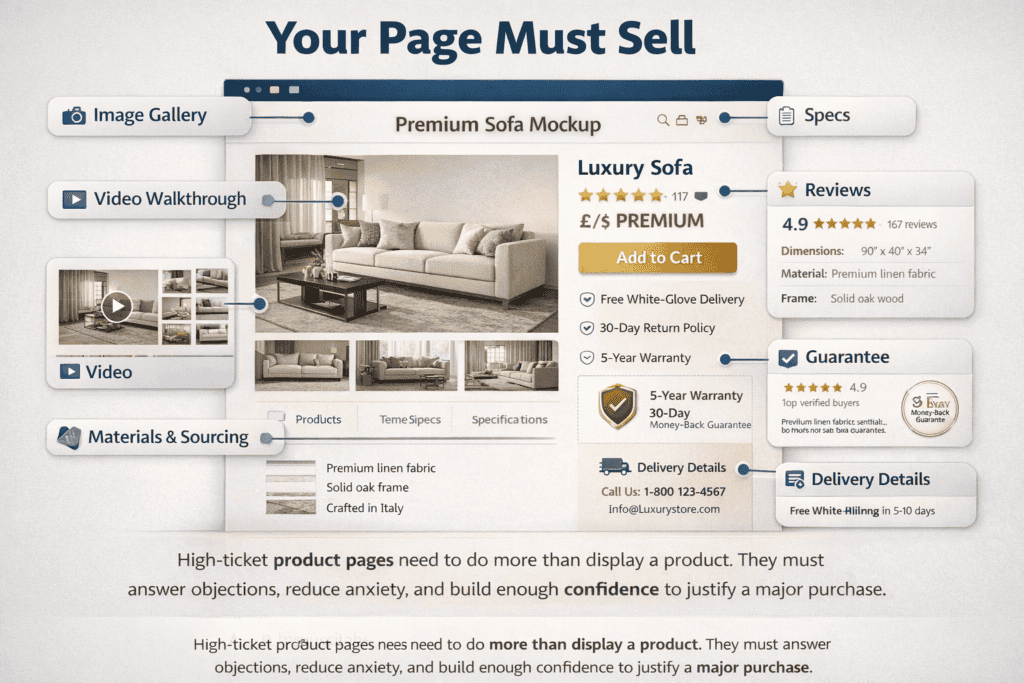
In a physical luxury retail environment, a skilled salesperson handles objections, builds rapport, explains provenance, and creates emotional resonance. Your product page has to do all of that, without a human present.
This means high-ticket product pages require significantly more investment than standard ecommerce pages. Expect to include professional photography from multiple angles, video walkthroughs, detailed specification tables, material and sourcing information, size and scale references, and critically social proof that speaks to the specific anxieties of a high-value buyer.
The question a £2,000 buyer is asking is not “does this look nice?” It is: “Can I trust this company with this level of investment? Will this actually be what I expect when it arrives?” Your product page needs to answer both questions comprehensively before the buyer ever reaches the checkout.
4. Trust Is Your Most Valuable Conversion Asset
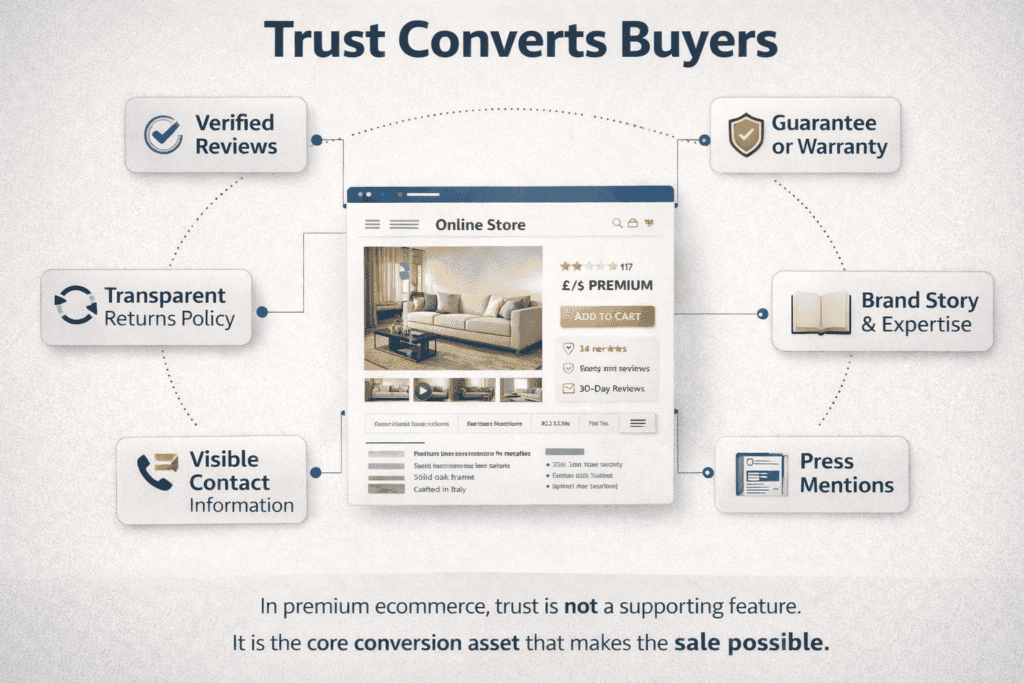
For high-ticket buyers, trust isn’t a nice-to-have it is the conversion. Every element of your online presence either builds or erodes it.
The trust signals that matter most for premium ecommerce include: verified customer reviews that speak to product quality and delivery experience; detailed, transparent return and guarantee policies; visible contact information and responsive customer service; press mentions or industry accreditations; and a brand story that communicates genuine expertise and longevity.
Research from the Baymard Institute consistently shows that checkout abandonment rates are highest when buyers feel uncertain about a store’s legitimacy or returns process. For high-ticket purchases, this uncertainty is amplified. The solution is radical transparency make it easier for a buyer to find reasons to trust you than to find reasons to doubt you.
5. Paid Traffic Economics Work Differently at High Ticket
If you’re running paid advertising for a £50 product, a £20 cost per acquisition is a problem. If you’re running paid ads for a £2,000 product with a 40% margin, a £200 CPA is an excellent result.
This seems obvious, but many sellers enter the high-ticket space still thinking in low-ticket CPA terms and either underspend on paid channels (starving campaigns before they optimise) or panic at acquisition costs that are actually perfectly healthy for their margin structure.
The key metric to anchor to is return on ad spend (ROAS) in the context of your net margin, not raw CPA. A high-ticket business can afford to acquire customers more expensively, run longer retargeting windows, and invest in more touchpoints across the customer journey because the value of each conversion justifies it.
6. SEO Has an Outsized Role in High-Ticket Sales
High-ticket buyers do extensive research before purchasing. They read comparison articles, look for reviews, search for alternatives, and often return to the same website multiple times before converting. This research-heavy behaviour makes organic search one of the most powerful and cost-efficient channels available to premium ecommerce brands.
A buyer searching “best bespoke roman curtains made to measure” or “how to choose a premium home audio system” is not browsing idly. They are deep in a consideration cycle and highly likely to convert if you can answer their questions authoritatively.
According to BrightEdge research, organic search drives over 53% of all website traffic and for considered, high-value purchases, that proportion is typically even higher. Investing in long-form buying guides, product comparison content, and in-depth category pages pays disproportionate dividends in the high-ticket space.
7. The Post-Purchase Experience Is Part of the Product
In low-ticket ecommerce, a smooth delivery and a functional returns process are the baseline expectation. In high-ticket ecommerce, the post-purchase experience is inseparable from the product itself and is often the primary driver of reviews, referrals, and repeat business.
Premium buyers expect premium unboxing experiences, proactive communication throughout the delivery process, easy access to specialist aftercare advice, and a returns process that doesn’t feel adversarial. If any part of the post-purchase journey feels inconsistent with the price they paid, you will lose not just the customer but their network.
8. Niche Down Further Than You Think You Need To
One of the counterintuitive realities of high-ticket ecommerce is that narrower positioning almost always outperforms broader positioning. A specialist in premium Italian bed linen will convert better and rank more easily than a general luxury home goods store even if the latter carries more products.
This is because high-ticket buyers are not looking for the most comprehensive option. They are looking for the most credible, expert option. Specialist positioning signals depth of knowledge, curation, and authority all of which map directly to trust, and therefore to conversions.
Identify the narrowest viable niche your product or range can credibly own. Build your brand, your content, and your SEO strategy around that specific space. You can always expand later, once you’ve established genuine authority in your core territory.
9. Retention Economics Make or Break High-Ticket Profitability
Because high-ticket customer acquisition is expensive, the economics of repeat purchase and referral become disproportionately important. A customer who buys once at £1,500 is valuable. A customer who buys twice, or who refers two friends, is transformational.
This means that post-purchase marketing email sequences, loyalty recognition, personalised product recommendations, exclusive offers for returning customers deserves a level of investment that many high-ticket sellers overlook in favour of constantly chasing new acquisition.
According to Harvard Business Review, acquiring a new customer costs between five and twenty-five times more than retaining an existing one. In high-ticket ecommerce, where acquisition costs are already elevated, this ratio makes retention strategy one of the highest-leverage investments available to you.
10. Profitability Requires Saying No to the Wrong Customers
This is the strategy most high-ticket ecommerce guides won’t tell you: not every buyer is a good buyer at the premium end of the market.
Customers who are primarily price-driven, who are unclear on their requirements, or who have misaligned expectations before purchase are significantly more likely to generate returns, disputes, negative reviews, and support burden all of which erode margin at a scale that matters in low-volume, high-value businesses.
The solution is not to be exclusionary for its own sake. It is to qualify buyers through your content, your positioning, and your pre-purchase communications. Clear, detailed product information filters out buyers who aren’t the right fit. A transparent returns policy attracts confident buyers and deters those who are hedging. A brand story that communicates your values will naturally attract customers who share them.
In high-ticket ecommerce, who you sell to is as strategically important as how you sell.
The Bottom Line
High-ticket ecommerce rewards businesses that think differently about every element of the customer journey from the depth of a product page to the quality of a follow-up email. The margin opportunity is real. So is the complexity.
The sellers who profit consistently in the premium space share a common discipline: they design their entire operation around the expectations and psychology of a considered, high-value buyer, and they never mistake high revenue for high profitability.
Get those fundamentals right, and high-ticket ecommerce is one of the most sustainable and scalable models available to independent online sellers.
About the author:
Sofiko Saltkhutsishvili is a content writer and a Partner Marketing Manager at SEO Sherpa – Global Best Large SEO Agency Winner. The agency focuses on SEO, PPC, Digital PR, and Search Everywhere Optimization.
Sofiko enjoys conducting in-depth research on topics she writes about and shares her authentic experiences with readers. On the side, she is a Creator Agent, connecting LinkedIn creators to the right brands for partnerships. Originally from beautiful Georgia, she currently resides in its capital, Tbilisi.