A 2025 Ahrefs study found that 96.55% of all pages get zero organic traffic from Google. For e-commerce stores, that number hits even harder because the pages getting ignored are usually the ones that make money: product and category pages.
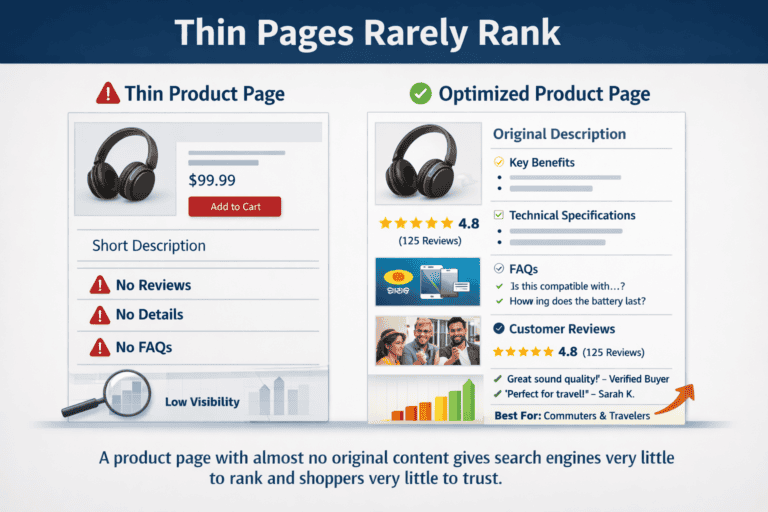
Most store owners assume the problem is competition. It is not. The problem is that the average product page gives Google almost nothing to work with. A manufacturer description, a price, an add-to-cart button, and maybe a stock photo. That is not a page worth ranking. That is a placeholder. And if you are still working on the basics of getting your e-commerce store found on Google, fixing your product pages is where the biggest gains are hiding.
This article breaks down exactly why e-commerce product pages fail in search, what the top-performing pages do differently, and where to focus your effort if you want organic traffic that actually converts into sales.
The Thin Content Problem
According to Reboot Online’s analysis of e-commerce SEO performance, 92% of the lowest-performing e-commerce sites have thin content issues. Content depth correlates directly with rankings, and most product pages are running on fumes.
The average e-commerce page title is just 39 characters long, well below the recommended 50 to 60 character range. Meta descriptions average 96 characters, missing the optimal 155 to 160 window. These are basic signals that tell Google what your page is about, and the majority of stores are not even filling them out properly.
But the real issue goes deeper than meta tags.
A product page with 50 words of manufacturer copy is competing against pages with 300 to 500 words of original content, customer reviews, detailed specifications, comparison sections, and FAQ blocks. Google has made clear through its Helpful Content guidelines that pages need to demonstrate genuine expertise and provide real value to users. A thin product page does neither.
The fix is not complicated, but it takes work. Each product page needs original descriptions focused on benefits and use cases (not just specs), a section explaining who the product is for and why, and enough unique content that Google can distinguish your page from every other store selling the same item. If you are reselling products, this is especially critical. Using the same manufacturer description as 50 other stores guarantees you will never rank.
Missing Schema Markup
Structured data is one of the highest-leverage, lowest-effort SEO improvements available to e-commerce stores. And most stores either skip it entirely or implement it incorrectly.
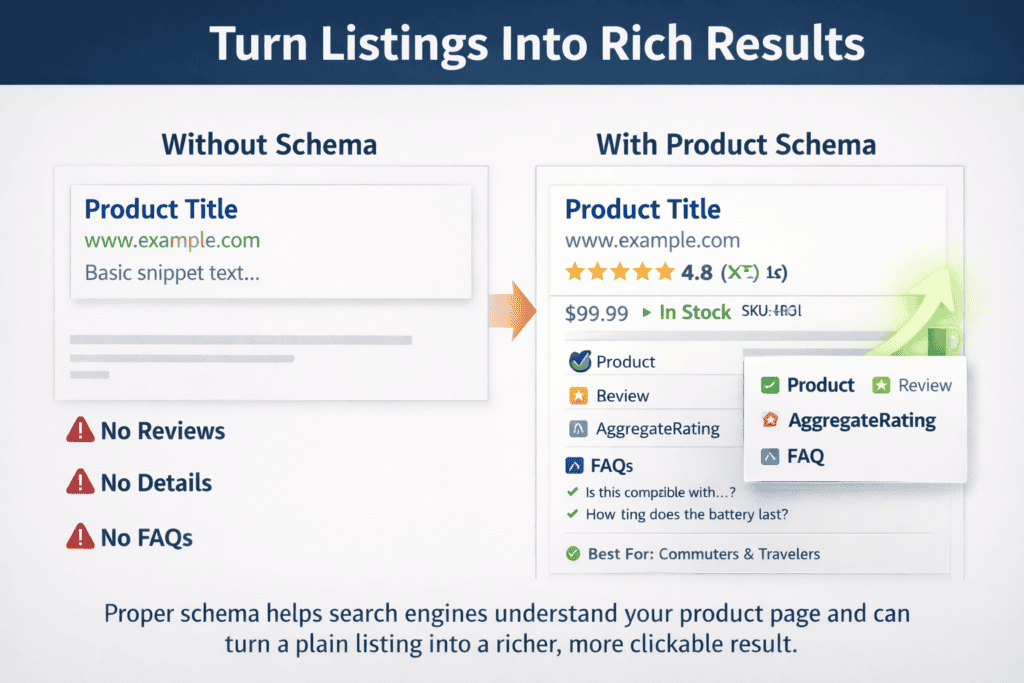
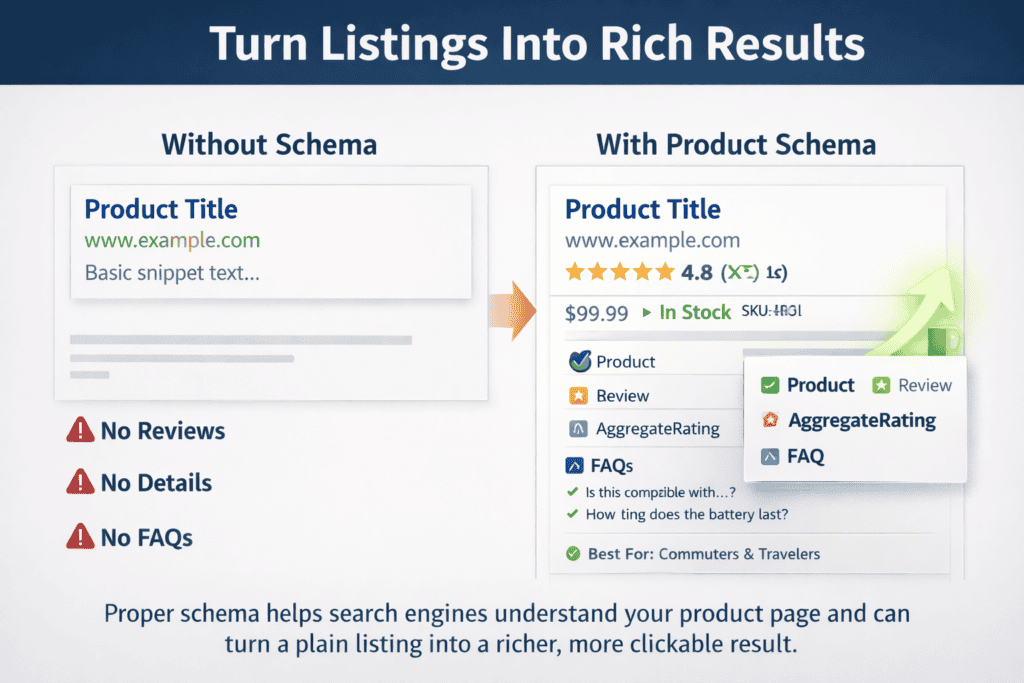
Pages with structured data achieve 20 to 40% higher click-through rates in search results, according to Charle Agency’s analysis of e-commerce SEO benchmarks. Rich results, where Google displays star ratings, prices, and availability directly in the search listing, achieve an 82% higher CTR compared to standard listings. Product schema specifically delivers 4.2x higher visibility in Google Shopping.
With AI Overviews now using structured data as a primary source for product information, proper schema implementation is not optional in 2026. It is table stakes.
At minimum, every product page should include Product schema with price, availability, and SKU, along with Review and AggregateRating schema if you have customer reviews, and FAQ schema for any question-and-answer content on the page. Most modern e-commerce platforms like Shopify, WooCommerce, and BigCommerce either support this natively or through plugins. If you are not sure whether your schema is working, run your pages through Google’s Rich Results Test.
For a deeper look at how search engines and AI systems evaluate your store’s credibility signals, the guide to SEO, AEO, and E-E-A-T on this site covers the framework in detail.
Reviews and User-Generated Content
Sites displaying customer reviews experience conversion increases of up to 270%. Products with 50 or more reviews convert 4.6 times better than those without. And brands integrating user-generated content see up to 6x higher conversion rates.
Those numbers are about conversion, but they matter equally for SEO. Google treats customer reviews as unique content. A product page with 20 genuine reviews has substantially more indexable text, more keyword variation, and more freshness signals than a page with none. Reviews answer the long-tail questions that shoppers actually search for, things like “does this jacket run small” or “is this blender loud.”
According to Semrush’s research on e-commerce optimization, 73% of top e-commerce brands use user-generated content on their product pages. That number drops to just 28% for mid-sized brands. The gap represents a massive competitive advantage for stores willing to invest in collecting and displaying reviews.
If your product pages do not have reviews yet, here is where to start. Send post-purchase emails requesting reviews (timing matters, send them after the customer has had time to use the product, not the day it arrives). Make leaving a review as frictionless as possible, ideally one click from the email. And display reviews prominently on the page, not hidden behind a tab that requires scrolling.
Product videos are worth mentioning here too. Video content boosts conversions by 17% and engagement by 33%. A short product demonstration video does more for both ranking and conversion than another paragraph of marketing copy. If you are unsure which layout or content approach works best, A/B testing different product page formats can give you the answer.
The Internal Linking Gap
This is the problem most e-commerce stores do not even know they have.
According to Reboot Online, 86% of e-commerce sites lack optimized internal linking. That is a staggering number for what is arguably the single most controllable SEO lever available.
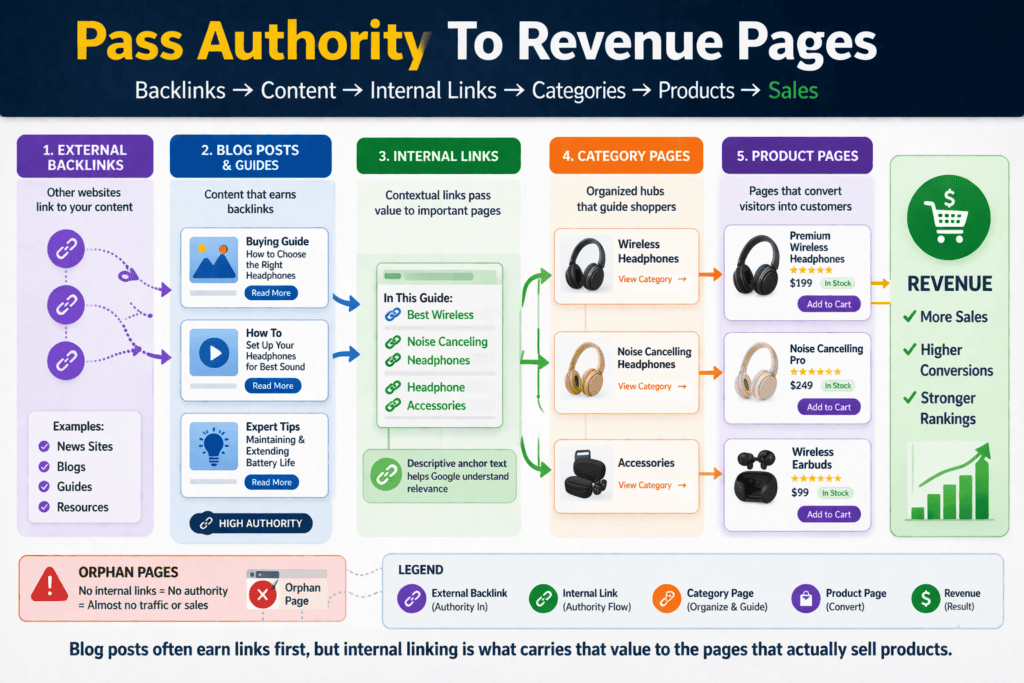
Here is why it matters so much for product pages specifically. As covered in the e-commerce link building guide on this site, external backlinks almost never point directly to product pages. They point to blog posts, guides, and resource pages. The only way to transfer that authority to the pages that generate revenue is through internal links.
A blog post about “how to choose running shoes for beginners” that earns 30 backlinks is valuable. But it is only valuable for your bottom line if it links to your running shoe category page and your best-selling product pages with descriptive anchor text. Without those internal links, the authority stays trapped on the blog and never reaches the pages that convert.
The fix has three parts. First, audit your existing blog content and add contextual links to relevant product and category pages. Second, structure your site so that product pages are reachable within three clicks from the homepage. Third, use related products, cross-sells, and breadcrumb navigation to create a dense web of internal links across your store.
Tools like Ahrefs Site Audit can identify orphan pages, pages with no internal links pointing to them, that are effectively invisible to both Google and your customers.
Page Speed: The Silent Ranking Killer
Google estimates that 53% of mobile users abandon a site if it takes longer than three seconds to load. For e-commerce stores, where mobile accounts for roughly 75% of traffic, this is not a minor issue.
The impact is measurable. Portent’s analysis found that e-commerce sites loading in one second have a 2.5x higher conversion rate than sites loading in five seconds. A Vodafone case study showed that a 31% improvement in Largest Contentful Paint led to an 8% increase in sales. Speed is just as important for your landing pages as it is for product pages.
But speed affects more than just conversion. Google uses Core Web Vitals, which measure loading performance, interactivity, and visual stability, as ranking signals. A slow product page is not just losing customers. It is losing rankings to faster competitors.
The biggest speed killers on e-commerce product pages are usually uncompressed product images (compress them and use lazy loading so images only load as users scroll), too many third-party scripts like chat widgets, analytics tools, and recommendation carousels all loading at once (defer non-critical JavaScript), and layout shifts caused by late-loading elements like price badges or review stars.
Run your product pages through Google PageSpeed Insights and prioritize fixing anything in the red. For stores running on Shopify or WooCommerce, platform-specific speed optimization apps can handle the heavy lifting.
Category Pages Deserve More Attention
Most stores treat category pages as simple product grids. That is a missed opportunity.
A Digitaloft study of 300 top-ranking e-commerce category pages found that the average word count was just 310 words, with 44% having fewer than 200 words. But here is the critical finding: category pages with zero unique content that still ranked in the top spot almost always belonged to household-name brands with massive domain authority.
If you are not Nike or Amazon, you cannot rank category pages without some unique, useful content. The study found that the sweet spot for most stores is 200 to 400 words of content that helps the shopper understand the category and make a purchase decision. Not a 2,000-word essay. Not a “what is” explainer that belongs on Wikipedia. Just clear, specific guidance about what the category offers, what to look for, and why to buy from you. In a market where e-commerce is becoming harder to compete in, this kind of content is what separates stores that rank from stores that do not.
Think of it as the advice a knowledgeable salesperson would give in a physical store. That is the content that performs.
The Compound Fix
No single change will make your product pages rank. The stores that dominate organic search in 2026 are the ones that get all of these elements working together.
Unique, detailed product content that goes beyond manufacturer descriptions. Proper schema markup so Google can display rich results. Customer reviews that add fresh, keyword-rich content to every page. A deliberate internal linking architecture that funnels authority from content to commercial pages. Fast load times across all devices.
Each of these individually moves the needle a small amount. Together, they compound into the kind of organic visibility that turns search traffic into actual revenue.
The good news is that most of your competitors are not doing any of this well. That 96.55% stat is not just a scary number. It is the size of the opportunity.
About the Author

Matija Konjić is the founder of Link Inbound, a link building and content marketing agency working with B2B and B2C brands. He has built campaigns across 40+ industries and obsesses over the data behind what actually moves rankings.