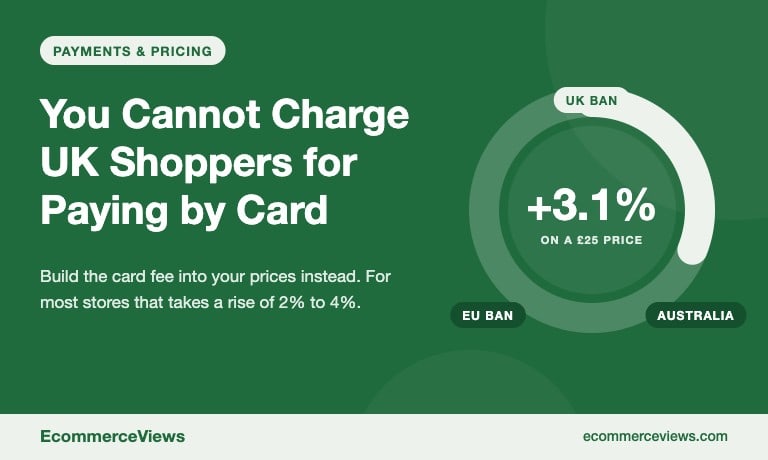
Every card payment costs an online store money, and every store owner has at some point wanted to add that cost to the customer’s bill. In the UK you cannot. Since 13 January 2018, charging consumers extra for paying by debit card, credit card or most other electronic methods has been illegal. The same ban applies across the EU, and Australia is now removing card surcharges on its main networks too.
My view is that this is not a problem to work around. It is a pricing job. Stores that treat the card fee as part of their cost of sale, and build it into every price on purpose, protect their margin better than stores that hope to recover it at checkout. The arithmetic is simple, and the price increases needed are smaller than most owners expect.
Key points
- Surcharging consumer card payments in the UK has been banned since 13 January 2018. HM Treasury estimated that UK consumers paid £166 million in surcharges in 2015.
- The EU ban started on the same day, under the second Payment Services Directive. BEUC expected more than 95% of payments to be free of card surcharges after it.
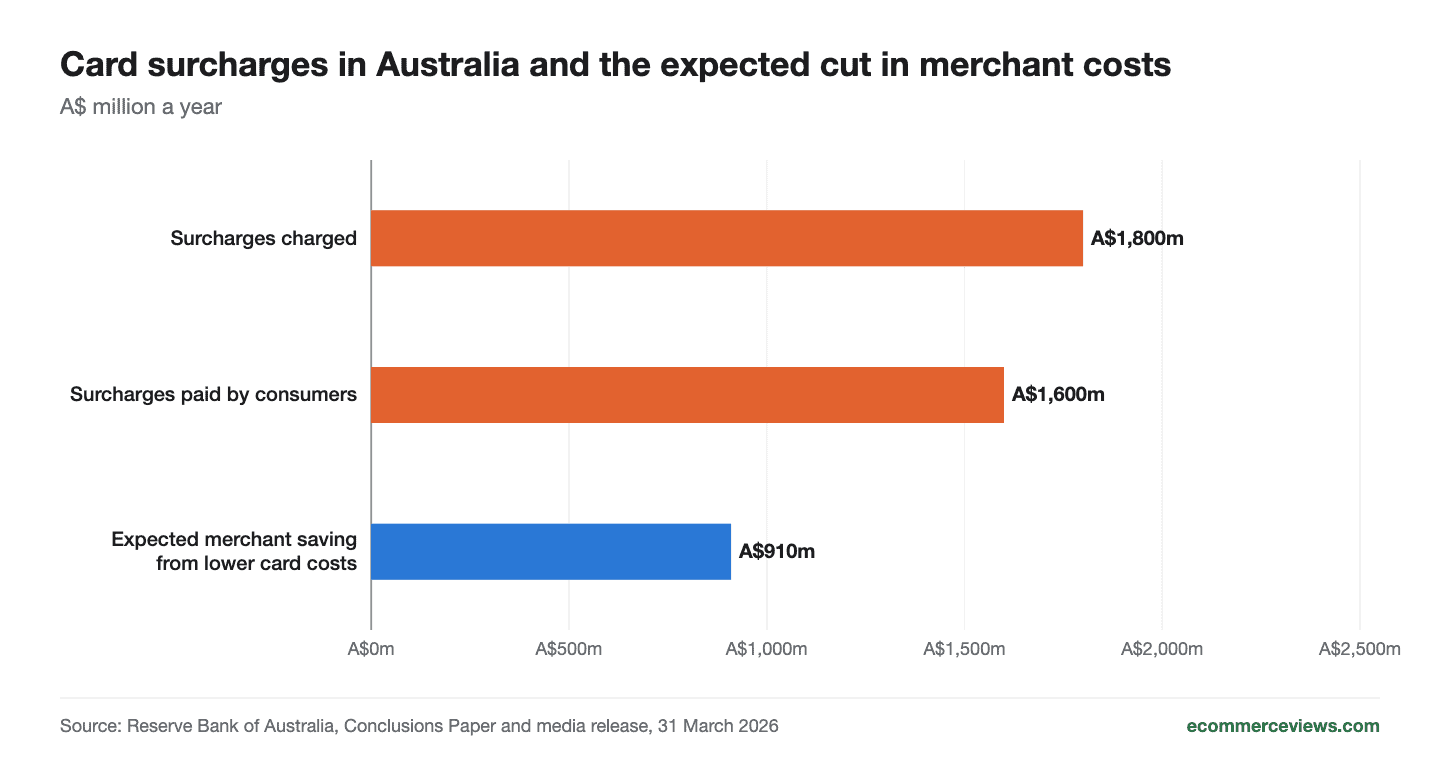
- Australia is removing surcharges on debit, prepaid and credit cards on the eftpos, Mastercard and Visa networks from 1 October 2026. The Reserve Bank of Australia (RBA) found that consumers paid about AUD 1.6 billion of the AUD 1.8 billion in surcharges charged each year.
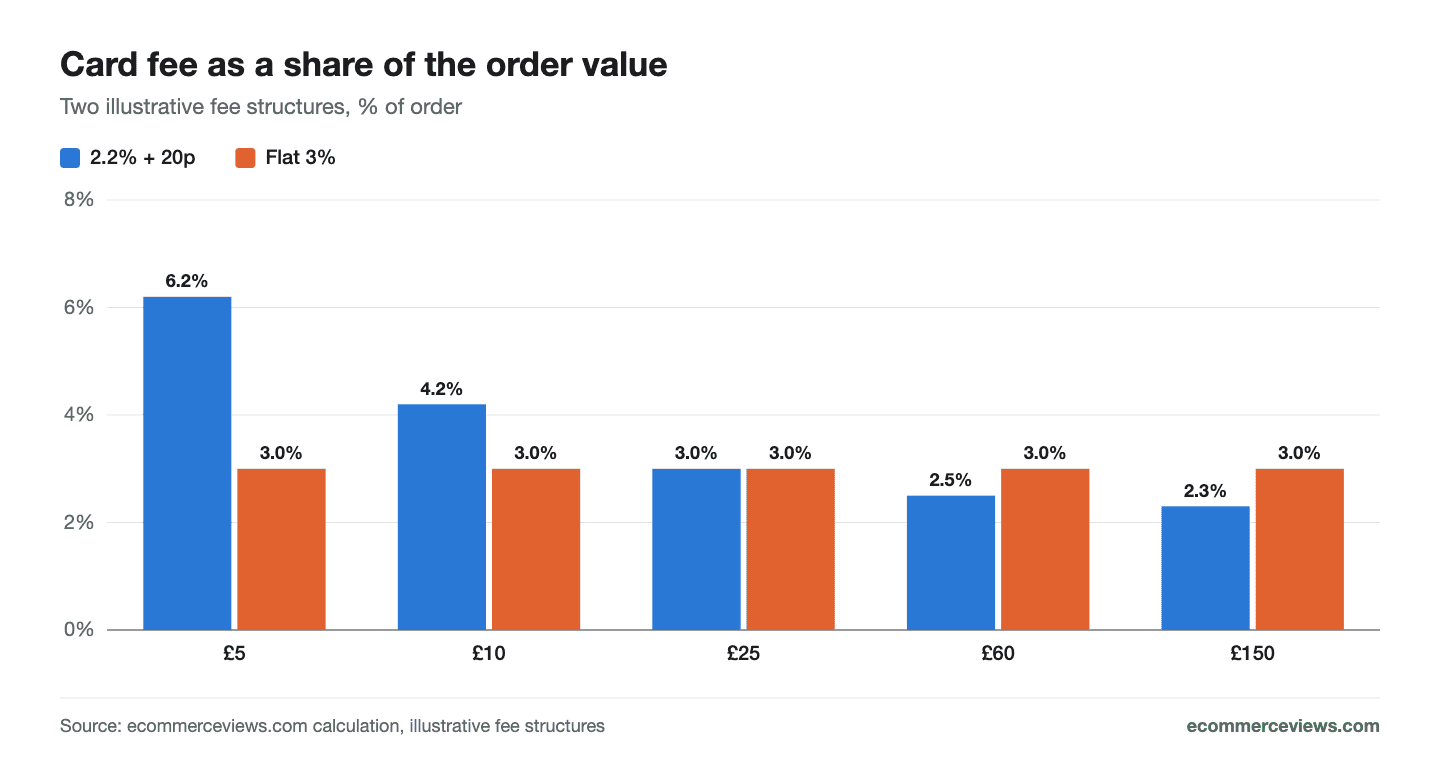
- A typical card fee takes 3% of a £25 order in our illustrative example (2.2% + 20p), but 6.2% of a £5 order, because of the fixed fee.
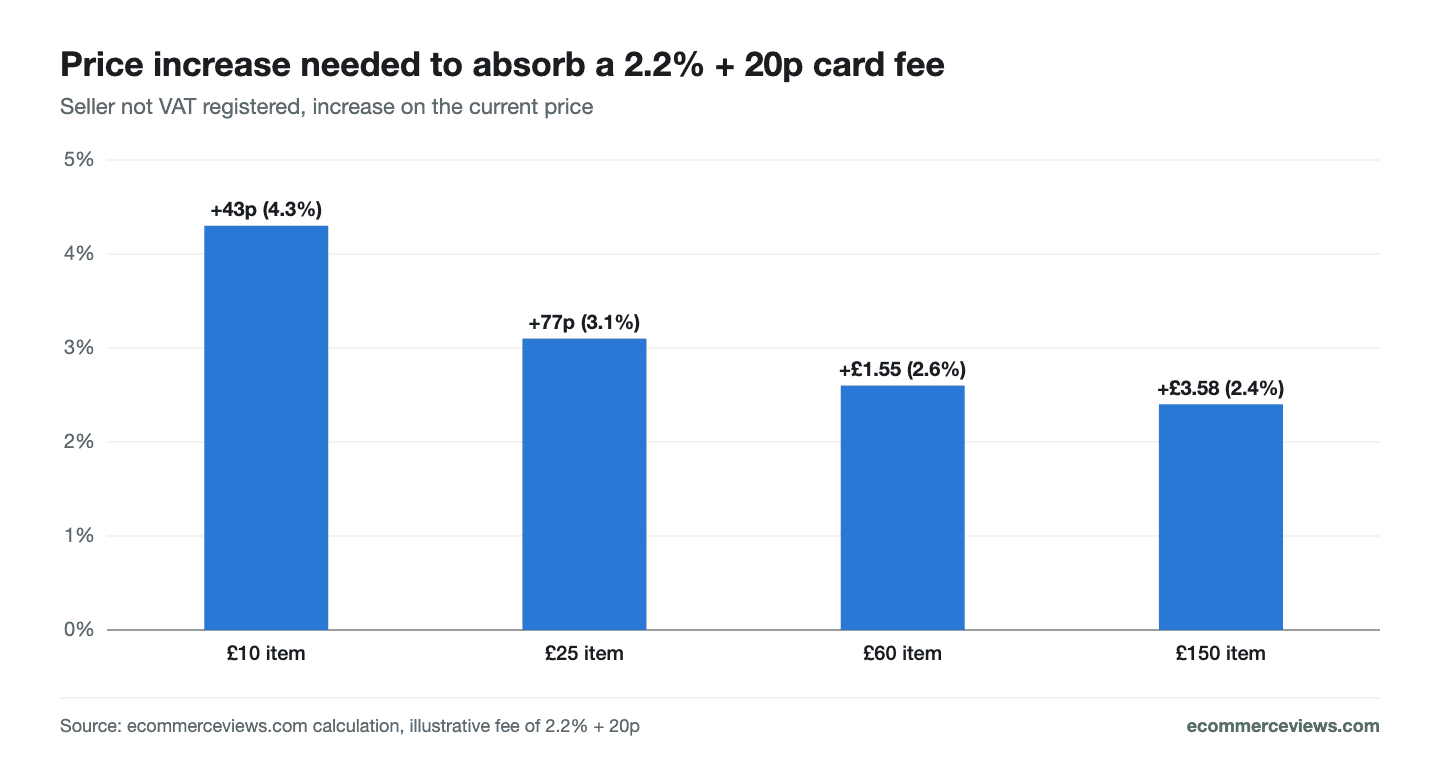
- To absorb that fee fully, a £25 price needs to rise by 77p, or 3.1%. A £60 price needs £1.55 more (2.6%) and a £10 price 43p more (4.3%).
- For a VAT-registered seller the increase is slightly larger: about 3.5% on a £30 item, because the fee is charged on the VAT-inclusive price.
The UK ban
The rule sits in the Consumer Rights (Payment Surcharges) Regulations 2012. The original version only banned surcharges above the trader’s actual cost. A 2018 amendment, regulation 6A, went further. It stops a business from charging any fee to a consumer for paying with a consumer card-based payment instrument, or with other covered payment services, from 13 January 2018.
In practice that covers:
- consumer debit and credit cards
- other covered electronic payments to consumers
- the payment method chosen at checkout, whatever the device
It does not cover commercial cards issued to businesses, so a B2B store selling to companies paying by corporate card is in a different position.
How the ban is enforced
When the ban came in, the Treasury announcement said it would also apply to other payment systems such as PayPal, and that Trading Standards can take enforcement action. Customers who pay an unlawful surcharge can ask for it back.
The EU ban
The same date marked the start of the EU-wide ban under the second Payment Services Directive (PSD2). The European consumer group BEUC noted at the time that the ban covers card payments, credit transfers and direct debits, while some member states left room for exceptions such as business cards. Before the ban, the European Commission estimated that 14% of merchants in Ireland and the UK added card surcharges.
Where surcharging is still allowed
Outside Europe the picture is mixed:
- United States: surcharging on credit cards is allowed in most states, within card scheme rules. Visa, for example, requires merchants to notify their acquirer 30 days before they start surcharging. Some states restrict it.
- Australia: surcharges have been allowed if they do not exceed the merchant’s cost of acceptance. That is now ending on the main networks.
For a UK store selling to UK and EU consumers, the answer is simple: you cannot surcharge them. The question is how to recover the cost instead.
Australia shows where the debate ends
Australia is the most useful case, because it tried the “cost-based surcharge” model that some UK retailers still wish they had, and decided to end it.
Card surcharges in Australia and the expected cut in merchant costs
In its review of merchant card payment costs, the RBA found that card surcharging had doubled since 2022 and that 16% of merchants were surcharging. In its executive summary, it estimated that consumers paid around AUD 1.6 billion of the AUD 1.8 billion in surcharges charged each year, including surcharges they did not expect because of poor signage.
What the RBA decided
The RBA’s answer has two parts, set out in its 31 March 2026 media release: remove surcharges on the main networks, and lower the wholesale card costs merchants pay so they can price them in. That is close to the situation UK stores have been in since 2018.
| Change | Detail | Takes effect |
|---|---|---|
| Surcharges removed | Debit, prepaid and credit cards on the eftpos, Mastercard and Visa networks | 1 October 2026 |
| Lower interchange caps | Domestic cards, especially consumer credit cards | 1 October 2026 |
| New cap on foreign-issued cards | Interchange on cards issued abroad | 1 April 2027 |
| Expected merchant saving | Lower wholesale card costs | about A$910 million a year |
Source: Reserve Bank of Australia, Conclusions Paper and media release, 31 March 2026.
The fee is already in your costs, so put it in your prices
A card fee is not an extra on top of a sale. It is part of the cost of making the sale, just like packaging and postage. The useful question is how big it is as a share of each price.
Card fee as a share of the order value, two illustrative fee structures
The chart uses two illustrative fee structures rather than any one provider’s rates. One is a percentage plus a fixed fee (2.2% + 20p). The other is a flat 3%. Two things stand out:
| Order value | Fee at 2.2% + 20p | Share of order | Fee at flat 3% | Share of order |
|---|---|---|---|---|
| £5 | £0.31 | 6.2% | £0.15 | 3.0% |
| £10 | £0.42 | 4.2% | £0.30 | 3.0% |
| £25 | £0.75 | 3.0% | £0.75 | 3.0% |
| £60 | £1.52 | 2.5% | £1.80 | 3.0% |
| £150 | £3.50 | 2.3% | £4.50 | 3.0% |
Illustrative fee structures. Source: ecommerceviews.com calculation.
- On cheap items the fixed fee dominates. A 20p fixed fee is 4% of a £5 order on its own.
- On larger orders the percentage matters most, and a flat-rate structure becomes the more expensive one above £25.
Your own fee depends on your provider, your order size and where your customers’ cards come from. Work out your real figure with the UK Payment Fee Calculator.
How much prices need to rise
Absorbing the fee does not mean adding the fee percentage to every price. Because the fee is charged on the new, higher price, you need a little more. The formula is:
New price = (current price + fixed fee) / (1 – percentage fee)
Price increase needed to absorb a 2.2% + 20p card fee
For a seller who is not VAT registered, with a 2.2% + 20p fee:
| Current price | Price that keeps the same income | Increase | Increase in % |
|---|---|---|---|
| £10.00 | £10.43 | £0.43 | 4.3% |
| £25.00 | £25.77 | £0.77 | 3.1% |
| £60.00 | £61.55 | £1.55 | 2.6% |
| £150.00 | £153.58 | £3.58 | 2.4% |
Illustrative fee of 2.2% + 20p. Source: ecommerceviews.com calculation.
For VAT-registered sellers, the price shown to the customer includes 20% VAT, and the card fee is charged on that full amount. To keep the same income excluding VAT, a £12 item needs to go to about £12.57 (+4.8%), a £30 item to £31.06 (+3.5%), a £60 item to £61.87 (+3.1%) and a £150 item to £154.31 (+2.9%).
These are small changes. Most customers will not notice an extra 77p on a £25 product, especially if the new price sits on a natural price point. They do notice a separate line that says “card fee” at checkout, which is one reason the law changed.
Use price points, not exact numbers
You do not have to land on £25.77. Price points work in your favour here:
- £24.99 to £25.49 keeps you at about £24.73 after the fee, so it absorbs most of the cost while staying under £26.
- £24.99 to £25.99 gives you £25.22 after the fee, slightly more than the original £24.99.
- £9.99 to £10.49 leaves £10.06 after the fee, covering it fully.
Test any change rather than guessing. Our guide on what to measure after a price change sets out the numbers to watch in the weeks after.
The case against
There are fair arguments against simply raising prices.
- Cash and bank-transfer customers pay for card users. When the fee is in the price, every customer pays it, including those who use cheaper methods. Surcharges at least put the cost on the person who chose the card.
- Price comparison is brutal. On marketplaces and price comparison sites, a store that adds 3% to every price may slip down the rankings. A visible surcharge kept the listed price lower.
- Fees differ by card. Premium and international cards cost more to process. A single price increase cannot match the real cost of each payment.
- Small orders are the hardest. On a £5 item, absorbing a fixed fee means a 6% rise, which can push a cheap product out of its price band.
These points are real, but they do not change the law. A UK store cannot surcharge consumers, so the choice is between pricing the fee in deliberately or quietly losing margin on every order.
What to do
- Find your real effective fee. Look at last month’s payment fees divided by last month’s card revenue. That one percentage tells you how much margin you are giving away.
- Price new products with the fee included. Add the fee to your cost per unit, next to product cost, packaging and postage, before you set a price.
- Fix your lowest-priced items first. The fixed fee hits small orders hardest, so review anything under £15. Bundles and minimum order values help more than tiny price changes here.
Lower the fee, not just the price
Compare providers on your own order mix. The cheapest provider depends on your average order value and customer locations, which our overview of payment gateway fees explains.
Make each order carry the fee better
Raise the average order value. A larger basket spreads the fixed fee and the postage over more revenue. Our analysis of free shipping and parcel prices shows why thresholds also matter for delivery costs.
Keep the checkout clean
Do not add hidden fees at checkout. Beyond the legal risk, unexpected costs at checkout are a leading reason for abandoned carts, as our guide to conversion rate optimization covers.
The bottom line
The UK and EU made their decision in 2018, and Australia is following in 2026. Card fees belong in the price, not on the receipt. For most online stores, absorbing them takes a price rise of 2% to 4%, which a well-chosen price point can hide almost entirely. The stores that suffer are the ones that never do the sum and let the fee come out of their margin, one order at a time.