Free shipping is sold to merchants as a conversion tool and to shoppers as a basic expectation. What rarely gets said is that it is a promise to absorb a cost that rises faster than almost anything else in an online store’s budget.
US government price data makes the point plainly. Between 2004 and 2024, the prices charged by couriers and express delivery companies more than tripled. Over the same period, the prices of the goods those parcels carry rose by less than a fifth. My view is that any store still offering unconditional free shipping on a fixed threshold it set years ago is quietly giving away more margin every year, and should change the deal.
Key points
- Courier and express delivery prices rose 217% from 2004 to 2024 (annual averages), an average of 5.9% a year.
- Core consumer goods prices rose 18% over the same 20 years, or 0.8% a year. Relative to the goods they deliver, parcel prices have risen about 2.7 times.
- Delivery prices outpaced goods prices in 19 of the last 20 years. The only exception was 2009.
- Since September 2019, courier prices are up 67.1%, expedited courier services 78.7% and postal prices 58.8%. Core goods prices are up 17.1%.
- The gap is widening again: in the 12 months to September 2026, courier prices rose 11.4% while core goods prices rose 0.7%.
- Large carriers keep raising list rates. FedEx set a 5.9% average increase on US package list rates for January 2026.
Where the numbers come from
The delivery figures are producer price indexes (PPI) from the US Bureau of Labor Statistics, published through FRED. They measure the prices that delivery companies receive for their services:
- Couriers and express delivery services (PCU492110492110), the main series for private parcel carriers, with sub-indexes for standard (ground) and expedited services
- Postal service (PCU491110491110)
For goods, we use the consumer price index for commodities less food and energy commodities (CUUR0000SACL1E), often called core goods. It covers the kind of products online stores sell: clothing, electronics, furniture, household goods, toys and similar items.
All long-run comparisons use annual averages for 2004 to 2024. The 2025 annual average for core goods is incomplete because the October 2025 CPI was not collected during the US government shutdown, so for recent years we compare September with September. These are US indexes, but the forces behind them, from fuel to labor to the number of parcels, apply to carriers in Europe too.
Twenty years of delivery inflation
Set both price levels to 100 in 2004 and the divergence is striking. By 2024, courier prices stood at 317, postal prices at 199, and core goods at 118.
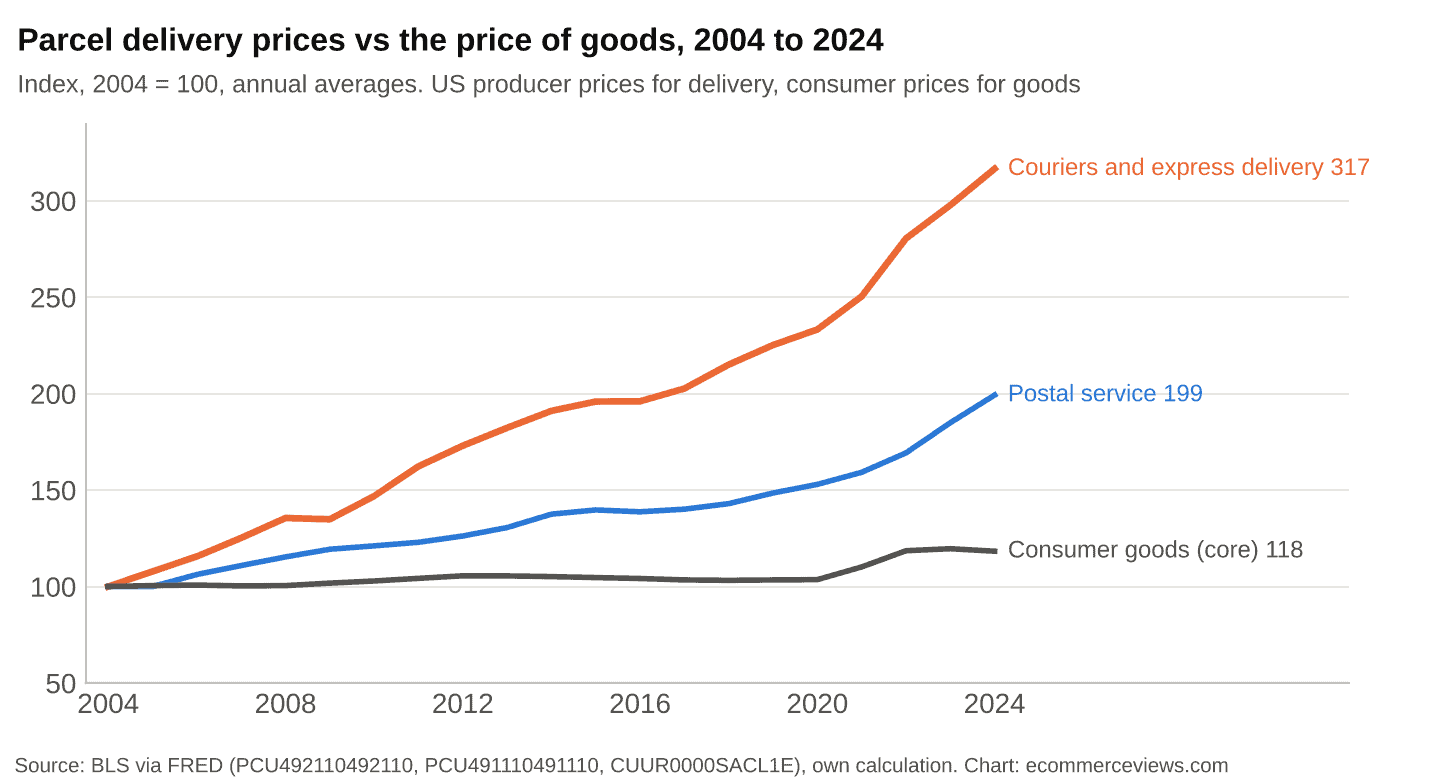
Parcel delivery prices vs the price of goods, index 2004 = 100
| Price index, annual average | 2004 to 2024 change | Average per year |
|---|---|---|
| Couriers and express delivery | +216.6% | +5.9% |
| Standard courier services | +211.3% | +5.8% |
| Expedited courier services | +228.5% | +6.1% |
| Postal service | +99.3% | +3.5% |
| Core consumer goods | +18.3% | +0.8% |
Source: BLS producer and consumer price indexes via FRED, own calculation.
The two lines tell the story of modern ecommerce. Goods became cheaper to make and source, thanks to global supply chains and automation, so their prices barely moved for 15 years. Delivery is labor, fuel, vehicles and the last mile to the door, and none of those got cheaper. At the same time, the growth of ecommerce itself pushed up demand for parcel delivery year after year.
For an online store, this means the cost of shipping a typical order has risen far faster than the price you can charge for what is in the box. A product that sold for $40 in 2004 and cost $8 to ship would, at these index rates, sell for about $47 in 2024 but cost about $25 to ship.
The gap opens almost every year
This is not one bad stretch. In 19 of the 20 years from 2005 to 2024, courier prices rose faster than core goods prices.
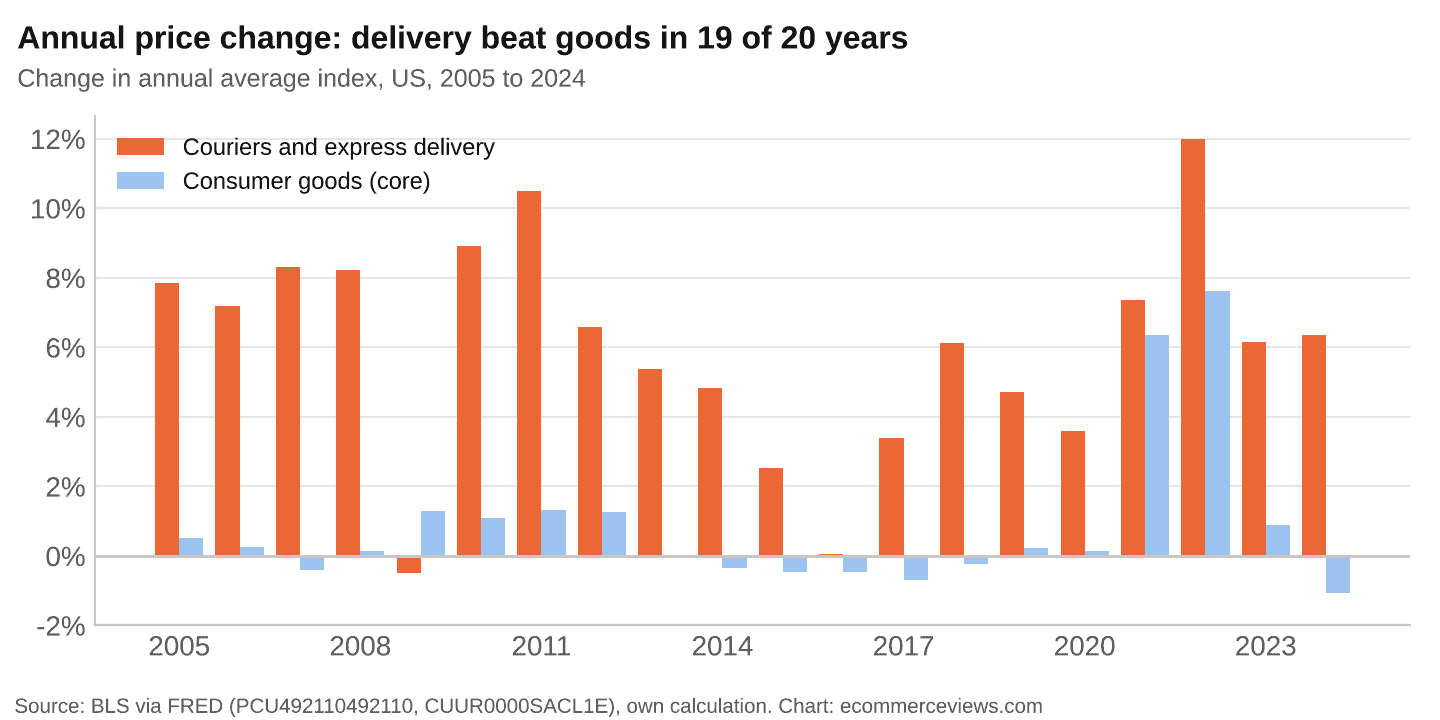
Annual price change for courier services vs core consumer goods, 2005 to 2024
The only year goods won was 2009, when courier prices fell 0.5% during the recession. In 2022 courier prices jumped 12.0%, the largest increase in the period. Even in 2021 and 2022, when goods inflation spiked to 6.4% and 7.6%, delivery prices rose faster still.
The pattern matters for planning. A free shipping policy set once and left alone loses value every year, not just in a crisis. Our analysis of how selling online is no longer cheaper than running a store found the same pressure from the cost side: fulfillment is eating into the margin advantage online retail once had.
Since 2019, the squeeze has accelerated
The most recent seven years show the sharpest gap.
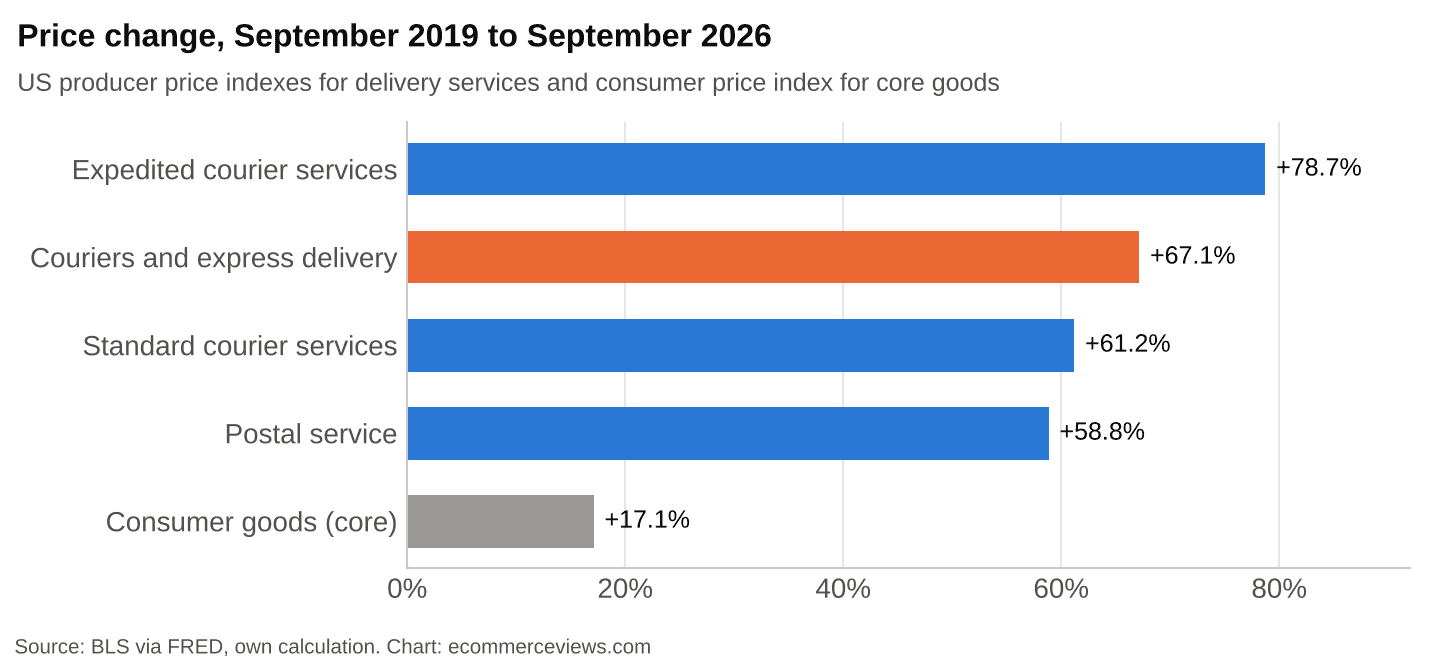
Price change for delivery services and core goods, September 2019 to September 2026
| Price change | Sep 2019 to Sep 2026 | Sep 2024 to Sep 2025 | Sep 2025 to Sep 2026 |
|---|---|---|---|
| Couriers and express delivery | +67.1% | +7.0% | +11.4% |
| Expedited courier services | +78.7% | +7.8% | +16.3% |
| Standard courier services | +61.2% | +6.6% | +8.6% |
| Postal service | +58.8% | +7.4% | +7.4% |
| Core consumer goods | +17.1% | +1.5% | +0.7% |
Source: BLS via FRED, own calculation.
Over the latest 12 months, courier prices rose 11.4% and expedited services 16.3%, while core goods prices barely moved at 0.7%. Postal prices, which many small stores rely on for light parcels, rose 7.4% in each of the last two years.
Carriers are explicit about this. FedEx set a 5.9% average increase on its US package list rates effective 5 January 2026, as Supply Chain Dive reported. Annual list rate increases are standard practice for large carriers, and surcharges for fuel, size and residential delivery come on top.
A worked example
To see what this does to a real order, take a store that in September 2019 sold a typical basket for $60 and paid $9 to ship it with a courier. Shipping was 15% of the order value, and the store offered it free.
| Same order | September 2019 | September 2026 (at index rates) |
|---|---|---|
| Order value (core goods prices, +17.1%) | $60.00 | $70.26 |
| Courier cost (courier prices, +67.1%) | $9.00 | $15.04 |
| Shipping as share of order value | 15.0% | 21.4% |
Illustrative calculation using the BLS index changes above.
The store did nothing wrong. It kept its prices in line with the goods market and kept its promise of free shipping. Yet the share of each order spent on delivery rose from 15.0% to 21.4%. On a business with a net margin of 10%, that shift alone can wipe out most of the profit on a free-shipping order.
The case against
There are serious arguments for keeping free shipping, and they deserve a fair hearing.
- Shoppers expect it. Unexpected shipping costs are one of the most common reasons people abandon carts. Removing free shipping can reduce conversion, especially for stores that compete with large marketplaces where free delivery is standard.
- Free shipping is marketing. For many stores, it works as a customer acquisition cost. If it brings in buyers who come back, the delivery cost can be worth paying on the first order. We made a similar argument in reverse about free returns as a default: the policy can pay off, but only when someone measures it.
- Producer prices are not your rates. The PPI tracks prices carriers receive overall. Negotiated discounts, regional carriers and shipping software can give a store rates that rise more slowly than the index.
- Prices can be raised instead. A store can fold delivery into product prices and still advertise free shipping.
These are fair points, and the last one is the right instinct. But it only works if you actually raise prices in line with delivery costs, every year. Most stores do not. They set a threshold or a pricing model once and leave it in place while delivery costs rise by 6% or more a year. Over five years, that alone can add a third to the cost of every free parcel.
What to do
The answer is not to drop free shipping. It is to stop treating it as a fixed promise and start treating it as a price you manage.
- Review your free shipping threshold every year. If your carrier costs rose 7% to 11% in the last year, your threshold probably needs to rise too. A threshold set in 2019 and never changed is now about 40% below where it would be if it had tracked courier prices.
- Track shipping cost as a share of order value. Calculate what you pay to ship an average order and divide it by the average order value. If the share is rising, your free shipping policy is costing more each year. Our ecommerce profit calculator can help you see the effect on margin.
Pricing moves that protect margin
- Build delivery into product prices gradually. Small, regular price increases are easier for customers to accept than one large change. Monitor conversion after each one, as covered in our guide on what to measure after a price change.
- Offer a paid fast option. Expedited delivery prices have risen fastest, by 78.7% since 2019. Free standard shipping with a paid express option keeps the headline promise without absorbing the most expensive service.
- Make free shipping a loyalty benefit. Limiting free delivery to repeat customers, members or orders above the threshold targets the cost at buyers most likely to come back.
Operations that lower the cost per parcel
- Renegotiate and compare carriers yearly. List rates rise every January. A store that never renegotiates pays the increase in full. Regional carriers, parcel consolidators and multi-carrier software often beat a single national contract.
- Cut size and weight. Dimensional weight pricing means packaging size can cost more than product weight. Right-sized boxes and lighter materials lower the rate on every parcel. Our last-mile delivery guide covers the main cost drivers at the end of the delivery chain.
- Fight split shipments. A second parcel for the same order can nearly double its delivery cost. Good inventory placement keeps more orders in one box.
The bottom line
Delivery has been one of the fastest-rising costs in ecommerce for two decades. Courier prices have more than tripled since 2004, while the price of the goods in the box has barely moved, and in the last year the gap widened again. Free shipping can still be the right offer. But a store that does not raise its threshold, its prices or its carrier discounts every year is not offering free shipping. It is paying for it out of a margin that shrinks a little more each January.