Free returns became the default in online retail for a simple reason: they made strangers willing to buy from a website they had never used. That job is mostly done. People now know how ecommerce works, but the policy stayed, and for most stores it has turned into a subsidy paid by careful customers on behalf of careless ones.
The industry’s own numbers show the tension. In the 2025 Retail Returns Landscape published by the National Retail Federation and Happy Returns, 82% of shoppers said free returns are an important consideration when buying online, up from 76% a year earlier. In the same study, which surveyed 358 ecommerce leaders at large US retailers, 72% of merchants said they had started charging for at least one return option in the past twelve months, up from 66%. Shoppers want returns to be free; retailers are concluding they cannot afford it.
My view is that the retailers are right, with an important condition: charging works when it is selective and well designed, and fails when it is a blunt fee slapped on every return. Here is the evidence on both sides, and what a sensible middle looks like.
Returns are now a cost line, not an edge case
Before the pandemic, returns were a manageable nuisance for most stores. Retailers estimated that 8.1% of US retail sales were returned in 2019, worth $309 billion. Two years later the rate had doubled.
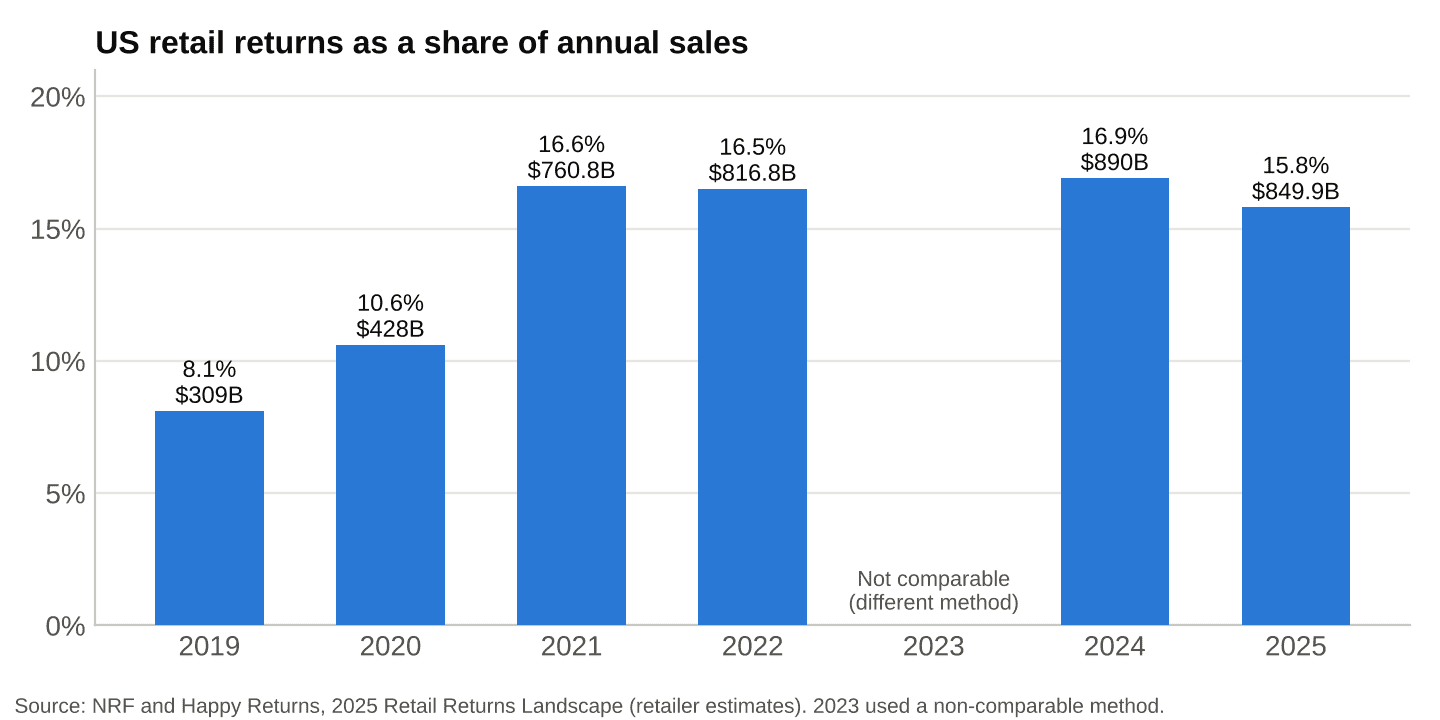
US retail returns as a share of annual sales, 2019 to 2025
The 2025 estimate is a return rate of 15.8% of sales, or $849.9 billion, slightly down from 16.9% in 2024 but still almost twice the 2019 level. Online orders come back more often than store purchases: retailers expect 19.3% of online sales to be returned in 2025, and a separate NRF study found online return rates running 21% higher than overall return rates. For a store selling only online, roughly one order in five is a candidate to reverse.
The operational strain is just as real as the cost. In the same report, 40% of retailers said they had been forced to choose between shipping new orders and processing returns because warehouse or logistics capacity ran out, and about half said it takes six to ten days to get a returned item back on sale. Returns now compete with outbound orders for the same people and shelf space, which is why they belong in the core of order processing and management rather than in a customer service side process.
Free returns pay for behavior you would never choose to fund
The uncomfortable part of the data is not the volume of returns but what is driving it. The NRF consumer survey asked shoppers directly what they have done in the past year:
- Bracketing: 36% of shoppers bought items with the intent to return some of them, rising to 53% of Gen Z shoppers.
- Wardrobing: 27% returned items after using them, and 49% of Gen Z.
- Bending the truth: 45% said it is acceptable to bend the truth when making a return, and 66% of Gen Z.
- Outright fraud: 20% admitted to a decoy return, 21% to shipping fewer items back than claimed, and 18% to returning an empty box.
Retailers see the same pattern from their side. Merchants report that 23% of purchases in the past year included a bracketed item, rising to 26% in apparel and footwear, and estimate that 9% of all returns are fraudulent, which on $849.9 billion of returns is roughly $76 billion. In its announcement of the findings, NRF also noted that shoppers aged 18 to 30 made an average of 7.7 returns of online purchases in the past year, more than any other age group.
None of this means most customers are dishonest. It means a free, unconditional policy makes the costly behavior rational for a meaningful minority, and every other customer pays for it through higher prices or thinner selection.
What actually happened to stores that started charging
If charging for returns were a disaster, the retailers that tried it would say so. The NRF report asked them, and the answers are mixed in a way worth reading carefully. Merchants that introduced return fees reported these benefits:
- 53% saw overall return rates fall
- 52% saw more exchanges instead of refunds
- 51% saw shoppers switch to a different, free return method
- 43% recovered some revenue from returns
- 42% saw return fraud fall
And these downsides:
- 47% received more customer complaints
- 44% saw return fraud increase
- 39% saw fewer exchanges
- 37% lost customers over the fees
- 34% saw average order value fall
- 24% saw sales decrease
Two things stand out. More than half of retailers saw returns go down, while about a quarter saw sales go down, which suggests the trade worked for many of them. And the results contradict each other in places, with some merchants reporting more fraud and others less, which suggests the design of the fee mattered more than the fee itself.
The strongest argument for keeping returns free
The case for free returns is not just sentiment. A meta-analysis published in the Journal of Retailing combined the results of 21 studies on return policies and found that more lenient policies increase purchases overall. That is the core of the free-returns argument, and it holds: a generous policy lowers the perceived risk of buying, and some customers buy who otherwise would not.
The same research is more nuanced than the slogan, though. It split leniency into types and found they behave differently. Generous time windows actually reduced return rates, likely because the longer people own something, the more attached they become to it. Generous scope, such as allowing returns on sale items, increased returns. Leniency on money and effort raised purchases, with a smaller effect on returns.
The consumer data points the same way. Shoppers say they care about free returns, but they also care about ease and speed: 76% are more likely to choose a return option that gives an instant refund or exchange, and 71% say a poor returns experience makes them less likely to shop with a retailer again, up from 67%. Free and painful loses to cheap and easy.
Why the evidence still points toward charging, selectively
Put the two sides together and the conclusion is not “free” or “paid” but “which returns, and how”. The research says time windows reduce returns and scope increases them; the retailer data says fees cut return rates for most stores but cost some of them customers. A policy that keeps the generous parts and charges for the expensive parts captures most of the benefit with little of the damage.
Retailers’ own reasons for charging support that reading. Among those charging, the top-ranked reasons were rising costs of processing returns (40%), rising carrier shipping costs (40%) and economic uncertainty including tariffs (33%), ahead of discouraging returns as such (31%) and fighting fraud (29%). Most are not trying to punish customers. They are trying to stop a cost line from growing faster than revenue, and much of that cost sits in reverse shipping and handling, the most expensive leg of ecommerce logistics.
How to charge for returns without losing good customers
A selective policy is mostly about making the cheap options free and the expensive options paid. The return methods retailers offer are already moving in that direction: in 2025, 43% offered buy-online-return-in-store (up 10 points), 41% offered mail returns with a QR code instead of a printed label (up 9 points), and 25% offered “no box, no label” drop-off with a carrier (up 8 points). A workable structure for most online stores:
- Keep exchanges and store credit free. They keep the revenue in the business and are what most shoppers who return actually need.
- Charge for refunds by mail, and deduct the fee from the refund rather than asking for a separate payment.
- Offer a free low-cost route, such as a drop-off point or consolidated carrier return, so price-sensitive customers always have an option.
- Keep a long return window. It costs little and, according to the research, can lower returns.
- Waive fees for repeat or loyalty customers, who are the least likely to bracket or wardrobe.
- State the policy before checkout, not in a buried terms page. 81% of shoppers read return policies before buying from a retailer, up from 77%, and clear checkout design is where the policy should be visible.
The fee itself can be modest. Its main job is to make the shopper pause before ordering three sizes to keep one, not to recover the full cost of every return.
Cut returns before they happen
The cheapest return is the one that never starts. Retailers dealing with bracketing are attacking it at the product page: 42% are adding more customer reviews, 41% more sizing information, 38% are highlighting items with low return rates, and 36% are using recommended-size tools. Only 33% are using return shipping charges as their tactic, which shows fees work best as one tool among several.
For most stores, better product information and honest reviews will reduce returns more than any fee, and they make the purchase more likely at the same time. The role reviews play in setting accurate expectations is covered in our analysis of how online reviews influence purchases.
Fraud needs its own answer
Charging for returns does little against deliberate fraud, and the NRF data hints that fees can even push some abusers toward fraud, since 44% of merchants that started charging saw return fraud increase. Detection matters more. 85% of merchants say they use AI or machine learning in their returns process to spot fraud, but only 45% believe those tools are truly effective. For a smaller store, practical checks go a long way: weigh returned parcels, inspect items before refunding, and flag accounts with unusually high return rates. Where automated tools fit into returns and inventory work is covered in our piece on AI in ecommerce operations and inventory.
When free returns still make sense
There are stores for which the old default remains the right one:
- New brands with no reputation yet, where reducing the risk of a first purchase matters more than the cost of returns.
- High-margin products with low return rates, where the policy costs little and sells a lot.
- Gifting periods, when buyers are not the end users. Retailers expect 17% of holiday sales to be returned, and a free gift return is part of what makes the purchase easy.
- Categories where fit is not an issue, such as consumables, where bracketing is rare.
Outside those cases, free unconditional returns are a cost most online stores choose by habit, not by calculation.
The bottom line
The question is no longer whether online stores can afford to charge for returns. Nearly three-quarters of large retailers already do for at least one method, and more than half of those saw return rates fall. The real question is how to charge without driving away the customers who return rarely and in good faith. Keep exchanges free, keep windows long, keep a free route available, charge for the expensive refunds, and put most of the effort into stopping unnecessary returns at the product page. That is not a less generous policy. It is a fairer one.