Every autumn, small online stores make the same plan: build the biggest discount they can afford, launch it on Black Friday, push it hard through Cyber Monday, and hope volume makes up for margin. The plan copies what large retailers do, and for a small store it is usually the worst way to spend the most valuable weeks of the year.
The data for 2026 makes the case better than any opinion. Adobe’s 2026 holiday forecast expects US online spending to reach $275.1 billion between November 1 and December 31, up 6.7% on last year. Cyber Week, the five days from Thanksgiving to Cyber Monday, is expected to bring in $47.5 billion of that, or 17.3%. The other 83% will be spent on the other 56 days of the season, at discounts far shallower than the Cyber Week peak.
My argument is simple: a small store should show up for Cyber Week, but it should not build its season around a discount war it cannot win. The money is spread across the whole season, and the growth is in places that have little to do with the deepest percentage off.
The season is wider than Cyber Week
The shape of holiday spending has been flattening for years, and 2025 showed it clearly. According to Adobe’s final results for the 2025 season, US consumers spent $257.8 billion online in November and December, up 6.8%, and there were 25 days on which they spent more than $4 billion, up from 18 days the year before.
Do the arithmetic on the 2026 forecast and the picture is even clearer:
- Cyber Week: $47.5 billion over five days, 17.3% of the season.
- Every other day in November and December: about $227.6 billion over 56 days, or roughly $4.1 billion a day on average.
- Black Friday: $12.9 billion, about three times an ordinary day in the season, but just 4.7% of the total.
- October: a further $95.8 billion is expected online, up 8%, faster than the holiday season itself, with $9.9 billion during the October Prime Day event alone.
Black Friday is a big day. It is not the season. A store that spends its budget, its inventory and its email list on five days is betting most of its year on 17% of the demand.
The discount war is flat, and small stores cannot win it
Cyber Week deals are getting no deeper. Peak discounts in 2025 were almost identical to 2024: 30.9% off listed prices in electronics against 30.1% a year earlier, 25.1% in apparel against 23.2%, 18.8% in furniture against 19%. Adobe expects 2026 to be on par again, peaking at up to 30% during Cyber Week, with up to 14% in early November, up to 21% just before Thanksgiving and 10% to 15% through December.
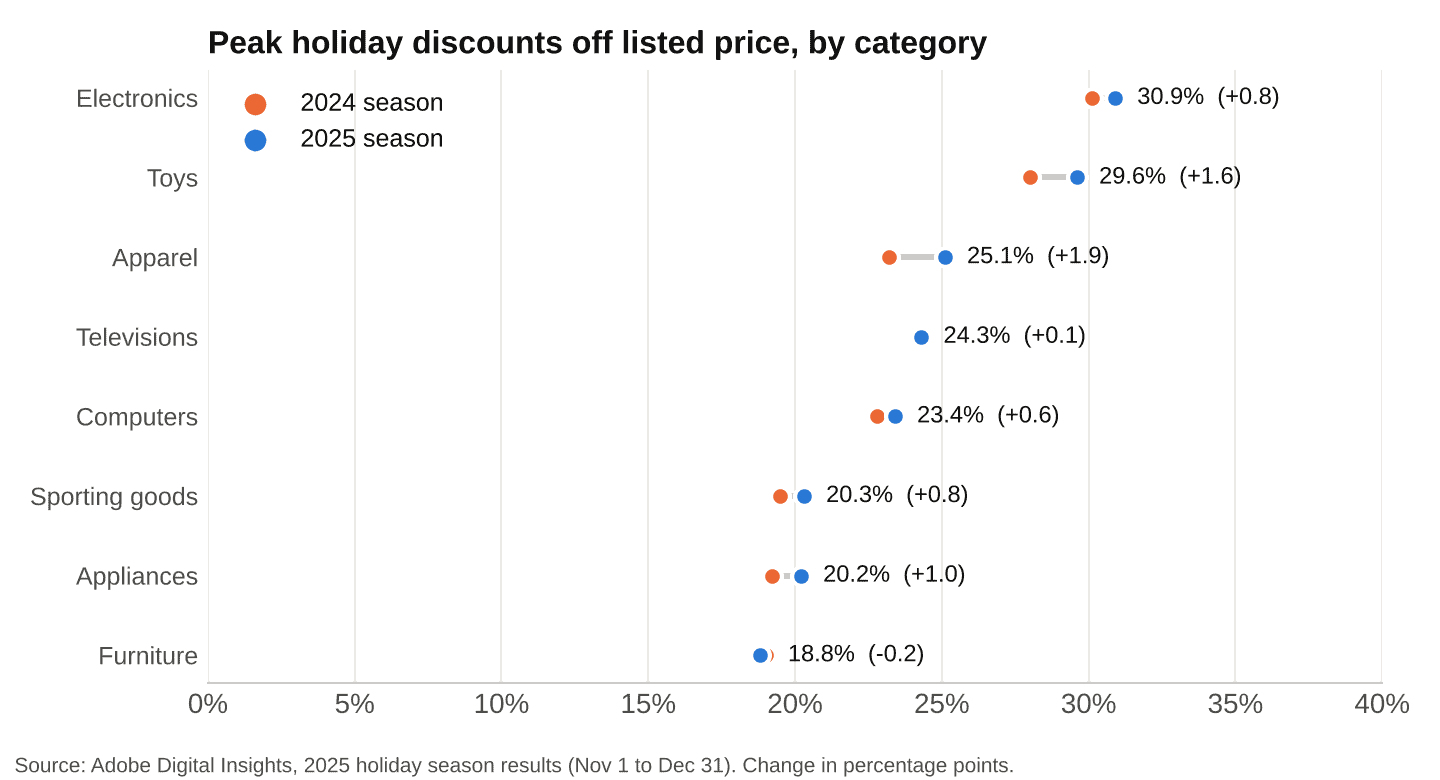
Peak holiday discounts off listed price by category, 2024 and 2025 seasons
The large retailers setting those benchmarks have buying power, logistics scale and supplier funding for promotions that a small store does not. Matching a 30% discount on a product with a 40% gross margin leaves almost nothing for shipping, fees and returns. And spending kept growing in 2025 without discounts getting meaningfully deeper, which suggests that the extra percentage points are not what moves shoppers. A small store competes better on what large retailers cannot easily copy: curation, expertise, a story, and products worth paying full price for, the positioning behind high-ticket ecommerce.
Where the holiday growth actually is
The categories growing fastest online this season are not the ones with the biggest discounts. Adobe’s 2026 forecast puts the strongest growth in grocery ($26.1 billion, up 10.3%), toys ($9.6 billion, up 9.6%), cosmetics ($9.2 billion, up 9.5%) and furniture ($33.4 billion, up 7.3%), while the two tentpole categories with the deepest deals grow more slowly: electronics ($63.3 billion, up 5.9%) and apparel ($51.3 billion, up 4.7%).
Two other patterns point away from price as the main lever:
- Shoppers are stocking up on essentials. During Cyber Week, Adobe expects online sales of clothing basics to run 210% above September levels, personal hygiene products 150%, baby products 113%, pet products 93% and household cleaning items 49%.
- Shoppers are trading up, not just down. In 2025, the share of units sold for the most expensive products in each category rose 20% compared with the rest of the year, with increases of 56% in electronics, 55% in sporting goods, 38% in appliances and 34% in personal care.
For a small store, that suggests two better holiday plays than a sitewide discount: lock in repeat buyers of everyday products before the season starts, and offer premium bundles and gift sets that let shoppers spend more for something special. Stores selling consumables can go further and turn holiday buyers into subscribers, an approach covered in our guide to the best ecommerce platforms for subscription boxes.
Creators and affiliates are where shoppers discover deals
The channels that bring holiday shoppers to a store are shifting faster than the discounts. In 2025, social media drove 4.6% of holiday online revenue, up from 3.3%, a 40.3% increase in share, and affiliates and partners, which include influencers, drove 20.4%, up from 17.6%. For 2026, Adobe expects social media’s share of revenue to grow 17% and affiliates’ to grow 12%, against just 4% for paid search.
Inside the affiliate channel, cashback and rewards sites lead with 36% of traffic, followed by influencers and creators at 22%. A small store cannot outbid large retailers on search ads during Cyber Week, when every competitor is bidding on the same terms, but it can work with a handful of creators whose audiences match its products. Our overview of the TikTok Creator Marketplace covers one way to find them.
AI assistants are becoming a holiday research tool
The newest channel is also the fastest growing. Traffic to US retail sites from generative AI chat services and browsers rose 693.4% during the 2025 holiday season, from a modest base, with the heaviest use in video games, toys, appliances, electronics and personal care. Adobe expects AI-referred traffic to rise another 130% this season, with the biggest jump on Thanksgiving (up 159%).
Shoppers who use these tools say they come away more sure of their choices: in a survey of 5,000 US consumers fielded for Adobe in July 2026, 77% of those who had used AI for online shopping said it made them more confident in a purchase, and 69% said they were less likely to return what they bought. A small store that is easy for assistants to read and recommend competes on product fit rather than on price, which is exactly the contest it can win. The practical steps are in our guide to getting your store into AI search results.
The case for going all in on Black Friday
There is a fair argument on the other side, and it deserves a hearing. Cyber Monday is still expected to be the biggest online shopping day of the year, at $15.1 billion, and Black Friday is the fastest growing of the big days, up 9.2%, because retailers are pulling their best deals earlier. Shoppers expect some kind of offer during Cyber Week, and a store that goes completely silent risks looking closed.
The macro picture also favors online sellers. Deloitte’s 2026 holiday forecast expects US ecommerce sales of $316.1 billion to $318.9 billion between November and January, up 7.5% to 8.4%, against total retail growth of 4.0% to 4.8%. Holiday demand online is growing roughly twice as fast as retail overall, and Cyber Week is where much of the attention lands.
None of that changes the conclusion, only its shape. Be present during Cyber Week with an offer you can afford. Do not make it the plan.
Before Black Friday: build the audience you will sell to
The most profitable holiday sales for a small store come from people who already know it. That means the work happens in October and early November, while advertising is cheaper and inboxes are quieter:
- Grow the email and SMS list with an early-access offer rather than a discount code.
- Launch gift guides and bundles early, when October spending is already rising.
- Ask past customers what they plan to buy, and stock to that rather than to last year’s bestseller list.
- Set up creator partnerships before their calendars fill.
A list built before the peak is a list you do not have to pay for during it. Our guide to email and SMS marketing covers how to grow and segment it.
During the peak: protect the margin
When Cyber Week arrives, the goal is to capture demand without giving away the season’s profit:
- Discount selectively: clearance stock, bundles and slower lines, not the products people would buy anyway.
- Prefer added value to price cuts: free shipping, a gift with purchase or an upgraded bundle often costs less than an equivalent percentage off.
- Prepare for mobile: Adobe expects a record 63% of Cyber Week spending to come from mobile devices.
- Recover the carts you already earned, because traffic is at its most expensive and every abandoned checkout is costly.
That last point has the highest return of anything on this list, and our guide to abandoned cart emails covers the sequence and timing that recover the most orders.
December: the forgotten month
After Cyber Monday most small stores relax, yet December still holds weeks of strong spending at discounts of only 10% to 15%. It is the part of the season where small stores can compete most easily, because shoppers are buying gifts against a deadline rather than hunting the lowest price:
- Publish clear shipping cutoff dates and promote them as the deadline approaches.
- Sell gift cards and digital gifts for buyers who missed the cutoffs.
- Offer flexible payment: Buy Now Pay Later is expected to drive $21.3 billion of holiday online spending this season, 82% of it on mobile.
Make the final purchase as fast as possible on a phone, because late shoppers are impatient and mostly mobile. Our overview of one-click checkout solutions compares the options.
The bottom line
The 2026 holiday season will set another record, and most of the money will be spent outside the five days everyone plans around. A small store that tries to match big-retailer discounts on Black Friday trades its margin for a sliver of the season. A store that starts early, sells what people are actually stocking up on, works with creators and AI assistants, and keeps selling through December competes where it can win, and keeps the profit it earns.