Seven in ten shoppers who put something in a cart leave without paying. Baymard Institute’s running average across 50 separate studies puts the cart abandonment rate at 70.22%, and the same research shows why: 42% of US shoppers say they were only browsing, and among the rest, extra costs at checkout (40%), slow delivery (20%), distrust of the site with card details (19%), forced account creation (18%), and a long or complicated checkout (17%) lead the list.
Some of those shoppers were never going to buy. Many of them were one small objection away from buying, and an abandoned cart email is the only marketing message a store can send to someone who has already picked the product, put it in the cart, and told you their address. No other email a store sends starts from that position.
This guide covers how to build the flow properly: what to fix in the checkout before you send a single message, what the benchmarks say a good flow looks like, the three-email sequence and its timing, what each message should do, how to stay on the right side of consent law, and how to measure recovery without fooling yourself.
Fix the checkout before you fix the emails
An abandoned cart flow recovers a fraction of lost carts. A better checkout prevents them, and the causes in Baymard’s data are mostly design decisions. Its research on reducing cart abandonment singles out the total cost problem: shoppers hesitate when they cannot see the full order cost up front, and the fix is to show the complete total, including shipping, tax, and fees, in the cart itself. Before building the flow, check the four things that generate the carts it will try to recover:
- Total cost visibility: shipping and tax shown in the cart, or at least estimated, before the shopper enters the checkout
- Guest checkout: offered prominently, with account creation proposed after the order, not before it
- Field count: name, address, email, payment, and nothing else; every optional field removed or collapsed
- Payment methods: card plus the wallets your customers use (Apple Pay, Google Pay, PayPal, and the local methods in your markets)
Each of these reduces the number of carts entering the flow, which sounds like a loss for the email program and is a gain for the store. Emails recover a minority of carts under the best conditions; a checkout that does not lose them in the first place is worth more than any sequence.
What a good flow looks like in numbers
Abandoned cart emails are the best-performing automated messages in ecommerce, and the gap over everything else is large. Klaviyo’s analysis of more than 143,000 abandoned cart flows, published in its abandoned cart benchmark report, found an average open rate of 50.5%, a click rate of 6.25%, a placed-order rate of 3.33%, and revenue per recipient of $3.65, with the top 10% of brands reaching $28.89 per recipient. Revenue per recipient also varies by what you sell: automotive and hardware brands average close to $10, home and garden and electronics around $6.
Those numbers set the targets. A flow open rate below 40% points to a subject line or deliverability problem. A click rate below 4% usually means the email does not show the cart clearly or the call to action is buried. A placed-order rate under 2% with healthy opens and clicks means the objection that stopped the purchase is still there, and the email did not answer it.
Why the flow beats every campaign you send
The abandoned cart flow is worth more than a monthly promotional calendar, and the reason is timing rather than copy. Klaviyo’s 2026 benchmark report puts the average placed-order rate for automated flows at 2.11% against 0.16% for one-off campaigns, a thirteen-fold difference, with top performers doubling both. A campaign lands when the store wants to send it. A flow lands when the shopper has just shown intent. Stores that pour effort into campaign design while running a default abandoned cart flow have the priority backwards.
Capture the address before the shopper leaves
A flow can only send to addresses it has. On most platforms the email field is the first step of the checkout, and the cart is associated with the address as soon as it is entered, which means shoppers who abandon at the shipping or payment step are reachable. Shoppers who abandon from the cart page, before entering the checkout, usually are not, unless they were logged in or captured earlier.
That is why the flow sits inside a wider conversion effort rather than replacing one: an early email capture (a first-order incentive, a save-your-cart prompt) widens the pool the flow can reach. The broader set of levers is covered in our ecommerce conversion rate optimization guide; for the flow itself, the rule is that every checkout should ask for email first, before shipping details, and should keep the field on the same screen as the products so the shopper sees what they are leaving.
The three-email sequence and when to send it
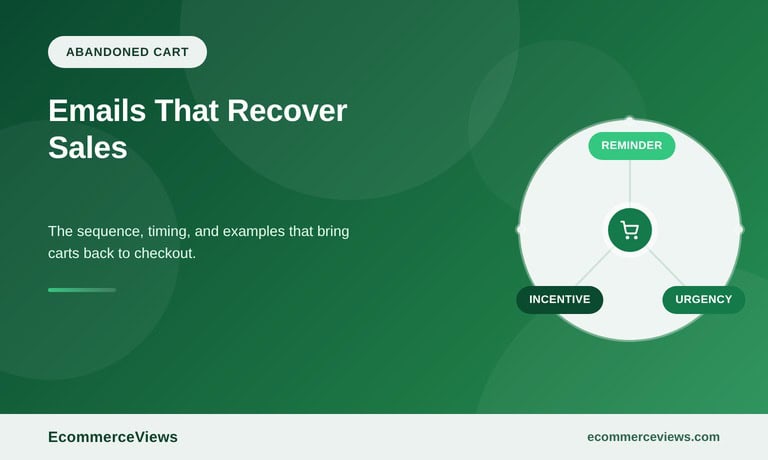
Three emails is the standard because it matches how the objections fall. One email catches distraction. Two catch hesitation. Three, with something new to say, catches the price-sensitive shopper who was waiting to see if you would blink. More than three and you are training people to ignore you.
- Email 1, one to two hours after abandonment: a reminder, nothing else. Show the cart, link straight back to it, remove friction.
- Email 2, around 24 hours: answer the objection. Shipping cost and speed, returns, reviews of the item, a support contact.
- Email 3, 48 to 72 hours: a reason to decide now. An incentive if your margins allow it, a stock or price warning if they are true, or simply a final reminder that the cart will expire.
Exit the sequence the moment the order is placed, and exit it if the shopper returns and empties the cart. Suppress anyone who has received a flow in the last few weeks so a habitual browser does not get a new sequence every visit. And keep the sending window sensible: a reminder at 3 a.m. in the shopper’s time zone is a reminder to unsubscribe.
Email 1: the reminder
The first email does one job, and it does it best when it looks like a receipt rather than a promotion. Subject lines that work are plain: “You left something in your cart”, “Your cart is saved”, “Still thinking it over?”. Inside, the product image, name, variant, and price, a single button back to a cart that still contains the items, and a line of support contact. No discount, no urgency, no cross-sell. The shopper’s most likely reason for leaving is that something interrupted them, and the email’s job is to end the interruption.
A short, personal note works better than brand copy here. “Hi Ana, your basket is still here whenever you’re ready” from a named person outperforms a designed template with a hero banner, because it reads like a store, not a campaign.
Email 2: the objection
The second email assumes the first did not work because something specific stopped the purchase, and it tries to answer that something without knowing exactly what it was. The Baymard reasons are the guide: cost, delivery, trust, and effort. So the second email states shipping cost and delivery time plainly, links the returns policy, shows a review or two of the exact item in the cart, and offers a way to ask a question. Payment friction belongs here as well; a surprising share of abandonments come from a card that declined or a missing payment method, and if you have recently changed your gateway or added wallets, this is the place to say so. The fees behind those choices are their own decision, covered in our guide to payment gateway fees, but from the shopper’s side the message is simple: you can pay the way you want to, and here is how.
Email 3: the decision
The third email introduces something that was not in the first two. For stores with margin to spare, that is a modest discount or free shipping, and it belongs in the third email rather than the first for two reasons: most recoverable carts convert before it, and a discount in email one teaches shoppers to abandon on purpose. For stores that cannot discount, the third email can be honest urgency: low stock on the item, a price change coming, or the cart expiring. Never invent scarcity. Shoppers check, and a fake “only 2 left” costs more trust than it earns.
Whichever route, the third email closes the sequence explicitly. “This is the last reminder we’ll send about this cart” is a line that raises conversions, because it tells a hesitant buyer that the decision is theirs and the window is real.
SMS and push as a second channel
Email is the backbone of cart recovery, but it is not the only channel, and stores that have collected phone numbers with consent can add a single SMS to the sequence. The pattern that works is one text, sent between the first and second email, short and specific: the item name, a link back to the cart, and a way to opt out. Push notifications, for stores with an app or a web push audience, fit the same slot. Both channels need explicit, separate consent and both punish overuse harder than email does. Where SMS fits in a store’s wider messaging, and how to run it without burning the list, is covered in our email and SMS marketing guide; for the flow, treat SMS as one extra touch, never a parallel sequence.
Consent and the law
Abandoned cart emails are marketing messages, and the fact that the shopper entered an address at checkout does not make them transactional. In the United States, the Federal Trade Commission’s CAN-SPAM compliance guide sets the baseline for any commercial email: accurate header and sender information, a subject line that reflects the content, a physical postal address, a clear way to opt out, and opt-outs honored within ten business days. Cart reminders qualify as commercial email under those rules, so the unsubscribe link and the address are not optional even in a two-line reminder.
In the European Union and the United Kingdom, the bar is higher. Sending marketing email to someone who has not purchased generally requires consent, and an address typed into a checkout form is not, on its own, consent to marketing. Stores selling into those markets typically add a clear checkbox or notice at the email step, and suppress the flow for shoppers who did not agree. The cost of getting this wrong is a complaint, a fine, or a spam-folder reputation that damages every other email you send, all for a message that was supposed to recover a sale.
Measuring recovery without fooling yourself
Every email platform reports “recovered revenue”, and every one of them counts generously. A shopper who opened the reminder, ignored it, and came back three days later through a Google search will usually be attributed to the flow. The honest measurement asks a different question: of the carts that entered the flow, how many were completed within the flow’s window, and how does that compare to the completion rate of carts that were abandoned before the flow existed or that were held out of it?
That requires tracking the checkout steps as events rather than relying on the email tool’s attribution. Our guide to GA4 event implementation on ecommerce platforms covers the begin_checkout, add_shipping_info, add_payment_info, and purchase events that make the funnel visible. With those in place, you can see where carts actually die, measure recovery against a baseline, and compare the flow’s revenue per recipient with Klaviyo’s benchmarks instead of with the platform’s own applause.
Test the things that move the number
Once the sequence runs, most stores never touch it again, and the ones that test usually test subject lines, which is the variable with the smallest effect. The variables worth testing, in order of impact, are the timing of the first email, whether the third email carries an incentive at all, the sender (a person versus the brand), and the layout of the cart contents (one product at a time versus the full cart). Each test needs enough abandoned carts to reach a conclusion, which for small stores means running one test for weeks rather than five tests for days. The method for doing that properly, including how long to run a test before believing it, is the subject of our guide to A/B testing for ecommerce.
Turn the flow into a program
An abandoned cart flow is the first of a family. Once it runs well, the same logic extends to browse abandonment (viewed a product, did not add it), checkout abandonment as a separate flow with different copy from cart abandonment, and back-in-stock and price-drop notifications for the carts the flow could not recover. Each one triggers on shopper behavior rather than on the store’s calendar, which is why all of them outperform campaigns.
Build them in that order, one at a time, and measure each against a baseline before adding the next. Recovery flows are one of the few parts of ecommerce marketing where the numbers are unambiguous: a cart was abandoned, a message was sent, an order was or was not placed. They deserve the same seriousness as the paid channels that bring the shoppers in, because they are working on the shoppers who were closest to buying, and the wider picture of what actually lifts revenue, from acquisition to retention, is laid out in our guide to how to increase ecommerce sales in 2026. Cart recovery is where most stores should start, because the shoppers are already standing at the register.
Keep reading: see our full guide to conversion rate optimization, or read about one-click checkout and selling high-ticket products.