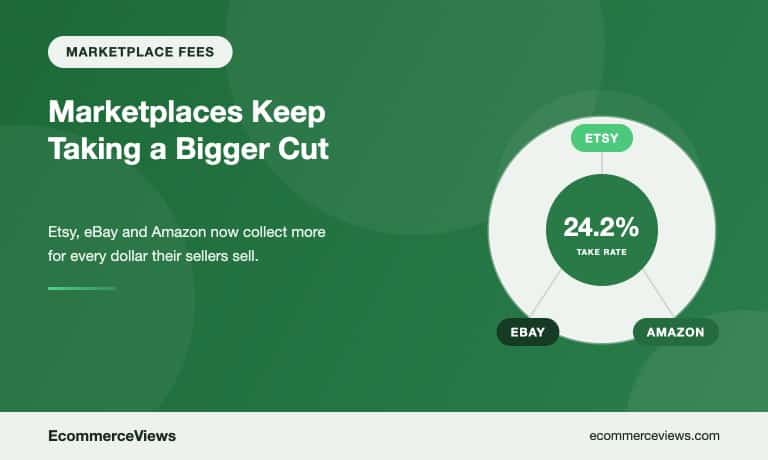
Selling on a marketplace has always meant paying a share of every sale. What has changed is the size of that share. The annual reports of Etsy, eBay and Amazon show that between 2019 and 2025, all three collected more revenue for every dollar their sellers sold, in eBay’s case mostly before 2022 and in Etsy’s case almost every year.
My view is that this is not a temporary squeeze. It is how mature marketplaces make money once growth in buyers slows: they earn more from the sellers they already have, increasingly through advertising. For an independent seller, that makes a direct sales channel less of a nice extra and more of an insurance policy.
Key points
- Etsy’s take rate rose from 16.5% in 2019 to 24.2% in 2025. For every $100,000 of goods its sellers sold, Etsy collected about $16,450 in 2019 and about $24,200 in 2025.
- Etsy’s revenue grew 24% from 2021 to 2025 while the value of goods sold fell 12%. Higher fees and ads, not more sales, drove the growth.
- Etsy’s ad and services take nearly doubled as a share of sales, from 4.1% of GMS in 2020 to 7.4% in 2025.
- eBay’s take rate rose from 10.3% in 2019 to 13.9% in 2025. Most of the rise came by 2022 as eBay took over payment processing, and it has stayed near 13.8% to 13.9% since.
- eBay’s advertising revenue grew 73% from 2022 to 2025, from 1.6% to 2.5% of GMV.
- Amazon’s third-party seller services revenue grew 3.2 times from 2019 to 2025 and its advertising revenue 5.4 times, while its own online store sales grew 1.9 times.
- Third-party sellers’ share of Amazon units rose from 53% to 61.5%. Adjusted for that, seller fees per dollar of seller sales rose by an estimated 20%.
Where the numbers come from
All figures come from the companies’ annual reports (Form 10-K) and, for Amazon’s seller unit mix, its quarterly earnings releases. The latest filings are Etsy’s 2025 annual report, eBay’s 2025 annual report and Amazon’s 2025 annual report, all filed with the US Securities and Exchange Commission in early 2026.
The key measure is the take rate: total revenue divided by the value of goods sold on the platform. Etsy and eBay both publish the inputs, gross merchandise sales (GMS) and gross merchandise volume (GMV). Amazon does not publish the value of goods its sellers sell, so for Amazon we compare revenue lines and use its disclosed share of units sold by third-party sellers to build a rough estimate.
A take rate is not the same as the fee schedule a seller sees. It includes every fee the platform earns from sellers: commissions, payment processing, listing fees, advertising, shipping labels and, at Amazon, fulfillment. That is why it is the better measure of what a marketplace really costs.
Etsy: a third more per dollar of sales
Etsy shows the clearest pattern of the three.
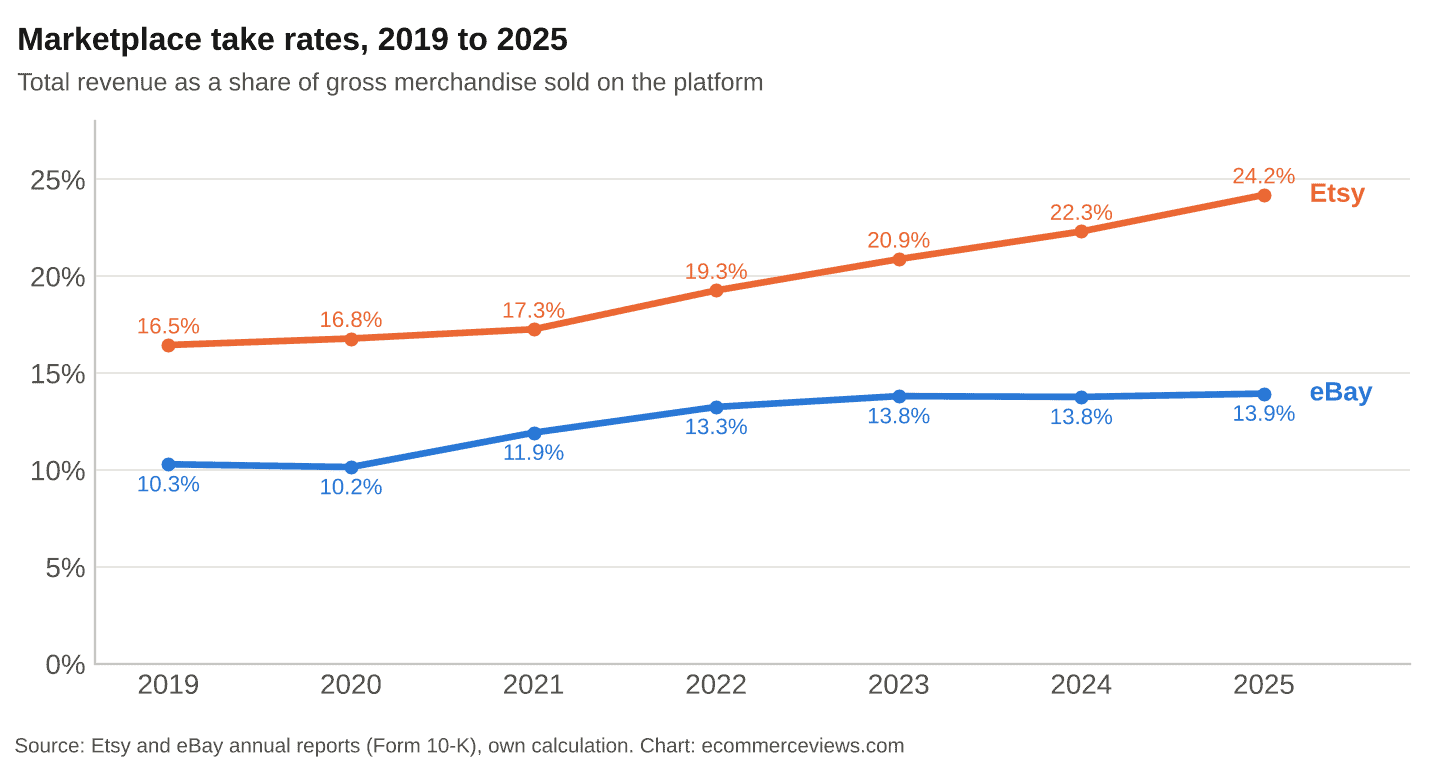
Etsy and eBay take rates, 2019 to 2025
| Etsy | GMS | Revenue | Take rate |
|---|---|---|---|
| 2019 | $4.97 bn | $0.82 bn | 16.5% |
| 2021 | $13.49 bn | $2.33 bn | 17.3% |
| 2023 | $13.16 bn | $2.75 bn | 20.9% |
| 2025 | $11.92 bn | $2.88 bn | 24.2% |
Consolidated figures, including Depop and Reverb (sold in June 2025). Source: Etsy Form 10-K filings, own calculation.
The years after the pandemic are the telling part. From 2021 to 2025, the value of goods sold on Etsy’s marketplaces fell by 11.7%. Revenue rose by 23.8% over the same period. A marketplace with shrinking sales volume grew its income by taking more from each sale.
Etsy reports two revenue types, and both rose as a share of sales:
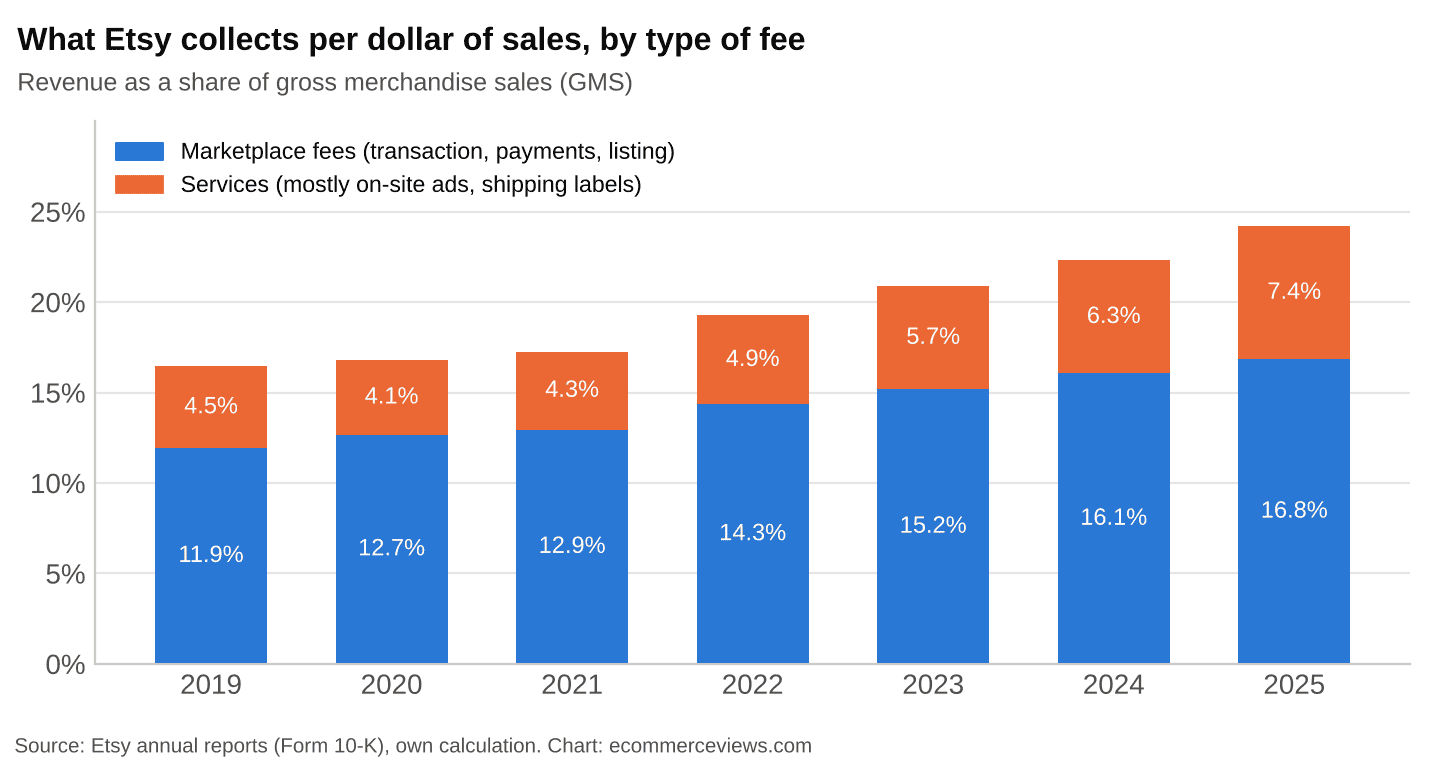
What Etsy collects per dollar of sales, marketplace fees vs services
Marketplace fees (transaction, payment processing and listing fees, including fees on sales from Etsy’s offsite ads) rose from 11.9% of GMS in 2019 to 16.8% in 2025. Services revenue, which is mostly on-site advertising plus shipping labels, rose from 4.1% of GMS in 2020 to 7.4% in 2025. In its 2025 report, Etsy attributes most of the services growth to a higher average price per click on Etsy Ads.
That second line is the one to watch. Advertising is optional on paper, but when competing sellers pay for visibility, sellers who do not pay lose it. Rising ad prices work like a fee increase that never needs to be announced.
eBay: a step up, then a plateau
eBay’s take rate rose from 10.3% in 2019 to 13.3% in 2022, then stayed nearly flat: 13.8% in 2023 and 2024, and 13.9% in 2025.
| eBay | GMV | Net revenues | Take rate |
|---|---|---|---|
| 2019 | $72.1 bn | $7.4 bn | 10.3% |
| 2021 | $87.4 bn | $10.4 bn | 11.9% |
| 2023 | $73.2 bn | $10.1 bn | 13.8% |
| 2025 | $79.6 bn | $11.1 bn | 13.9% |
Continuing operations, as reported in the filings. Source: eBay 2025 annual report and earlier 10-K filings, own calculation.
Most of the step up has a specific cause. Between 2019 and 2021, eBay moved sellers from PayPal to its own managed payments system. Payment processing fees that sellers used to pay to PayPal began to show up as eBay revenue. Part of the higher take rate is therefore a fee that moved, not a new one.
The more recent change is advertising. eBay’s advertising revenue grew from $1.15 billion in 2022 to $1.99 billion in 2025, a 73% increase, while GMV grew about 8%. As a share of GMV, ads went from 1.6% to 2.5%. eBay’s 10-K describes Promoted Listings, its seller ad product, as a meaningful source of revenue. The headline take rate is flat, but within it, a growing share comes from sellers paying to be seen.
Amazon: fees and ads outgrow everything else
Amazon is the hardest to measure, because it does not disclose the value of goods its third-party sellers sell. But its revenue lines make the direction clear.
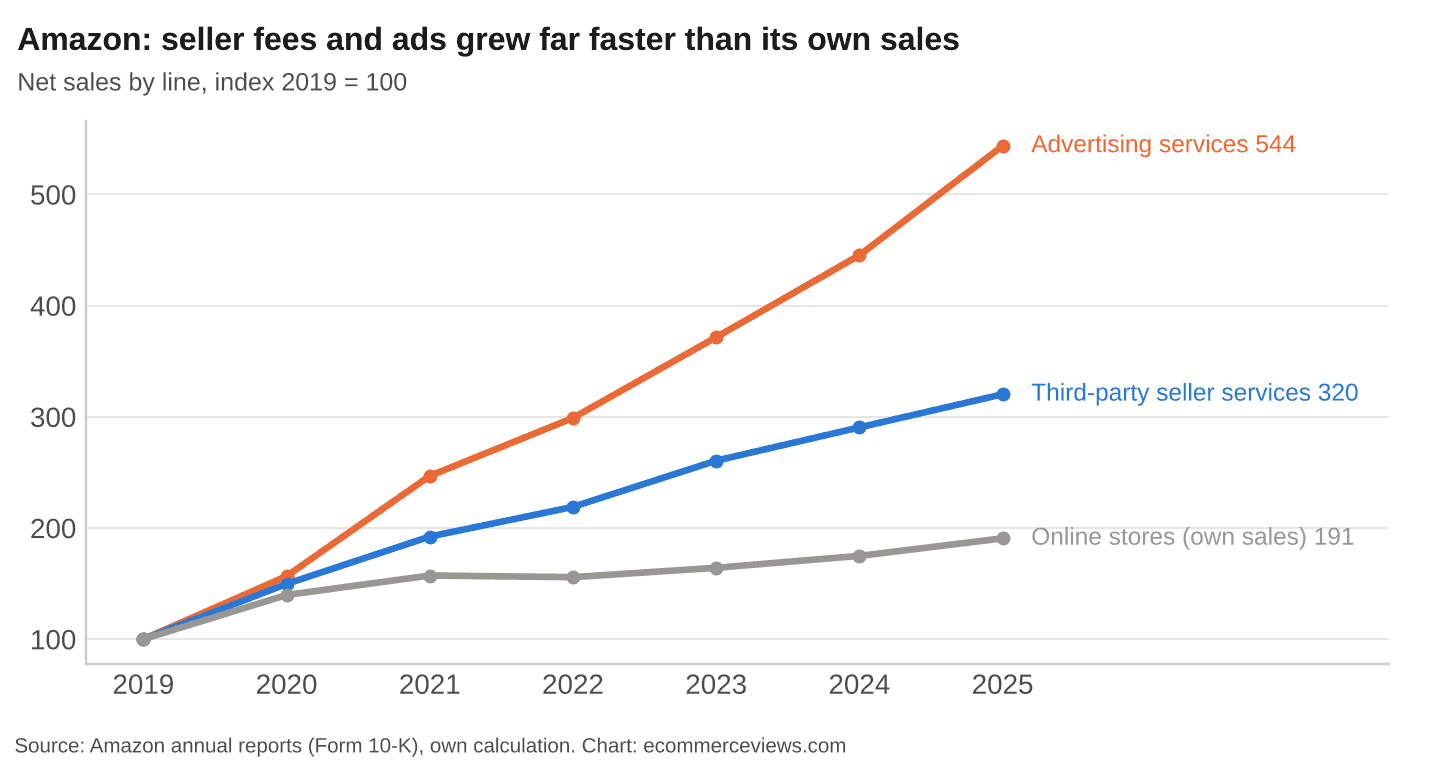
Amazon net sales by line, index 2019 = 100
| Amazon net sales | 2019 | 2025 | Growth |
|---|---|---|---|
| Online stores (Amazon’s own sales) | $141.2 bn | $269.3 bn | 1.9 times |
| Third-party seller services | $53.8 bn | $172.2 bn | 3.2 times |
| Advertising services | $12.6 bn | $68.6 bn | 5.4 times |
Source: Amazon Form 10-K filings.
Third-party seller services cover the commissions, fulfillment and shipping fees Amazon earns from sellers. Advertising covers sponsored ads from sellers, vendors and others. Together they reached $240.8 billion in 2025, compared with $66.4 billion in 2019.
Part of this growth is simply more third-party selling. According to Amazon’s quarterly earnings releases, third-party sellers’ share of paid units rose from an average of 53% in 2019 to 61.5% in 2025. To separate volume from price, we built a rough estimate: assume third-party and Amazon-owned units sell at similar prices, scale Amazon’s own online store sales by the unit mix, and divide seller services revenue by the result.
On that basis, seller services revenue was equal to about 33% of estimated third-party sales in 2019 and about 40% in 2025, a rise of roughly 20%. The figure is high because it includes fulfillment (FBA) fees, which many sellers choose to pay instead of shipping themselves. Its exact level depends on the price assumption, so treat it as a direction, not a precise take rate. Almost all of the increase happened between 2019 and 2022, and the estimate has stayed near 40% since.
Advertising is excluded from that estimate. Add it, and the rise in what selling on Amazon costs is larger still.
The case against
There are good arguments that rising take rates are not simply bad news for sellers.
- Sellers get more for the money. Marketplaces have added services that sellers used to buy elsewhere: payment processing, fulfillment, shipping labels, offsite advertising. If a fee moves from PayPal or a courier to the marketplace, the seller’s total cost may not change. eBay’s managed payments shift is the clearest case.
- Advertising is optional. No seller is forced to buy Etsy Ads or Promoted Listings, and some sellers do well without them.
- The platforms bring the buyers. A marketplace delivers demand that a small store would have to pay for anyway, through search ads, social ads or email. Compared with the cost of acquiring customers directly, a 15% to 25% take can still be a good deal.
- Not every take rate is rising. eBay’s has been flat for three years, and our Amazon estimate has been flat since 2022.
- Group figures blend different businesses. Etsy’s consolidated figures include Depop and, until mid-2025, Reverb, which have their own fee models. Changes in the mix move the group take rate.
I accept most of this. The point is not that marketplaces are a bad deal. It is that the deal keeps changing in one direction, and the seller does not set the terms. When the growth of buyers slows, as it has on Etsy and eBay, the easiest lever left is the seller’s margin. Advertising is the quietest way to pull it.
What to do
A marketplace can stay a core channel. The goal is to stop depending on it completely.
- Calculate your own take rate. Add up every fee you paid each platform last year, including ads, payment processing and fulfillment, and divide by your sales there. Compare it with 2023. If it rose faster than your prices, your margin went to the platform. Our ecommerce profit calculator helps put the numbers side by side.
- Track ad spend as a fee. Count marketplace ads as part of the cost of selling there, not as marketing. If you need ads to keep your ranking, they are a commission.
Lower what you pay to be seen
- Know each platform’s ranking rules. Organic visibility on Etsy search depends on listing quality and conversion, not just on ad budget. Getting the basics right reduces how much you need to pay to be seen.
Do not rely on one marketplace
- Spread your marketplace risk. Selling on more than one platform limits the damage when one raises fees or changes its rules. Our guide to marketplace management covers how to run several without losing control of stock and pricing.
Build the insurance
- Run your own store, even a small one. A direct store on a platform you control is the only channel where you set the fees. Our comparison of Shopify and WooCommerce covers the main options.
Keep the customers you win
- Move repeat buyers to your own list. Marketplace customers who come back are worth the most. Where platform rules allow it, use packaging inserts and follow-up offers to bring them to your store and your email list.
- Offer buyers a reason to come direct. A small loyalty discount, bundles or products sold only on your own site give repeat customers a reason to skip the marketplace, and every order that moves saves you the full take rate.
The bottom line
Etsy now collects about $24 of every $100 its sellers sell, up from about $16 in 2019. eBay collects about $14, up from about $10. Amazon’s seller fees and ad revenue have grown far faster than its own retail sales. None of this means marketplaces are not worth selling on. It means their cut tends to rise when their growth slows, and sellers have little say in it. A store you own, with customers you can reach directly, is the cheapest insurance against the next increase.
Choosing where to sell? Compare Amazon, eBay, Etsy and Vinted fees side by side in our guide to online marketplaces for UK sellers.