For the past 18 months, the ecommerce industry has been told that AI agents are about to do our customers’ shopping for them. Payment networks launched agent programs, Google and OpenAI published competing protocols, and a wave of commentary warned that small stores would be cut out as shoppers stopped visiting websites at all.
My view is that the fear is aimed at the wrong thing. The record so far shows that AI assistants are becoming a real place where people discover products, but that buying inside the assistant has been much slower to take off. What decides whether a store shows up is not its size. It is whether its product data is complete, accurate and machine-readable. That is good news for small stores, because product data is something they can fix this month.
Key points
- The infrastructure arrived in 2025. Mastercard launched Agent Pay on 29 April 2025 and Visa launched Intelligent Commerce on 30 April 2025. Google announced its Agent Payments Protocol (AP2) on 16 September 2025 with more than 60 partner companies.
- Checkout inside the chat stalled. OpenAI launched Instant Checkout in ChatGPT on 29 September 2025. On 24 March 2026, it said it would let merchants use their own checkout while it focuses on product discovery.
- Discovery is where the use is. 44% of US adults said they use ChatGPT in February 2026, up from 18% in 2023, according to Pew Research Center.
- Europe is earlier on the curve. 32.7% of EU residents aged 16 to 74 used generative AI tools in the last three months of the 2025 survey, and 25.5% used them for private purposes.
- Age is the biggest divide. 63.8% of 16 to 24 year olds in the EU used generative AI, against 6.5% of 65 to 74 year olds.
- Most non-users simply see no need. 64.3% of EU residents who had not used generative AI gave “no need” as a reason. Only 7.3% cited privacy or security concerns.
- Product feeds are the entry ticket. OpenAI’s merchant program lists products from feeds that meet its specification, and says purchases that start in ChatGPT carry no fees.
What actually launched
The last 18 months produced a lot of announcements. It helps to separate them into three layers: payments, protocols and assistants.
Payments. Card networks moved first. Mastercard’s Agent Pay introduced “agentic tokens”, which let an AI agent pay on a customer’s behalf with limits set by the customer. Visa’s Intelligent Commerce gave developers tools to add identity checks and spending controls to agents. Both were announced within two days of each other at the end of April 2025.
Protocols. In September 2025, Google published AP2, built on signed “mandates” that record what a shopper authorized, so a merchant can prove that an agent’s purchase was approved. Two weeks later, Stripe and OpenAI released the Agentic Commerce Protocol (ACP). In Stripe’s announcement, the company described ACP as an open standard that lets merchants sell through AI agents “with a single integration” while keeping control of orders, payments and fulfillment.
Assistants. The ACP launch came with Instant Checkout, which let ChatGPT users in the US buy from Etsy sellers without leaving the chat. Stripe said more than a million Shopify merchants would follow.
| Date | Launch | What it does |
|---|---|---|
| 29 April 2025 | Mastercard Agent Pay | Agentic tokens for payments made by AI agents |
| 30 April 2025 | Visa Intelligent Commerce | Agent payment and identity tools for developers |
| 16 September 2025 | Google AP2 | Signed mandates that prove what a shopper approved |
| 29 September 2025 | OpenAI Instant Checkout and ACP | Buying inside ChatGPT, open protocol with Stripe |
| January 2026 | Google Universal Commerce Protocol | Shared standard for agents and store systems |
| 24 March 2026 | ChatGPT shopping update | Focus on discovery, checkout on the merchant’s own site |
Sources: company announcements and the trade press reports linked below.
The checkout experiment did not go as planned
The most important event for small stores happened quietly. Six months after Instant Checkout launched, OpenAI changed direction. In its 24 March 2026 update, reported by Digital Commerce 360, OpenAI said it was “allowing merchants to use their own checkout experiences while we focus our efforts on product discovery.”
The new setup works differently. ChatGPT shows product comparisons with prices, reviews and specifications, then sends the shopper to the retailer to pay. Large retailers such as Target, Sephora, Best Buy and Wayfair supply product data through ACP, and Shopify merchants are connected through the Shopify Catalog. Walmart built its own app inside ChatGPT, with account linking and loyalty points.
OpenAI’s merchant page now states plainly that purchases are completed on merchant-owned websites or apps, and that there are no fees on purchases that start in ChatGPT. Shopify and Etsy sellers are already included without any application. The service is live in the US, with other regions to follow.
This matters because the scariest version of the agent story, where the assistant owns the customer and the store becomes an invisible warehouse, has not happened. Shoppers still finish the purchase on the store’s site, with its brand, its checkout and its customer relationship.
Google is building the same pipe from a different side
Google took a different approach. In January 2026 it introduced the Universal Commerce Protocol (UCP), an open standard for how agents and store systems talk to each other, from discovery through checkout to returns. According to The New Stack, more than 20 companies co-developed or endorsed it, including Shopify, Etsy, Wayfair, Target, Walmart and Visa.
Google said UCP would power a native checkout for eligible product listings in AI Mode in Search and in the Gemini app, starting with US retailers.
Feeds are already the entry point
For merchants, the practical point is that Google’s agent features are fed by the same product data that already powers Google Shopping. A store that has never set up a Merchant Center feed is invisible to these features before any agent arrives. Our guide to free Google Shopping listings covers the first step.
How many shoppers actually use AI assistants
The adoption data supports the “discovery first” reading. Use of AI assistants is growing fast, but from a modest base, and it is concentrated among younger people.
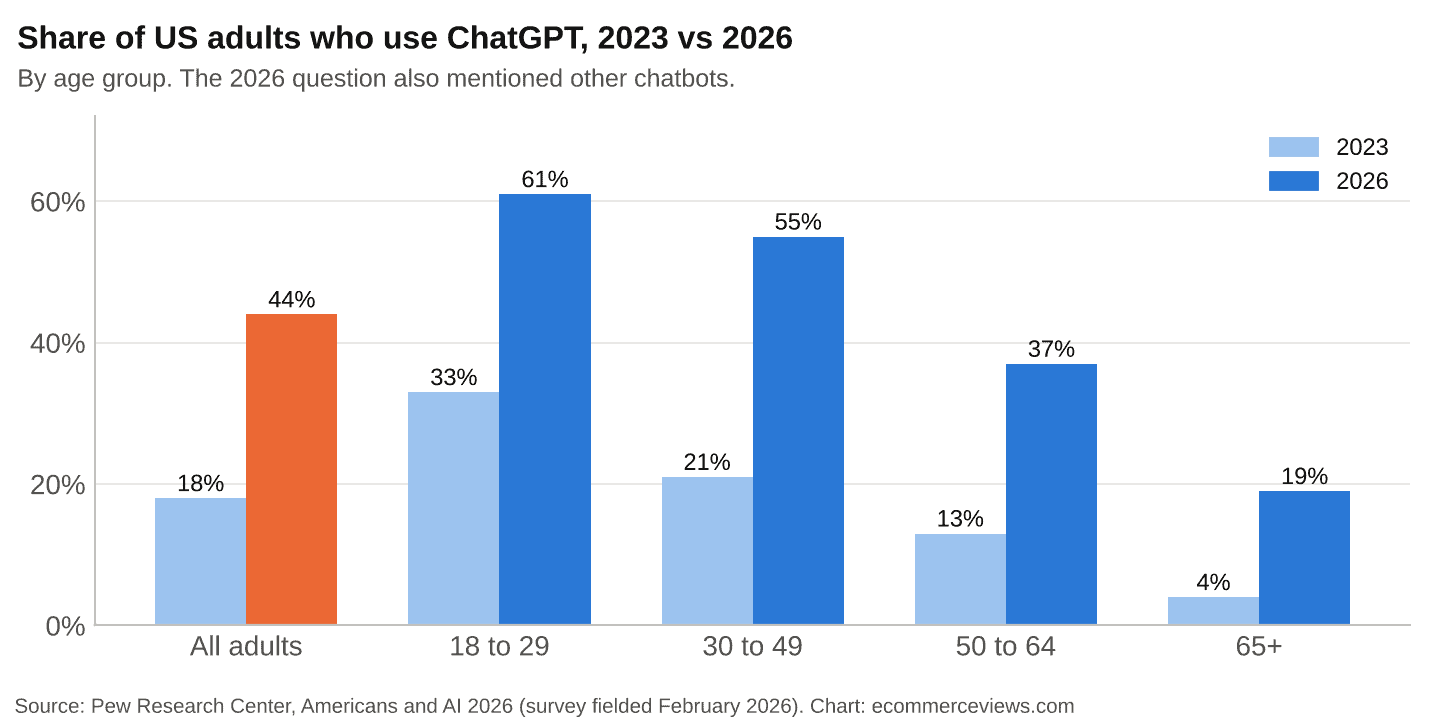
Share of US adults who use ChatGPT, 2023 vs 2026, by age
In the US, Pew Research Center found that 44% of adults said they use ChatGPT in February 2026, compared with 18% in 2023 and 34% in 2025. Use reached 61% among 18 to 29 year olds and 55% among 30 to 49 year olds, but only 19% among those aged 65 and over. Pew notes that the 2026 question also mentioned other chatbots, so the latest jump is partly a wording change.
| Share of US adults who use ChatGPT | 2023 | 2024 | 2025 | 2026 |
|---|---|---|---|---|
| All adults | 18% | 23% | 34% | 44% |
| Ages 18 to 29 | 33% | 43% | 58% | 61% |
| Ages 30 to 49 | 21% | 27% | 41% | 55% |
| Ages 50 to 64 | 13% | 17% | 25% | 37% |
| Ages 65 and over | 4% | 6% | 10% | 19% |
Source: Pew Research Center, Americans and AI 2026.
Europe is further behind
Eurostat’s first survey of generative AI use by individuals, run in 2025, shows a lower level in the EU.
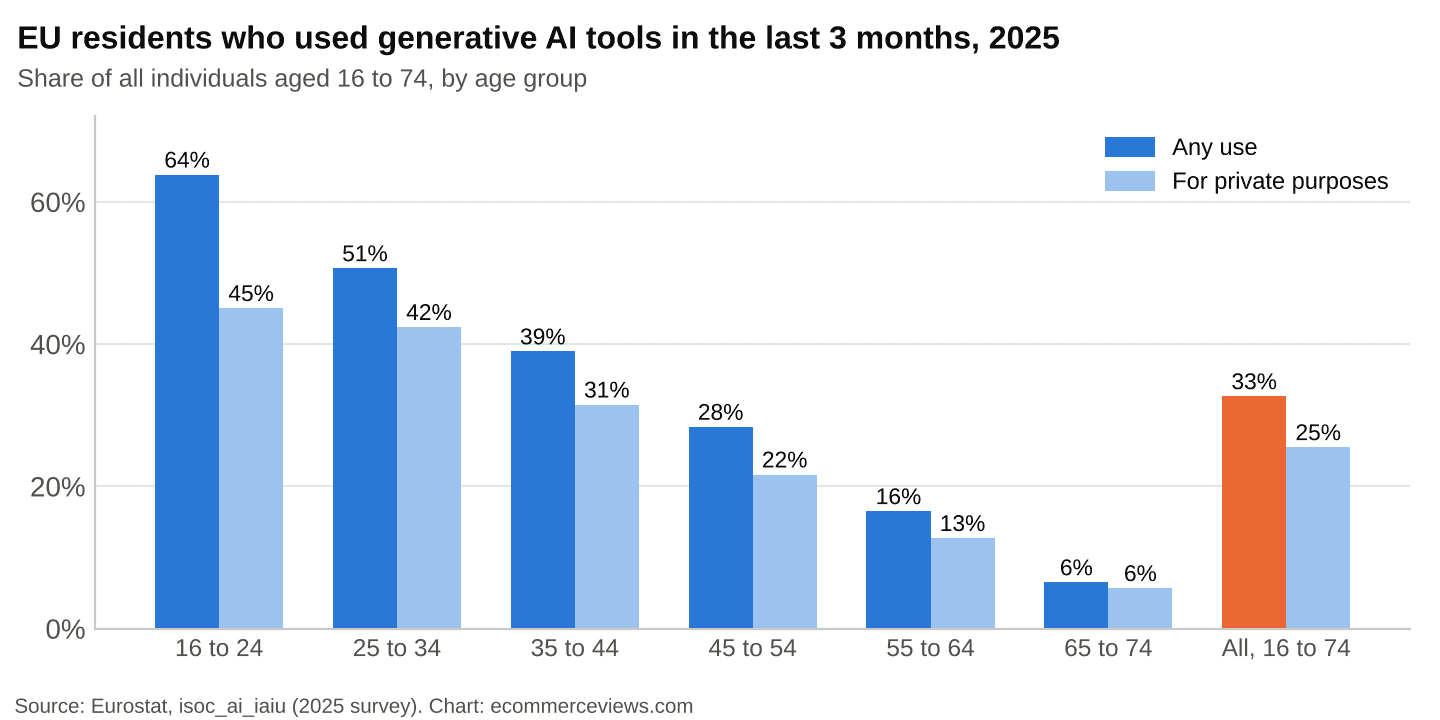
EU residents who used generative AI tools in the last 3 months, by age, 2025
Across the EU, 32.7% of people aged 16 to 74 had used a generative AI tool in the previous three months, and 25.5% had used one for private purposes, which is where shopping research would show up. The age gap is steep: 63.8% of 16 to 24 year olds used these tools, against 16.5% of 55 to 64 year olds and 6.5% of 65 to 74 year olds.
The country spread is wide as well. Private use ranged from 43.3% in Cyprus and 40.9% in Greece to 14.8% in Romania and 12.8% in Italy. Germany (27.2%) and France (27.7%) were close to the EU average, and Croatia sat just below it at 24.7%.
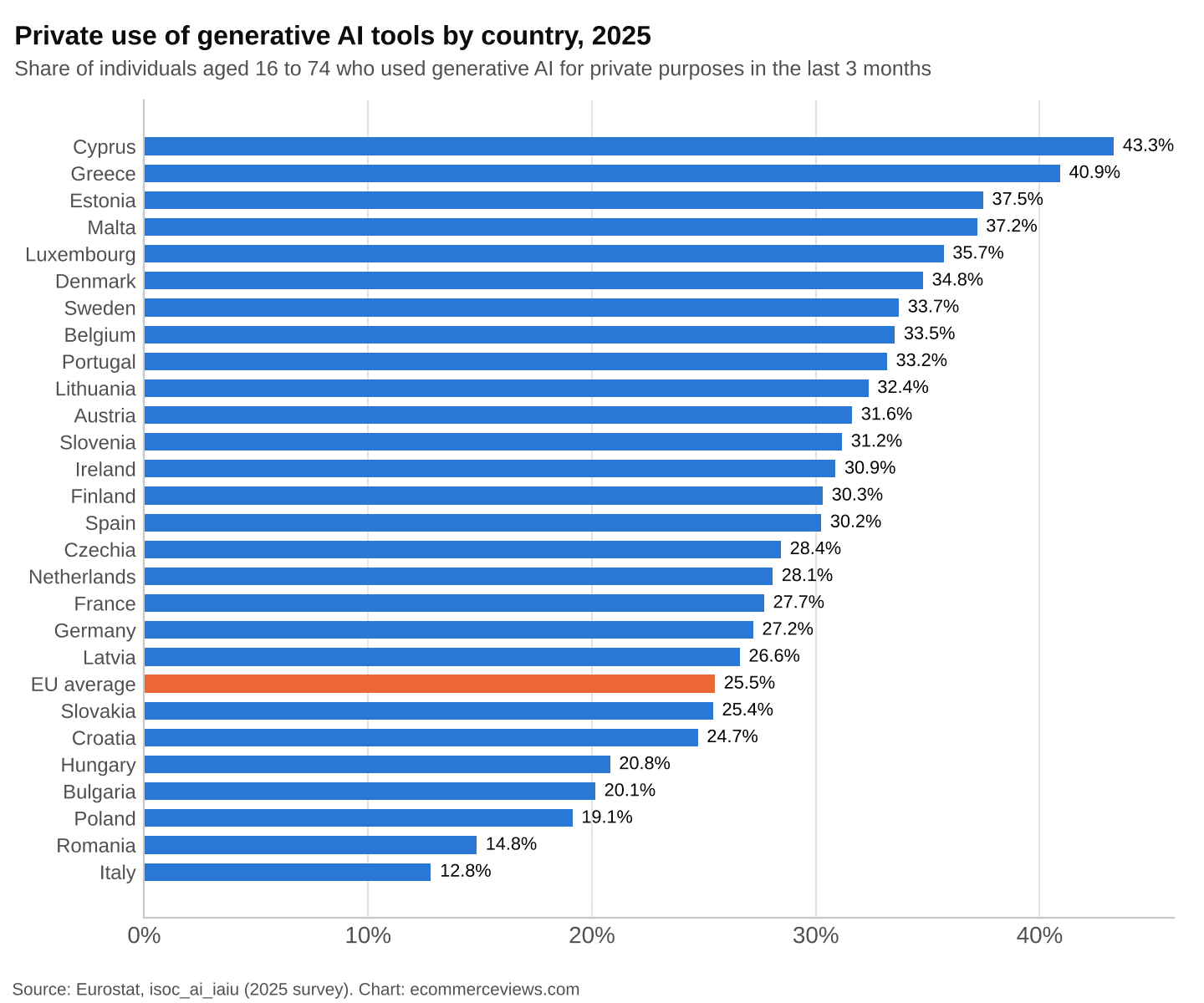
Private use of generative AI tools by country, 2025
The reasons for not using these tools are telling. Of EU residents who had not used generative AI, 64.3% said they had no need for it, 13.8% did not know how to use it, and only 7.3% cited privacy, security or safety concerns. Most people are not afraid of AI assistants. They just have not found a reason to use them yet. The full figures are in Eurostat’s isoc_ai_iaiu table.
For a store selling to European customers, the conclusion is that AI assistants are a growing discovery channel, strongest with customers under 35, but they are not yet where most of your buyers are.
Why product data is the deciding factor
An AI assistant cannot look at your homepage design or read your brand story the way a person does. It reads structured facts: product name, price, availability, size, color, materials, shipping time, return policy and reviews. When a shopper asks for “waterproof hiking boots under 150 euros that ship to Croatia this week”, the assistant can only recommend products whose data answers each part of that question.
That is why I think agents reward good small stores rather than punish them. A large retailer with a messy catalog of 200,000 products and inconsistent attributes has a harder job than a small store with 300 well-described products. The feed decides, not the ad budget.
Most catalogs are not ready. Common problems include missing attributes, prices or stock levels that differ between the site and the feed, vague titles and descriptions written for people rather than for comparison. Our piece on why product data breaks between ERP, PIM and sales channels explains where those gaps usually come from.
The case against
There are reasonable arguments that small stores should be worried.
- Platforms may still take over checkout. OpenAI stepped back, but Google is building native checkout into AI Mode and Gemini, and Walmart already runs its own app inside ChatGPT. If checkout inside assistants does take off, the platform could own the customer relationship, as marketplaces do today.
- Visibility rules are opaque. No assistant publishes how it ranks products. A store can do everything right and still not appear, with no way to find out why.
- Big retailers get the first integrations. The named launch partners are Target, Walmart, Best Buy and other large chains. Small stores depend on their platform, such as Shopify or Etsy, to connect them, and stores on other platforms may wait longer.
- It may be too early to invest. With a quarter of EU residents using generative AI for private purposes, and no reliable data on how many purchases start in an assistant, some store owners will reasonably decide to wait.
I take these seriously, especially the first. But the cost of preparing is low, because the work is mostly cleaning up product data that also improves Google Shopping, marketplace listings and on-site search. Waiting does not save much money, and it risks being invisible when assistants become a larger channel. The same groundwork also helps with getting your store into AI search results.
What to do
The work splits into two parts: making your products readable to agents, and making sure the purchase still ends on your site.
- Fix your product feed first. Make sure every product has a precise title, price, stock status, GTIN where one exists, size and color attributes, and good images. Keep the feed in sync with your site, since a price or stock mismatch is the fastest way to be dropped.
- Write descriptions that answer questions. Assistants match products to specific requests. Materials, dimensions, compatibility, care instructions and who the product is for are more useful than marketing adjectives. Our guide on writing product descriptions that rank and convert applies here too.
- Publish clear shipping and returns data. Agents compare delivery times and return policies. Put them in your feed and in structured data on product pages, not only in a footer page.
Make your store easy to recommend
- Collect reviews on product pages. Review counts and ratings are among the facts assistants use to compare products. Our analysis of how online reviews influence purchases covers how to gather more of them.
- Use your platform’s AI channels. If you sell on Shopify or Etsy, your catalog may already be connected to ChatGPT. Check your platform settings and make sure your best products have complete data.
- Track AI referrals. Set up analytics to spot visits from chatgpt.com, gemini.google.com and similar sources, and watch which products they land on. That tells you which listings assistants already trust.
The bottom line
AI shopping agents are real, but the first year of them did not go the way the hype predicted. Payment networks and protocols are ready, assistants are gaining users quickly, and yet the leading assistant decided to send shoppers back to stores to pay. What agents need most from merchants is accurate, complete product data. That is a level playing field, and one where a small, well-run store can beat a large, messy one. Prepare your feed now and treat agents as a new discovery channel, not a threat.