By Shaheryar Muhammad Khan, Founder & CEO, Nxthatch Technologies
Contributor Article for Ecommerce Views
For a small ecommerce catalog, product information can look simple. A title. A description. A price. A few images. Maybe a SKU and barcode.
As the catalog grows, that simplicity disappears quickly.
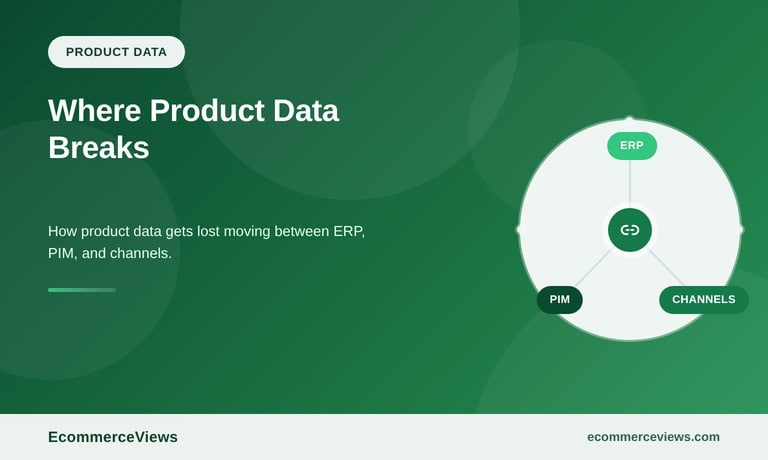
Product information starts moving between suppliers, spreadsheets, ERP systems, PIM platforms, ecommerce stores, marketplaces, warehouse systems, and marketing channels. Each system has different responsibilities, different field structures, and different requirements.
That is when product data begins to break.
The problem is rarely that a business has no data. More often, the same product exists in several systems, with each one holding a slightly different version of the truth.
A product may have one title in the ERP, another in the PIM, shortened attributes in Shopify, different category mappings on Amazon, and a marketplace feed rejecting a required value altogether.
The real challenge is not storing product information. It is controlling how that information moves.
ERP, PIM, and Ecommerce Platforms Have Different Jobs
One of the first problems appears when businesses expect a single platform to manage every part of the product lifecycle.
An ERP is typically strongest at operational information such as SKUs, inventory, procurement, costs, supplier information, warehouse data, and order-related information.
A PIM has a different responsibility. It is designed to organize, enrich, validate, and distribute customer-facing product information such as product names, descriptions, specifications, attributes, categories, media, translations, channel-specific content, and identifiers such as GTINs.
The ecommerce platform then needs the version of that data required to sell the product successfully through a specific storefront.
Problems start when ownership is unclear. If the ERP, PIM, and ecommerce platform can all modify the same field independently, the business effectively has three sources of truth.
A better architecture assigns ownership deliberately. For every important product attribute, the business should know where the information is created, which system owns the authoritative value, which systems may modify it, where it must be distributed, and what validation must happen before publication.
Without those rules, integrations simply move inconsistent data faster.
Product Attributes Are Usually Where Problems Surface First
Consider a straightforward attribute such as color. One supplier might provide Navy Blue, another Navy, another Dark Blue, and another NAVY-01.
Those values may be understandable to a person, but ecommerce systems and marketplaces often need standardized values.
The same problem appears with dimensions, materials, sizes, units, product types, category names, brand names, and packaging information.
If every supplier uses a different vocabulary, those differences eventually reach the customer experience. Filters stop working consistently, products appear in the wrong categories, marketplace listings fail validation, and search becomes less useful.
Teams then spend time fixing individual listings when the actual problem sits much earlier in the product-data workflow. That is why normalization should happen before syndication rather than after a listing fails.
Validation Should Happen Before Products Reach a Channel
Many ecommerce teams discover product-data problems only after a platform rejects a feed. That is late in the process.
A better workflow validates product information before it reaches Shopify, Amazon, Walmart, a retailer portal, or another destination.
Validation can check whether required attributes exist, identifiers follow the expected format, dimensions use approved units, titles remain within channel limits, category mappings are valid, required images are present, product relationships are complete, restricted values have been removed, and channel-specific requirements are satisfied.
The important point is that validation rules should be predictable. If a product cannot be published because it is missing a required value, the system should identify the exact problem and return it to the appropriate person. Otherwise, teams end up investigating failed feeds manually.
GTIN and GS1 Data Need Governance Too
Product identifiers often look like simple fields in a database. Operationally, they can become much more complicated.
GTINs may need to remain correctly associated with a particular product, packaging level, or variant. Duplicate identifiers, formatting mistakes, and incorrect product relationships can create problems across retailers and marketplaces.
The software should not treat identifiers as arbitrary text. Businesses should establish clear rules around where GTINs originate, who can change them, how duplicates are prevented, how variants are represented, how packaging relationships are maintained, and how identifier changes are audited.
When product identifiers are governed like ordinary editable content, errors can spread into every downstream channel.
Channel Requirements Should Not Rewrite the Master Record
Another common problem occurs when different sales channels require different versions of product information.
A marketplace may impose a title limit. A retailer may require a specific taxonomy. A storefront may need marketing-focused copy. Another channel may require additional technical attributes.
Businesses sometimes solve this by modifying the master product data for whichever channel needs attention at that moment. That creates instability.
Instead, the product-data model should distinguish between the master record and channel-specific representations. The master record preserves the core product information. Channel mappings determine how that information should appear in each destination.
For example, a master product name might be ‘Women’s Waterproof Trail Running Shoe,’ while a marketplace title adds selling language and an internal ERP description remains a short code. These can all refer to the same product without competing to become the universal value.
Integrations Need More Than API Connections
Connecting an ERP to a PIM or a PIM to an ecommerce platform is often described as an integration project. Technically, that may mean APIs, webhooks, scheduled jobs, or file imports.
But the difficult part usually comes before the API call.
Teams need to decide which system initiates a change, what happens when two systems contain different values, whether updates are real-time or scheduled, what happens when synchronization fails, whether partial updates are allowed, how errors are surfaced, whether data can be rolled back, and how changes are logged.
An integration without these rules may successfully transfer information while still creating unreliable product data. A working API is not the same as a working product-data workflow.
AI Can Help, but It Should Not Become the Source of Truth
AI can be useful in product-data operations. It can assist with generating descriptions, classifying products, mapping attributes, detecting missing information, suggesting categories, extracting specifications from supplier documents, translating content, and identifying potential duplicates.
The risk appears when generated or inferred information is published automatically without sufficient controls.
Some fields are suitable for AI assistance. Others should remain deterministic. A product description can potentially be drafted by AI and then reviewed. A GTIN should not be guessed. A marketing title may be generated from verified attributes. A regulated technical specification should not be invented because the source value is missing.
A useful architecture therefore separates AI-assisted enrichment from authoritative product data. AI can propose. Rules can validate. People can review where necessary. The system should still determine what is trusted enough to publish.
Product Data Quality Is a Workflow Problem
Businesses often try to improve product data by asking teams to clean the catalog. That can work temporarily. But if the process that produced the bad data remains unchanged, the same problems return.
Sustainable product-data quality requires ownership. For every critical attribute, teams should know who provides it, who verifies it, which system owns it, what makes it valid, which channels require it, and what happens when it is missing.
This turns product-data management from a cleanup exercise into an operating model.
What Growing Ecommerce Businesses Should Review
When catalog complexity starts increasing, businesses should look at the complete product-data journey rather than only the storefront.
1. Where does each important product attribute originate?
Map the actual source rather than where employees currently edit it.
2. Which system owns the master value?
Avoid allowing multiple systems to independently control the same field.
3. What should be validated before publication?
Move quality checks upstream.
4. Which requirements are channel-specific?
Do not distort the master record to satisfy one destination.
5. What happens when something fails?
A useful workflow should show the error, the responsible person, and the action required to resolve it.
These questions become increasingly important as businesses add suppliers, products, countries, storefronts, and marketplaces.
The Goal Is Not More Product Data
Ecommerce businesses do not need more product information simply for the sake of having it. They need product information they can trust.
That means building a system where data has clear ownership, predictable validation, controlled transformations, and reliable distribution.
ERP, PIM, and ecommerce platforms can work extremely well together when their responsibilities are clearly defined. When they are not, every additional integration creates another place for inconsistencies to spread.
The strongest product-data architecture is therefore not the one with the most platforms. It is the one where every system knows what it owns, every channel receives what it needs, and every error has a clear path back to the person or process that can fix it.
About the Author
Shaheryar Muhammad Khan is Founder & CEO of Nxthatch Technologies, a custom software and product-engineering company working across SaaS, AI-assisted workflows, ecommerce, PIM, and product-data systems. He focuses on designing software around real operational workflows, integrations, data governance, and scalable product architecture.