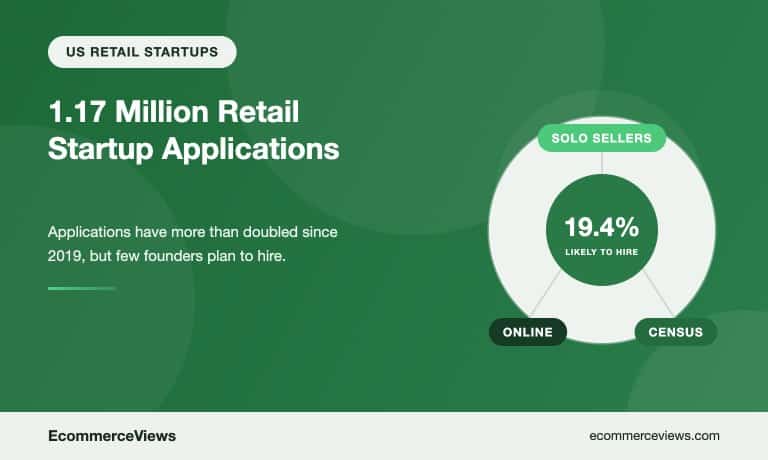
Retail is now the most popular sector for new businesses in the United States, and it is not close. US Census Bureau data shows that people filed more than 1.16 million applications to start retail businesses in 2025, more than double the 2019 figure and far ahead of any other industry.
But the applications tell a second story. A shrinking share of them come from businesses that plan to hire anyone. The surge is made of solo founders, side projects and online sellers, not new stores with staff. This study uses 21 years of Business Formation Statistics to show how big the wave is, who is behind it, and how many of these businesses turn into employers.
Key findings
- Retail business applications reached 1,166,015 in 2025, 2.25 times the 2019 level of 518,436 and almost four times the 2005 level.
- Retail is the largest sector for new applications. It took 20.6% of all US business applications in 2025, up from 14.8% in 2019. Professional services, in second place, had about two thirds as many.
- Only 19.4% of 2025 retail applications were high-propensity, meaning they showed signs of becoming employers. In 2005 the share was 68.4%, and in 2019 it was 32.3%.
- Just 4.7% of 2025 retail applications listed a planned date for paying wages, down from 37.3% in 2005. In raw numbers, these applications were flat: 55,327 in 2025 against 55,487 in 2019.
- About 3.8% of 2025 retail applications are projected to become employer businesses within two years, against 7.0% of 2019 applications and 20.0% of 2005 applications.
- The wave is still growing. Retail applications in January to September 2026 were 10.4% higher than in the same months of 2025.
How we analyzed the data
The data comes from the US Census Bureau’s Business Formation Statistics (BFS), which counts applications for an employer identification number (EIN) filed with the IRS. An EIN is the tax ID that most businesses need to open a bank account, register with a payment provider or a marketplace, or hire staff. We used the monthly national file and summed unadjusted monthly figures into calendar years, from 2005 to 2025, plus January to September 2026.
Definitions used in this study:
- Business applications are all EIN applications, excluding those for tax liens, estates, trusts and similar non-business purposes.
- High-propensity applications are the subset the Census Bureau identifies as likely to become businesses with payroll: corporations, applications that say they will hire, that give a first wages-paid date, or that come from certain industries.
- Applications with planned wages are those that state a date when the business expects to pay wages for the first time.
- Business formations within 8 quarters count applications that became employer businesses (with payroll) within two years. Census publishes actual counts up to applications made in 2021 and projections for 2022 to 2025.
The BFS assigns each application to a sector based on what the applicant writes on the form. It does not split retail into store and online retailers, so the data shows the retail wave as a whole. We explain below why most of it is likely online.
Retail applications more than doubled
For most of the 2000s and early 2010s, US retail applications grew slowly, from about 300,000 a year in 2005 to 376,000 in 2015. Growth picked up after 2015, and then 2020 changed the scale completely.
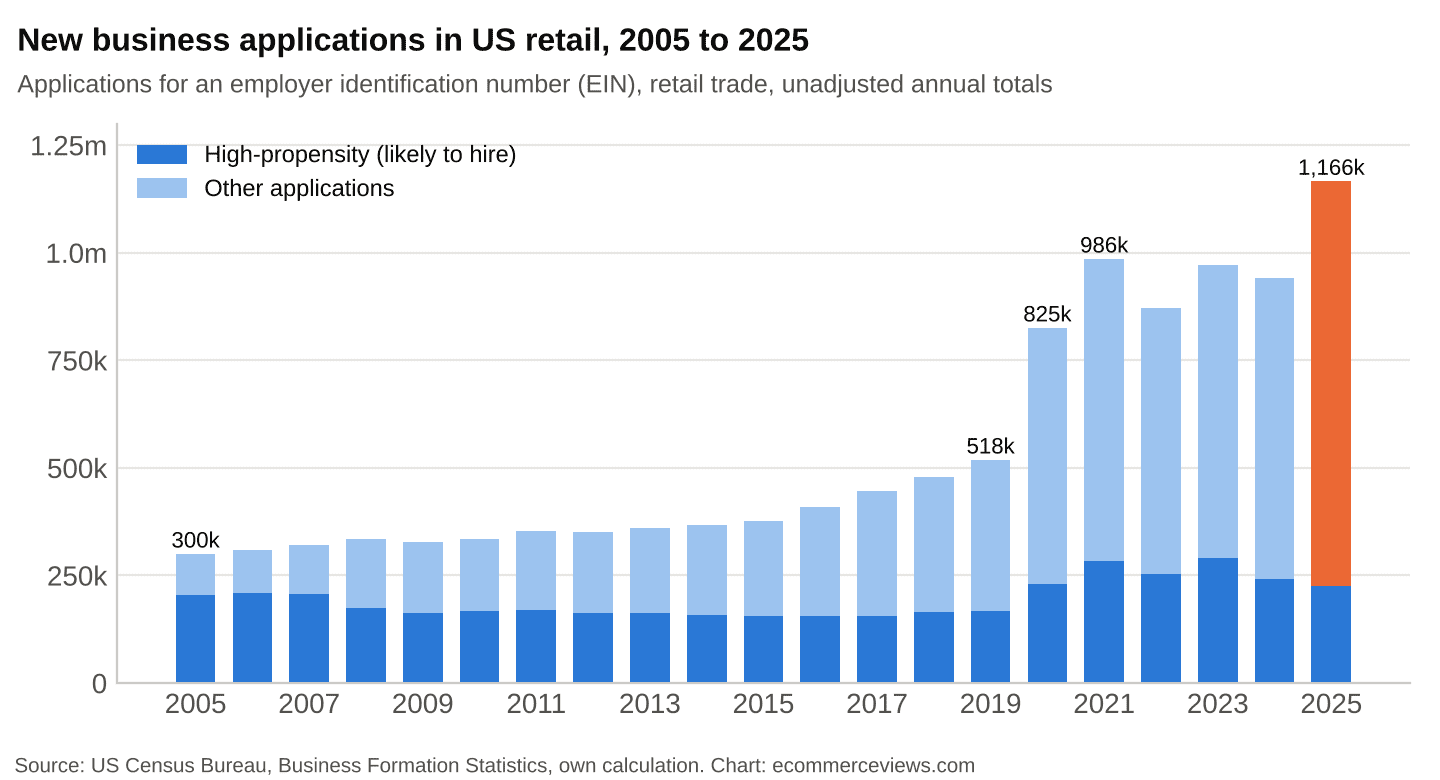
New business applications in US retail, 2005 to 2025
| Year | Retail applications | Share of all US applications | High-propensity share |
|---|---|---|---|
| 2005 | 299,948 | 12.1% | 68.4% |
| 2015 | 376,436 | 13.5% | 41.2% |
| 2019 | 518,436 | 14.8% | 32.3% |
| 2020 | 825,357 | 18.9% | 27.8% |
| 2021 | 985,596 | 18.3% | 28.7% |
| 2023 | 971,410 | 17.8% | 29.9% |
| 2025 | 1,166,015 | 20.6% | 19.4% |
Unadjusted annual totals. Source: US Census Bureau, Business Formation Statistics, own calculation.
Retail applications jumped by 59% in 2020 and kept rising in 2021. They dipped in 2022 and 2024 but never returned to pre-pandemic levels. In 2025 they hit a new record, and the seasonally adjusted monthly figure for July 2026 (140,858) was 3.2 times the 2019 monthly average.
Between 2019 and 2025, annual retail applications rose by about 648,000. Only about 9% of that increase came from high-propensity applications. The rest came from businesses that showed no sign of planning to hire.
Why the wave is mostly online
The BFS does not separate online sellers from physical shops, but several facts point the same way.
First, research by economist John Haltiwanger, summarized in an NBER Digest on pandemic business formation, found that three quarters of the 2020 surge in startups was concentrated in ten industries. Nonstore retail, the category that includes online sellers, accounted for a third of that growth.
Second, physical retail requires premises, stock and usually staff. A store with no planned employees and no planned wages is rare. An online shop run from home, a marketplace account or a dropshipping business needs none of these, but it still needs an EIN to open a business bank account and to sign up with most payment providers and marketplaces.
Third, the share of applications with planned wages fell hardest exactly when the number of applications rose most. These are businesses designed to be run by one person.
Fewer new retail businesses plan to hire
The high-propensity share of retail applications has fallen in almost every year since 2005. Until about 2013, retail was above the all-sector average. Since then it has fallen faster, and in 2025 the gap was the widest on record.
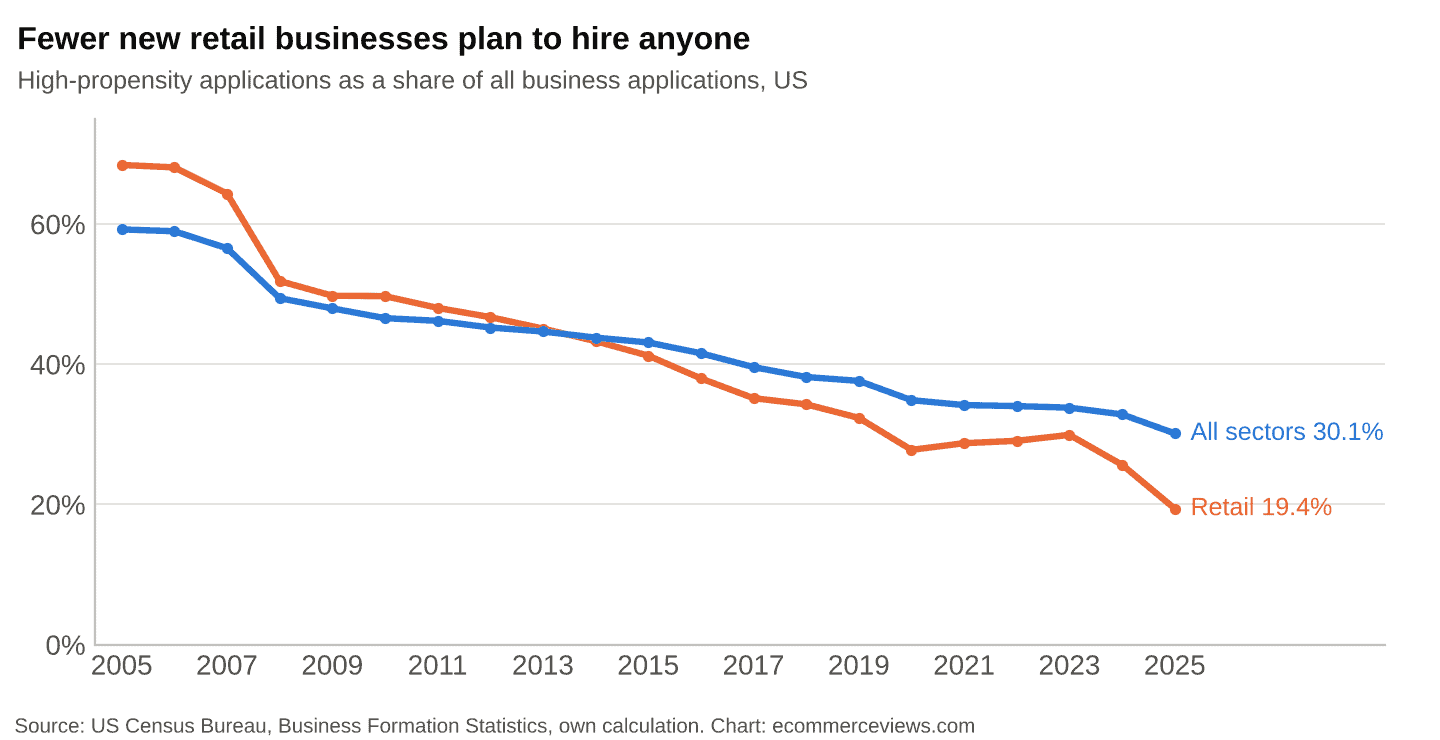
High-propensity applications as a share of all applications, retail vs all sectors
| Share of applications | 2005 | 2019 | 2025 |
|---|---|---|---|
| Retail: high-propensity | 68.4% | 32.3% | 19.4% |
| All sectors: high-propensity | 59.2% | 37.6% | 30.1% |
| Retail: with planned wages | 37.3% | 10.7% | 4.7% |
Source: US Census Bureau, Business Formation Statistics, own calculation.
The low cost of starting is a big part of the appeal. We looked at what a store can do with a minimal budget in our piece on starting an online business from $1,000.
High-propensity retail applications did grow in absolute terms, from 167,659 in 2019 to 226,087 in 2025, an increase of 34.8%. So the number of serious new retail employers is up. It is just much smaller than the headline wave suggests.
How many become employers
The most useful BFS series for founders is the count of applications that actually become employer businesses. For retail, that number has stayed remarkably steady while applications exploded.
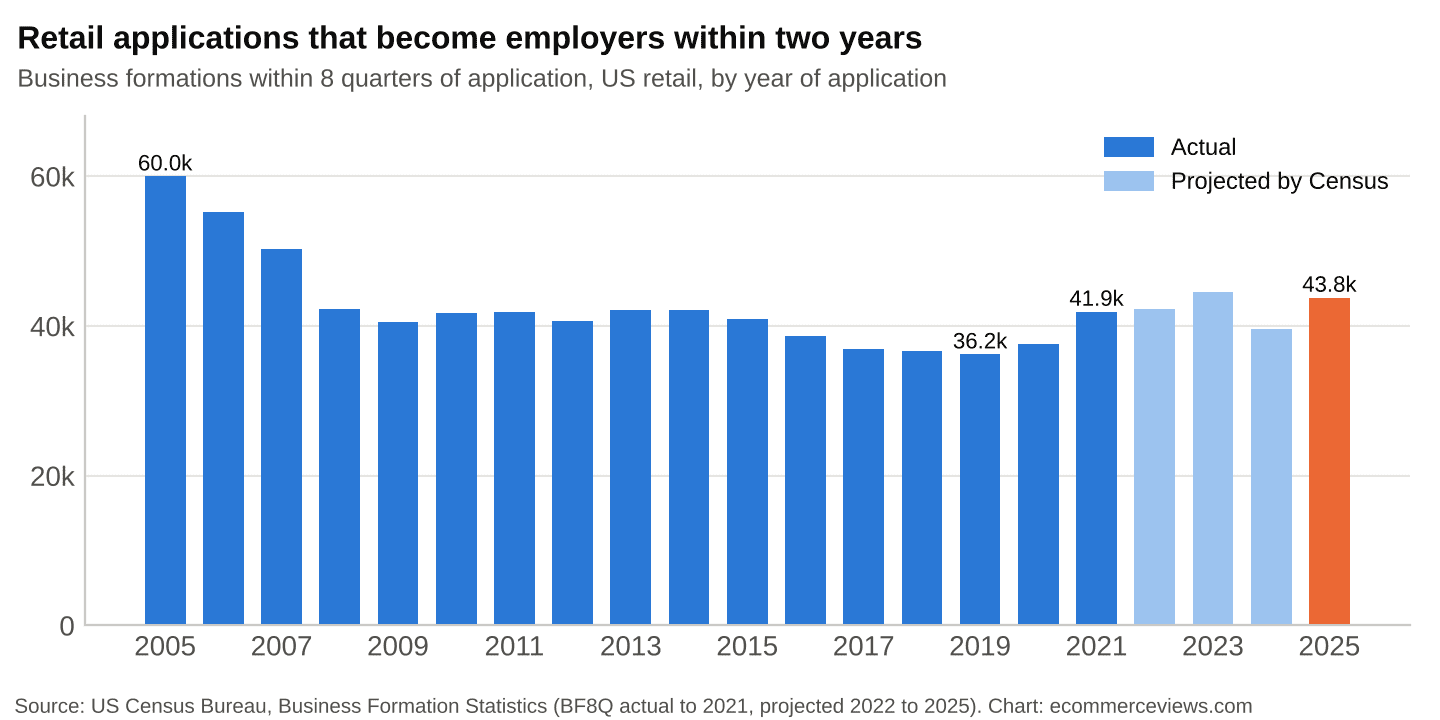
Retail applications that become employers within two years, actual and projected
Applications made in 2005 produced 59,985 employer businesses within two years. By 2019, that figure was 36,209. Applications made in 2021, the first pandemic wave with complete data, produced 41,899. Census projects 43,782 formations from the 2025 applications.
| Application year | Retail applications | Employers within 2 years | Conversion rate |
|---|---|---|---|
| 2005 | 299,948 | 59,985 | 20.0% |
| 2019 | 518,436 | 36,209 | 7.0% |
| 2021 | 985,596 | 41,899 | 4.3% |
| 2025 | 1,166,015 | 43,782 (projected) | 3.8% |
Source: US Census Bureau, Business Formation Statistics, own calculation.
The number of new retail employers in 2025 is projected to be about 21% higher than in 2019. The number of applications is 125% higher. The rest are businesses that remain one-person operations, sell part time, or never start trading at all. Thin margins are part of the reason, as our analysis showing that selling online is no longer cheaper than running a store found.
The time from application to first payroll has also stretched. For retail applications made in mid-2006 that hired within two years, the average delay was about 1.8 quarters. For mid-2019 applications it was about 2.5 quarters.
2026 keeps the pace
The first nine months of 2026 show no slowdown.
| January to September | 2025 | 2026 | Change |
|---|---|---|---|
| Retail applications | 845,957 | 933,528 | +10.4% |
| All US applications | 4,273,086 | 4,927,840 | +15.3% |
| Retail high-propensity applications | 174,593 | 190,862 | +9.3% |
Unadjusted. Source: US Census Bureau, Business Formation Statistics, own calculation.
Retail applications are still growing, though slightly more slowly than applications overall, so retail’s share eased to 18.9% in the first nine months of 2026. About 20.4% of this year’s retail applications are high-propensity, close to the 2025 level. The appetite for starting an online business clearly has not faded, which fits the case we made on whether ecommerce is still worth it in 2026.
What this means for online stores
The data has a clear message for anyone starting or running a small online shop: you have far more competition than before 2020, but most of it is small, part time and fragile.
- Expect crowded niches. More than a million new retail businesses a year means low-cost, easy-to-copy products attract many sellers quickly. Differentiation through product, brand or service matters more than ever.
- Do not compare yourself to the headline numbers. Most of the new competitors will never hire, and many will not last. A store that survives its second year and builds repeat customers is already ahead of most of the 2025 cohort.
- Plan the first hire deliberately. Only 3.8% of 2025 retail applications are projected to become employers within two years. Knowing when the workload and margins justify a first employee is a real milestone, not a default.
- Pick tools that one person can run. Most new retail businesses are run by their founder alone. Our comparison of the best ecommerce platforms for small businesses focuses on platforms that suit a solo seller.
Starting right if you are one of the million
- Treat the business as a business from day one. An EIN, a separate bank account and clean records make it far easier to grow, borrow or sell later. Our guide to setting up an ecommerce business covers the setup steps.
- Test demand before you invest. With so many new entrants, a small first order of stock or a preorder page shows whether a product sells before you commit cash to inventory.
- Count every cost. Payment fees, shipping, returns and advertising add up quickly for a solo seller. Know your margin per order before you scale.
Limits of the data
- Applications are not businesses. An EIN application shows intent. Many applicants never start trading, and the BFS cannot say how many non-employer businesses actually operate.
- No split between store and online retail. The BFS reports retail as one sector, so the online share of the wave is inferred, not measured.
- Sector is self-reported. Applicants choose their industry on the form, and some online sellers may pick other sectors, while some retail applications may come from service businesses.
- Recent formations are projections. Employer formation counts for applications after 2021 are Census projections, which may change as payroll data comes in.
- Other reasons for EINs. Some people file for an EIN to open a marketplace or payment account, register for sales tax, or keep their Social Security number private, even if their business is small. This may inflate applications relative to real activity.
- Annual totals are unadjusted sums. Monthly figures are revised in later releases, so the most recent months may change slightly.
The bottom line
Retail is where Americans start businesses now, and most of them start online and alone. The number of retail applications has more than doubled since 2019 and set a new record in 2025, while the share planning to hire anyone has fallen to under one in five. For established online stores, that means a crowded but mostly lightweight field of competitors. For new founders, it means the hard part is no longer getting started. It is becoming one of the few businesses that grows past its founder.