For most of the last decade, China was the market that showed everyone else where ecommerce was heading. Online sales grew by a quarter or more every year, and the online share of retail climbed faster than anywhere else of similar size.
That phase is over. Data from the National Bureau of Statistics of China (NBS) shows that online sales of physical goods reached 27.6% of total retail sales in 2023 and then slipped back, to 26.1% in 2025. Online growth has fallen from more than 30% a year to under 4%. This study looks at eleven years of official figures, plus the first nine months of 2026, to show what happens to ecommerce when it stops being new.
Key findings
- Online retail sales of physical goods reached 13,092.3 billion yuan in 2025, about four times their 2015 level of 3,242.4 billion yuan.
- The online share of retail rose from 10.8% in 2015 to a peak of 27.6% in 2023, then eased to 26.5% in 2024 and 26.1% in 2025.
- Online growth has slowed in almost every year, from 31.6% in 2015 to 5.2% in 2025 and 3.8% in January to September 2026.
- Online still grows faster than retail overall. In the first nine months of 2026, online goods sales rose 3.8% while total retail sales rose only 1.1%, so the online share for that period was 25.7%, up from 25.0% a year earlier.
- Food is now the engine. Online food sales grew 14.5% in 2025 and 15.8% in January to September 2026, while online clothing sales grew 1.9% and 3.4%.
- China’s express delivery system handled 199.0 billion parcels in 2025, roughly 142 for every person in the country.
How we analyzed the data
All figures come from the NBS English-language press releases on total retail sales of consumer goods, published every month, and from its annual statistical communiqués. We collected the December (full-year) release for every year from 2015 to 2025 and the year-to-date releases for 2024, 2025 and 2026.
Definitions:
- Online retail sales of physical goods are sales of goods made through online trading platforms, including retailers’ own websites and third-party platforms. Services such as travel, food delivery and tickets are counted separately and are not included in this study.
- Total retail sales of consumer goods is China’s headline retail measure. It includes sales of goods by all retailers, online and offline, and the income of the catering industry.
- Online share is NBS’s own published ratio of the two, available from 2016. For 2015 and for January to September 2026, NBS did not publish a share, so we calculated it from the published values.
Three caveats matter. First, NBS publishes growth rates on a “comparable basis,” which adjusts for changes in the set of reporting businesses. They do not always match the change between published levels, so this study quotes the published growth rates rather than computing its own. Second, the 2024 figures were revised after the Fifth National Economic Census. We use the revised 2024 values from the statistical communiqué (12,787.8 billion yuan and a 26.5% share). Third, all values are nominal, not adjusted for inflation.
Ten years of growth, then a plateau
Between 2015 and 2023, China added about two percentage points of online share every year. The share passed 20% in 2019 and jumped to 24.9% in 2020, when lockdowns kept shoppers away from stores. It reached its high point of 27.6% in 2023.
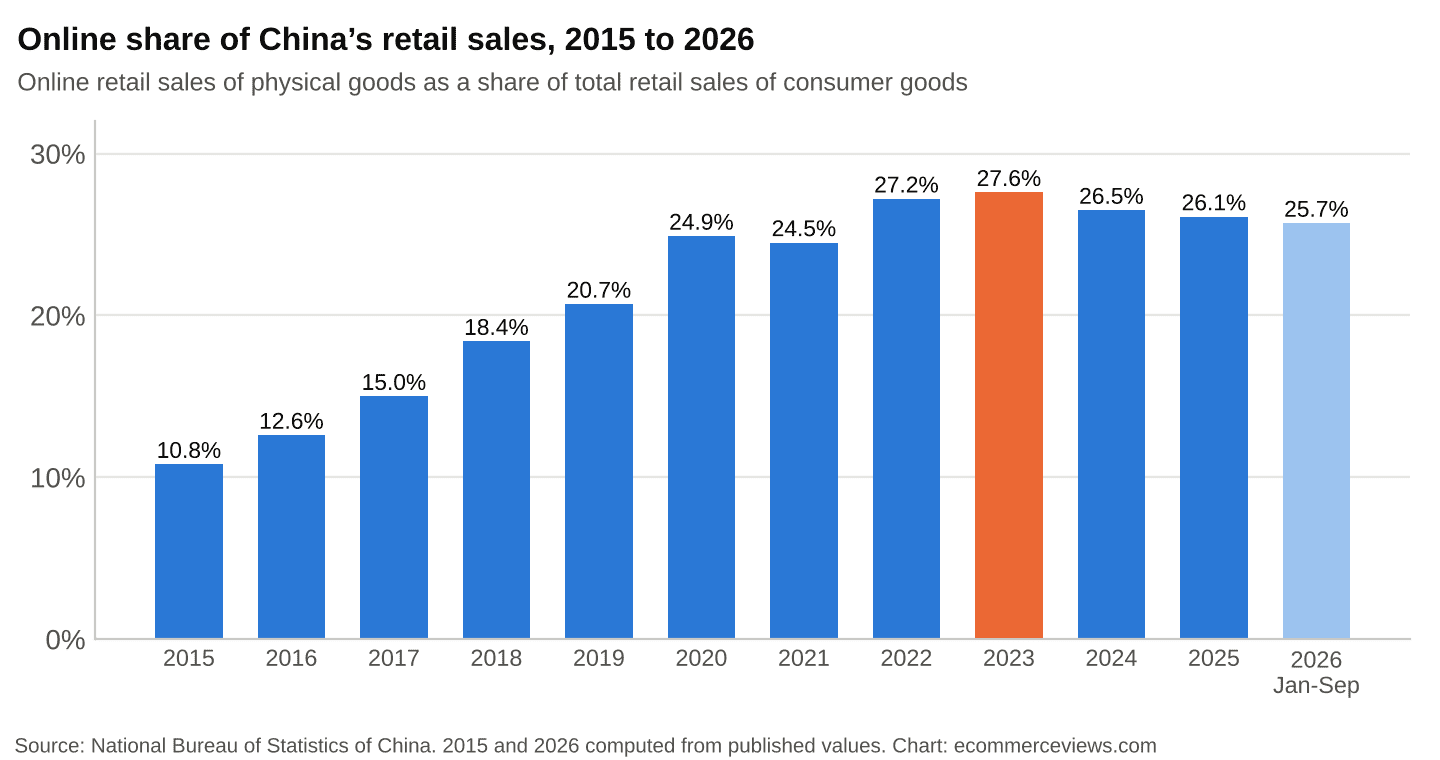
Online share of China’s retail sales, 2015 to 2026
Since then, the line has turned slightly down. The share fell to 26.5% in 2024 and 26.1% in 2025. The January to September 2026 figure of 25.7% looks lower again, but it should not be compared with full-year numbers. The last quarter includes China’s biggest online shopping festivals, so a nine-month share always runs below the annual one. Compared with the same nine months of 2025 (25.0%), the 2026 share is actually higher.
| Year | Online sales of physical goods (bn yuan) | Growth as published | Online share of retail |
|---|---|---|---|
| 2015 | 3,242.4 | +31.6% | 10.8% |
| 2017 | 5,480.6 | +28.0% | 15.0% |
| 2019 | 8,523.9 | +19.5% | 20.7% |
| 2020 | 9,759.0 | +14.8% | 24.9% |
| 2021 | 10,804.2 | +12.0% | 24.5% |
| 2022 | 11,964.2 | +6.2% | 27.2% |
| 2023 | 13,017.4 | +8.4% | 27.6% |
| 2024 | 12,787.8 | +6.5% | 26.5% |
| 2025 | 13,092.3 | +5.2% | 26.1% |
2024 revised after the Fifth National Economic Census. 2015 share calculated from published values. Source: National Bureau of Statistics of China.
The plateau tells us something important. Roughly one in four yuan of retail spending is online in China, and that level has held for four years even as online platforms kept investing heavily in live commerce, instant delivery and discount apps. The remaining three quarters include categories where online has always struggled: cars, fuel, building materials and restaurant meals, which together form a large part of China’s retail total.
For context on how China compares with other regions, our overview of ecommerce by region puts Asia Pacific next to the US and Europe.
Growth has fallen from 30% to under 4%
The slowdown in growth is even clearer than the plateau in share.
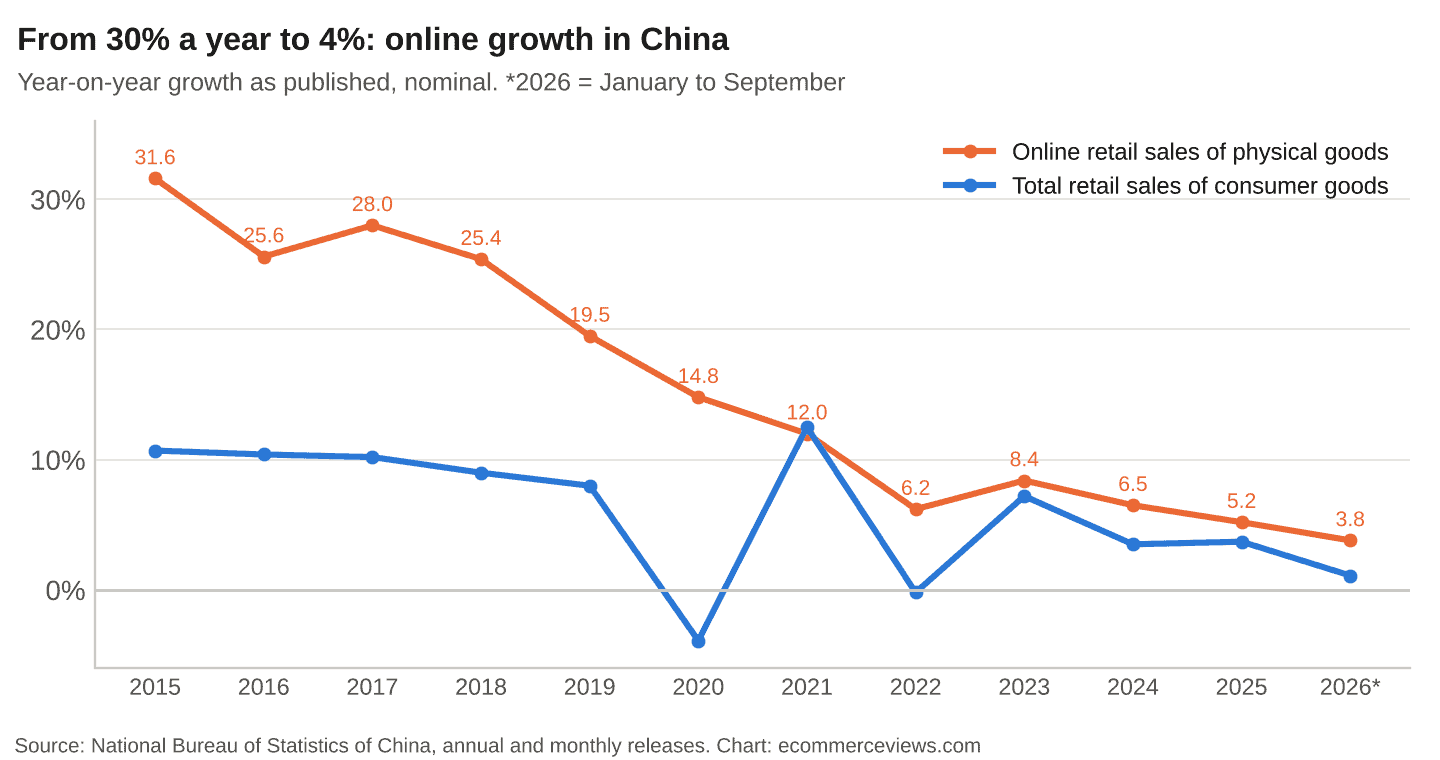
Growth of online and total retail sales in China, 2015 to 2026
In 2015, online goods sales grew 31.6%. By 2019 the rate was 19.5%, by 2022 it was 6.2%, and in 2025 it was 5.2%. In the first nine months of 2026, growth slowed further to 3.8%, the weakest figure in the series. Even the lockdown year of 2022 saw 6.2%.
Total retail sales tell a different story. They grew around 10% a year until 2018, collapsed in 2020 (minus 3.9%), rebounded in 2021 and have grown slowly since: 3.5% in 2024, 3.7% in 2025 and only 1.1% in January to September 2026. The gap between online and total growth, which was more than 20 points in 2015, has narrowed to between 1.5 and 3 points.
That gap is what moves the share. When online grows only slightly faster than retail as a whole, the share barely changes. In 2026 the gap widened again, mostly because the offline side weakened. Motor vehicle sales by large retailers fell 14.9% in January to September 2026, according to the NBS release for that period, while online goods sales still grew 3.8%.
Put simply, online is not accelerating in China. It is holding up better than the rest of retail.
Food is the last fast-growing category
NBS reports online growth for three broad groups of goods: food, clothing, and daily use goods. Their paths have split sharply.
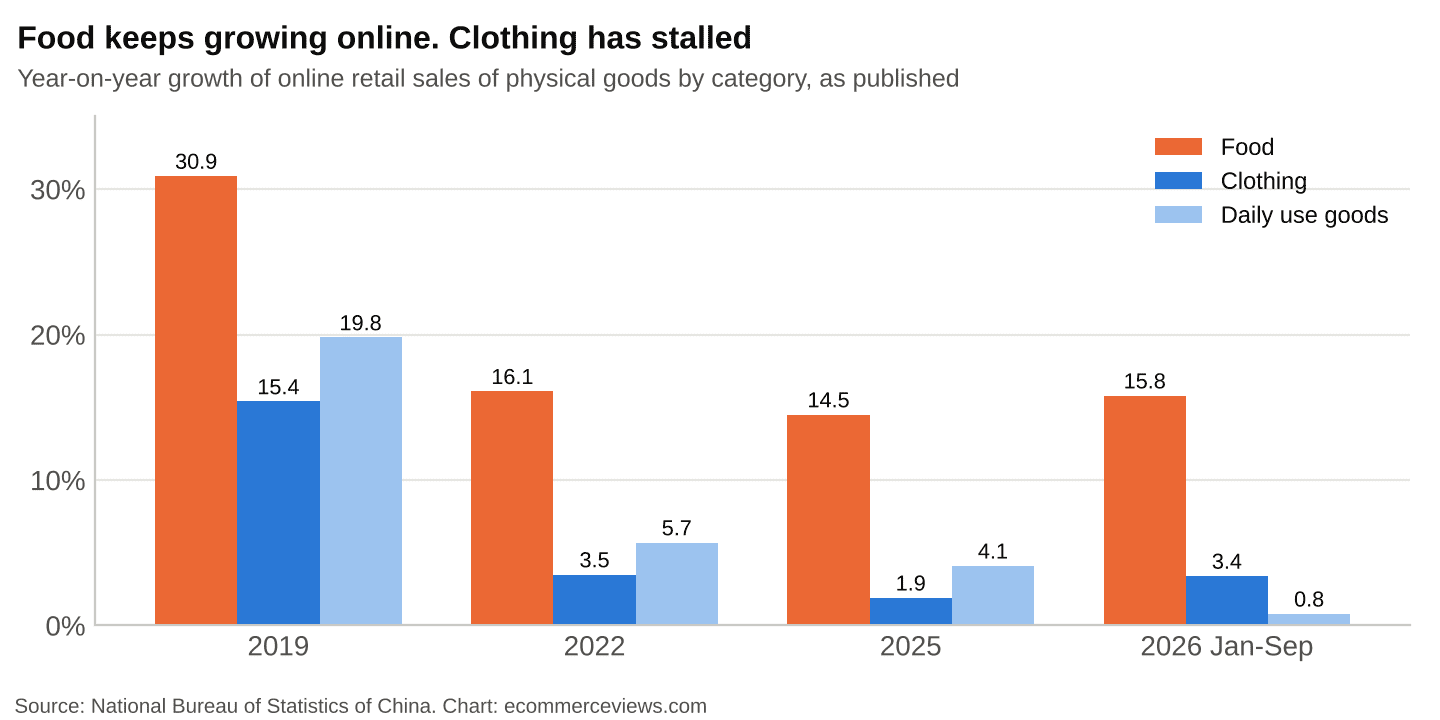
Online sales growth in China by category, selected years
| Online category growth | Food | Clothing | Daily use goods |
|---|---|---|---|
| 2015 | +40.8% | +21.4% | +36.0% |
| 2019 | +30.9% | +15.4% | +19.8% |
| 2022 | +16.1% | +3.5% | +5.7% |
| 2024 | +16.0% | +1.5% | +6.3% |
| 2025 | +14.5% | +1.9% | +4.1% |
| 2026, Jan to Sep | +15.8% | +3.4% | +0.8% |
Growth as published. The third group was labelled “other commodities” until 2018. Source: National Bureau of Statistics of China.
Food has grown by double digits online in every year of the series. Even in 2025, when overall online growth was 5.2%, food grew 14.5%. Fresh groceries, instant retail (delivery within an hour from local stores) and community group buying have kept pulling food purchases online.
Clothing is the opposite case. It was one of the first categories to move online in China, and its online growth has been in low single digits since 2022: 3.5%, then 10.8% in the 2023 rebound, then 1.5%, 1.9% and 3.4%. A category that is already heavily online, with cheap competition from discount platforms, has little room left to grow in value.
Daily use goods, the broad middle of household products, slowed to 0.8% in the first nine months of 2026.
The lesson for sellers anywhere is that ecommerce maturity is uneven. Categories that went online early saturate first, while groceries and other everyday purchases keep growing long after the overall market has slowed. We saw a similar split in our analysis of UK online retail, where store types moved online at very different speeds.
The parcel machine behind it
China’s online market runs on an enormous delivery system. According to the 2025 statistical communiqué, express delivery companies handled 199.0 billion parcels in 2025, with revenue of 1,493.9 billion yuan. That works out to about 142 parcels per person and an average revenue of roughly 7.5 yuan per parcel.
| Express delivery in China | 2024 | 2025 |
|---|---|---|
| Parcels handled | 175.1 billion | 199.0 billion |
| Revenue | 1,403.4 billion yuan | 1,493.9 billion yuan |
Statistical coverage of express delivery was adjusted in 2024. Source: NBS statistical communiqués for 2024 and 2025.
Two points stand out. Parcel volumes kept growing strongly while the value of online goods sales grew slowly, which suggests more, cheaper orders: smaller baskets, more frequent buying and more low-price items. And the revenue per parcel is very low by international standards, which is what makes cheap goods viable online in China.
China’s low-cost model travels abroad
The same combination of cheap goods and cheap parcels is what cross-border platforms brought to Western markets. The rules for those parcels are now changing in the US and the EU, which we covered in our piece on the end of duty-free parcels. For small Western stores, that is a reminder that China’s mature home market and their own markets are more connected than they look.
What this means for online stores
China is not a market most small Western stores sell into directly. But it is the clearest preview of what a mature ecommerce market looks like, and three lessons apply everywhere.
- Expect the share to plateau, not keep rising. China reached about 27% online and stopped. Business plans in Europe and the US often assume the online share will keep climbing for decades. China’s data suggests that each market has a ceiling set by its mix of categories, and growth slows sharply as it gets close.
- Growth moves to everyday categories. Food is still growing by double digits online in China, while fashion has stalled. In less mature markets, groceries, household consumables and health products are where the next decade of online growth is most likely to come from.
- Volume grows faster than value. More parcels at lower prices means thinner margins per order. Stores that rely on high order counts at low prices need very efficient fulfillment to make money.
How to compete when online stops being new
When the market stops growing quickly, growth has to come from winning share from competitors rather than from new shoppers coming online.
- Invest in retention, not only acquisition. In a mature market, most online shoppers already have their preferred stores and platforms. Repeat customers are cheaper to serve than new ones.
- Watch the price competition from platforms. China’s slowing value growth has gone hand in hand with aggressive low-price platforms. The same platforms compete in Western markets, as our comparison of Amazon and Temu shows. Competing on price alone against them rarely works for small stores.
Content is where the remaining growth is fought for
As growth slowed, Chinese platforms leaned heavily on live commerce and short video to keep shoppers buying. The same formats are now spreading to Western markets, and our article on social and livestream commerce covers how they work for smaller sellers. The point for a store owner is not to copy China’s model, but to accept that in a mature market, attention has to be earned with content rather than bought with discounts.
Limits of the data
- Published growth rates and published levels do not always match. NBS calculates growth on a comparable basis. For example, the revised 2024 level and the 2025 level imply growth of about 2.4%, while the published 2025 growth rate is 5.2%. We quote the published rates and do not compute growth from levels.
- Revisions after the economic census. The 2024 online sales figure was revised from 13,081.6 to 12,787.8 billion yuan, and the share from 26.8% to 26.5%. Earlier years were not revised in the same way, so small differences between years should be read with care.
- 2026 is partial. January to September figures exclude the strongest online shopping season and cannot be compared directly with full years.
- The definition of online services changed in 2026. NBS now reports online sales of services on a broader basis. This study uses only physical goods, which are consistent across the period.
- Category labels are broad. “Daily use goods” covers many product types, and NBS does not publish online sales levels by category, only growth rates.
- Nominal figures. None of the values is adjusted for inflation. Older releases, such as the December 2015 retail release, are the source for the start of the series.
The bottom line
China built the world’s largest ecommerce market by growing online sales 25% to 30% a year for most of the last decade. Today, about a quarter of its retail spending is online, the share has stopped rising, and growth is close to the pace of retail as a whole. Food is the only major category still growing fast. For online sellers everywhere, China’s data is a useful warning: the easy growth from shoppers moving online ends, and what comes after is a fight for share, built on retention, efficient delivery and categories that are still moving online.