For two years after the pandemic, European online retailers sold less than they had in 2021. Lockdown buyers went back to shops, inflation squeezed budgets, and the volume of goods sold by online retailers fell in both 2022 and 2023. That hangover is now over.
Eurostat’s monthly retail statistics show that the sales volume of EU online and mail order retailers passed its 2021 peak in September 2024 and kept climbing. In June 2026 it reached a new record, and in the first seven months of 2026 it grew more than three times as fast as retail as a whole. But the recovery is uneven: in some countries online retailers are growing by a fifth a year, while in others they still sell less than in 2021.
Key findings
- EU online retail volume more than doubled in ten years. The annual average index rose 132% between 2015 and 2025. Total retail volume rose 19% over the same period.
- The pandemic hangover lasted two years. Online retail volume fell 2.4% in 2022 and 2.0% in 2023, and bottomed out in September 2023 at 12% below the May 2021 peak.
- The peak was regained in September 2024. In 2025, the average volume was 8.7% above 2021, and in June 2026 the index hit a record 116.3 (2021 = 100).
- Online is growing faster again: in January to July 2026, online retail volume was 5.3% higher than a year earlier, against 1.7% for all retail.
- Online retailers outgrew total retail in 14 of 17 countries in the first seven months of 2026, led by Bulgaria and Denmark (both +21.3%) and Lithuania (+19.7%).
- Five countries are still below 2021: Greece (-19.2%), Denmark (-16.7%), Austria (-12.9%), Croatia (-12.0%) and Sweden (-1.0%), comparing 2025 with 2021.
- Lithuania leads the decade: its online retail volume in 2025 was more than three times its 2019 level.
How we analyzed the data
The data comes from Eurostat’s monthly retail trade statistics (dataset sts_trtu_m), part of the EU short-term business statistics. We used:
- Activity: NACE G4791, “retail sale via mail order houses or via internet”, compared with G47, all retail trade except motor vehicles.
- Measure: deflated sales volume, which removes price changes, so the figures show how much was sold, not how much it cost.
- Adjustment: seasonally and calendar adjusted, indexed to 2021 = 100.
- Period: January 2015 to August 2026 for the EU-27, and the latest month available for each country (July or August 2026).
One definition matters more than any other. G4791 covers businesses whose main activity is selling by mail order or online, such as pure online retailers and marketplaces selling their own stock. Online sales by retailers that are mainly store-based, like a supermarket chain with a web shop, are counted under their store category. So this index tracks the online retail sector, not every euro spent online.
Annual figures are averages of the twelve monthly index values. For 2026, we compare January to July with the same months of 2025, because that is the latest period available for every country in the comparison. Nine member states (including Ireland, Hungary and Slovakia) do not publish this series, so country comparisons cover 18 countries.
A decade in one chart: steady growth, a spike, a hangover
Plot the two indexes since 2015 and three phases appear.
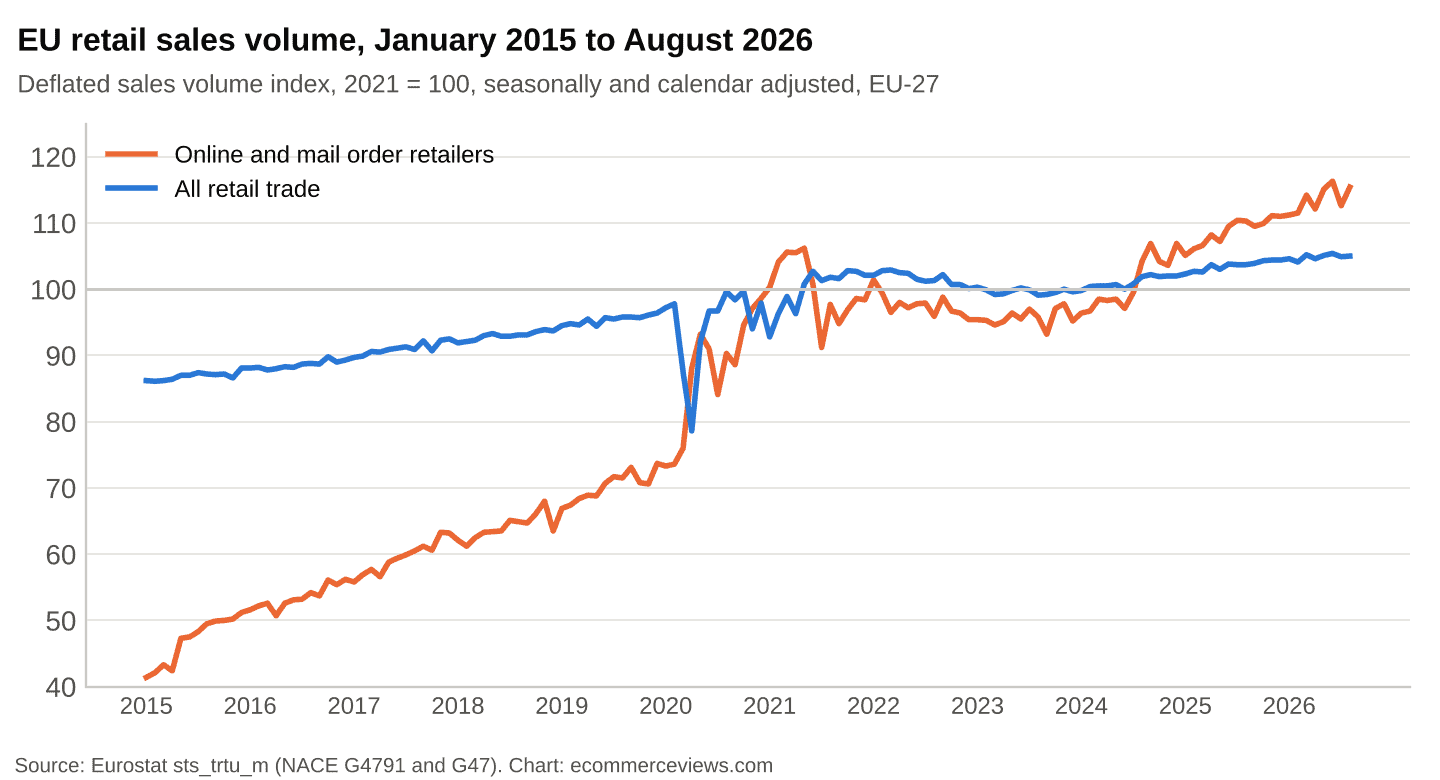
EU retail sales volume, online and mail order retailers vs all retail, 2015 to 2026
Before the pandemic, online retailers grew fast and steadily. Their sales volume rose by 10.6% a year on average from 2015 to 2019, while total retail grew by about 2% to 3% a year.
In 2020 and early 2021, the lines split apart. In April 2020, as stores closed across Europe, total retail volume fell 19.6% from February, while online retail volume jumped 19.7%. By May 2021, online retail volume was 44% above its December 2019 level.
From mid-2021 to 2023, the boom reversed. Shops reopened, households faced the highest inflation in decades, and spending on goods weakened. Online retail volume fell 2.4% in 2022 and another 2.0% in 2023 on an annual basis. In September 2023 it reached its low point, 12% below the May 2021 peak.
| Year | Online and mail order retailers | All retail trade |
|---|---|---|
| 2016 | +13.9% | +2.0% |
| 2018 | +7.6% | +2.1% |
| 2019 | +9.7% | +2.6% |
| 2020 | +24.5% | -0.8% |
| 2021 | +14.4% | +5.6% |
| 2022 | -2.4% | +1.7% |
| 2023 | -2.0% | -2.0% |
| 2024 | +5.4% | +1.4% |
| 2025 | +7.8% | +2.5% |
Annual change in average sales volume, EU-27. Source: Eurostat sts_trtu_m, own calculation.
The US followed a similar arc, as our study of 27 years of Census data shows. The table makes one point that is easy to miss. Even in the bad years, online retail did not collapse. It gave back a small share of a very large gain. In 2023, the online index was still 36% above its 2019 level, while total retail was only about 4% above.
The recovery: past the peak and still climbing
Online retail volume regained its May 2021 peak in September 2024. Since then it has kept rising. The 2025 average was 8.7% above 2021, and the index reached a record of 116.3 in June 2026. In August 2026, the latest month for the EU total, online retail volume was 4.6% above August 2025, against 1.3% for all retail.
That makes the post-pandemic picture clearer than it looked in 2023. The online share of European retail was pulled forward by lockdowns, partly pushed back, and has now resumed its long-run climb. We found a similar pattern in the UK, where our study of 20 years of ONS data showed online retail growing again after a post-pandemic dip.
The pace is slower than before the pandemic. From 2015 to 2019 online retail volume grew by about 10.6% a year. From 2023 to 2025 it grew by about 6.6% a year. Online is still taking share from stores, just not at the speed of the 2010s.
Where online retail has not recovered
The EU average hides very different national paths. Comparing average sales volume in 2025 with the 2021 boom year:
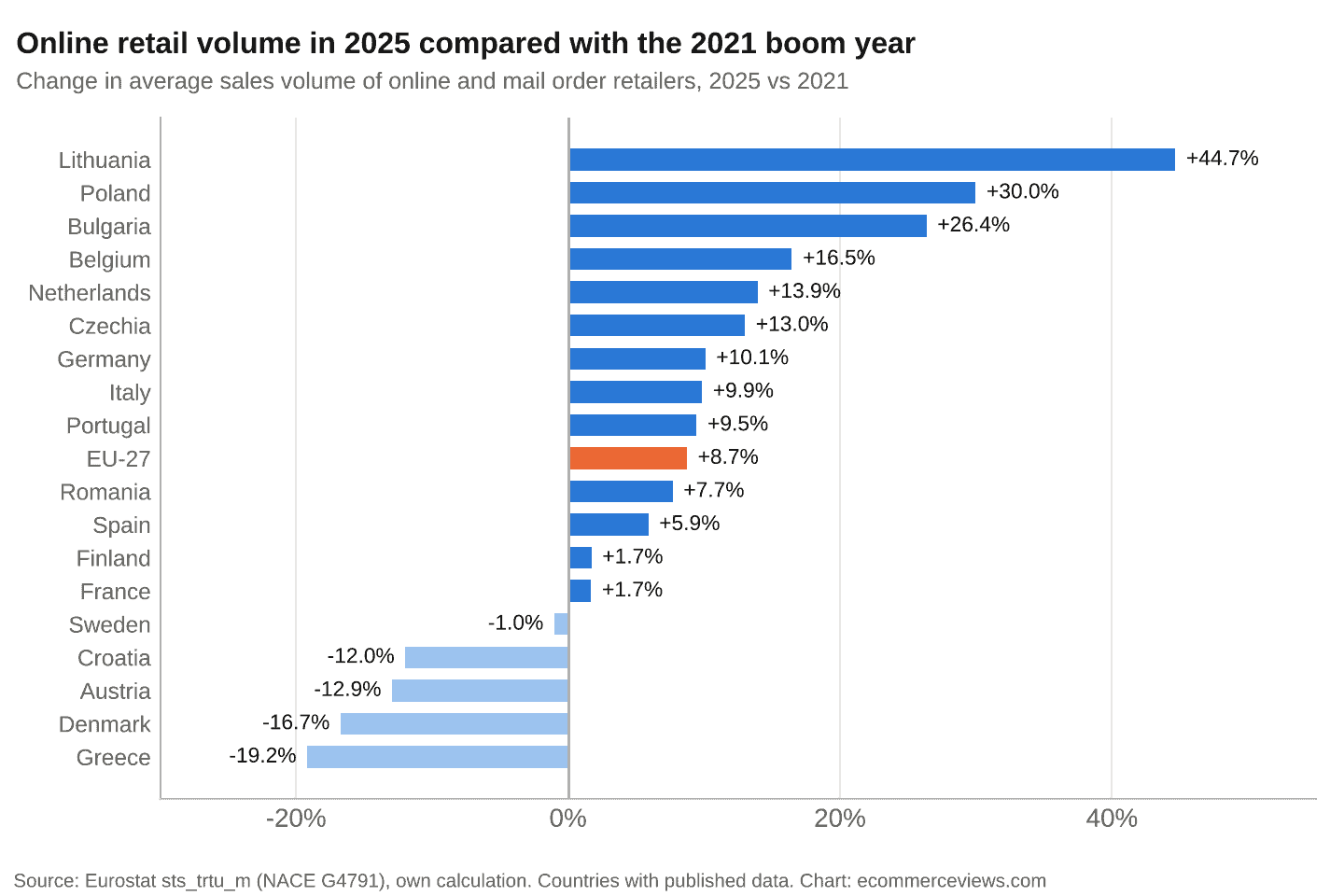
Change in online retail volume, 2025 vs 2021, by country
- Strong gains: Lithuania (+44.7%), Poland (+30.0%), Bulgaria (+26.4%), Belgium (+16.5%), the Netherlands (+13.9%) and Czechia (+13.0%).
- Close to the EU average: Germany (+10.1%), Italy (+9.9%), Portugal (+9.5%), Romania (+7.7%) and Spain (+5.9%).
- Barely recovered: Finland and France (both +1.7%).
- Still below 2021: Sweden (-1.0%), Croatia (-12.0%), Austria (-12.9%), Denmark (-16.7%) and Greece (-19.2%).
The countries still below 2021 are not all small or slow ecommerce markets. Denmark and Sweden are among Europe’s most mature online markets, as our analysis of what Europeans buy online showed. Their 2021 peak was simply very high, and part of it was a one-off. Austria and Croatia also had a sharp lockdown spike that has not been repeated.
Over a longer window, the picture improves for everyone. Every one of the 18 countries sold more online in 2025 than in 2019. Austria grew least (+3.3%), and Lithuania most (+206.7%, or more than three times its 2019 volume).
2026: where online retail is growing now
The first seven months of 2026 show a broad acceleration.
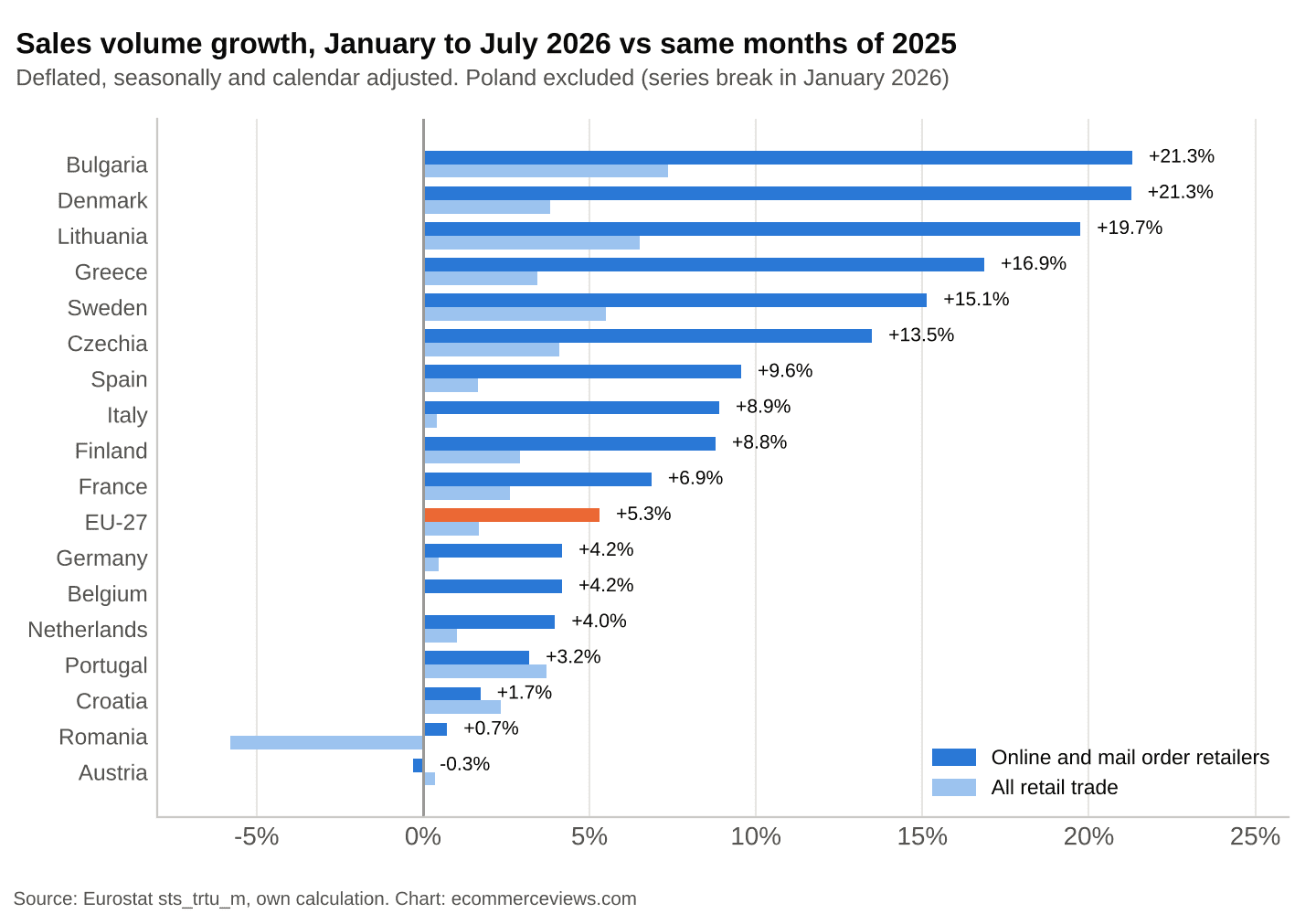
Sales volume growth, January to July 2026 vs 2025, online retailers vs all retail, by country
| Country | Online and mail order retailers | All retail trade |
|---|---|---|
| Bulgaria | +21.3% | +7.4% |
| Denmark | +21.3% | +3.8% |
| Lithuania | +19.7% | +6.5% |
| Greece | +16.9% | +3.4% |
| Sweden | +15.1% | +5.5% |
| Czechia | +13.5% | +4.1% |
| Spain | +9.6% | +1.7% |
| Italy | +8.9% | +0.4% |
| France | +6.9% | +2.6% |
| Germany | +4.2% | +0.5% |
| EU-27 | +5.3% | +1.7% |
| Austria | -0.3% | +0.4% |
Change in average sales volume, January to July 2026 vs January to July 2025, selected countries. Source: Eurostat sts_trtu_m, own calculation.
Online retailers grew faster than total retail in 14 of the 17 countries we could compare. The exceptions were Austria, Croatia and Portugal, where online and store sales grew at similar rates.
The most interesting pattern is that some of the countries that fell furthest after 2021 are now growing fastest. Denmark, Greece and Sweden are all in the top five for 2026 growth. That fits a simple story: the post-pandemic correction has run its course, and those markets are returning to their underlying trend.
The largest markets are growing more slowly. Germany (+4.2%), the Netherlands (+4.0%) and Belgium (+4.2%) are below the EU average. Italy (+8.9%) and Spain (+9.6%) are well above it, which suggests southern Europe is still catching up with the north. For context on how these markets compare globally, see our overview of ecommerce by region.
Poland: a strong decade, an unclear 2026
Poland deserves a separate note. Its online retail volume grew 146% between 2019 and 2025, the second-largest gain in the EU after Lithuania. But its index fell by 11% between December 2025 and January 2026 and has stayed at that lower level since.
A drop that sharp and sudden in a single month usually points to a statistical change, such as a new sample of businesses or a company being reclassified, rather than a real collapse in demand. Total Polish retail volume, by contrast, was 2.9% higher in January to July 2026 than a year earlier. Eurostat’s retail trade volume overview publishes the national series as reported, so until the national statistics office explains the break, the 2026 Polish figures should not be read as a decline, so we left Poland out of the 2026 comparison.
What this means for online stores
For European online sellers, the data supports a cautiously positive reading.
- Plan on growth again, but not on 2020. EU online retail volume is growing at around 5% a year in real terms, roughly three times the rate of total retail. That is healthy, but it is not the double-digit growth of the 2010s or the lockdown spike. Budgets and stock plans should be built on single-digit growth.
- Look at your market, not the EU. A store selling into Denmark or Greece is riding a strong rebound. A store focused on Germany or the Netherlands faces slower growth and stronger competition. Our study of how few European businesses sell online shows how different the competitive picture is by country.
- Treat 2021 as an outlier in your own data. If your sales are still below 2021, you may not be doing anything wrong. In five EU countries the whole online retail sector is still below 2021. Compare yourself with 2019 and with the current trend instead.
Where the opportunity is
- Central and Eastern Europe keeps outgrowing the west. Lithuania, Bulgaria and Czechia combine high growth since 2019 with strong growth in 2026. For cross-border sellers, these markets are growing from a lower base and may be less crowded.
- Southern Europe is accelerating. Spain and Italy are growing well above the EU rate in 2026. Both are large markets where online retail still has room to take share from stores.
- Follow the categories that are driving growth. Our roundup of ecommerce trends for 2026 covers the product and channel shifts behind these numbers.
- Real growth matters more than headline sales. The volume index strips out inflation. If your euro sales grew 5% while your prices rose 5%, you sold no more than a year ago, while the market as a whole sold more. Track units or deflated sales to see if you are keeping up.
Limits of the data
- Pure online retailers only. G4791 covers businesses that mainly sell online or by mail order. Web shops run by store-based retailers are not included, so the index does not measure all online spending.
- Classification by main activity. If a large business moves between categories, for example when an online retailer opens stores, the index can jump. The Polish break in January 2026 is likely an example.
- Nine countries are missing. Ireland, Hungary, Slovakia, Slovenia, Estonia, Latvia, Luxembourg, Malta and Cyprus do not publish this series, though they are included in the EU total.
- Indexes, not levels. The data shows how sales volume changed, not how large each market is. A fast-growing small market can add less in euros than a slow-growing large one.
- Recent months are revised. Short-term statistics are revised as more businesses report. The 2026 figures should be treated as provisional. Methodology details are in Eurostat’s short-term business statistics metadata.
The bottom line
European online retail has worked through its pandemic hangover. After two years of falling volume, EU online and mail order retailers passed their 2021 peak in late 2024 and are now growing about three times faster than retail as a whole. The growth is slower than before the pandemic and very uneven across countries, but the direction is clear again: online is taking share from stores, one percentage point at a time.