For a decade, the cheapest way to sell a low-priced product to an American or European shopper was not to stock it locally. It was to ship it in a single parcel straight from a factory region in China, under a customs rule that let small consignments enter without duty. Local online stores paid import duty on their stock, paid for warehousing and paid local taxes. Their cross-border competitors, shipping parcel by parcel, often paid none of it.
That rule is now ending on both sides of the Atlantic. The United States suspended its $800 duty-free exemption for all countries in August 2025, and the European Union replaced its €150 exemption with a flat duty from July 2026. Most coverage has framed this as bad news: higher prices for shoppers, disruption for importers, a trade fight with China.
My view is the opposite. For most small online stores, especially in Europe and the US, the end of duty-free parcels removes a subsidy that worked against them, and the early data shows it is already changing where shoppers spend. The change is not painless, and some small sellers lose out, but the net effect is a fairer market.
Key points
- The duty-free channel grew enormous. US de minimis shipments rose from 134 million in 2015 to over 1.36 billion in 2024. Low-value parcels entering the EU rose from 1.4 billion in 2022 to 5.8 billion in 2025.
- Almost all of it came from one place. 91% of EU ecommerce shipments under €150 came from China in 2024, according to the European Commission.
- The rules have changed. The US now applies normal duties to low-value shipments. The EU charges €3 per item category on parcels under €150 from 1 July 2026 until a permanent system arrives in 2028.
- The early effect is large. Postal traffic into the US fell by more than 80% when the exemption ended, and France’s economy minister said parcel inflows into the EU fell 30% to 50% after July 2026.
- The biggest cross-border sellers are feeling it. Shein’s US revenue fell 14.3% year on year in the first quarter of 2026, according to its IPO filing.
How big the duty-free channel became
De minimis rules exist for a sensible reason: collecting duty on a $15 parcel can cost more than the duty itself. When the thresholds were set, small consignments were mostly gifts and occasional personal orders. Ecommerce turned them into a supply chain.
In the US, the White House’s fact sheet on suspending the exemption put de minimis volume at 134 million shipments in 2015 and over 1.36 billion in 2024, with Customs and Border Protection processing more than 4 million of them a day. That is a tenfold increase in nine years.
Europe followed the same curve, later and faster:
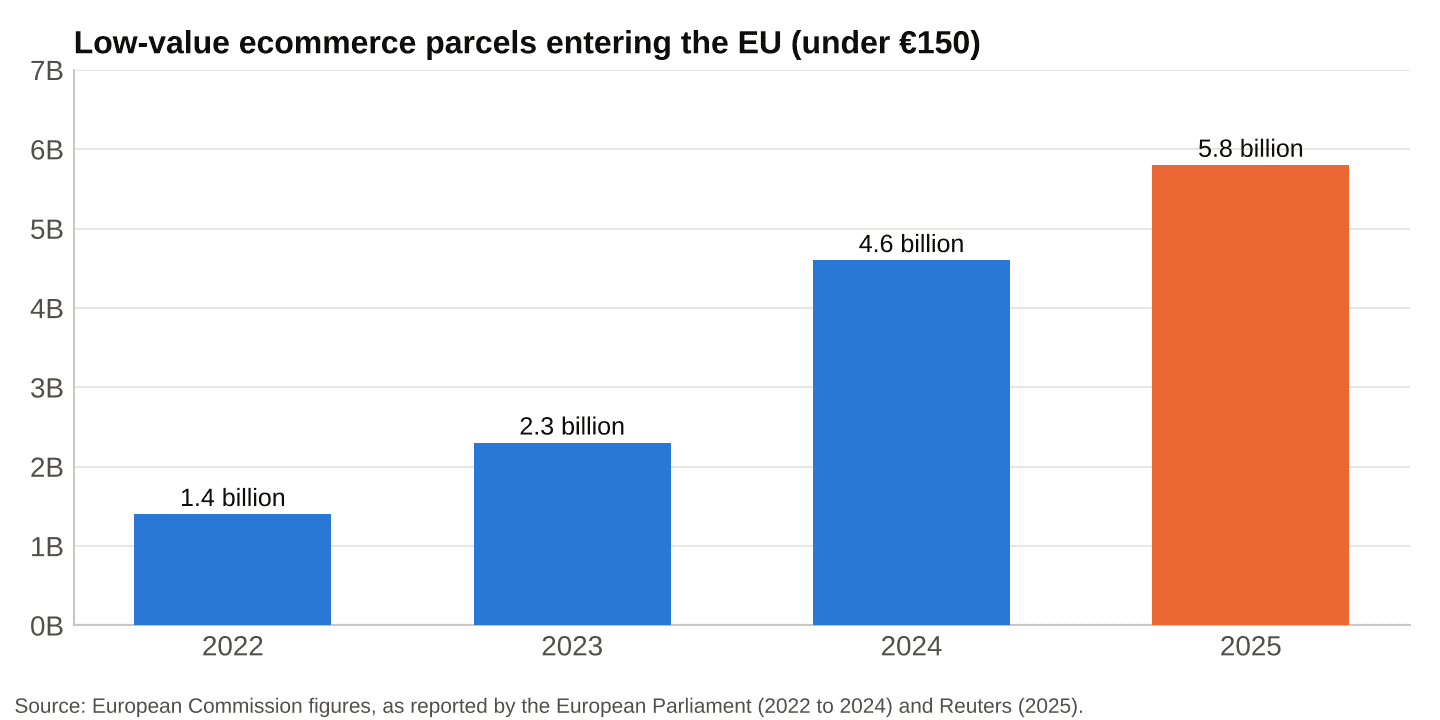
Low-value ecommerce parcels entering the EU, 2022 to 2025
The European Commission counted 1.4 billion low-value parcels in 2022, 2.3 billion in 2023 and 4.6 billion in 2024, roughly 12 million a day. In January 2026 it reported 5.8 billion for 2025, a 26% increase in a single year, and estimated that around 65% of small parcels were undervalued on their customs declarations to stay below the threshold. For a market of about 449 million people, 5.8 billion parcels is more than one parcel per person per month.
What has changed
The two regimes have ended in different ways:
- United States. Duty-free entry ended for goods from China and Hong Kong on 2 May 2025, and for goods from all countries on 29 August 2025. Low-value commercial shipments now pay the duties that apply to their country of origin, and postal shipments were moved onto a duty system of their own.
- European Union. The EU Council gave final approval in February 2026 to remove the €150 duty exemption. As KPMG’s summary of the new rules explains, a flat customs duty of €3 now applies to each item category in a parcel worth less than €150, from 1 July 2026 until 1 July 2028, when the EU’s customs data hub is expected to allow normal tariff rates on every item regardless of value. A parcel with a silk blouse and two wool blouses contains two tariff categories and pays €6.
The Commission has also proposed a separate handling fee, which the European Parliament reported at €2 per parcel, to cover the cost of customs checks.
The early results in the US
The US change came first, so it offers the clearest evidence. When the exemption ended for all countries, postal traffic into the US fell by more than 80%, the Universal Postal Union reported in September 2025, as many national postal services paused US-bound parcels until they could collect duties.
Spending moved quickly too. Card data from Consumer Edge, reported by Modern Retail, showed US spending on Temu down roughly 30% and on Shein nearly 20% in May 2025, the first month after duty-free entry ended for Chinese goods. Over the same period, Temu’s sales in the EU grew by more than 60% year on year, a sign of where the volume went next.
The government collected what the exemption used to waive. US Customs and Border Protection reported in December 2025 that it had collected more than $1 billion in duties on over 246 million low-value shipments since the phase-out began, and that seizures of unsafe and non-compliant goods had risen 82%.
The numbers from Shein’s own filing
The most detailed evidence comes from one of the companies most exposed to the change. Shein’s IPO filing, covered by DesignRush in July 2026, shows:
- US revenue fell 14.3% to $2.04 billion in the first quarter of 2026, from $2.38 billion a year earlier
- The US share of Shein’s revenue fell to 22.5% of the quarterly total
- Fulfillment costs reached 47.7% of net revenue, up from 45.6% across 2025
- The company posted a $99 million net loss for the quarter, against a $395 million profit a year earlier, partly due to a one-off accounting charge
Shein’s total revenue still grew slightly, by 1.1%, as other markets made up for the US. But the filing shows exactly what the end of duty-free parcels does: it raises the cost of selling from a distant warehouse, one order at a time, and that cost lands on the business model built around it.
Europe: early signs since July 2026
The EU’s €3 duty has been in force for just over three months. The first official comment came from French Economy Minister Roland Lescure, who said at the end of August that the inflow of small parcels into the EU had fallen by between 30% and 50% since 1 July. That is a political statement rather than a published statistic, and the full data will take months to appear. But the direction matches what happened in the US.
Why this helps small online stores
The case against duty-free parcels is not about nationality. It is about two sellers of the same product paying different costs depending on how they ship it.
A local online store selling a €12 phone case has imported it in bulk, paid duty and VAT on the shipment, stored it, and pays to ship it domestically. A cross-border seller shipping the same case directly to the customer, declared at a value below the threshold, paid no duty at all, and often had its shipping subsidized. The local store competed with one hand tied.
The €3 duty narrows that gap in a way that matters most at exactly the price points where small stores struggle. On a €12 item, €3 is a 25% cost increase for the cross-border seller. On a €6 item, it is 50%. On a €120 item, it is 2.5% and barely noticeable. The rule hits the ultra-cheap end of the market hardest, which is where small local sellers were least able to compete. The way the largest marketplaces compete on price is covered in our comparison of Amazon vs Temu.
There is a second benefit that gets less attention. The Commission’s estimate that around 65% of small parcels were undervalued means that a rule built on declared value was being gamed at scale. A flat charge per item category is crude, but it is much harder to dodge than a value threshold.
Who buys from outside the EU
The data on European shoppers suggests the market at stake is real but concentrated. According to Eurostat’s survey of online purchases, in 2023, 20.1% of EU residents who had shopped online in the previous three months had bought from sellers outside the EU, against 83.0% who had bought from sellers in their own country.
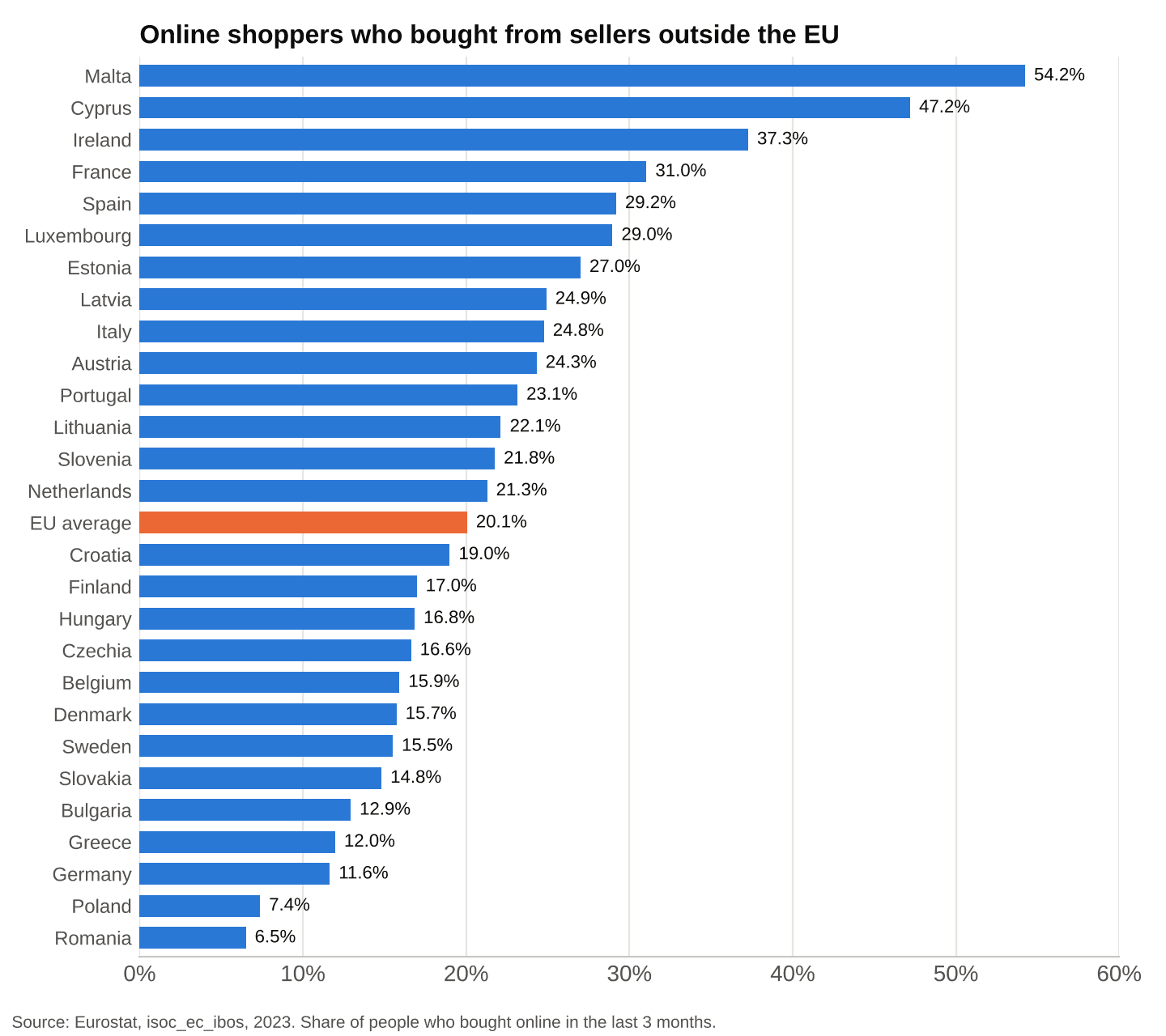
Share of EU online shoppers who bought from sellers outside the EU, by country, 2023
The share varies widely. In Malta (54.2%), Cyprus (47.2%) and Ireland (37.3%), buying from outside the EU is common, partly because local selection is limited. In Germany only 11.6% of online shoppers did so, down from 23.2% in 2020, and in Poland and Romania fewer than one in ten. Younger shoppers lean on non-EU sellers more: 25.4% of online buyers aged 16 to 24, against 13.0% of those aged 65 to 74.
That pattern matters for the argument. The share of shoppers buying from outside the EU stayed around one in five from 2020 to 2023, while the number of low-value parcels kept multiplying. The growth came from the same customers ordering far more often, in smaller and cheaper parcels, which is exactly the behavior a per-item charge discourages.
The case against, and where it is right
Ending duty-free parcels has real costs, and some fall on small businesses:
- Shoppers pay more. For the cheapest products, the duty is passed on, and low-income shoppers who relied on ultra-cheap imports lose the most.
- Small importers lose a convenience. Small businesses that ordered supplies, samples and components in small parcels now face duties and paperwork on each one.
- Dropshipping gets harder. Stores that ship products directly from overseas suppliers to customers now carry duty on every order. Our guide to the best ecommerce platforms for dropshipping covers the models that still work, which increasingly rely on local stock.
- The big platforms adapt. Shein opened a warehouse in Poland in December 2025, and the largest cross-border marketplaces are moving more stock into local fulfillment centers. Once goods are imported in bulk and stored locally, they pay the same duties as everyone else, but they also arrive faster.
- Small non-EU sellers are caught too. The €3 duty applies to parcels from anywhere outside the EU, including independent brands in the UK and the US that ship to European customers.
These are fair points. But most of them describe a market adjusting to rules that every local seller already followed. When cross-border marketplaces move stock into local warehouses, they compete on the same terms as everyone else: paying duty on imports, holding inventory and delivering from inside the market. That is a contest small stores can be in.
What small online stores should do now
The rule change helps, but it does not win customers on its own:
- Revisit your price comparisons. Products where you lost to ultra-cheap imports at €5 to €20 may now be competitive. Recheck the landed price a shopper sees from the alternatives, including the new duty.
- Sell speed. Cross-border parcels are now slower and more uncertain at customs. Next-day or two-day delivery from local stock is a clear advantage, and our guide to last-mile delivery covers how to offer it affordably.
- Lead with trust and compliance. Customs authorities are seizing more unsafe and non-compliant goods. Product safety marks, clear returns and a local address are selling points.
- Check your own supply chain. If you import small consignments from suppliers outside the market, budget for duty on each one, or consolidate orders into fewer, larger shipments.
Do not try to win on price alone
The worst response would be to treat the new rules as permission to fight the cheapest cross-border sellers on price. They still have the scale, and many will absorb part of the duty to protect market share. The gap has narrowed; it has not closed. Small stores win by being the better choice, not the marginally cheaper one, the same reasoning behind our argument that Black Friday is the wrong battle for small online stores.
Selling across borders yourself
The new rules cut both ways for stores that sell abroad. A European store shipping to US customers now faces US duties on each order, and a UK or US brand shipping small orders to EU customers pays the €3 duty per item category. Stores that relied on duty-free exports should model the landed cost for their customers and consider delivered-duty-paid shipping, so that buyers are not surprised by charges at the door. The paperwork side is covered in our guide to international shipping and customs.
The bottom line
De minimis rules were written for gifts and occasional orders, and ecommerce turned them into a duty-free lane for billions of parcels a year. Closing that lane raises some prices and inconveniences some businesses, including small ones. But it ends a cost advantage that local online stores could never match, and the first data from the US and Europe shows shoppers and sellers already adjusting. For small online stores, this is the most favorable change to the competitive landscape in a decade. The stores that benefit will be the ones that use it to compete on speed, trust and quality, rather than waiting for the cheapest parcels to disappear on their own.