Almost everything written about ecommerce is about consumers: holiday spending, shopping apps, social commerce, the latest marketplace from China. The numbers that get the headlines are retail numbers. Yet in the US, the biggest ecommerce market by far is not people buying from businesses. It is businesses buying from each other.
The Census Bureau’s E-Stats 2022 report, released in March 2025, measured ecommerce across the whole economy. Manufacturers shipped $4.83 trillion of goods through electronic orders in 2022, and merchant wholesalers made $3.76 trillion of ecommerce sales. Retail ecommerce, by the same measure, was $997.5 billion.
My argument is that most online sellers, and most of the advice written for them, are aimed at the smaller market. B2B buyers now want to buy online, often in large amounts, and the businesses that serve them online are still far fewer than those competing for consumers. For many stores, the biggest growth opportunity is not another consumer channel. It is selling the same products to businesses.
Key points
- Manufacturing and wholesale ecommerce together reached $8.59 trillion in the US in 2022, about 8.6 times the $997.5 billion of retail ecommerce measured in the same report.
- A third of US wholesale sales are now ecommerce. Merchant wholesalers made 33.0% of their sales electronically in 2022, up from 27.9% in 2011.
- B2B ecommerce grew faster than retail ecommerce in 2022: 14.1% for manufacturing e-shipments and 14.6% for wholesale, against 6.5% for retail.
- B2B buyers want to buy without a salesperson. 67% of B2B buyers prefer a rep-free buying experience, according to a Gartner survey published in March 2026.
- They are willing to place large orders online. 39% of B2B decision makers would spend more than $500,000 in a single remote or self-serve transaction, according to McKinsey’s 2024 B2B Pulse survey.
The size gap
The Census Bureau’s E-Stats program is the only official source that measures ecommerce across manufacturing, wholesale, retail and services using the same definition: orders placed over the internet, EDI networks, email or other online systems. Its 2022 figures, the latest available:
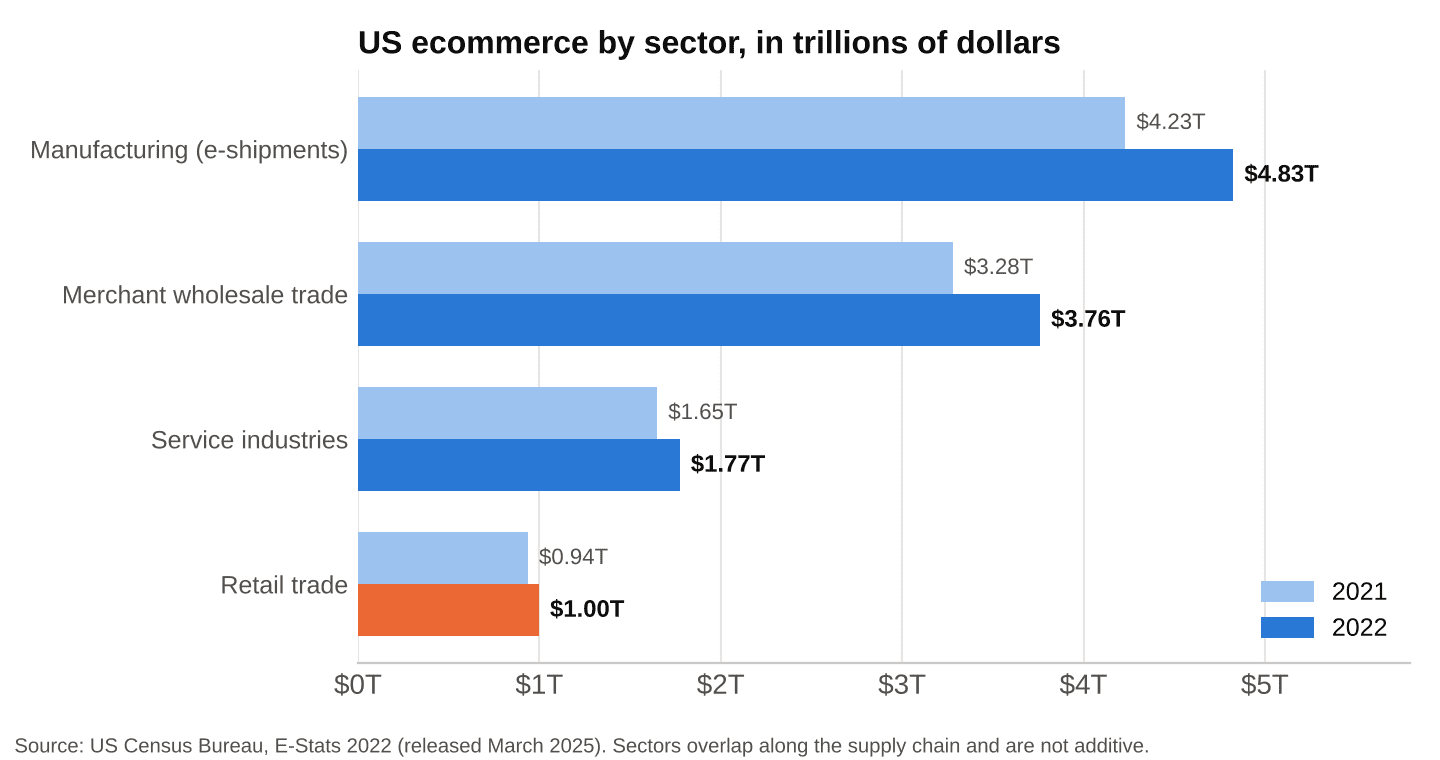
US ecommerce by sector, 2021 and 2022
| Sector | 2021 | 2022 | Growth |
|---|---|---|---|
| Manufacturing (e-shipments) | $4,230.8 billion | $4,825.9 billion | +14.1% |
| Merchant wholesale trade | $3,280.0 billion | $3,760.2 billion | +14.6% |
| Service industries | $1,649.6 billion | $1,773.9 billion | +7.5% |
| Retail trade | $936.6 billion | $997.5 billion | +6.5% |
US Census Bureau, E-Stats 2022. Values in current dollars. Retail covers businesses with paid employees only.
A caution on reading this: the sectors overlap. A product can be sold electronically by a manufacturer to a wholesaler, then by the wholesaler to a retailer, then by the retailer to a consumer, and each sale is counted in its own sector. The sectors cannot be added into one total for the economy. But each one measures real orders between real buyers and sellers, and the comparison holds: at every stage of the supply chain before the consumer, ecommerce is several times larger than at the consumer end.
Growth also favored B2B in 2022. Manufacturing and wholesale ecommerce each grew about 14%, more than twice the 6.5% growth of retail ecommerce. Part of that reflects the high inflation of 2022, since all the figures are in current dollars, but the gap is large enough to matter.
A third of wholesale is already online
Wholesale is where the B2B shift is easiest to see, because the Census Bureau’s Annual Wholesale Trade Survey tracks ecommerce every year.
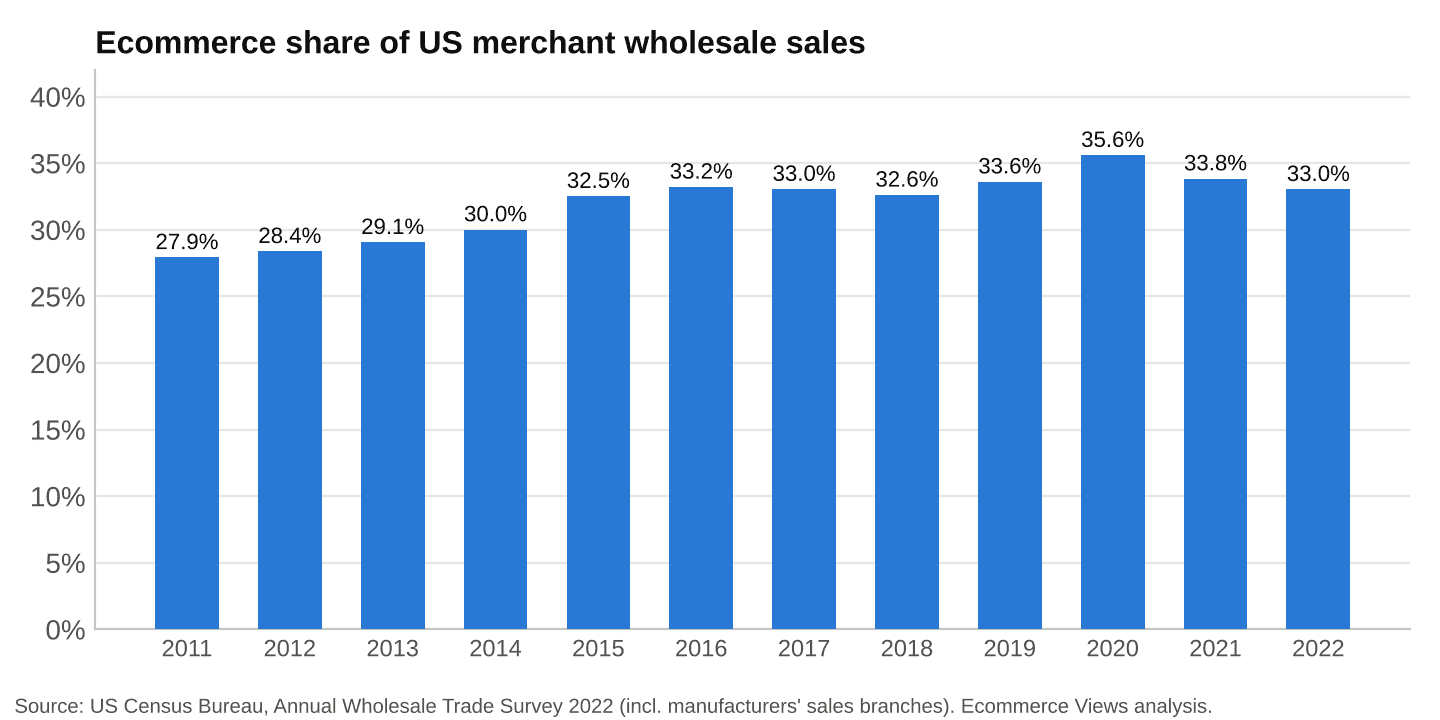
Ecommerce share of US merchant wholesale sales, 2011 to 2022
Ecommerce made up 27.9% of merchant wholesale sales in 2011. It reached 30% in 2014, peaked at 35.6% in 2020 when buyers could not meet salespeople in person, and stood at 33.0% in 2022. Over those eleven years, wholesale ecommerce sales grew 96.4%, from $1.91 trillion to $3.76 trillion, while total wholesale sales grew 66.0%.
The split between types of wholesaler is revealing:
- Manufacturers’ own sales branches made 43.9% of their sales through ecommerce in 2022. These are the sales arms of large producers, most of them connected to their customers by EDI.
- Independent merchant wholesalers made 28.6%, up from 22.3% in 2011. These are the distributors that buy from many producers and sell to many businesses, and they are where most of the recent growth has come from.
Which industries buy online the most
The share of wholesale sold through ecommerce varies widely by product:
| Wholesale category | Ecommerce sales | Share of sales | Share in 2011 |
|---|---|---|---|
| Drugs and druggists’ sundries (2021) | $869.9 billion | 74.9% | 71.0% |
| Motor vehicles and parts | $562.3 billion | 50.8% | 49.1% |
| Household appliances and electrical goods | $323.0 billion | 35.7% | 28.3% |
| Grocery and related products (2021) | $397.3 billion | 35.5% | 29.2% |
| Paper and paper products | $64.4 billion | 34.7% | 32.1% |
| Professional and commercial equipment | $221.4 billion | 29.3% | 27.8% |
| Furniture and home furnishings | $40.3 billion | 28.2% | 20.1% |
| Apparel and piece goods | $48.1 billion | 27.8% | 22.7% |
| Hardware, plumbing and heating | $69.8 billion | 24.6% | 16.0% |
| Chemicals | $69.3 billion | 21.5% | 15.8% |
| Beer, wine and spirits | $40.8 billion | 19.2% | 10.4% |
| Farm product raw materials | $21.8 billion | 6.7% | 7.3% |
US Census Bureau, Annual Wholesale Trade Survey. 2022 unless marked; 2021 shown where the 2022 estimate was not published.
The categories with the biggest gains since 2011 are not the ones dominated by a few giant distributors. Hardware and plumbing rose from 16.0% to 24.6%, furniture from 20.1% to 28.2%, and beer, wine and spirits almost doubled from 10.4% to 19.2%. These are markets full of small and mid-sized trade customers, contractors, restaurants and independent shops, and they are moving online.
B2B buyers want to buy online
The demand side is moving faster than the supply side. Business buyers increasingly expect to research, order and reorder the way they shop as consumers.
In a Gartner survey of 646 B2B buyers, conducted in August and September 2025 and published in March 2026, 67% said they prefer a buying experience without a sales representative, and 45% said they had used AI during a recent purchase.
AI is already part of B2B buying
The second Gartner number matters for online sellers. B2B buyers are already asking AI assistants to research and shortlist suppliers, which rewards sellers whose catalogs, prices and specifications are visible and readable online. A distributor whose product range lives in PDFs and sales reps’ heads is invisible to that process. Our guide to getting a store into AI search results applies to trade buyers as much as to consumers.
Big orders are moving online too
The old assumption was that online ordering suited small, repeat B2B purchases while large deals needed a salesperson. That is changing as well. McKinsey’s 2024 B2B Pulse survey of 3,942 decision makers in 13 countries found that 39% of B2B buyers would spend more than $500,000 in a single remote or self-serve transaction, up from 28% two years earlier, and 20% would spend more than $1 million, up from 15%. In the same survey, online sales accounted for 34% of B2B revenue, while in-person sales fell to 17%.
Why online sellers ignore B2B
If the market is this large, why does most ecommerce effort go into consumers? A few reasons come up again and again:
- Visibility. Consumer ecommerce is public and measurable. Holiday records, app rankings and social trends make headlines; a distributor’s reorder portal does not.
- Platform defaults. Most store platforms are built for card payments, one price for everyone and a single-item cart. B2B buyers need accounts, price lists, quotes and invoices.
- Perceived complexity. Net payment terms, tax exemptions, purchase orders and approvals sound like enterprise problems, even though modern platforms handle most of them.
- Data quality. Business buyers need accurate specifications, stock levels and pack sizes. Many sellers’ product data is not good enough to sell without a salesperson filling the gaps, a problem we covered in why product data breaks between ERP, PIM and ecommerce channels.
None of these is a reason the market is closed to smaller sellers. They are reasons fewer sellers compete for it.
The case against
There are fair arguments for staying consumer-focused, and they deserve a hearing:
- Sales cycles are longer. A new trade account may take weeks of quotes, samples and approvals before the first order.
- Credit risk is real. Selling on 30 or 60-day terms means financing customers and chasing payments.
- Margins are thinner per unit. Trade buyers expect volume pricing, so each unit earns less than a retail sale.
- Large buyers want integration. Big customers may require EDI connections or catalog feeds into their procurement systems, which takes investment and sometimes a more flexible architecture, with the trade-offs covered in our piece on headless commerce vs traditional ecommerce platforms.
These are trade-offs, not barriers. Thinner unit margins are offset by larger orders, lower acquisition costs per dollar of revenue and repeat purchasing that consumers rarely match. And the integration demands come mainly from the largest buyers; small and mid-sized businesses, the fastest-moving part of the market, mostly want a good website with their own prices and an easy way to reorder.
How a consumer store can start selling to businesses
For a store that already sells online, adding B2B is mostly a matter of features and process rather than a new business:
- Create a trade account route. Let business customers register, verify them and show them trade pricing after login.
- Offer tiered and volume pricing. Price breaks by quantity are the single most expected B2B feature.
- Support how businesses pay. Invoices, purchase orders and payment on terms for approved accounts. Card fees on large orders add up quickly, which our overview of payment gateway fees helps put in numbers.
- Make reordering effortless. Saved lists, order history and quick-order forms by product code matter more to trade buyers than product storytelling.
- Add request-for-quote. For large or custom orders, a quote request keeps the buyer online even when the deal needs a conversation.
- Publish complete product data. Specifications, pack sizes, lead times and documents such as safety data sheets.
Choosing a platform for B2B
Not every platform handles these features equally. Some include customer groups, price lists and quote tools natively; others need apps or extensions, and costs add up. Our comparison of BigCommerce vs WooCommerce for mid-market stores looks at how two common options handle more complex catalogs and customers. Check customer-specific pricing, quote handling and invoice payments before choosing, because these are the features B2B buyers notice first.
Finding the first trade customers
B2B buyers are fewer than consumers but worth far more each, which changes how they are found. Search for trade terms, industry directories, trade shows, LinkedIn and direct outreach to businesses that already buy similar products from distributors all work better than broad consumer advertising. Turning website visitors into identified trade leads is covered in our overview of ecommerce lead generation tools.
The bottom line
The ecommerce story most sellers follow is the consumer one, and it is the smaller story. In the US, electronic orders between businesses run to trillions of dollars a year, a third of wholesale already happens online, and B2B buyers say they would rather order without a salesperson, sometimes for orders worth more than $500,000. The consumer market is crowded with sellers competing for the same shoppers on the same channels. The B2B market is larger, growing at least as fast and served online by far fewer stores. For any seller whose products are also bought by businesses, ignoring it is the expensive choice.