Since 6 April 2025, buying fake reviews, hiding paid-for reviews and quietly burying bad ones have been banned outright in the UK. The rules sit in the Digital Markets, Competition and Consumers Act 2024 (the DMCC Act), and the Competition and Markets Authority (CMA) can now fine a business up to 10% of its global turnover without going to court first.
Many small store owners read this as one more compliance burden. My view is the opposite. The new rules mostly constrain the businesses that were gaming reviews at scale. For a small store that collects genuine reviews and shows all of them, the law removes an unfair competitor and turns honesty into something shoppers can trust again.
Key points
- Government research estimates that 11% to 15% of product reviews in three popular categories on UK ecommerce platforms are likely fake.
- Well-written fake reviews make shoppers 3.1% more likely to buy, rising to 9.2% for products priced over £80. A Which? study that also inflated star ratings found a 12.6% effect.
- Fake review text on products alone costs UK consumers an estimated £50 million to £312 million a year, and the government says the true figure is likely higher.
- The government’s chosen policy was expected to save consumers about £3.7 billion over 10 years, while costing businesses about £1.8 billion, mostly sales that fake reviews would otherwise have won.
- When the CMA checked more than 100 businesses that publish reviews, 54 received letters saying they might not comply. 90% of those made changes.
- In March 2026 the CMA opened its first five fake review investigations, into Autotrader, Feefo, Dignity, Just Eat and Pasta Evangelists. All five were still open at the September 2026 update.
- Asking every customer for a review is still allowed. Paying for reviews is allowed only if the review is genuine and clearly labelled as incentivised.
What the law now bans
The ban is set out in paragraph 13 of Schedule 20 to the DMCC Act, which lists practices that are unfair in all circumstances. For reviews, that means:
- Fake reviews: reviews that claim to come from a real customer’s experience when they do not, including reviews written by staff, friends or software.
- Concealed incentivised reviews: reviews given in exchange for money, discounts, vouchers or free products where the incentive is not made clear.
- Commissioning or facilitating either of the above, including offering a refund or gift card to a customer who changes a negative review.
- Misleading review information: star ratings, review counts or summaries that give a false picture, for example because negative reviews were removed or only happy customers were invited.
Businesses that publish reviews must also take “reasonable and proportionate steps” to prevent and remove banned reviews. In practice, the CMA expects a written review policy, a regular risk assessment and a process to investigate suspicious reviews.
How big the fake review problem is
The best UK evidence comes from research commissioned by the Department for Business and Trade (DBT) and published in April 2023. It found that 11% to 15% of reviews for consumer electronics, home and kitchen, and sports and outdoors products on ecommerce platforms were likely fake.
The same research tested how shoppers react. Badly written fake reviews backfire: shoppers were 5.3% less likely to buy. But well-written fake reviews work.
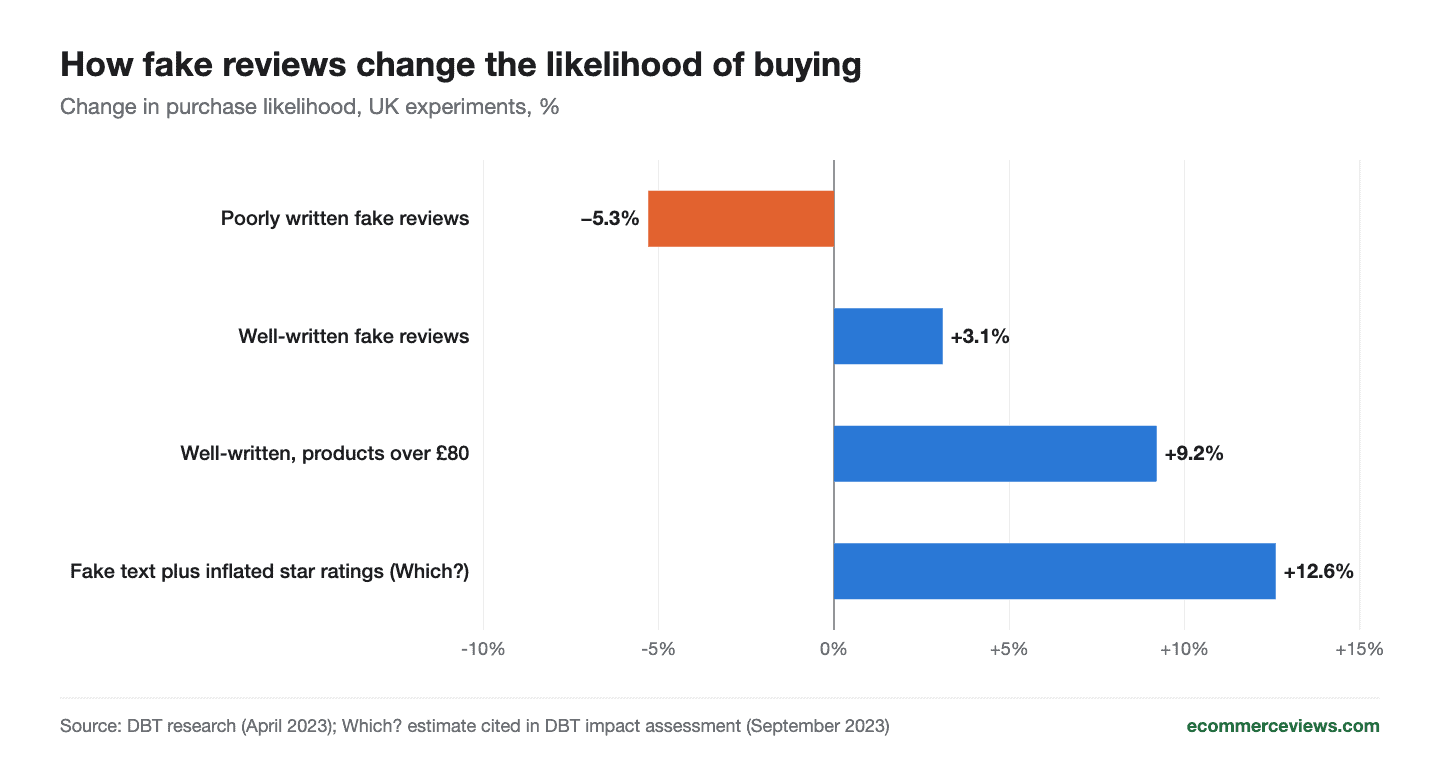
Change in likelihood of buying a product with fake reviews, UK experiments
| Finding | Figure |
|---|---|
| Share of product reviews likely fake (three categories) | 11% to 15% |
| Effect of poorly written fake reviews on buying | -5.3% |
| Effect of well-written fake reviews on buying | +3.1% |
| Same, for products over £80 | +9.2% |
| Effect with fake text and inflated star ratings (Which?) | +12.6% |
| Yearly consumer harm from fake review text on products | £50m to £312m |
Sources: DBT research (April 2023); Which? estimate as cited in the DBT impact assessment (September 2023).
The harm estimate is narrow by design. It covers only review text on physical products. It leaves out services, such as restaurants, hotels and trades, and it ignores inflated star ratings, which many shoppers look at first.
What the government expected the ban to cost and save
Before the law was passed, DBT’s impact assessment estimated the effect of each policy option over 10 years. For the chosen option, combining legislation with CMA guidance, it assumed a 60% reduction in fake reviews.
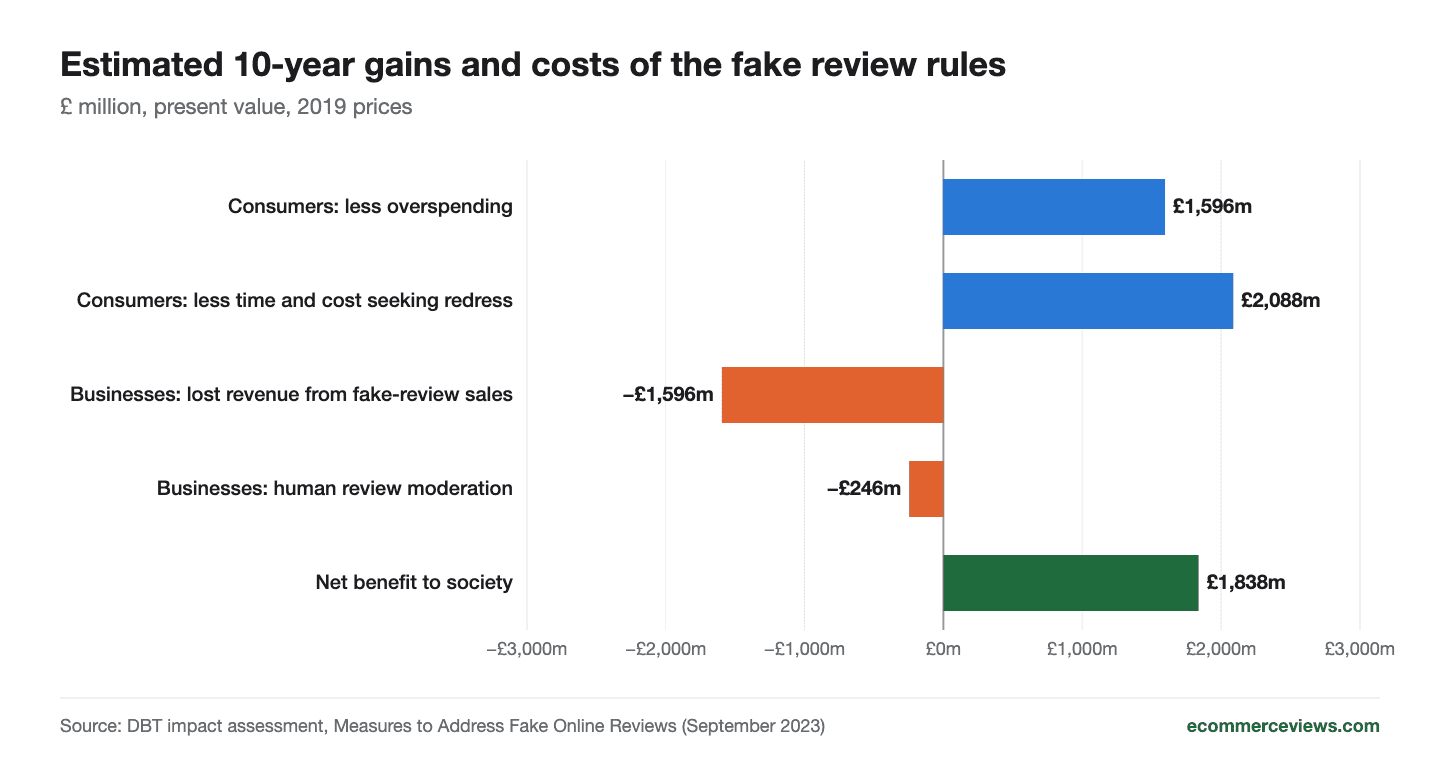
Estimated 10-year gains for consumers and costs to businesses from the fake review rules
| 10-year present value, 2019 prices | Estimate |
|---|---|
| Consumer saving: overspending on products with fake reviews | £1,596m |
| Consumer saving: time and cost of seeking refunds or resolution | £2,088m |
| Cost to businesses: lost revenue from sales won by fake reviews | £1,596m |
| Cost to businesses: human review moderation | £246m |
| Net benefit to society | £1,838m |
Source: DBT impact assessment, Measures to Address Fake Online Reviews (September 2023).
Read that table carefully, because it holds the core of my argument. About 86% of the estimated cost to business is revenue that came from fake reviews in the first place. The assessment assumed shoppers overspend 12p in every pound spent on products with fake reviews, and lose another 16p on average in the time and cost of trying to put things right. That money does not disappear when fake reviews go. It moves back to products that deserved it.
The first enforcement wave
The CMA gave businesses a three-month adjustment period after it opened its online reviews work in July 2025. Then it checked. According to its online consumer reviews case page, it reviewed the websites of more than 100 businesses that publish reviews and wrote to 54 of them, more than half, about possible failings.
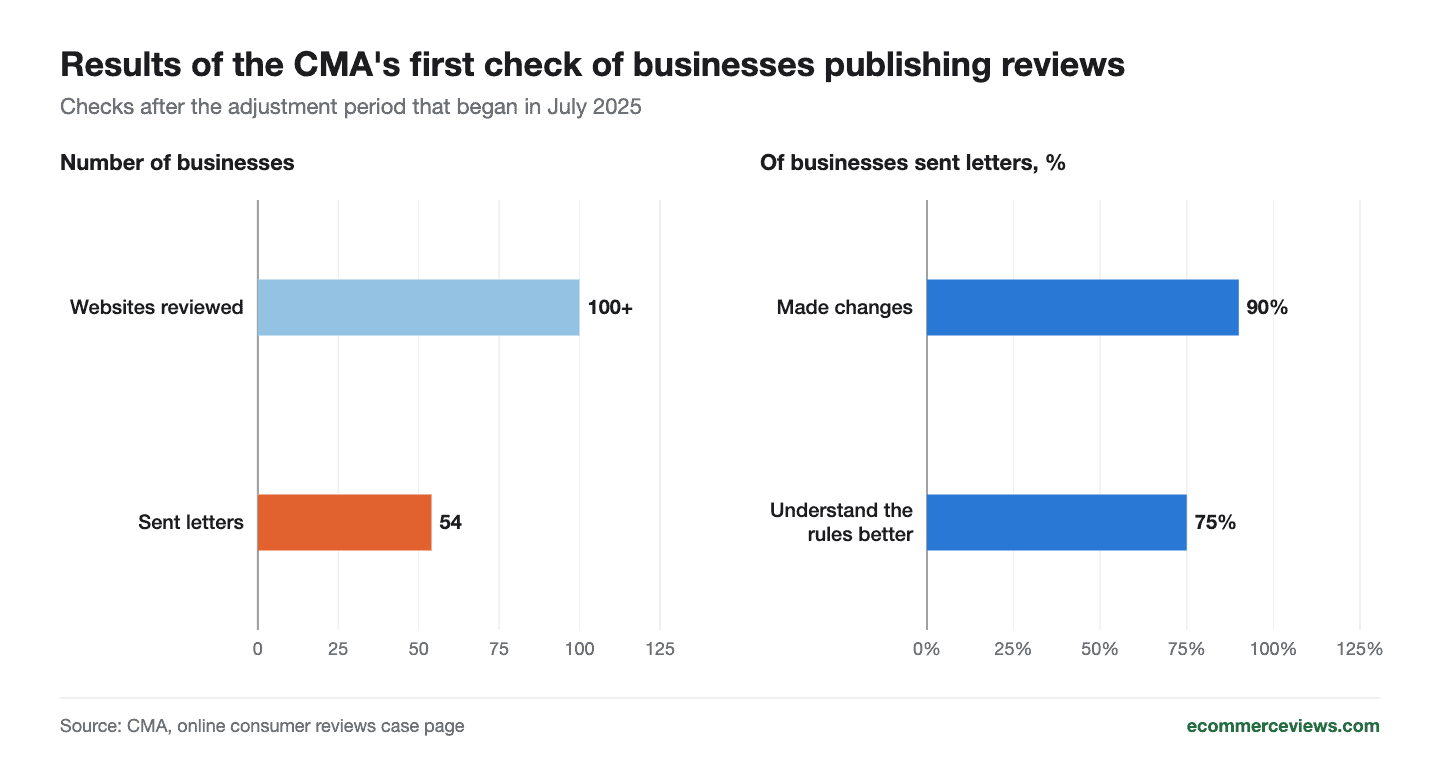
Results of the CMA’s first check of businesses publishing reviews
The letters worked. The CMA says 90% of the businesses it wrote to made changes, and 75% said they now understood the rules better.
Five investigations, all still open
On 27 March 2026, the CMA announced investigations into five businesses. The cases cover almost every type of review problem the law addresses:
| Business | What the CMA is examining |
|---|---|
| Autotrader and Feefo | Whether 1-star reviews were kept off the platform and out of star ratings |
| Dignity | Whether staff were asked to write positive reviews |
| Just Eat | Whether its ratings system inflated some restaurants’ and grocers’ ratings |
| Pasta Evangelists | Whether customers got discounts on future orders for 5-star reviews, without disclosure |
Source: CMA, 27 March 2026. No finding has been made, and the CMA stresses that no business should be assumed to have broken the law.
The CMA’s case pages were updated on 28 September 2026 and list the investigations as ongoing, with the next update due in winter 2026 to 2027. With these cases, 14 businesses were under review using the CMA’s new consumer powers.
Two things stand out. First, these are not obscure sellers. They include a national marketplace, a review platform and a well-known food brand. Second, the alleged practices are ordinary ones: a discount for a good review, a filter on bad ones, a nudge to staff. Small stores do the same things, often without thinking of them as risky.
Why this helps small stores
Fake reviews were never a level playing field. Buying hundreds of five-star reviews costs money and organisation, and the payoff is largest for sellers chasing volume on big marketplaces. A small store with 40 honest reviews and a 4.6 rating was competing against listings with 2,000 reviews of doubtful origin.
The law changes that in three ways:
- It raises the cost of cheating. A fine of up to 10% of global turnover is a serious risk for anyone running a review farm.
- It forces platforms to act. Marketplaces and review sites must take reasonable steps to detect and remove fake reviews, so the inflated competition should shrink over time.
- It makes genuine signals more valuable. Shoppers already rely on reviews. If they can trust them more, the stores with real, mixed, detailed reviews benefit.
Reviews already sit at the centre of how people choose. The CMA itself notes that around 90% of consumers use reviews, linked to £217 billion of UK online retail spending in 2023. Our look at how online reviews influence purchases covers how review content shapes buying decisions.
The case against
There are fair objections to my view.
- Compliance takes time small stores do not have. A written review policy, a risk assessment and a moderation process are easy for a large retailer with a legal team. For a one-person shop, they are another job on a long list.
- Enforcement is slow. More than 18 months after the ban started, none of the first five investigations has reached a decision. Fake reviews have not vanished, and cheaters may simply move to platforms that are harder to police.
- The cost estimates are uncertain. The government’s numbers rest on assumptions, such as a 60% fall in fake reviews, that nobody has yet measured. The sensitivity ranges in the impact assessment are wide.
- Honest stores can still be hurt. Competitors can post fake negative reviews too, and a small store has less power than a big brand to get them removed.
These points are real. But none of them makes cheating a better strategy than it was before April 2025. The compliance work for a small store is modest, as the next section shows, and the downside of being caught has grown enormously.
What to do
Most of the rules can be met with a few simple habits. The CMA’s short guide for businesses is the best starting point.
- Ask every customer, not just the happy ones. Sending a review request to all buyers is allowed. Sending it only to customers who rated you highly, or pausing requests after a bad week, can count as cherry-picking.
- Never trade a reward for a positive review. If you offer a discount or free product for a review, it must be offered whatever the rating, and the review must be clearly labelled as incentivised.
- Publish negative reviews. You may remove reviews that are fake, abusive or unrelated to your product. You may not remove or hide genuine complaints, or make a refund conditional on deleting a review.
Turn reviews into a strength
- Keep staff, friends and family out of it. Reviews from people connected to the business count as commissioned reviews unless that link is made clear.
- Write a short review policy. Explain how you collect reviews, which reviews you remove and why, and how you label incentivised ones. Put it on your site next to your reviews.
- Reply to criticism in public. A calm, helpful reply to a 2-star review does more for trust than a wall of 5-star ones. Our guide on getting more product reviews covers fair ways to grow review volume on Shopify, WooCommerce and Amazon.
- Check your review apps and agencies. If you use a review platform or a marketing agency, you remain responsible for what they do on your behalf.
Reviews are one part of a trustworthy store
Fake reviews are one way stores mislead shoppers. Hidden costs are another, and they hurt trust just as much. If you want to see what a sale is really worth after fees, postage and VAT, our free tools for UK online sellers help you set fair, transparent prices from the start.
Reviews now feed AI search too
The same logic applies to how reviews are displayed in AI search. Assistants increasingly summarise reviews rather than show them one by one, and our guide to getting your store into AI search results covers how stores can show up in those answers.
The bottom line
The UK’s fake review ban is not mainly a burden on small stores. It is a constraint on the businesses that inflated their ratings at scale, and the government’s own numbers say most of the cost to business is revenue that fake reviews should never have won. For an independent store, the rules ask for little more than good practice: ask everyone, reward no one for praise, publish the bad with the good and say so openly. Do that, and honest reviews become one of the few advantages a small store can hold over much bigger competitors, alongside the basics in our conversion rate optimization guide.