Matija Konjić is the founder of Link Inbound, a link building and content marketing agency working with B2B and B2C brands. He has built campaigns across 40+ industries and obsesses over the data behind what actually moves rankings.
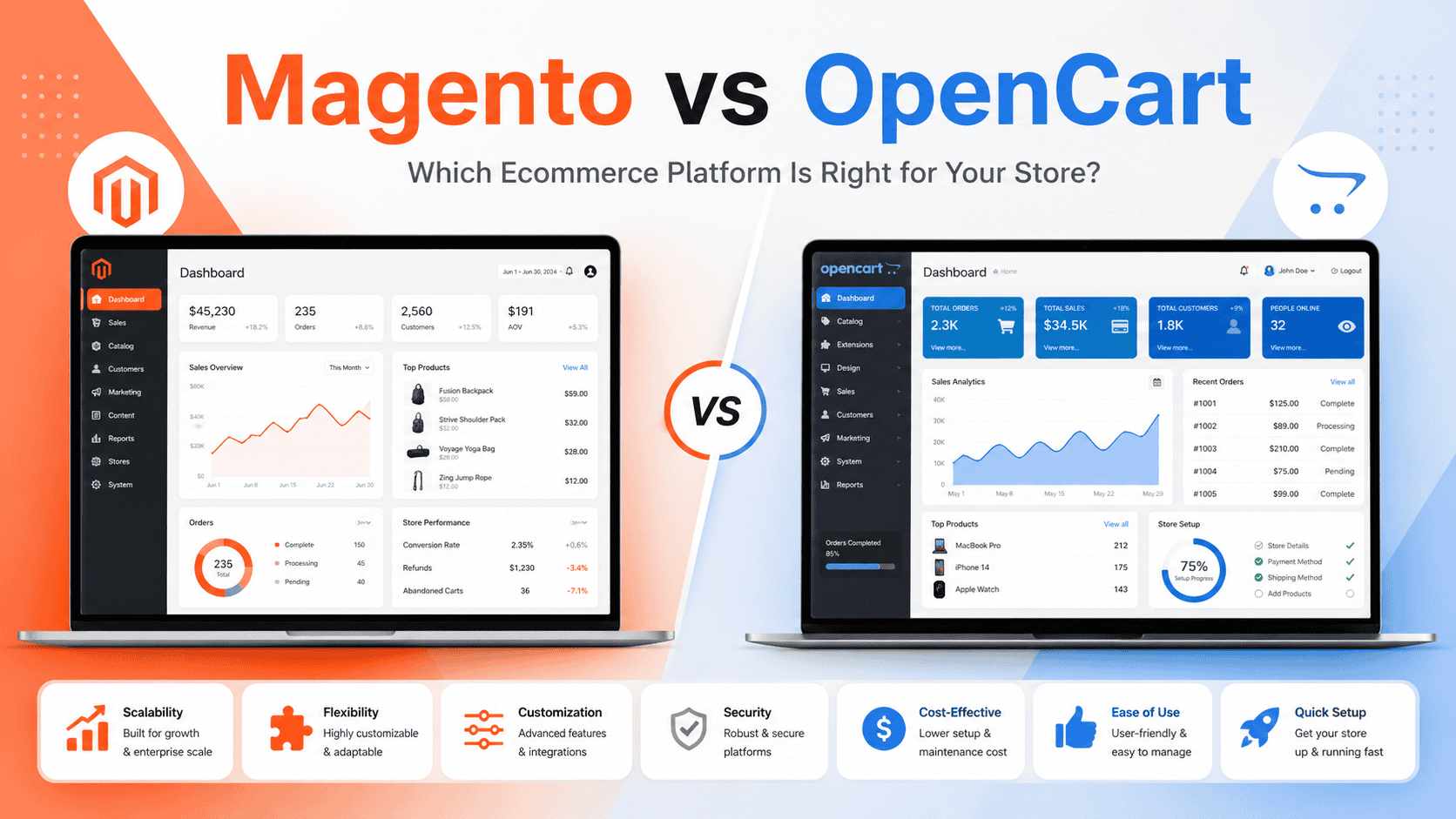
Magento and OpenCart are both open-source ecommerce platforms, but they sit at opposite ends of the complexity spectrum. Magento (now Adobe Commerce in its enterprise version) is built for large catalogues, complex business logic, and teams with dedicated development resources. OpenCart is built for speed and simplicity, letting store owners get online quickly without needing a development team.
Choosing between them is not about which platform is “better.” It is about which one matches your store’s size, technical resources, and growth trajectory. This comparison covers every factor that matters so you can make the right call.
Quick comparison table
| Factor | Magento (Open Source) | OpenCart |
| Type | Self-hosted, open-source (Adobe Commerce for enterprise) | Self-hosted, open-source (OpenCart Cloud available) |
| Base cost | Free (Open Source), ~$22,000+/yr (Adobe Commerce) | Free |
| Hosting requirements | 2-4GB RAM minimum, dedicated or VPS recommended | Runs on basic shared hosting |
| Ease of use | Steep learning curve, developer-oriented | Moderate, admin panel is straightforward |
| Extensions | 4,000+ on Marketplace | 13,000+ on OpenCart marketplace |
| Scalability | Enterprise-grade, handles millions of SKUs | Best for small to mid-size catalogues |
| Multi-store | Native, advanced (shared catalogue, separate domains) | Native, simple (separate storefronts from one admin) |
| B2B features | Built-in (quotes, custom pricing, company accounts) | Limited (requires extensions) |
| Community size | Large, enterprise-focused | Smaller, growing |
| Market share | ~7% of top 1M ecommerce sites | ~1-2% of top 1M ecommerce sites |
Table of contents
- Architecture and technical approach
- Pricing and total cost
- Ease of use and admin panel
- Extensions and marketplace
- Scalability and performance
- Hosting and server requirements
- Multi-store and multi-language
- Community and long-term support
- SEO capabilities
- When to choose Magento
- When to choose OpenCart
- The verdict
Architecture and technical approach
Magento is built on a sophisticated architecture using PHP with the Zend/Laminas framework. It uses an EAV (Entity-Attribute-Value) database structure that allows extreme flexibility in product attributes and catalogue organisation, but adds complexity to queries and development. The codebase is large, modular, and designed for teams of developers working on enterprise-scale projects. A typical Magento installation involves dependency injection, service contracts, and a layered architecture that follows strict design patterns.
OpenCart uses a straightforward MVC (Model-View-Controller) architecture with a much simpler codebase. The database schema is relational and direct, which makes queries faster on smaller catalogues and development more accessible to PHP developers without specialised training. A developer familiar with basic PHP and MySQL can start modifying OpenCart within days. The same developer would likely need weeks to become productive in Magento’s architecture.
This difference defines everything else in the comparison. Magento’s architecture supports complex business logic at scale. OpenCart’s architecture prioritises accessibility and speed of implementation. Neither approach is wrong, but they serve very different use cases.
Pricing and total cost
Both platforms offer free, open-source versions. But the total cost of ownership is vastly different.
Magento Open Source is free to download. However, running it requires serious hosting infrastructure (typically $50-$500/month for adequate VPS or dedicated hosting), development expertise (Magento developers charge $80-$200/hour), and ongoing maintenance. A basic Magento store build typically costs $15,000-$50,000 for initial development and $500-$2,000/month for hosting and maintenance. Adobe Commerce (the enterprise version) starts at roughly $22,000 per year for small businesses and scales into six figures for larger operations.
OpenCart is also free. Running it costs dramatically less. Shared hosting at $5-$20/month handles most OpenCart stores comfortably. Development costs are lower because the platform is simpler and developer rates tend to be more accessible. A basic OpenCart store can be built for $1,000-$5,000 and maintained for $50-$200/month. OpenCart Cloud offers a hosted option that eliminates server management entirely.
For a thorough look at what OpenCart offers and whether it still makes sense in 2026, our full OpenCart review covers the details.
Ease of use and admin panel
OpenCart wins this category clearly. Its admin panel is clean, logically organised, and does not require training to navigate. Adding products, managing categories, processing orders, and configuring settings are all straightforward. A non-technical store owner can manage day-to-day operations without developer help.
Magento’s admin panel is powerful but dense. The sheer number of configuration options can be disorienting for new users. Settings are spread across multiple nested menus, and many features require understanding Magento’s specific terminology. Tasks that take two clicks in OpenCart can require five or six steps in Magento. This complexity is the price of flexibility: Magento’s admin exposes controls that OpenCart simply does not have, but you pay for that with a steeper learning curve.
For day-to-day order processing, both platforms handle the basics well. Magento provides more granular order status workflows and advanced inventory allocation. OpenCart keeps it simple with clear order statuses and quick processing actions. If your team is small and non-technical, OpenCart’s admin will save hours of frustration.
Extensions and marketplace
OpenCart’s marketplace lists over 13,000 extensions, which might surprise people who assume the smaller platform has a smaller ecosystem. These cover payment gateways, shipping methods, themes, product feeds, marketing tools, and administrative utilities. Pricing ranges from free to $100+ for premium extensions. The variety is impressive, though quality varies and some extensions lag behind on updates.
Magento’s Marketplace has around 4,000 extensions. The count is lower, but average quality and enterprise-readiness tend to be higher. Many Magento extensions are built by established agencies and come with SLAs and dedicated support. Pricing reflects this: enterprise-grade Magento extensions routinely cost $200-$1,000+.
For payment gateways specifically, both platforms support all the major providers (Stripe, PayPal, Braintree, Authorize.net, and regional gateways). OpenCart has wider coverage for regional and niche payment methods thanks to its larger extension count. Magento’s payment integrations tend to be more deeply built, with better support for complex scenarios like split payments and B2B invoicing.
Scalability and performance
This is where Magento’s enterprise heritage shows. Magento handles catalogues with hundreds of thousands of SKUs, millions of customer records, and thousands of concurrent users. Its built-in full-page caching, Varnish support, and Elasticsearch integration (required for catalogue search in Magento 2) make it capable of handling enterprise-level traffic when properly configured.
OpenCart performs well for small to mid-size stores, typically up to a few thousand products. Beyond that, performance tuning becomes necessary. The database structure is simpler, which means faster queries on smaller datasets, but less efficient handling of very large catalogues with complex attribute sets. For most stores with under 10,000 SKUs, OpenCart’s performance is perfectly adequate on standard hosting.
If you are running a large operation with complex catalogue requirements, Magento is built for it. If you are running a store with a focused product range and moderate traffic, OpenCart will serve you well without the infrastructure overhead. The architecture decisions you make around URL structure and crawl efficiency will matter on both platforms, but Magento gives you more tools to manage them at scale.
Hosting and server requirements
OpenCart’s lightweight architecture means it runs comfortably on shared hosting plans. A $10-$20/month plan from providers like SiteGround or Cloudways handles most OpenCart stores without issues. This low barrier to entry is one of OpenCart’s strongest selling points. You do not need DevOps expertise to keep your store online.
Magento demands significantly more. The minimum recommended setup is 2-4GB of RAM, a modern multi-core processor, SSD storage, and a dedicated or VPS environment. Production Magento stores typically run on configurations costing $100-$500/month. Enterprise deployments with high availability often use cloud infrastructure (AWS, Google Cloud, or Azure) with costs reaching thousands per month.
Magento also requires additional services that OpenCart does not: Elasticsearch or OpenSearch for catalogue search (mandatory since Magento 2.4), Redis or Memcached for session and cache storage, and Varnish for full-page caching. Each adds configuration complexity and server resources. If your team does not have server administration expertise, managed Magento hosting from providers like Nexcess handles this but adds to the monthly cost.
Multi-store and multi-language
Both platforms support multi-store setups natively, but the depth of support differs significantly.
Magento’s multi-store architecture is one of its strongest features. You can run multiple stores from a single installation with shared or separate catalogues, different currencies, different languages, different themes, and even different domains. Products, customers, and orders can be managed centrally or independently per store. For businesses operating across multiple brands or markets, this level of control is difficult to replicate on other platforms. The best ecommerce platform debate often comes down to how well multi-store is handled, and Magento excels here.
OpenCart also supports multi-store management from a single admin panel. You can create separate storefronts with different themes, languages, and currencies. The setup is simpler than Magento’s, which is both a strength (faster to configure) and a limitation (less granular control over shared resources). For businesses running two or three stores with moderate complexity, OpenCart’s approach works well.
For multi-language support, both platforms handle it natively. Magento’s store view system lets you create language-specific versions of every piece of content. OpenCart’s language system works similarly but is quicker to set up. If international selling is central to your business, both platforms can handle it, but Magento offers finer control for complex international operations.
Community and long-term support
Magento has a large, established community backed by Adobe’s resources. The annual Adobe Summit brings thousands of developers and merchants together. There are thousands of certified Magento developers, hundreds of solution partners, and an extensive ecosystem of agencies that specialise in Magento development. Finding experienced Magento developers is not difficult, though they command premium rates.
OpenCart’s community is smaller but active. The OpenCart forum is the primary support channel, with active threads on development, extensions, and troubleshooting. There are several companies who have been building on OpenCart for years and continue to invest in the ecosystem. Developer rates are more accessible, which matters for stores operating on smaller budgets.
Long-term, Magento’s backing by Adobe provides confidence that the platform will continue to receive updates, security patches, and new features. OpenCart’s future depends on its community and core team, which introduces some uncertainty but also means the platform stays lean and focused on what its users actually need rather than enterprise feature bloat.
SEO capabilities
Both platforms provide the SEO essentials: customisable meta titles and descriptions, clean URL structures, XML sitemaps, and canonical tags.
Magento’s SEO features are more comprehensive out of the box. It includes built-in rich snippets support, layered navigation SEO settings, URL rewrite management, and advanced canonical tag configuration. The platform handles complex catalogue SEO scenarios (like configurable products with many variations) better than most competitors.
OpenCart covers the basics well but relies more on extensions for advanced SEO functionality. Third-party SEO extensions add features like structured data markup, advanced sitemap configuration, and bulk meta tag management. For most stores, these extensions close the gap with Magento. Stores that need help understanding what they get wrong about ecommerce SEO will find OpenCart’s simpler setup easier to audit and fix.
The SEO toolkit discussion also extends to content marketing. If your store plans to use blog content as a traffic driver, Magento’s built-in CMS handles basic pages but is not a strong blogging platform. OpenCart’s blog capabilities are similarly limited without extensions. For content-heavy strategies, both platforms often benefit from integration with a dedicated CMS or specialised SEO tools.
When to choose Magento
- You have a large catalogue. Tens of thousands of SKUs with complex attributes, configurable products, and bundled offerings are what Magento was designed for.
- You need B2B functionality. Adobe Commerce includes company accounts, custom catalogues, quote management, requisition lists, and purchase order workflows. OpenCart has nothing comparable built in.
- You operate multiple stores or brands. Magento’s multi-store architecture is among the most powerful of any ecommerce platform.
- You have a development team. Magento rewards teams that can invest in customisation. Without developers, you will hit walls quickly.
- You are processing high volume. Thousands of orders per day, complex fulfilment workflows, and ERP integrations are standard territory for Magento.
- You plan to scale to enterprise. Adobe Commerce provides a clear growth path with enterprise support, SLAs, and advanced features.
When to choose OpenCart
- You want to launch quickly with low cost. OpenCart gets you from installation to live store faster and cheaper than Magento. If budget is a primary constraint, OpenCart’s total cost of ownership is a fraction of Magento’s.
- Your catalogue is small to mid-size. Under 10,000 SKUs with standard product types, OpenCart handles comfortably without the infrastructure overhead Magento requires.
- Your team is small or non-technical. OpenCart’s admin panel does not require training. A store owner can manage products, orders, and basic settings without calling a developer.
- You need a lot of extensions without high costs. OpenCart’s larger extension marketplace offers more options at lower price points than Magento’s.
- You are in a region with limited hosting budgets. OpenCart runs on affordable shared hosting. Magento’s minimum server requirements price out many small businesses in emerging markets.
- You want simplicity without SaaS lock-in. OpenCart gives you open-source ownership and flexibility without the complexity tax that comes with Magento. For merchants who have looked at strategies to increase ecommerce sales, OpenCart lets you focus on selling rather than managing infrastructure.
The verdict
Magento and OpenCart serve different segments of the ecommerce market, and trying to pick an overall winner misses the point.
Choose Magento if you are building a large-scale operation with complex requirements, a development budget, and plans to grow into enterprise territory. The platform’s depth justifies its complexity and cost when your business genuinely needs those capabilities.
Choose OpenCart if you want an open-source platform that is affordable, manageable, and gets out of your way so you can focus on selling. OpenCart’s strengths are speed to launch, low operational cost, and a straightforward admin experience that does not require a team of specialists.
The mistake most merchants make is choosing a platform based on what they might need someday rather than what they need now. A store doing $50,000/year in revenue does not need Magento’s enterprise architecture. A store doing $5 million/year with 50,000 SKUs will outgrow OpenCart. Match the platform to where your business actually is, not where you hope it will be in five years, and you will make the right choice.
For stores exploring the full range of options, our comparisons of getting into AI search results and SEO vs. paid ads for budget allocation cover the marketing side of the equation, which matters just as much as the platform choice itself.