Disclosure: the founder of EcommerceViews is Marketing Director at OpenCart.
OpenCart Review 2026: Free, Flexible, but Hands-On
Reviewed by the EcommerceViews editorial team · How we review · Published 18 May 2026
Most platforms want you to pay before you have made your first sale. OpenCart does not. It is free to download, free to install, and free to run and that changes the maths for anyone starting out with limited budget and no guarantee yet that their store will work.
That alone makes it worth taking seriously. But free does not always mean good. Here is what OpenCart actually delivers for a first-time merchant in 2026.
What OpenCart Actually Is
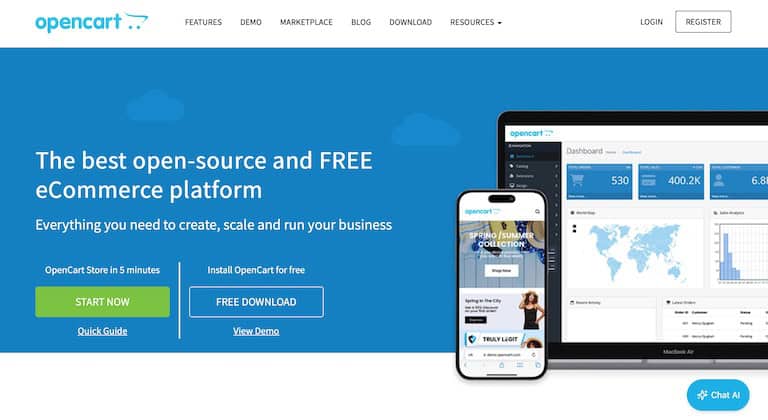
OpenCart is open-source ecommerce software. You download it, install it on your own hosting, and you own everything the code, the data, the store. Nobody can change the pricing on you, lock you out, or shut you down.
That is a fundamentally different model to Shopify or BigCommerce. There is no platform company sitting between you and your customers. What you build is yours.
Getting Started
Most hosting providers offer one-click OpenCart installation through their control panel. You do not need to understand code to do it. Once installed, the admin dashboard is clean and logical products on the left, orders in the middle, settings on the right. Nothing is buried three menus deep.
Adding your first products takes minutes. You can set prices, add images, manage stock levels, and create product categories without any technical knowledge. The default theme is functional and mobile-friendly straight out of the box.
A realistic monthly cost for a beginner OpenCart store hosting, a free theme, and a standard payment gateway sits at around £5 to £15 per month. Compare that to £80–£150 on Shopify. That difference matters a lot in year one.
What Works Well
✓
No transaction fees, no mandatory monthly subscription, no revenue share. You pay for hosting that is it. For merchants testing a new product or market, keeping fixed costs low in the early stages is genuinely valuable.
✓
OpenCart lets you run multiple stores from a single admin panel with no extra charge. If you sell in different niches or want separate storefronts for different markets, this is built in rather than an expensive add-on.
✓
Every customer record, every order, every product it all lives on your server. You can export it, back it up, and take it anywhere. No platform can restrict your access to your own customers.
✓
Stripe, PayPal, and most major UK payment providers integrate with OpenCart either natively or through free extensions. Getting paid is not complicated.
✓
Thousands of free and paid extensions cover everything from SEO tools to shipping integrations to loyalty programmes. Many are free, and the paid ones are typically one-time purchases rather than monthly subscriptions.
Where It Falls Short
!
Unlike Shopify, nobody handles security patches or updates for you. You need to stay on top of this. It is not difficult, but it does require some attention particularly around keeping your OpenCart version current.
!
There is no 24/7 support line. Help comes from the OpenCart forums, documentation, and a large community of developers. For most questions, answers are available quickly but it is not the same as a live chat button.
!
The out-of-the-box theme is clean and functional but not going to win any design awards. A paid theme (usually £30 to £80 as a one-time cost) makes a significant difference to how professional your store looks.
OpenCart vs the main alternatives
- vs Shopify: Shopify costs more per month but includes hosting, security, a fast checkout, support and a very large app store. It is the better choice for most non-technical merchants.
- vs WooCommerce: both are free and self-hosted, but WooCommerce has a far larger ecosystem, stronger SEO and content tools, and many more developers. It is the better open-source choice for most stores. See our WooCommerce vs OpenCart comparison.
- vs PrestaShop: PrestaShop is stronger for European, multi-country stores and has better built-in features, at a higher module cost. See PrestaShop vs OpenCart.
- vs Magento: Magento is far more powerful for large or B2B stores, and far more expensive to run. See Magento vs OpenCart.
Who Should Use OpenCart
OpenCart is the right choice for merchants who want to keep costs low, own their store outright, and are comfortable with a small amount of initial setup. If your budget is tight in year one, the difference between £15 a month and £150 a month is the difference between staying in the green and burning through savings before you find your footing.
It also suits merchants who plan to grow. Because you own the platform and pay no transaction fees, the economics get better as your sales increase not worse.
Who Should Look Elsewhere
If you want absolutely zero setup friction and are happy to pay for the convenience, Shopify removes more of the early work. For merchants who genuinely cannot spend any time on configuration and are willing to pay a premium for that, a fully hosted platform may suit better.
Our Verdict
OpenCart is one of the most underrated options available to first-time merchants. The fact that it costs nothing to run changes the entire risk calculation when you are starting out you can build, test, and adjust without a monthly bill ticking away in the background.
It is not as polished out of the box as Shopify, and it requires a little more ownership of your setup. But for merchants who are willing to spend a weekend getting things right, the long-term payoff no transaction fees, no platform lock-in, no escalating monthly costs is hard to beat.
Compare with: WooCommerce review · PrestaShop review · Shopify review · Also see: WooCommerce vs OpenCart · PrestaShop vs OpenCart
What OpenCart Actually Costs
The software is free, but a working store is not. Typical first-year costs in the UK:
- Hosting: £3–£10/month for shared hosting on a very small store; £15–£60/month for a VPS, which most growing stores need.
- Domain: around £10–£15/year. SSL is usually free with your host.
- Theme: free default theme, or up to around £120 for a premium one.
- Extensions: often £100–£300 to cover SEO, email integration, filtering and payments, sometimes with renewal fees. Check each one supports your OpenCart version.
- Developer time: typically £40–£90/hour in the UK for setup, fixes, updates and security.
A realistic first-year total is roughly £400–£900 before your own time, and more if you need regular development help. That can be cheaper than a hosted platform, but hosted plans include hosting, security, updates and support that you would otherwise handle or pay for yourself.
Ecommerceviews Score Breakdown
Reviewed by the Ecommerceviews editorial team. We do not accept payment for positive reviews. Our scores reflect independent assessment only.