Becoming an ecommerce expert: skills, strategies, and where to learn
The ecommerce industry has reached a critical inflection point where expertise genuinely matters. With global online retail sales projected to hit $6.9 trillion in 2025 and artificial intelligence reshaping how businesses sell and consumers shop, the demand for skilled ecommerce experts has never been higher. Yet the field remains remarkably accessible anyone with dedication can develop real expertise through free and low-cost resources, practical experience, and guidance from established practitioners.
What defines an ecommerce expert today isn’t just knowing how platforms work. It’s understanding the intricate connections between technology, consumer psychology, data analytics, and marketing strategy. The most effective practitioners combine deep platform knowledge with the ability to interpret customer behavior, optimize conversion funnels, and leverage emerging technologies like AI personalization. This article provides a complete roadmap for developing that expertise.
The ecommerce landscape has fundamentally shifted
The numbers tell a compelling story of transformation. Ecommerce now represents 20.5% of all global retail sales, with over 2.77 billion people shopping online worldwide. Perhaps more significantly, mobile commerce accounts for 59% of all online transactions, a shift that has fundamentally changed how successful stores must be designed and operated.
Social commerce has emerged as a dominant force, with the market reaching approximately $1 trillion globally in 2024. In the United States alone, 118 million people now purchase products directly through social media platforms. TikTok has become particularly influential 31,000 TikTok Shops operate in the US market, with 75% of dollar sales concentrated in health and beauty categories.
The B2B sector dwarfs consumer ecommerce, valued at $32 trillion in 2025 roughly five to six times larger than B2C. This represents enormous opportunity for professionals who develop expertise in enterprise sales platforms and complex purchasing workflows.
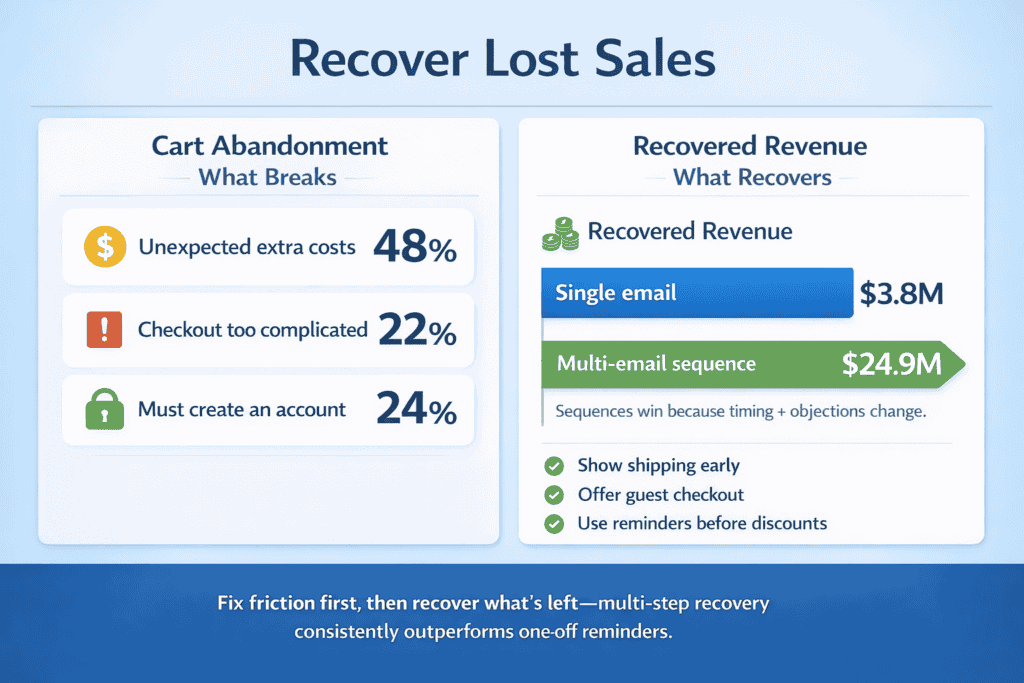
Consumer behavior continues to evolve in ways that reward sophisticated operators. Cart abandonment rates hover around 70% across the industry, with unexpected shipping costs, complicated checkout processes, and forced account creation driving customers away. Yet businesses that master abandoned cart recovery see transformative results multi-email recovery campaigns generate $24.9 million in recovered revenue compared to $3.8 million for single-email approaches.
The ecommerce experts seven skill domains define true ecommerce expertise
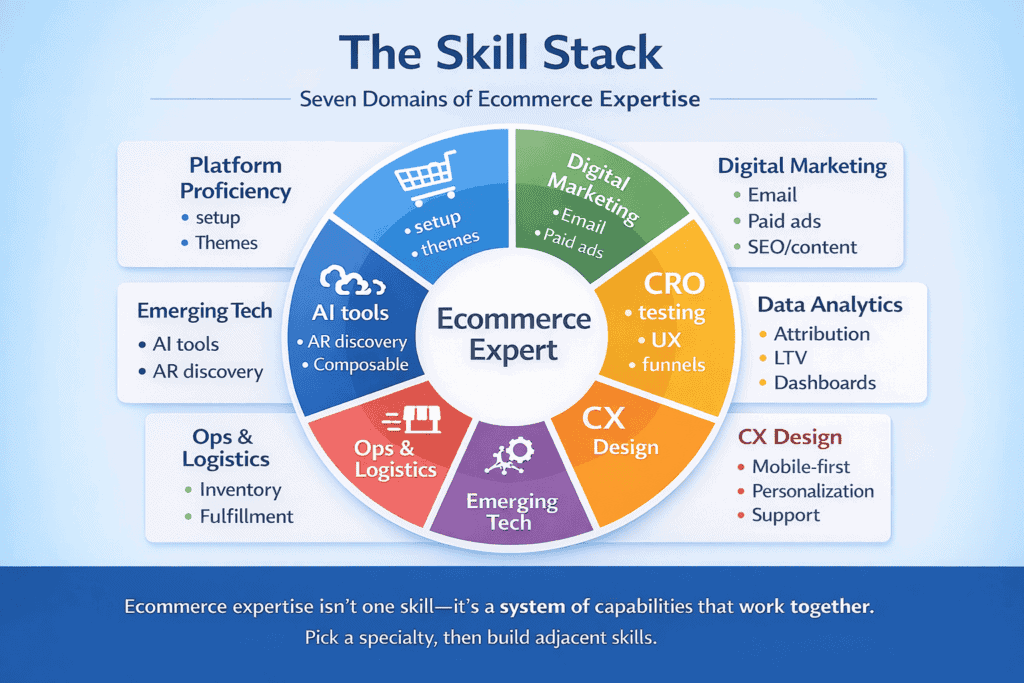
Ecommerce expertise isn’t monolithic. The field encompasses distinct specializations, each requiring deep knowledge and practical experience. Understanding these domains helps aspiring ecommerce experts and professionals choose their path and develop targeted skills.
Platform proficiency forms the foundation. Experts must understand how ecommerce platforms Shopify, Opencart, WooCommerce, Magento, BigCommerce actually work at both user and technical levels. This includes store configuration, theme customization, app integration, and increasingly, understanding APIs and headless architecture. Shopify alone powers 5.6 million live stores, making it the most common starting point for platform specialists.
Digital marketing mastery separates successful stores from failures. This encompasses email marketing (which delivers $68 for every $1 invested), search engine optimization, paid advertising across Google and Meta platforms, and content strategy. The most effective ecommerce marketers understand how these channels work together, not in isolation.
Conversion rate optimization represents perhaps the highest-leverage skill in ecommerce. Average stores convert just 2-4% of visitors into buyers. Products with customer reviews see up to 270% higher conversion rates, while effective checkout optimization can reduce abandonment dramatically. CRO specialists combine psychology, data analysis, and systematic testing to continuously improve performance.
Data analytics has become non-negotiable. Experts must interpret customer behavior patterns, track attribution across channels, calculate customer lifetime value, and translate data into actionable strategy. Proficiency with Google Analytics 4, platform-native analytics, and data visualization tools is essential.
Customer experience design extends beyond the transaction to encompass the entire journey from discovery through post-purchase. This includes mobile-first design principles, personalization strategy, customer service excellence, and loyalty program development. Companies with integrated omnichannel strategies retain 89% of their customers dramatically outperforming those with fragmented experiences.
Operations and logistics knowledge distinguishes sustainable businesses from those that struggle. Understanding inventory management, fulfillment optimization, returns processing, and cost control directly impacts profitability. Shipping costs have risen 33% since 2021, making operational efficiency increasingly critical.
Emerging technology fluency has become the differentiator for forward-looking professionals. AI-powered personalization, augmented reality experiences, voice commerce, and composable architecture are moving from experimental to essential. Organizations spending on AI customer experience tools report 97% positive ROI.
Meet the ecommerce experts practitioners shaping modern ecommerce
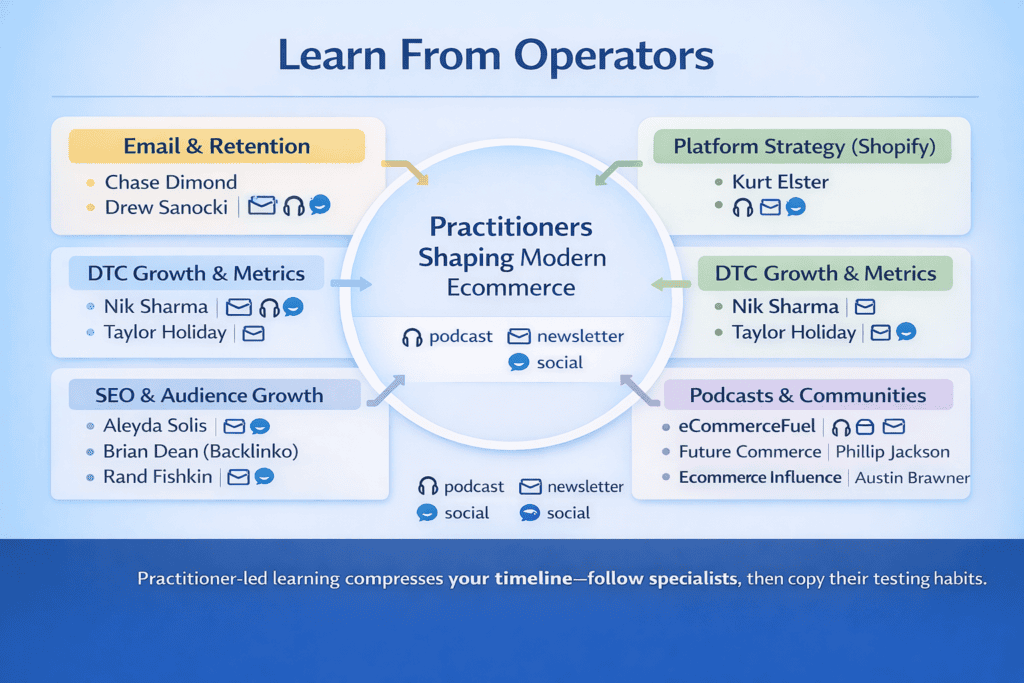
Learning from established experts accelerates development dramatically. Unlike many industries where thought leaders are primarily academics or executives, ecommerce benefits from practitioner-experts who actively share their methods.
Chase Dimond has become the definitive voice in ecommerce email marketing, having generated over $150 million in email-attributable revenue since 2018. His detailed breakdowns of welcome sequences, abandoned cart flows, and subject line optimization provide immediately actionable guidance. Following his content on X and through his newsletter offers a masterclass in retention marketing.
Kurt Elster has hosted “The Unofficial Shopify Podcast” since 2012, making him one of the longest-tenured Shopify educators. As a Senior Ecommerce Consultant and Shopify Plus Partner, he provides both strategic insight and tactical implementation guidance. His podcast consistently features successful merchants sharing specific strategies that worked.
Nik Sharma operates at the intersection of investment and operations, advising brands like JuneShine, Levels, and Feastables while sharing practical insights through his widely-read newsletter. His perspective combines hands-on DTC experience with strategic thinking about what makes brands successful.
Taylor Holiday leads Common Thread Collective and has become known for rigorous, data-driven analysis of ecommerce metrics. His detailed explorations of customer acquisition cost, lifetime value ratios, and profitability metrics help practitioners move beyond vanity metrics to genuine business understanding.
Drew Sanocki brings operator credibility through building and selling multiple ecommerce businesses. Now running PostPilot and writing the Nerd Marketing newsletter, he focuses on customer lifetime value optimization with systematic, proven frameworks.
For SEO expertise, Aleyda Solis stands out for international and technical search optimization, while Brian Dean’sBacklinko (now part of Semrush) provides comprehensive tactical guidance. Rand Fishkin, who built Moz before founding SparkToro, offers perspective on audience research and sustainable growth.
Podcast listeners benefit from Andrew Youderian’s eCommerceFuel (serving 1,200+ seven-figure store owners), Phillip Jackson’s Future Commerce (exploring commerce and culture intersection), and Austin Brawner’sEcommerce Influence (focused on growth and retention).
Building expertise through structured learning
The democratization of ecommerce education means anyone can develop professional-grade skills without traditional credentials. The most effective learning path combines free foundational resources with targeted certifications and practical application.
Google’s Digital Marketing & E-commerce Certificate on Coursera provides the strongest starting foundation. This seven-course program covers everything from digital marketing fundamentals through building and operating an ecommerce store. At approximately $49 per month, completing it in under six months costs roughly $300 and financial aid makes it accessible for free. The program teaches tools including Shopify, Google Analytics, and email marketing platforms while connecting graduates to an exclusive job board with 150+ employer partners.
Shopify certifications carry significant weight with employers and clients. Standard certifications covering Marketing Fundamentals, Development Fundamentals, and Solution Planning cost $149 each, while advanced certifications in app development and theme customization run $249. These proctored assessments validate genuine platform expertise rather than just course completion.
HubSpot Academy offers entirely free certifications that remain valuable despite costing nothing. Their Ecommerce Marketing, Inbound Marketing, Content Marketing, and Email Marketing certifications provide foundational skills recognized throughout the industry. Over 165,000 professionals have earned HubSpot certifications.
Google Analytics certification through Google Skillshop has become essentially mandatory for ecommerce professionals. The free certification validates understanding of the GA4 platform that powers most ecommerce analytics.
Meta Blueprint certifications ($99-$150 per exam) prove competency in Facebook and Instagram advertising critical for social commerce success. The Media Buying Professional and Creative Strategy Professional certifications demonstrate advanced advertising capabilities.
For intermediate practitioners, CXL Institute’s Ecommerce Marketing Minidegree ($289/month) provides advanced training across 23 courses taught by experts from major brands. The program covers customer acquisition, retention, conversion optimization, and analytics at a depth unavailable in introductory courses.
Beyond formal programs, consistent engagement with industry content accelerates learning. The r/ecommerce subreddit (177,000+ members), Shopify Community forums (700,000+ merchants), and Facebook groups like Ecommerce Entrepreneurs provide peer learning and real-world problem-solving. Books including “DotCom Secrets” by Russell Brunson, “Building a StoryBrand” by Donald Miller, and “Ecommerce Evolved” by Tanner Larsson offer systematic frameworks that structured courses sometimes lack.
Artificial intelligence has become the great differentiator
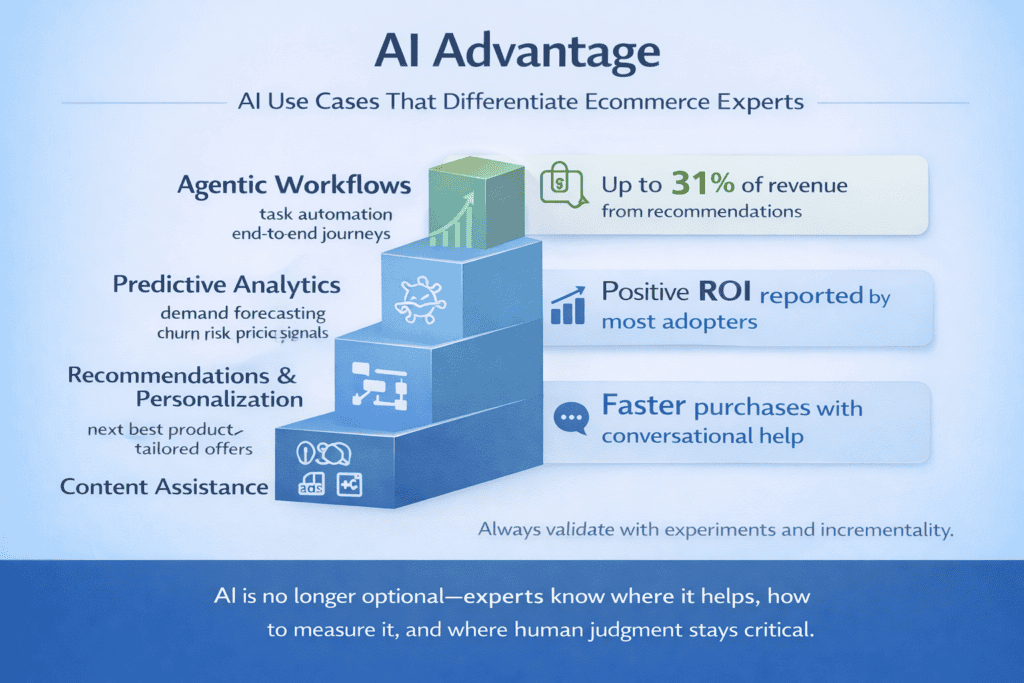
AI’s impact on ecommerce has moved from theoretical to transformational. 78% of organizations now use AI in at least one business function, with 97% of commerce organizations having AI implementation plans. Understanding and leveraging these technologies has become essential for competitive expertise.
AI-powered product recommendations now generate up to 31% of ecommerce revenues. Companies implementing AI personalization report a 369% increase in average order value during personalized sessions. These aren’t marginal improvements they represent fundamental competitive advantages.
Predictive analytics have matured dramatically. 44% of retailers use AI for predictive analytics, enabling demand forecasting that optimizes inventory investment, personalization that anticipates customer needs, and pricing that maximizes margins. Doe Beauty saves $30,000 weekly using Shopify’s AI-driven inventory management a case study in operational AI impact.
Conversational commerce through AI chatbots has progressed beyond simple FAQ bots to sophisticated shopping assistants. AI-enabled sites see 47% faster purchases, with natural language processing enabling complex query understanding. The conversational commerce market is projected to grow from $8.8 billion in 2025 to $32.7 billion by 2035.
The emergence of “agentic AI” autonomous systems that can complete tasks without human intervention represents the next frontier. These systems can handle entire shopping journeys, from product discovery through purchase completion. eBay and Etsy are already deploying agentic AI for both buyers and sellers.
For practitioners, this means developing new skill sets: understanding how to implement and optimize AI tools, recognizing appropriate AI applications, and maintaining the human judgment that AI cannot replace. 60% of US shoppers now turn to ChatGPT or Gemini for shopping assistance experts must understand how their stores appear to and interact with these systems.
Immersive technologies are reshaping product discovery
Augmented reality has crossed the threshold from novelty to necessity in certain categories. The AR market in ecommerce reached $5.88 billion in 2024 and is projected to hit $38.55 billion by 2030 a 35.8% compound annual growth rate that signals mainstream adoption.
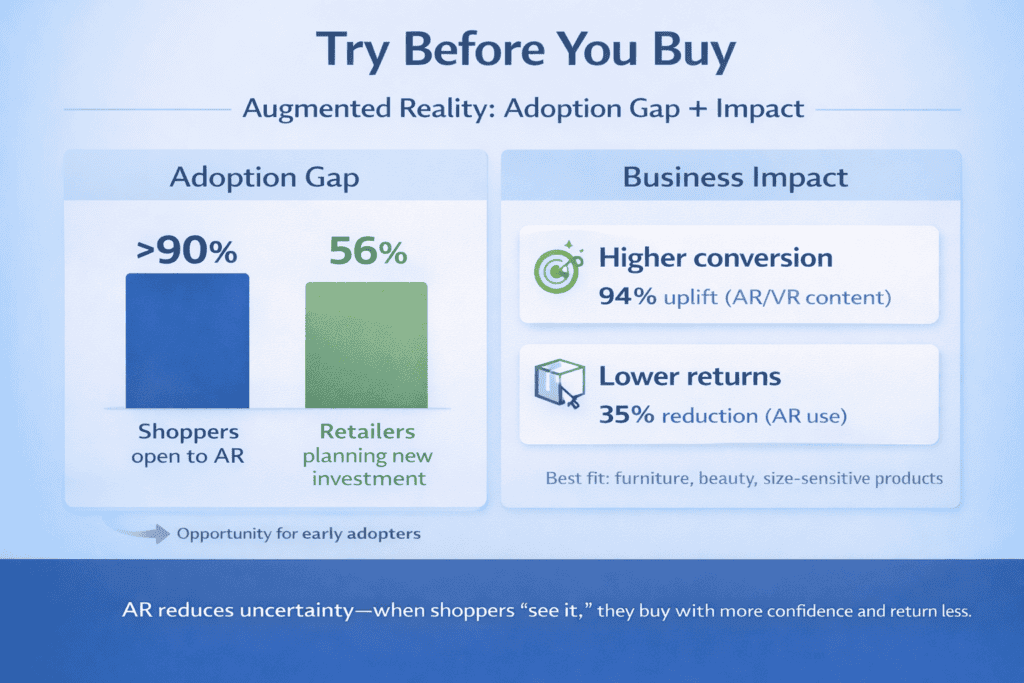
Consumer readiness has outpaced retailer implementation. Over 90% of American shoppers use AR or are open to using it, with 98% of those who tried AR finding it helpful in purchase decisions. 92% of Gen Z specifically want AR tools for ecommerce. Yet only 56% of retailers plan new AR/VR investments by 2025, creating competitive opportunity for early adopters.
The business impact is measurable and significant. Products with AR/VR content see 94% higher conversion ratesaccording to Shopify data. Retailers using AR report 35% reduction in returns—addressing one of ecommerce’s most persistent profit drains. Macy’s found that VR/AR for furniture led to 60% larger average basket values with return rates dropping below 2%.
Beauty and furniture have emerged as AR’s breakout categories. Sephora’s Virtual Artist facilitated 8.5 million try-ons in its first year. IKEA Place has been downloaded over 8 million times. 43% of smartphone shoppers now expect AR try-on features for beauty products it’s becoming table stakes, not differentiation.
Voice commerce, while less mature, is growing rapidly. The global voice commerce market reached $70.47 billion in 2025 and could approach $636 billion by 2035. 60% of US ecommerce shoppers already make daily or weekly voice purchases, primarily through Amazon’s Alexa ecosystem. Optimizing for voice search using conversational language and structured content for quick answers has become an emerging SEO discipline.
The technical architecture of modern ecommerce is evolving
Composable commerce and headless architecture have moved from enterprise experiments to mainstream practice. 73% of businesses now use headless website architecture, with 92% of US brands having adopted some form of composable commerce.
This architectural shift separates front-end presentation from back-end commerce functionality, enabling faster innovation and omnichannel flexibility. Companies implementing headless architecture report 42% average conversion rate increase, 50% reduction in time to launch new digital experiences, and 20% decrease in website load times.
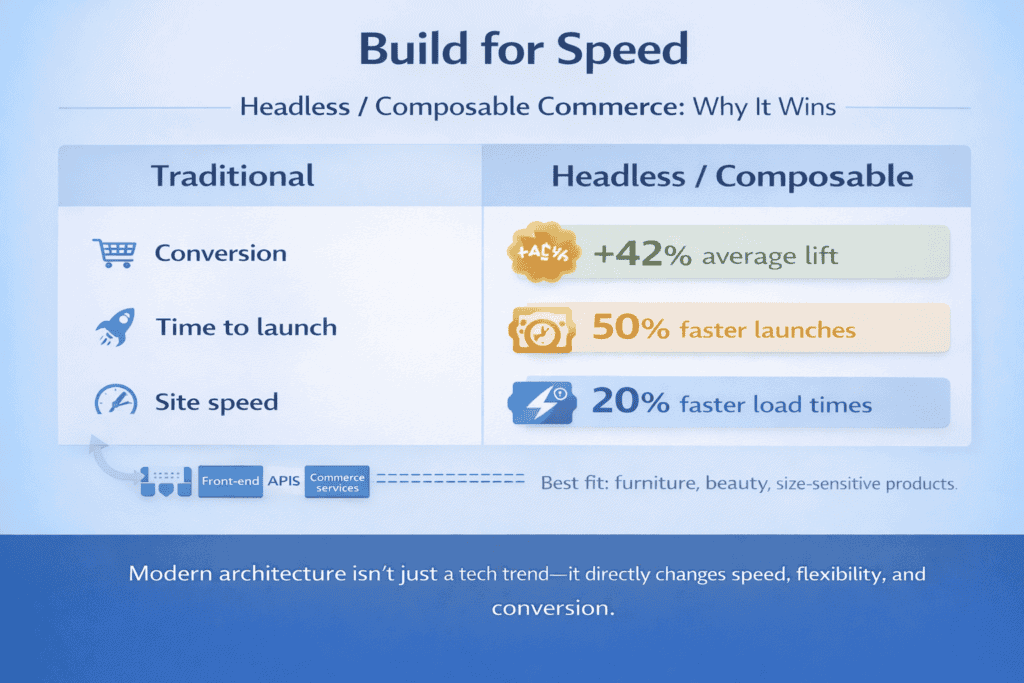
For practitioners, this means understanding APIs, microservices, and how modern commerce platforms connect. Shopify’s Hydrogen framework reduces build times by 50% compared to traditional themes. Nike improved mobile conversions by 25% through React-based headless implementation.
Buy Now Pay Later has become the dominant payment innovation. The global BNPL market reached $560 billion in 2025, with user adoption accelerating toward 900 million by 2027. 27% of US consumers have used BNPL, with Gen Z adoption growing 600% since 2019. BNPL users spend 6.42% more than non-BNPL shoppers, and offering BNPL options increases average order values by 20-40%.
Proven strategies from successful consultants
The most impactful ecommerce strategies combine fundamentals with sophisticated execution. Core best practices have been validated across thousands of stores and millions of transactions.
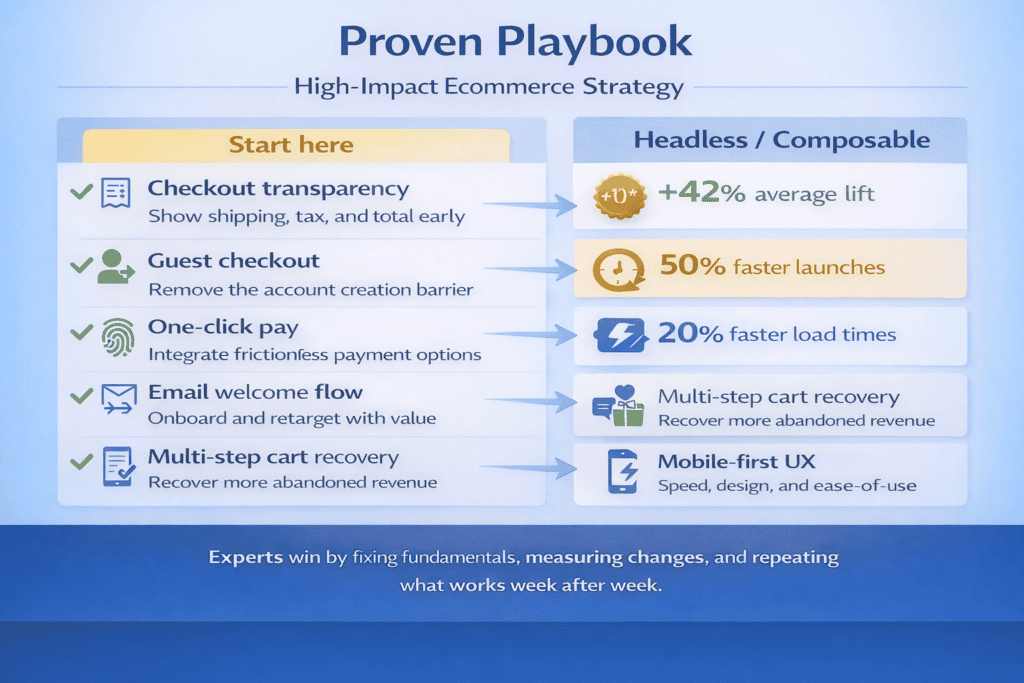
Checkout optimization delivers outsized returns because cart abandonment remains stubbornly high at approximately 70%. The primary driver unexpected costs revealed late in checkout has a straightforward solution: display full pricing including shipping and taxes early in the process. Offering guest checkout prevents the 34% of customers who abandon specifically due to forced account creation. One-click checkout through Shop Pay or similar services increases spending by 28.5%.
Email marketing fundamentals remain remarkably consistent. Welcome series generate 3x higher engagement than standard campaigns. Abandoned cart emails should begin without discounts 60% of customers return when reminded effectively with incentives reserved for final emails after 72 hours. Successful ecommerce brands send 2-4 emails weekly, with optimal send times at 8 PM for opens and 1 PM or 4-5 PM for clicks.
Customer retention economics have shifted dramatically as acquisition costs have risen 222% over the past decade. Retaining customers is 5-7x cheaper than acquiring new ones, with a 5% increase in retention potentially increasing profits by 25-125%. 81% of customers stay loyal to brands with loyalty programs. LuisaViaRoma’s loyalty program generated €16 million in revenue with 59% improvement in retention.
Product page optimization directly impacts conversion, yet only 49% of top ecommerce sites achieve “decent” or “good” product page UX according to Baymard Institute research. High-resolution, zoomable images showing multiple angles are table stakes. Customer reviews increase purchase probability significantly products with just five reviews see meaningful conversion lift, while comprehensive reviews can increase conversions by up to 270%.
Mobile-first design has become non-negotiable with over 60% of traffic originating from mobile devices. Google’s mobile-first indexing means mobile experience directly impacts search visibility. Cart abandonment runs 10-15% higher on mobile due to poor design addressing mobile UX provides immediate conversion gains.
Career paths for aspiring ecommerce agencies and ecommerce marketing professionals
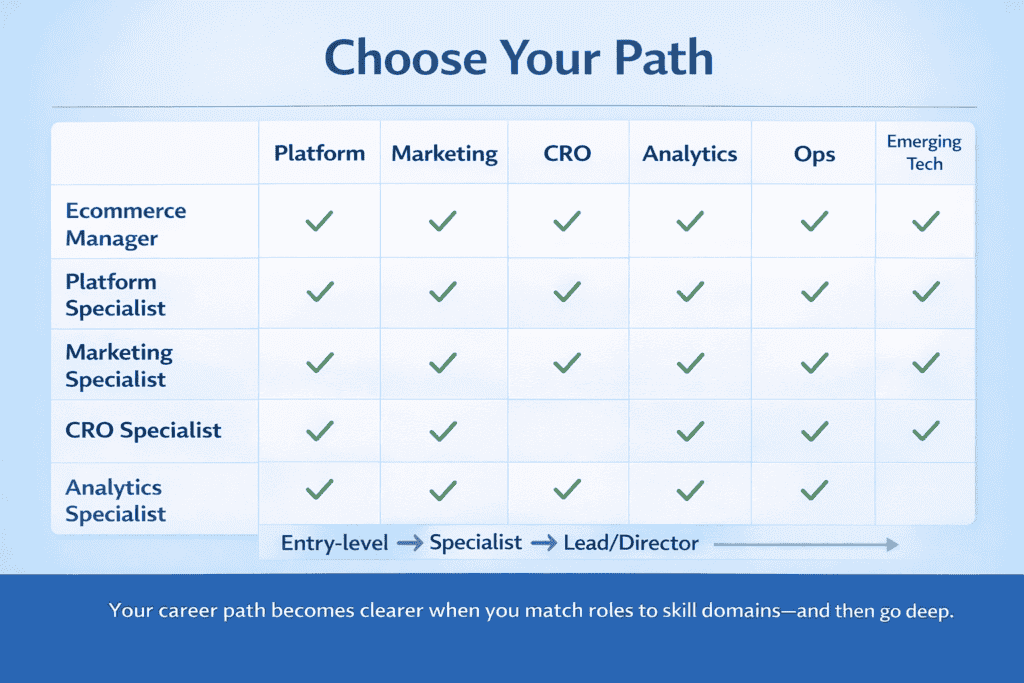
Ecommerce careers offer multiple specialization paths, each with distinct skill requirements and compensation trajectories.
Ecommerce Managers and Directors own overall strategy, P&L management, and cross-functional leadership. They coordinate marketing, operations, technology, and customer service toward unified business objectives. Salaries range from $90,000 to $160,000+ depending on experience and company size.
Platform Specialists develop deep expertise in specific systems Shopify, Opencart, Magento, WooCommerce, BigCommerce. They handle store configuration, theme development, migration projects, and technical optimization. Shopify specialists are most in demand given the platform’s market dominance, while Magento/Adobe Commerce specialists command premiums for enterprise complexity.
Marketing Specialists divide into email marketing (automation, segmentation, lifecycle campaigns), paid media (Google Ads, Meta advertising, TikTok), SEO (technical optimization, content strategy, link building), and content marketing (blogs, product content, video). Each subspecialty can support an entire career.
CRO Specialists focus exclusively on conversion optimization through A/B testing, user experience analysis, and funnel optimization. Given the high leverage of conversion improvements, skilled CRO professionals create enormous value.
Analytics Specialists translate data into strategy through performance reporting, customer behavior analysis, and predictive modeling. As ecommerce becomes increasingly data-driven, analytics expertise commands growing premiums.
Entry-level positions as E-Commerce Assistants or Digital Marketing Coordinators typically pay $40,000-$55,000. Mid-level specialists earn $60,000-$90,000. Directors command $90,000-$120,000. VP and C-level roles reach $160,000-$210,000+.
The path forward starts with fundamentals
Becoming an ecommerce expert is neither quick nor easy, but the path is clearer than ever. Start with Google’s free Digital Marketing & E-commerce Certificate and HubSpot Academy’s free certifications. These provide foundational knowledge across platforms, marketing, and analytics.
Add platform-specific credentials Shopify certifications for most practitioners, Meta Blueprint for social commerce focus, Google Analytics certification universally. Engage with practitioner content through podcasts, newsletters, and communities. Apply learning immediately through projects, whether personal stores, freelance work, or employer initiatives.
The most successful ecommerce professionals combine systematic learning with relentless practical application. They stay current with emerging technologies while mastering fundamentals. They learn from experts but develop their own tested approaches.
The opportunity is substantial. Global ecommerce continues growing at 7-8% annually even in mature markets, with mobile commerce, social commerce, and AI-driven personalization creating new competitive dimensions. Those who develop genuine expertise not just surface familiarity will find abundant career opportunities and business success.
If you’re putting this expertise into practice, our pricing page breaks down what platform costs actually look like, and our Shopify review is a good next read given how often Shopify comes up as the default starting point above.
The resources exist. The roadmap is clear. What remains is the commitment to sustained learning and practical application that transforms knowledge into expertise.