Ask five SEO providers what it costs to rank an online store and you will get five numbers, some of them ten times larger than others, all of them described as “fair for what you get”. Store owners end up comparing proposals that do not describe the same work, signing contracts they cannot evaluate, and judging the result on a traffic graph that takes months to move. It is no surprise that confidence in marketing spend is low across the industry, a problem we looked at in why only 7% of ecommerce merchants feel confident about their marketing spend.
The good news is that SEO pricing is not as opaque as it looks once you understand what drives it. There are only a few pricing models, the market rates are well surveyed, and the cost of any specific scope comes down to hours and to the price of the links and content involved. This guide covers what providers charge, how the pricing models differ, what makes ecommerce SEO more or less expensive for a particular store, what a given budget realistically buys, and the warning signs that a proposal is not worth signing at any price.
What the market charges
The most widely cited pricing benchmark comes from Ahrefs, which polled 439 SEO providers about their rates. Its findings give a useful map of the market:
- 78.2% of providers charge a monthly retainer, making it by far the dominant model
- The most popular retainer band is $501 to $1,000 a month, charged by 20.4% of respondents
- Agencies average $3,209 a month, while freelancers average about $1,349
- The average hourly rate is $111
These are averages across all kinds of clients, not ecommerce specifically, and they hide a wide spread. A local service business and a 20,000-product store both appear in the same survey, and they need very different amounts of work. Treat the numbers as a sense of the market, not a quote.
Why the surveys disagree
A second large survey, of agencies specifically, paints a cheaper picture. SE Ranking’s agency pricing research found that 64% of agencies charge below $1,000 a month, 60% set hourly rates below $100, and 66% charge under $2,000 per project.
The two surveys are not contradicting each other so much as sampling different parts of a very wide market. Rates vary enormously by region, by provider experience, and by the size of the clients each provider serves. An agency in a lower-cost market serving small local businesses and a specialist ecommerce agency in a major Western city are both “SEO agencies” in a survey, and they have almost nothing in common in price or scope. For a store owner, the practical takeaway is that the price on a proposal tells you little until you know how many hours and which deliverables it buys.
The four pricing models
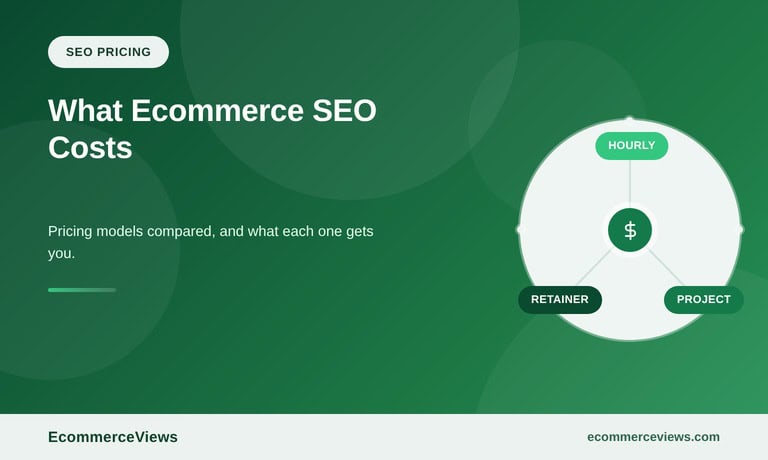
Almost every SEO proposal uses one of four models, or a mix of them. Each has a place, and each has a failure mode worth knowing:
- Monthly retainer: a fixed monthly fee for an ongoing scope of work, usually with a minimum term. It suits ongoing work like content, links, and technical maintenance. The risk is a vague scope, where the fee stays the same while the work quietly shrinks.
- Project fee: a fixed price for a defined deliverable, such as an audit, a migration plan, or a site architecture overhaul. It suits one-off work with a clear end. The risk is a project that produces a document nobody implements.
- Hourly consulting: paying for time, usually for advice, reviews, or training. It suits stores with an in-house team that needs direction rather than labor. The risk is unpredictable total cost for open-ended work.
- Performance-based pricing: fees tied to rankings, traffic, or revenue. It sounds like the safest option and is often the riskiest, because it rewards whatever metric is easiest to move, not necessarily the one that matters to the business.
For most stores, the sensible structure is a project to fix the foundations followed by a retainer for ongoing growth, with the retainer’s monthly deliverables written down in the contract.
What makes ecommerce SEO more or less expensive
Ecommerce SEO generally costs more than SEO for a brochure site of the same traffic level, because stores have more pages, more technical moving parts, and more commercial competition. Within ecommerce, these factors account for most of the difference between a modest budget and a large one:
- Catalog size and structure: a store with 300 products in 15 categories needs far less technical and content work than one with 30,000 products and deep faceted navigation
- Platform: hosted platforms limit what can be changed (and what can break), while open-source and headless setups offer more control and need more technical hours
- Competition: ranking a category page against marketplaces and national retailers requires more authority than ranking against other small stores
- Content needs: how many category pages need text, how many product descriptions need rewriting, and how many guides the strategy calls for
- Links: the number of links needed to compete, and the quality of the sites they come from, is often the largest single cost line
- Markets and languages: every additional country or language multiplies keyword research, content, and technical work
- Internal resources: a store with a developer and a writer on staff needs a strategist; a store with neither needs the labor too
Links deserve their own note, since they are where budgets most often go wrong. Cheap links from irrelevant sites are worse than useless; the tactics that work for stores, and what they realistically cost to execute, are covered in our analysis of ecommerce link building.
The price of links and content
Content and links are bought in units, which makes them easier to price than strategy. On the link side, BuzzStream’s analysis of nearly 500,000 sites selling guest posts put the average price of a guest post from a typical vendor at $461. That is the placement alone, before the cost of finding the right sites, writing content that is worth publishing, and making sure the link points at the page that needs it.
Content is priced by length and expertise. A well-researched buying guide written by someone who knows the product category costs several times what a generic blog post costs, and it is worth several times more. When comparing proposals, ask how many links and how many pieces of content the retainer includes each month, at what quality bar, and who writes them. That single question explains most of the gap between a $1,000 proposal and a $5,000 one.
What different budgets realistically buy
Because most SEO work is priced by time, you can sanity-check any proposal with simple arithmetic. At the $111 average hourly rate from the Ahrefs survey, a $1,000 monthly retainer buys about nine hours of work. That is enough to maintain a small store’s technical health, write one or two solid pieces of content, and report on progress. It is not enough to fix a large catalog, compete for a national head term, or build links at any meaningful pace.
Rough scopes by budget level look like this:
- Under $1,000 a month: technical maintenance, light on-page work, and reporting for a small store in a low-competition niche
- $1,000 to $3,000 a month: the above plus regular category and product content and a modest, steady flow of links
- $3,000 to $10,000 a month: a full program for a mid-sized store, covering technical work, content clusters, category optimization, and a serious link building effort
- Above $10,000 a month: large catalogs, multiple markets, highly competitive categories, or aggressive growth targets
These are rules of thumb, not prices. The point is that a budget has to match the scope; a $700 retainer promising “full ecommerce SEO” for a 10,000-product store is promising something the hours cannot deliver.
Start with an audit before a retainer
The most cost-effective first purchase for most stores is a proper audit, priced as a project. It shows what is broken, what is missing, and what the opportunity is, which is the information you need to judge whether a retainer proposal is aimed at the right problems. A good audit for a store covers indexation, crawl waste, faceted navigation, product and category pages, structured data, speed, and links, in roughly the order laid out in our ecommerce SEO audit checklist. You can run much of that checklist yourself before paying anyone, which also makes you a far better judge of the proposals you receive.
Freelancer, agency, or in-house
Who does the work changes the price as much as what the work is. Freelancers are the cheapest per hour and ideal for well-defined tasks, but most cover one or two specialties, so a store needing technical, content, and link work may need several. Agencies cost more and bring a team with mixed skills and continuity when one person leaves. Consultants charge the highest hourly rates and are best used to direct work done by others. In-house hires make sense once SEO is a permanent, full-time need, which for most stores means a large catalog or a significant share of revenue coming from organic search.
A common and efficient setup for a growing store is a mix: an in-house marketer or developer who implements, with an external specialist providing strategy and the parts that need specialized resources, such as link building.
Red flags in an SEO proposal
Google’s own guide for business owners, Do you need an SEO?, is blunt about one warning sign: if a provider guarantees first place in search results, find someone else. Nobody controls Google’s rankings, and a guarantee means either a misunderstanding of how search works or a plan to hit a metric that does not matter. Other warning signs in proposals for stores:
- No discovery before the price: a fixed package quoted without looking at the store, the platform, or the competition
- Vague deliverables: “ongoing optimization” with no stated number of content pieces, links, or technical tasks per month
- Secret methods: a provider unwilling to explain how links are acquired or where they come from
- Ranking reports without revenue: reporting built around keyword positions instead of organic sessions, orders, and revenue
- Long lock-ins without exit terms: a 12-month minimum with no performance review points
- Link volume promises: “50 links a month” at a price that only low-quality sites could deliver
None of these on its own proves a provider is bad, but each one is a question worth asking before signing.
Comparing SEO cost with paid acquisition
SEO and paid ads are paid for differently, which makes them hard to compare directly. Ads cost per click, forever; SEO costs a fixed amount per month whether the traffic grows or not, and the traffic it builds keeps arriving after the spending stops. The comparison that matters is cost per acquired customer over time, not cost per month. How that comparison usually plays out for stores, and when each channel deserves the larger share of the budget, is the subject of our guide to ecommerce SEO vs paid ads.
How to choose a provider
Ask every shortlisted provider the same questions, so the answers are comparable: what they would do in the first 90 days and why, how many hours the fee buys, how they build links and from which kinds of sites, which ecommerce platforms they have worked on, what they report on and how often, and what results comparable stores have seen. Ask to speak with a current ecommerce client. Our overview of ecommerce SEO services and agencies covers what to look for in more depth.
Then compare proposals on scope rather than price. The cheapest proposal is often the most expensive one in the end, because it buys a year of activity that does not move the pages that sell.
Setting expectations for the first year
The last cost to plan for is time. SEO results for a store build over months, and the first months of a retainer are often spent on technical fixes and content whose effect shows later. Budget for at least six months before judging a program, set milestones for each quarter (technical issues fixed, category pages rewritten, links earned, organic revenue), and review against them rather than against week-to-week rankings. The mistakes that most often waste a store’s first year of SEO spending are covered in our piece on what ecommerce stores get wrong about SEO in their first year. Avoid those, match the budget to the scope, and SEO becomes one of the few marketing costs that keeps paying back after the invoice is settled.