By EcommerceViews Editorial
Selling digital products looks simple from the outside. A customer pays, a file lands in their inbox, and you keep most of the money because there is nothing to ship. The reality is messier. The platform you pick has to handle secure file delivery, expiring or limited download links, licence keys for software, instant access to courses or membership areas, and the tax rules that apply when you sell an ebook to a buyer in Berlin from a base in Texas. Get any of those wrong and you lose money to fees and chargebacks, or create support tickets that eat the time you saved by not packing boxes.
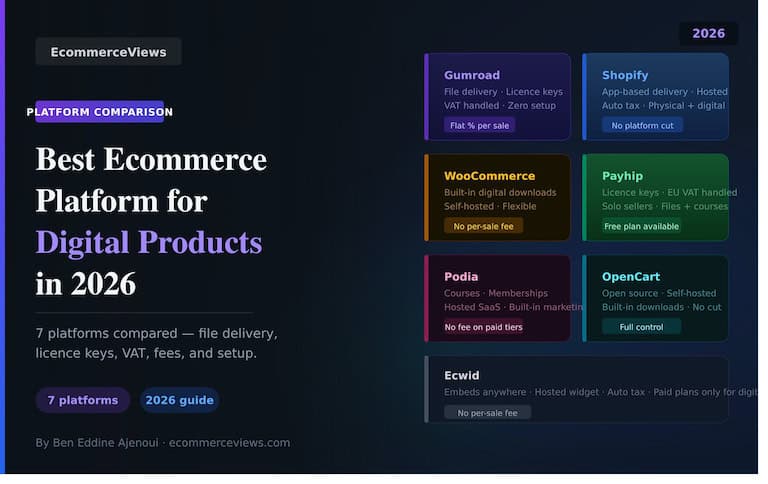
This guide compares seven well-known platforms that creators and small businesses use to sell downloads, ebooks, templates, software licences, online courses, and memberships: OpenCart, Shopify, WooCommerce, Ecwid, Gumroad, Podia, and Payhip. We weigh them on file delivery, licences and access, total cost once fees and app subscriptions are added up, VAT and tax, built-in marketing, and ease of setup. None is best at everything, so the goal is to match the platform to the kind of digital product you sell and how you want to run the business.
Quick comparison table
| Platform | Native digital delivery | Licence keys | Platform transaction fee | VAT or tax handling | Hosting model | Best suited to |
| OpenCart | Yes, downloadable products built in | Via extensions | None on the platform itself | Tax classes and geo zones, EU VAT via extensions | Self-hosted, open source | Owners who want control and no per-sale cut |
| Shopify | Via free or paid apps | Via apps | None on Shopify Payments, fee on other gateways | Automated tax, EU and UK VAT supported | Hosted SaaS | Sellers who also stock physical goods |
| WooCommerce | Yes, downloadable products built in | Via extensions | None on the platform itself | Tax engine plus plugins for EU VAT | Self-hosted on WordPress | WordPress users who want flexibility |
| Ecwid | Yes, on paid plans | Limited, via apps | None on the platform itself | Automated tax, EU VAT supported | Hosted widget, embeds anywhere | Sellers adding a store to an existing site |
| Gumroad | Yes, core feature | Yes, built in | Flat percentage per sale | Handles VAT as merchant of record | Hosted, link first | Creators who want zero setup |
| Podia | Yes, core feature | Limited | None on paid tiers, fee on free plan | Collects some tax, EU VAT support varies | Hosted SaaS | Course and membership sellers |
| Payhip | Yes, core feature | Yes, software key delivery | Free plan takes a cut, paid plans remove it | Acts on EU VAT for you | Hosted, link first | Solo sellers of files and courses |
Table of contents
- OpenCart
- Shopify
- WooCommerce
- Ecwid
- Gumroad
- Podia
- Payhip
- File delivery, licences and access control
- Fees, VAT and tax handling compared
- When to choose OpenCart
- When to choose Gumroad or Payhip
- When to choose Shopify or WooCommerce
- The verdict
OpenCart
OpenCart is an open source store platform you host yourself, and it treats downloadable products as a first class feature rather than an add-on. You attach one or more files to a product, and OpenCart releases them only after the order reaches a status you control. You set how many times a buyer can download each file and for how many days the link stays active, which covers the two worries digital sellers care about most: links shared forever, and customers losing access before they save the file. For ebooks, templates, audio packs, or PDF guides this is enough on its own.
The cost story is where OpenCart separates itself. The software is free and OpenCart does not take a cut of your sales, so beyond hosting, a domain, and any paid extensions, no slice of revenue leaves with the platform on every order. For a seller moving real volume in low-priced downloads, that gap adds up fast against tools that charge a percentage per sale, and our best ecommerce platform for small business in 2026 guide weighs the self-hosted and hosted models side by side. Licence keys and software delivery are not native, but the OpenCart extension marketplace fills the gap with modules for licence key distribution, EU VAT compliance, subscription billing, and watermarked PDFs. As with any extension ecosystem, check that a module supports your version and is still maintained before you build on it.
Tax uses built in tax classes and geo zones, so you set rates by customer location, and the VAT extensions add the validation European sellers need. Marketing gives you coupons, discounts, gift vouchers, reward points, and reviews out of the box, plus full control over the meta titles, descriptions, and URL structure that matter when so much digital demand starts as a search. Because you own the template and markup, you can add schema or tidy URLs freely, which helps when you pair the store with the right ecommerce SEO tools, and our 2026 OpenCart review covers the admin experience in more depth. The honest limit is that OpenCart asks more of you up front than a hosted builder, so if you have never managed a server, weigh that against the per-sale savings.
Shopify
Shopify is the hosted platform most people name first, and it sells digital products well, with one caveat: delivery runs through an app rather than the core product editor. Its free Digital Downloads app attaches files and emails a secure link after purchase, and the app store has paid options that add download limits, licence keys, PDF stamping, and video streaming. For a store that sells physical goods and wants a few downloads, that is a clean fit; for a digital-only store, it can feel like paying for physical-commerce machinery you never touch. Tax handling is a genuine strength: Shopify automates sales tax and supports EU and UK VAT, including the digital goods rules that trip up smaller tools.
On fees, Shopify charges a monthly subscription, and you avoid the extra per-transaction platform fee only if you use Shopify Payments; a third party gateway adds a percentage on top. Marketing is where the subscription earns its keep, with abandoned cart recovery, email, discount codes, gift cards, and a large app ecosystem for upsells and affiliates, and our Shopify versus WooCommerce comparison walks through the recurring-cost difference against the open source route. The catch for digital sellers is that you are renting a polished platform whose monthly cost climbs once you add the apps a download-only catalogue needs.
WooCommerce
WooCommerce is the open source plugin that turns a WordPress site into a store, and like OpenCart it has downloadable products built in. You mark a product as virtual and downloadable, attach the files, and set a download limit and an expiry window. Because it lives inside WordPress, it suits sellers who already run a blog or content site and want the shop next to their articles. The plugin is free and takes no percentage of sales, so the economics resemble OpenCart: you pay for hosting, a theme if you buy one, and extensions for licence keys, subscriptions, and EU VAT.
That flexibility is the appeal and also the maintenance burden, because a store running a stack of plugins needs someone to keep them patched across WordPress and PHP releases. The same content depth that helps you rank can hurt conversions if the funnel is an afterthought, the trap we cover in our guide to how to increase ecommerce sales in 2026. WooCommerce fits when WordPress is already your home and you want full control with no per-sale fees, but you carry the hosting, security, and updates a SaaS platform would handle.
Ecwid
Ecwid, now part of Lightspeed, is a store you embed into a site you already have, whether that is WordPress, Wix, a static HTML page, or a social profile. Digital goods are supported on paid plans, with files delivered after purchase and size limits to watch for larger files. The embed-first design is the whole point: if you have an existing website and do not want to rebuild it to sell a handful of downloads, you drop in the store and keep your current site. Sellers weighing that move often read our piece on why sellers are moving from Ecwid and Shopify to OpenCart to understand where the widget model starts to pinch.
Ecwid does not take a cut of your sales, so your costs are the plan fee plus your payment processor, though the limited free plan does not cover digital goods well. Tax supports automated rates and EU VAT, while licence key delivery is thinner than on the dedicated digital tools and usually needs an app. For marketing it offers coupons, abandoned cart recovery on higher tiers, and email integrations, and our Ecwid versus Shopify comparison covers the trade-offs against its closest rival. It suits sellers adding a store to an existing presence, and strains when your catalogue is large, your files are big, or licence delivery is central.
Gumroad
Gumroad is built for creators who want to sell something today. You upload a file, set a price, and share a link, and Gumroad handles delivery, the checkout, licence keys for software, and pay-what-you-want pricing, with no store to design and no server to manage. The trade-off is the fee: Gumroad takes a flat percentage of every sale, which becomes the most expensive option per transaction once you sell steadily, especially on low-priced products.
The upside that partly justifies that fee is that Gumroad acts as merchant of record, handling VAT and sales tax on your behalf, including the EU digital goods rules, and remitting them for you. Getting orders, refunds, and access right still matters, and our overview of order processing and management in ecommerce applies even here. Built around the product link rather than a browsable storefront, with lean marketing tools, Gumroad is strong for selling through your newsletter or a link in bio and weaker as a destination people browse.
Podia
Podia is aimed squarely at people selling courses, memberships, and digital downloads, bundling those tools into one hosted platform. You can host a course with drip scheduling, run a membership with gated content, sell standalone files, and build a simple website and email list in the same place. For a creator whose product is knowledge rather than a single file, that removes the need to stitch a course tool, an email tool, and a storefront together, and recurring access is first class here in a way it is not on the file-first tools.
Podia removes its transaction cut on paid plans while its free plan applies a percentage, so the move to a paid tier pays for itself as you grow, with gateway processing fees still on top. Tax handling is more limited than Shopify’s and EU VAT support can vary by setup, so European sellers should confirm the current state before committing; licence keys for software are not Podia’s focus. Its marketing toolkit is a strong point, with email, coupons, affiliate features, and upsells included. Built for education and recurring access, it is a weaker fit if you mainly sell software licences or one-off files.
Payhip
Payhip sits between Gumroad’s simplicity and a fuller store. It sells digital downloads, courses, memberships, and coaching, and it can deliver software licence keys, which makes it more capable than its minimal interface suggests. Like Gumroad it is link-first and quick to start, but it also gives you a hostable storefront. Fees are the headline: the free plan takes a percentage with no monthly cost, and the paid plans remove that cut for a flat fee, so high-volume sellers move up to escape the percentage while beginners start free.
Payhip also handles EU VAT for you, and for licence-based software in particular, built in key delivery plus VAT handling is a combination the bigger platforms only reach with extra apps. Marketing features include coupons, cross-sells, affiliate support, and an email tool. Where it pays to think ahead is discoverability, because link-first tools give you little organic footprint of their own, a gap our guide to getting your store into AI search results helps you close. Its limits are the family trait of hosted creator tools: less design freedom and less depth than a self-hosted store once your catalogue grows.
File delivery, licences and access control
Digital selling comes down to three jobs: get the right file to the buyer, stop that access from leaking, and, for software, hand over a valid key. OpenCart and WooCommerce build downloadable products into the core, so you attach files and set download caps and expiry windows without installing anything. Gumroad, Podia, and Payhip make delivery their whole reason to exist, so it is effortless but happens on their infrastructure, while Shopify and Ecwid sit in the middle, reliant on an app or a paid tier. Whatever you pick, file size is the quiet constraint to check first, because hosted tools often cap upload size and a large video course can hit that ceiling fast.
Licence keys separate the casual tools from the software-ready ones. Gumroad and Payhip generate and deliver keys natively, OpenCart and WooCommerce reach the same outcome through extensions, and Shopify and Ecwid lean on third party apps. If software licensing is central, weigh native key handling heavily, because retrofitting it later is more painful than choosing for it now. For memberships and courses the question shifts to gated access over time, which favours Podia and the self-hosted platforms with subscription extensions.
Fees, VAT and tax handling compared
Two costs decide the real price of selling digital goods: what the platform takes and what the tax authorities take. On the platform cut, the no-fee options stand apart. OpenCart, WooCommerce, and Ecwid do not take a percentage of your sales, so once you have paid for hosting or a plan, the marginal cost of each order is just your payment processor. Gumroad takes a flat cut with no escape hatch, Podia and Payhip charge a percentage only on their free tiers, and Shopify avoids an extra platform fee only if you use Shopify Payments. Our look at where your budget goes further, in SEO versus paid ads, is a useful companion once you know what each sale nets you.
Tax is the part sellers underestimate. The EU requires VAT to be charged based on where the buyer is for digital goods, not where the seller is, and similar destination rules apply in other regions, which is why merchant-of-record handling is so valuable. Gumroad, Payhip, and to a degree Podia take on VAT collection and remittance for you, so you are not registering across jurisdictions or filing returns in countries you have never visited, and that alone can justify a higher per-sale fee for a solo seller. Shopify automates the calculation and collection but leaves filing to you, while OpenCart and WooCommerce handle tax through their settings and VAT extensions, giving you full control and full responsibility at once. The right answer depends less on which platform is best at tax and more on whether you want to own the compliance or hand it off.
When to choose OpenCart
OpenCart is the strongest fit for digital sellers who want control and do not want a slice of every sale leaving the building. Consider it when:
- You sell low-priced downloads at volume and a per-sale fee would quietly erode your margin over hundreds or thousands of orders.
- You want native downloadable products with download limits and expiring links without paying for an app to unlock them.
- You value owning your store, your data, and your templates rather than renting a platform you cannot fully modify.
- You need specifics such as licence keys, EU VAT compliance, or subscription billing, and are comfortable adding them from extensions.
- Organic search is part of your plan and you want direct control over URLs, metadata, and markup rather than a fixed theme.
- You have technical help, in-house or hired, to manage hosting, updates, and security over time.
OpenCart is the weaker choice if you want a fully managed experience with nothing to maintain, or if you need tax remittance handled for you out of the box. The platform rewards owners who will invest a little setup effort in exchange for lower running costs and more control.
When to choose Gumroad or Payhip
The link-first creator tools win on speed, simplicity, and handing off the parts of selling that nobody enjoys. Reach for Gumroad or Payhip when:
- You want to launch today and sell through a newsletter, social posts, or a link in bio rather than a storefront.
- You would rather someone else handle VAT collection and remittance than register across multiple countries.
- You sell software and want licence key delivery built in without configuring an extension.
- You are early enough that a per-sale fee, or Payhip’s small monthly fee, costs less than the time spent building a store.
- Your priority is a clean checkout and reliable file delivery with almost no setup.
Between the two, Payhip tends to suit sellers who expect to grow, because its paid plans cut the percentage fee and it offers a hostable storefront, while Gumroad suits the creator who wants the shortest path to a working sale and is content to pay a flat percentage.
When to choose Shopify or WooCommerce
These two storefront platforms suit sellers who want a real, browsable shop and expect to sell more than just files. Pick Shopify or WooCommerce when:
- You sell physical products alongside digital ones and want a single catalogue and checkout for both.
- You want a polished, conversion-focused storefront that customers browse, not just a product link.
- You expect to lean on marketing features such as abandoned cart recovery, email, upsells, and affiliates.
- You expect to scale the catalogue and the team without outgrowing the platform.
Choose Shopify when you want a managed, hosted experience, you are willing to pay the subscription plus the apps a digital catalogue needs, and you value automated tax calculation. Choose WooCommerce when WordPress is already your home, you want full control with no per-sale fee, and you have the appetite to maintain the hosting and plugins yourself.
The verdict
There is no single best platform for digital products, only the best fit for what you sell and how you want to run things. For sellers who want control and the lowest long-run cost per sale, OpenCart is the standout, because native downloadable products and no platform cut mean your margin stays yours, and extensions cover licence keys, VAT, and memberships when you need them. The price is doing your own hosting and maintenance, and WooCommerce offers a similar no-fee, self-hosted deal for anyone already living in WordPress.
For creators who value speed and want the tedious parts handled, the hosted tools earn their keep. Gumroad and Payhip get you selling in minutes and take VAT off your plate as merchant of record, with Payhip pulling ahead as you scale thanks to lower fees and a real storefront. Podia is the clearest pick when courses and memberships are the business, while Shopify remains the safe, polished choice for selling physical and digital lines side by side.
The practical way to decide is to start from your product and your appetite for maintenance, not from a feature list. Sell software keys at volume and want to keep your margin? OpenCart or a no-fee self-hosted setup rewards you. Want to launch this afternoon and never think about VAT filings? A merchant-of-record tool is worth its fee. Run courses? Podia. Sell physical and digital together? Shopify. Match the platform to the work you actually want to do, and the right choice tends to become clear.
Keep reading: see our full guide to best ecommerce platforms compared, or read about best ecommerce platform for small business and best platform for subscription boxes.