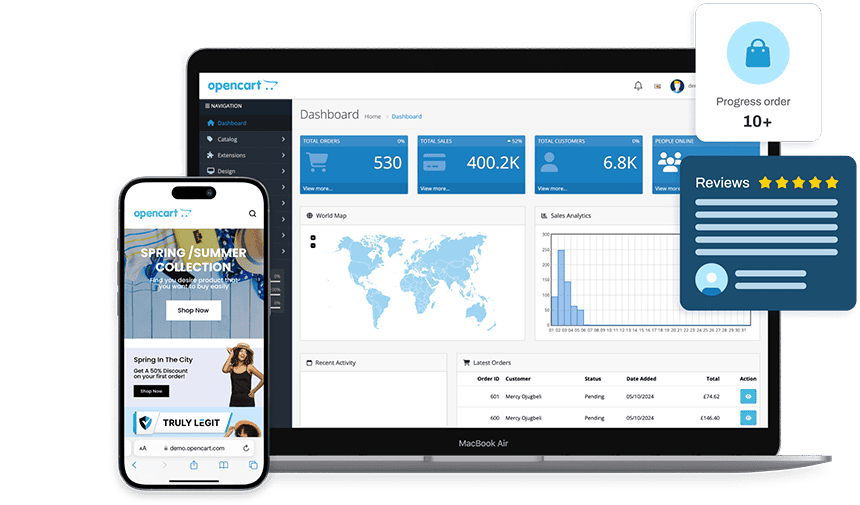
By EcommerceViews Editorial
OpenCart has been around long enough that some people assume it’s a relic a platform that made sense before Shopify existed, but one that merchants have quietly moved away from. That assumption is worth testing.
The reality is more interesting. OpenCart powers hundreds of thousands of online stores worldwide, has an active developer community, and in 2024 released version 4.x a significant rebuild that addressed some long-standing complaints. It is not a dying platform. But it is a specific kind of platform, and it is very much not for everyone.
This review is based on hands-on testing of OpenCart 4.x, looking at what it actually delivers in 2026 not what its marketing page says.
What Is OpenCart?
OpenCart is a free, open-source ecommerce platform written in PHP. You download it, install it on your own web hosting, and build your store from there. There is no monthly subscription to OpenCart itself the software is free. What costs money is everything around it: hosting, premium themes, extensions, and potentially a developer if you are not technically confident.
It was originally created by Daniel Kerr and has been maintained and developed by a global community ever since. The extension marketplace now lists over 13,000 add-ons, and the platform supports multiple stores, multiple currencies, and multiple languages from a single installation all without needing a paid plan upgrade.
That last point is significant. On Shopify, multi-currency support requires a higher-tier plan. On OpenCart, it is just part of the software.
Who Is OpenCart Actually Built For?
Before going further, it is worth being honest about the target user because OpenCart is genuinely not the right choice for everyone.
OpenCart works well for:
- Small to mid-size merchants who want full control over their store without monthly platform fees
- Developers building stores for clients who want a customisable, self-hosted solution
- Businesses in markets where Shopify’s pricing is difficult to justify at scale
- Merchants who want to run multiple storefronts under one admin panel
- B2B sellers who need features like customer group pricing, wholesale accounts, and order minimums
OpenCart is a harder sell for:
- First-time store owners with no technical background who need to launch quickly
- Merchants who want 24/7 platform support included in the price
- Anyone who wants an all-in-one solution where hosting, security, and updates are handled automatically
- Stores that expect very rapid growth and need a platform that scales without technical intervention
If you read that second list and some of it describes your situation, Shopify or BigCommerce will likely serve you better. There is no shame in that. OpenCart’s strengths come from the same place as its limitations it puts you in control, which means it also puts the responsibility on you.
Core Features
Multi-Store Management
This is one of OpenCart’s most underrated features. From a single admin panel, you can run multiple stores each with its own domain, theme, product catalogue, and pricing. For agencies managing several client stores, or for merchants who sell across different brands or regions, this is a genuine advantage. Most hosted platforms charge per store or require complex workarounds to achieve the same result.
Product Management
OpenCart handles product management well across most common use cases. You can create simple products, products with options (size, colour, material), digital downloads, and subscription-based products with the right extension. Bulk editing is available. Product attributes and filters are built in, which is useful for larger catalogues where customers need to sort and narrow results.
Where it gets slightly awkward is with very complex product configurations highly variable products with dependent options (choose colour, then different sizes become available based on that colour) can require additional extensions or custom development.
Payment and Shipping
OpenCart includes built-in support for PayPal, Stripe, bank transfer, cash on delivery, and a number of other payment methods. Additional payment gateways are available through the extension marketplace, covering most major providers globally.
Shipping is handled through a module system. Flat rate, free shipping, weight-based, and real-time rates from carriers like Royal Mail, FedEx, and UPS are all available. For UK merchants in particular, the shipping extension library is well-stocked.
Multi-Language and Multi-Currency
Both are built into the core platform. You can set up as many languages and currencies as you need. Currency conversion can be automatic based on live exchange rates, or you can set fixed rates manually. For merchants selling internationally, this is one area where OpenCart genuinely outperforms platforms that treat these features as premium add-ons.
Customer Accounts and Groups
OpenCart allows customers to register accounts, track orders, and save addresses. More usefully for B2B sellers, it supports customer groups meaning you can assign different pricing, tax rules, or product access to different groups of customers. A wholesale customer sees different prices than a retail customer, without any additional plugins required.
Reporting and Analytics
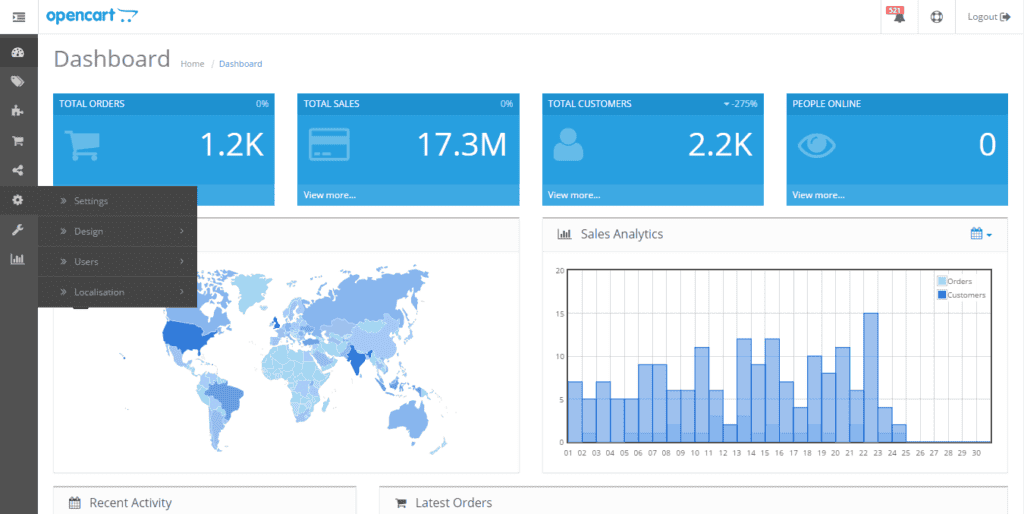
This is an area where OpenCart is functional but not exceptional. The built-in reports cover sales totals, products purchased, customers, and shipping. They do the job for basic oversight. If you need deeper analytics customer lifetime value, cohort analysis, funnel tracking you will be relying on Google Analytics integration rather than anything native to the platform.
The Extension Marketplace
OpenCart’s marketplace is one of its biggest strengths and one of its biggest sources of frustration.
With over 13,000 extensions covering everything from abandoned cart recovery to product reviews, advanced SEO, loyalty programmes, accounting integrations, and ERP connections, the range is impressive. There is almost certainly an extension for what you need.
The frustration comes from quality control. Extensions are produced by third-party developers and vary significantly in quality, documentation, and support. An extension that works perfectly on OpenCart 3.x may not be compatible with 4.x. Checking compatibility before purchasing is essential and refund policies on digital marketplace items are not always straightforward.
The better-maintained extensions tend to come from developers with strong review histories and responsive support threads. It is worth spending time reading those reviews before committing. Paid extensions typically range from £15 to £150 depending on complexity.
Themes
OpenCart’s default theme called Journal in version 4 is a noticeable improvement over older versions. It is clean, mobile-responsive, and reasonably modern in its design. It is not going to win any awards, but it is a workable starting point.
The premium theme market for OpenCart is smaller than Shopify’s, and the quality range is wide. Themes from reputable OpenCart marketplace sellers like Zemez or OpenCart Theme tend to be reliable. Expect to pay £50 to £120 for a quality premium theme. Free themes exist but are generally quite basic.
One important difference from Shopify: when you purchase an OpenCart theme, it is a one-time cost. There is no ongoing monthly fee for the theme. For merchants planning to run a store long-term, that adds up to a real saving.
SEO Capabilities
OpenCart’s built-in SEO tools cover the basics you can set custom URLs, meta titles, meta descriptions, and alt text for images. The URL structure is clean and customisable. Canonical tags are handled. Sitemaps can be generated.
Where OpenCart historically struggled was with technical SEO details that required third-party extensions things like structured data markup, breadcrumb schema, and granular control over indexing. In version 4.x, some of these have improved, but for a store serious about SEO performance, a dedicated SEO extension (several good ones exist in the marketplace) is still worth considering.
One area that still needs attention: page speed. A stock OpenCart installation does not include aggressive caching or image optimisation out of the box. Both are available through extensions and server-level configuration, but they require setup effort. For merchants on shared hosting, this can affect Core Web Vitals scores more than it would on a managed platform.
Pricing: What It Actually Costs
This is where OpenCart becomes genuinely interesting to analyse, because the headline price free does not tell the full story.
The OpenCart software itself: Free
Web hosting: This is your first real cost. OpenCart runs on standard PHP hosting. A decent VPS from a provider like SiteGround, Cloudways, or DigitalOcean will run between £15 and £60 per month depending on your traffic and requirements. Shared hosting is cheaper (£3–£10/month) but can cause performance issues for anything beyond a very small store.
Domain name: £10–£15 per year
SSL certificate: Included free with most hosts via Let’s Encrypt
Theme: £0 (default) to £120 (one-time, premium)
Extensions: Highly variable. A realistic budget for a properly functional store covering SEO, email marketing integration, advanced product filtering, and a solid payment gateway is £100–£300 in initial extension costs, potentially with some annual renewal fees.
Developer time: If you need customisation or run into technical issues, developer rates for OpenCart work typically run £40–£90 per hour in the UK.
Total realistic first-year cost for a properly set up OpenCart store: approximately £400–£900, depending on hosting choice, extension needs, and whether you need development help.
Compare that to Shopify’s Basic plan at £25/month (£300/year) plus transaction fees on third-party payment gateways, plus apps for features OpenCart includes natively. For stores doing significant volume, OpenCart’s cost structure often works out considerably cheaper over three to five years especially as Shopify app costs compound.
For a high-volume store processing hundreds of thousands of pounds in sales, the transaction fee savings alone can justify the OpenCart route.
Pros and Cons
Pros
- No monthly platform fees or transaction fees
- Multi-store, multi-currency, and multi-language built into the core
- Large extension library covering most use cases
- Customer group pricing makes B2B setups practical
- One-time theme costs rather than recurring fees
- Full control over hosting environment and data
- Active community with extensive forum support
Cons
- No official 24/7 support you are reliant on community forums or paid developer help
- Technical setup and maintenance require more effort than hosted platforms
- Extension quality is inconsistent; due diligence is needed before purchasing
- Page speed requires additional configuration to optimise
- Version 4.x is still maturing some extensions have not yet been updated to support it
- Not the right starting point for non-technical first-time merchants
OpenCart vs Shopify: The Short Version
Shopify wins on ease of use, support, and out-of-the-box reliability. OpenCart wins on total cost of ownership, control, and native features like multi-store and customer group pricing. The question is not which is objectively better it is which one fits your situation.
If you are a first-time merchant who wants to test a business idea with minimal setup friction, Shopify is the sensible choice. If you are an established merchant with some technical resource, a catalogue of products, and a desire to stop paying growing monthly fees, OpenCart deserves serious consideration.
Verdict: Is OpenCart Still Worth Using in 2026?
Yes, for the right merchant.
OpenCart is not trying to compete with Shopify for beginners, and it would lose if it did. What it offers is a mature, capable platform that puts you in control of your store without a subscription model eating into your margins every month. Version 4.x shows the project is actively maintained and moving forward.
The merchants who get the most from OpenCart are those who either have technical confidence themselves, or who work with a developer they trust. In those circumstances, OpenCart can support a serious, professional online store at a fraction of the long-term cost of hosted alternatives.
The merchants who struggle with it are those who need hand-holding, guaranteed support, and a platform that handles infrastructure automatically. That is a completely legitimate set of needs it is just not what OpenCart is designed for.
Our rating: 8.5/10
Solid, mature, and cost-effective for the right user. Not the easiest platform to learn, but one that rewards the effort.
Have you used OpenCart for your store? Share your experience in the comments below.