By Jonatan Parski, Co-Founder and CEO of Captain Words
More shoppers now start with a question, not a search. “What’s the best cashmere jumper that won’t pill?” “Which mattress is good for a side sleeper with back pain?” “Is this camera worth it for a beginner?” They ask ChatGPT, Google’s AI Mode or Perplexity, and they get one answer with three or four brand names in it.
If your brand isn’t one of those names, you’re not on the shelf.
At Captain Words, a GEO (generative engine optimization) agency, we track how AI assistants answer buying questions for ecommerce brands every day. For this piece we pulled together the data from six ecommerce categories we tracked in 2026: nearly 23,000 AI answers to real shopping questions. We looked at one thing: which websites the AI read and cited before it recommended a product.
The short version: the AI trusts other people talking about your products more than it trusts your own website.
The data: who gets cited in AI shopping answers
For each category we tracked a set of buying questions (“best X for Y”, “X vs Y”, “is X worth it”) across the major AI assistants and logged every source each answer pulled in. “Retrieved” means the AI read a page from that site while building the answer. “Cited” means it linked that site inline as a source.
| Category | AI answers analyzed | Reddit (retrieved / cited) | YouTube (retrieved / cited) | Most-cited source |
|---|---|---|---|---|
| Premium men’s knitwear (UK) | ~6,340 | 53% / 36% | 29% / 18% | |
| Mattresses (UK) | ~6,480 | 18% / 12% | 21% / 14% | Sleep Foundation |
| Vitamins and supplements (UK) | ~6,470 | 13% / 8% | 11% / 8% | BBC Good Food |
| Home equipment (US: HVAC, solar, generators) | ~1,640 | 24% / 13% | 23% / 20% | YouTube |
| Prosumer hardware (cameras, 3D printers, e-bikes, espresso machines, audio) | ~1,610 | 20% / 11% | 25% / 22% | YouTube |
| Car battery chargers (US) | ~325 | 52% / 23% | 45% / 13% |
Three things stand out.
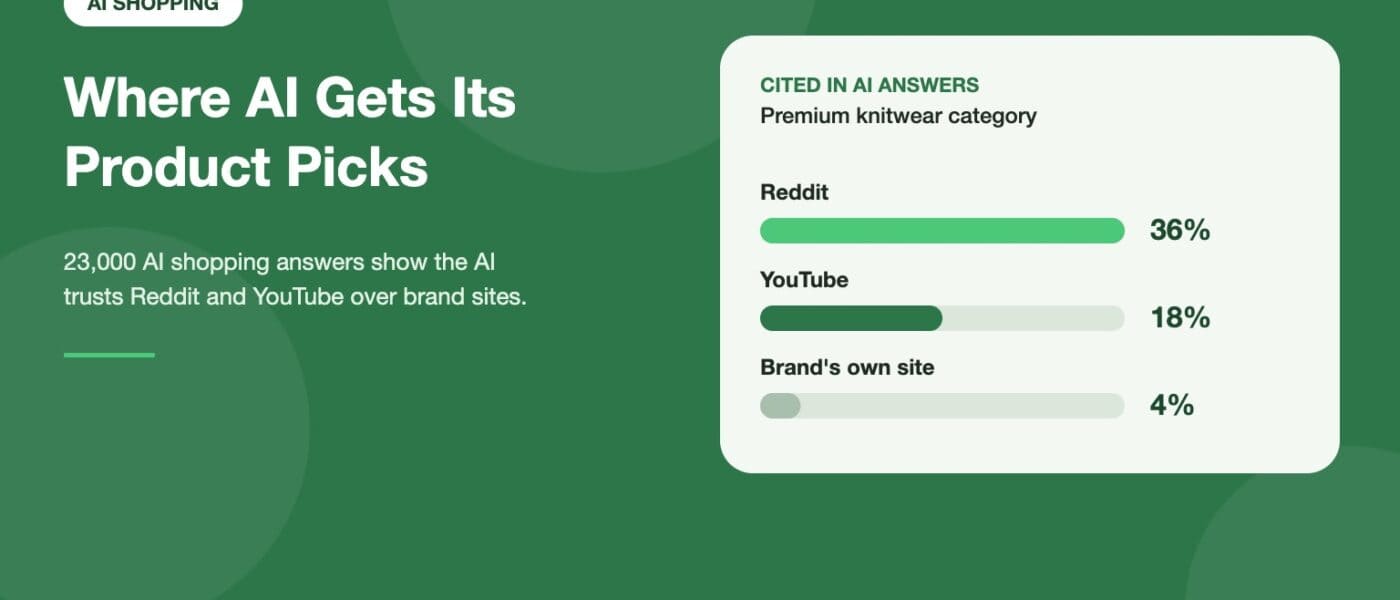
1. Reddit or YouTube was the single most-cited source in four of six categories. Not a review site, not a retailer, not a brand. In premium knitwear, Reddit was cited in 36% of all AI answers. That’s more than one in three answers pointing shoppers to a Reddit thread.
2. YouTube dominates anything people want to see working. In prosumer hardware and home equipment, YouTube was cited in 22% and 20% of answers, ahead of every editorial site. And when the AI pulls a YouTube video in those categories, it tends to cite it more than twice in the same answer. Video reviews aren’t background reading for the AI. They’re evidence.
3. Your own website is rarely the main source. In the knitwear category, the brand we tracked had its own site cited in about 4% of answers, while Reddit was cited in 36%. That’s roughly eight to one. A mattress brand we tracked had its site cited in under 5% of answers, against 14% for YouTube. The AI will happily mention your brand. It just prefers to back that mention with someone else’s words.
Where the pattern breaks (and why it matters)
Supplements are the exception, and it’s a useful one. In health-related categories the AI leans hard on institutional and editorial sources: the NHS was cited in 13% of supplement answers and BBC Good Food in 14%. Reddit and YouTube still showed up in around 8% each, but they weren’t leading.
The supplement brand we tracked had its own site cited in about 10% of answers, far better than the fashion and mattress brands. Its site carried detailed, specific product and ingredient content, and in a category where the AI wants facts, that paid off.
The lesson isn’t “Reddit always wins”. It’s that every category has its own source mix, and you need to know yours before you spend a dollar. A supplements brand should fight for health editorial and strong on-site content. A knitwear brand that ignores Reddit is skipping the biggest source in its category.
Review platforms are a quiet second layer
Trustpilot showed up in every category we looked at. It was cited in 9% of supplement answers and 6% of knitwear answers. When the AI is deciding whether a brand is trustworthy, aggregated customer reviews are one of the first things it checks. If your Trustpilot profile is thin or unanswered, that’s what the AI reads.
What this means for an online store
Here’s what we’d do with this data if we were running an ecommerce brand today.
Find out which sources your category actually uses. Ask ChatGPT and Google AI Mode the ten questions your customers ask before buying. Look at the sources each answer links. Do it more than once, since answers change from day to day. You’ll see the same five to ten domains repeat. That’s your real shelf.
Get discussed on Reddit, honestly. The threads AI cites are usually “what’s the best X” or “has anyone tried Y” posts in niche communities. Being in those conversations means real customers sharing real experiences, and your team answering questions openly as the brand. Fake reviews and sock-puppet accounts get removed, and Reddit moderators are good at spotting them.
Put your product in front of YouTube reviewers. If your product is physical and people want to see it working, send it to creators in your niche who do honest reviews and comparisons. A single solid review video can become a source the AI cites for months.
Get onto the lists the AI already reads. In mattresses the AI kept citing the same handful of review and comparison sites. Being included in those “best of” lists is worth more than another blog post on your own site.
Make your own site worth citing. The supplements data shows it can work. Clear specs, honest comparisons, ingredient or material details, sizing and care information, real FAQs. Write the answer to the question, not the marketing copy around it.
Tend your reviews. Ask happy customers to leave reviews on the platforms the AI reads, and reply to the unhappy ones. The AI reads both.
Measure it. Track a fixed set of buying questions over time and watch whether your brand shows up, where it ranks and which sources back it. Without that baseline, you can’t tell what’s working.
A note on the data
The figures come from Captain Words’ tracking of AI answers to category buying questions in 2026, run through the AI visibility platform Peec AI. Each category used its own question set, built around how shoppers in that market actually ask. Brand-level figures are shared anonymously. The numbers show which sources the AI relied on, not why a given brand was recommended, and source mixes shift over time, so treat them as a snapshot of each category rather than a fixed rule.
The bottom line
AI assistants are becoming the first salesperson your customer talks to. That salesperson doesn’t read your ads. It reads Reddit threads, YouTube reviews, comparison lists and customer reviews, and then decides which brands to name.
The brands that win in AI answers will be the ones real people already talk about in the places the AI listens.
About the author
Jonatan Parski is the Co-Founder and CEO of Captain Words, a GEO agency that helps brands get mentioned and cited in AI answers from ChatGPT, Google AI Overviews, AI Mode and Gemini, through Reddit, YouTube and editorial placements on the sites AI already trusts.