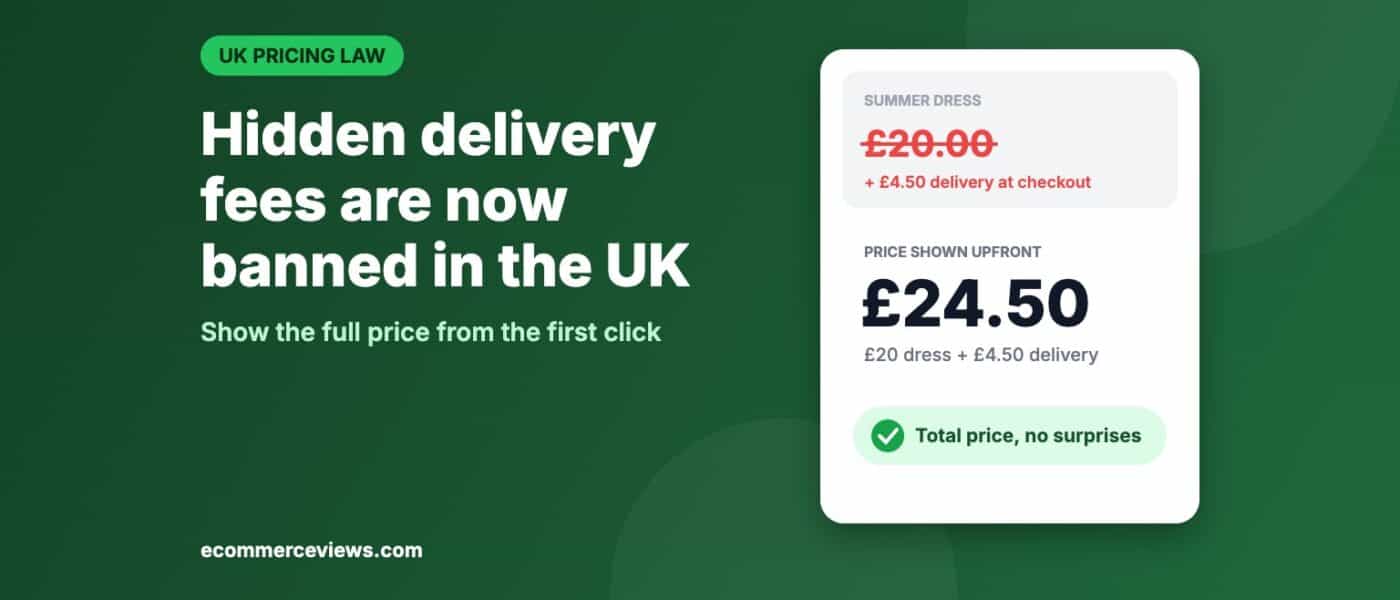
A £20 dress that becomes £24.50 at checkout is no longer a pricing tactic in the UK. Under the Digital Markets, Competition and Consumers Act 2024 (the DMCC Act), a price shown to shoppers must include every fee they cannot avoid, and that includes delivery when the customer has no way to collect the item themselves. Adding the mandatory charge at the last step is called drip pricing, and it is now banned.
Most of the attention has gone to ticket sites and booking fees, but the government’s own research tells a different story for online shops. In retail, the fee that gets dripped is almost always delivery, and delivery is where most of the money sits. My view is that small online stores should treat the ban as a reason to sort out their delivery pricing for good, not as a legal chore to patch at the last minute.
Key points
- 72% of 525 UK online and app providers sampled for the Department for Business and Trade (DBT) added at least one fee during checkout. In retail it was 83%.
- Take delivery out and retail drops to 15%. For online shops, drip pricing has mostly meant delivery charges.
- The median mandatory dripped fee was 11% of the base price, or 6% once delivery fees are excluded.
- DBT estimates dripped fees make UK consumers spend an extra £0.6 billion to £3.5 billion online a year. The top of that range is the scenario where dripped delivery fees count too.
- Of the £588 million a year linked to fixed mandatory fees, delivery accounts for £401.6 million, or 68%.
- The CMA’s guidance says a free delivery threshold is no excuse. Until the basket qualifies, the full delivery fee belongs in the total price.
- For a micro business, DBT put the one-off cost of compliance at about £170, roughly seven hours of work.
What the law now requires
The rule sits in section 230 of the DMCC Act. An advert, product page or app listing that lets a shopper buy something is an “invitation to purchase”, and it must show the total price. Section 230(4) defines that total as including “any fees, taxes, charges or other payments that the consumer will necessarily incur” when buying the product.
Three things follow for an online store:
- Mandatory fees go in the headline price. If a customer cannot buy the product without paying a charge, the charge is mandatory, whatever you call it. Service fees, handling fees and “small order” fees all count.
- Delivery is mandatory when there is no alternative. If you do not offer click and collect, the customer has to pay your delivery charge to get the product, so it is part of the price.
- Optional extras can stay separate. Next day delivery or gift wrapping can be shown on their own, as long as they are clearly optional and shown early.
If a fee cannot reasonably be calculated in advance, you must say how it will be worked out, with as much prominence as the price itself. That is a narrow exception, not a loophole, as the delivery rules below show.
Drip pricing was the norm, not the exception
Before the law was passed, DBT commissioned research on 525 online and mobile app providers in four sectors: entertainment, hospitality, retail, and transport and communication. The results are in its impact assessment on measures to address drip pricing.
72% of the providers included at least one dripped fee in their checkout. Just under half (46%) used dripped fees other than delivery. Of the providers with at least one dripped fee, 72% met at least one of five harm criteria, such as a mandatory fee or a fee shown past the halfway point of the checkout. More than half showed dripped fees beyond that halfway point.
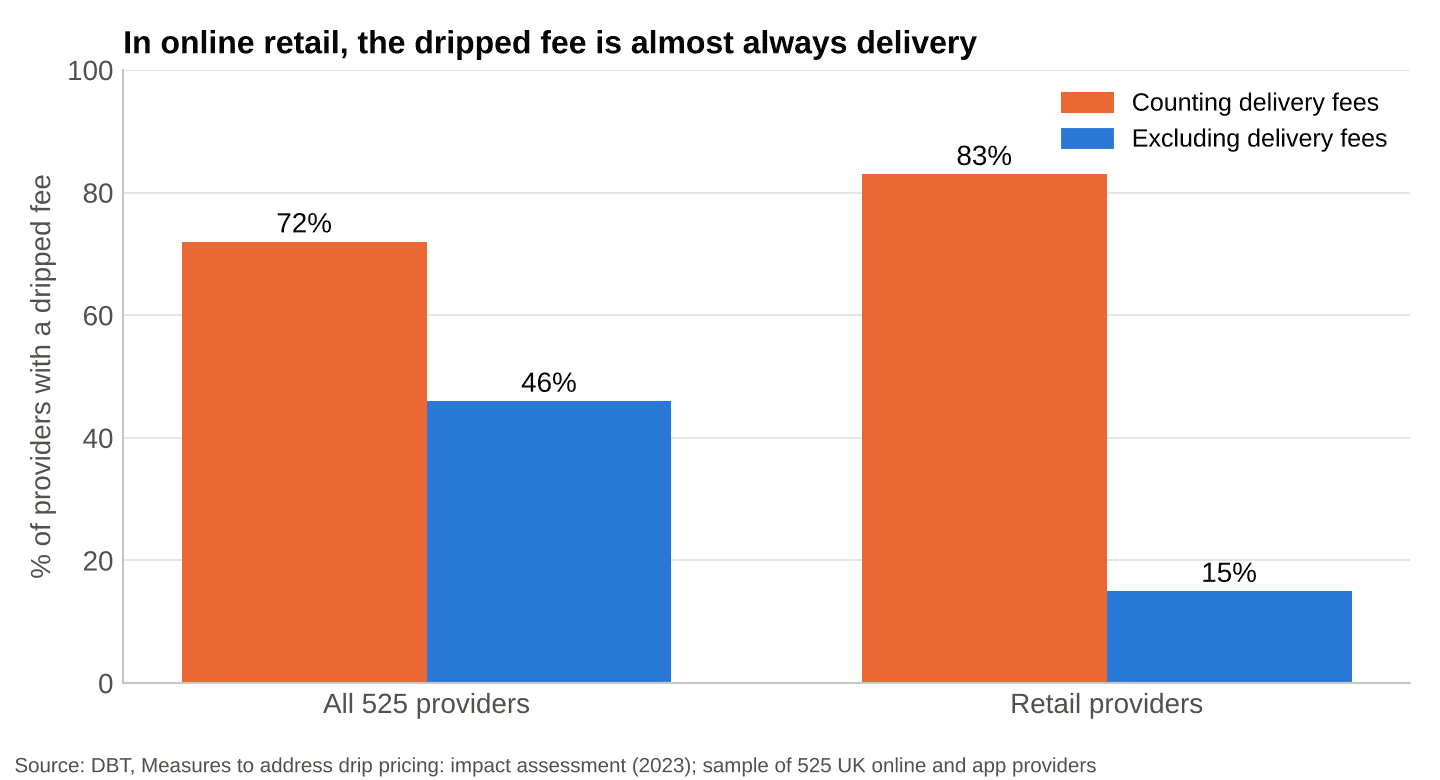
Share of UK online providers with at least one dripped fee, including and excluding delivery fees
Retail is the clearest case. It had the highest rate of dripped fees of any sector (83% of providers) but the lowest rate once delivery fees are removed (15%). The researchers noted that shoppers expect to pay for delivery, which makes these fees less harmful, but not knowing the amount can still lead them to pay more than expected.
Delivery is where the money is
One of DBT’s policy options required fixed mandatory fees to be in the price first shown. To value it, the department broke the consumer harm down by fee type. Delivery dwarfs everything else.
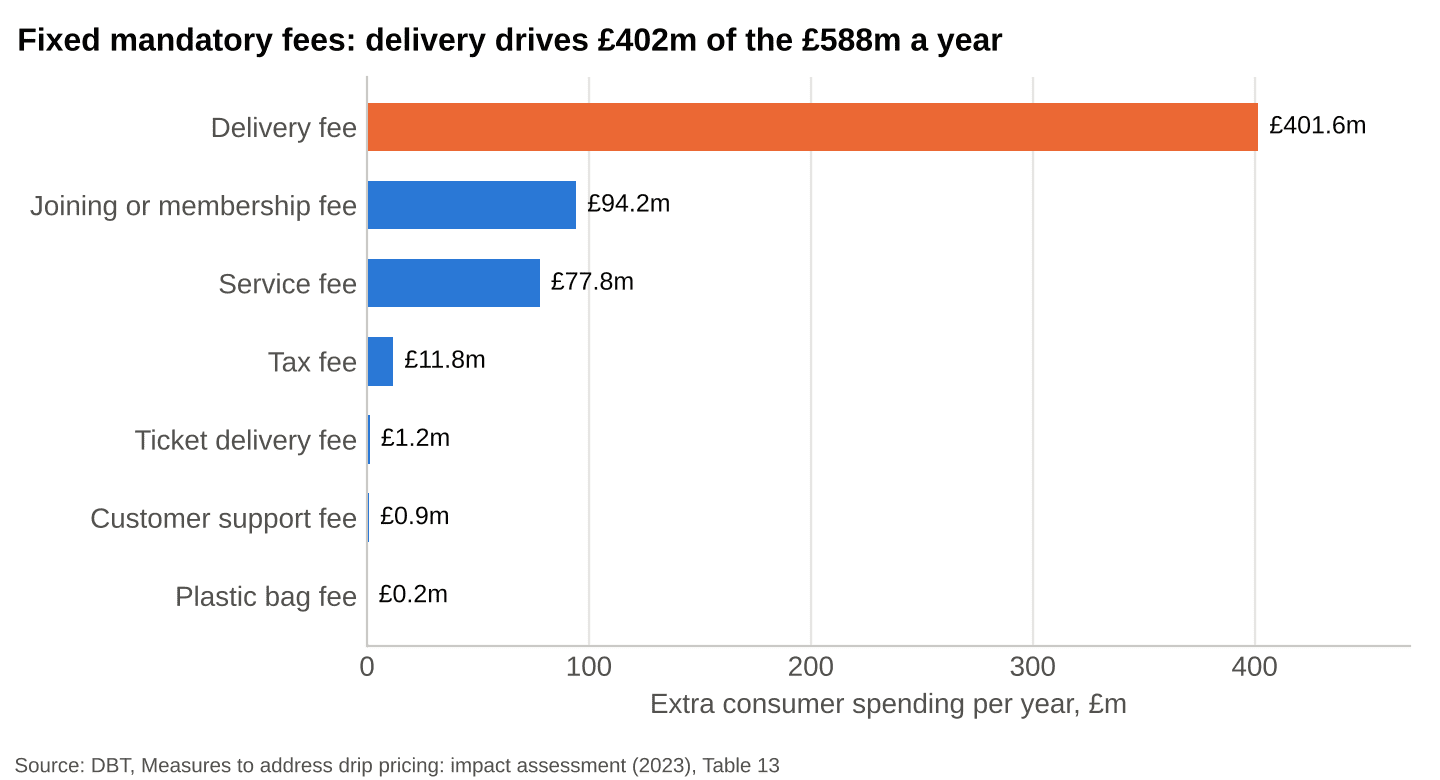
Extra consumer spending per year driven by fixed mandatory dripped fees, by fee type
| Fee type | Extra spending linked to the fee (£m a year) | Share that is mandatory | Extra spending from fixed mandatory fees (£m a year) |
|---|---|---|---|
| Delivery fee | 1,900.0 | 42% | 401.6 |
| Joining or membership fee | 157.0 | 60% | 94.2 |
| Service fee | 96.9 | 99% | 77.8 |
| Tax fee | 11.8 | 100% | 11.8 |
| Customer support fee | 28.5 | 3% | 0.9 |
| All fee types, including smaller ones not listed | 2,200 | 587.7 |
Delivery fees alone are linked to £1.9 billion of extra consumer spending a year. Only 42% are mandatory, and half of those are fixed amounts, which leaves £401.6 million a year from fixed mandatory delivery fees. That is 68% of the £587.7 million total for all fixed mandatory fees.
The fees are not small either. The median mandatory dripped fee was 11% of the base price, and the median optional one was 15%. Remove delivery and the mandatory median falls to 6%. Retail had the largest average mandatory fees relative to the base price, at 17%.
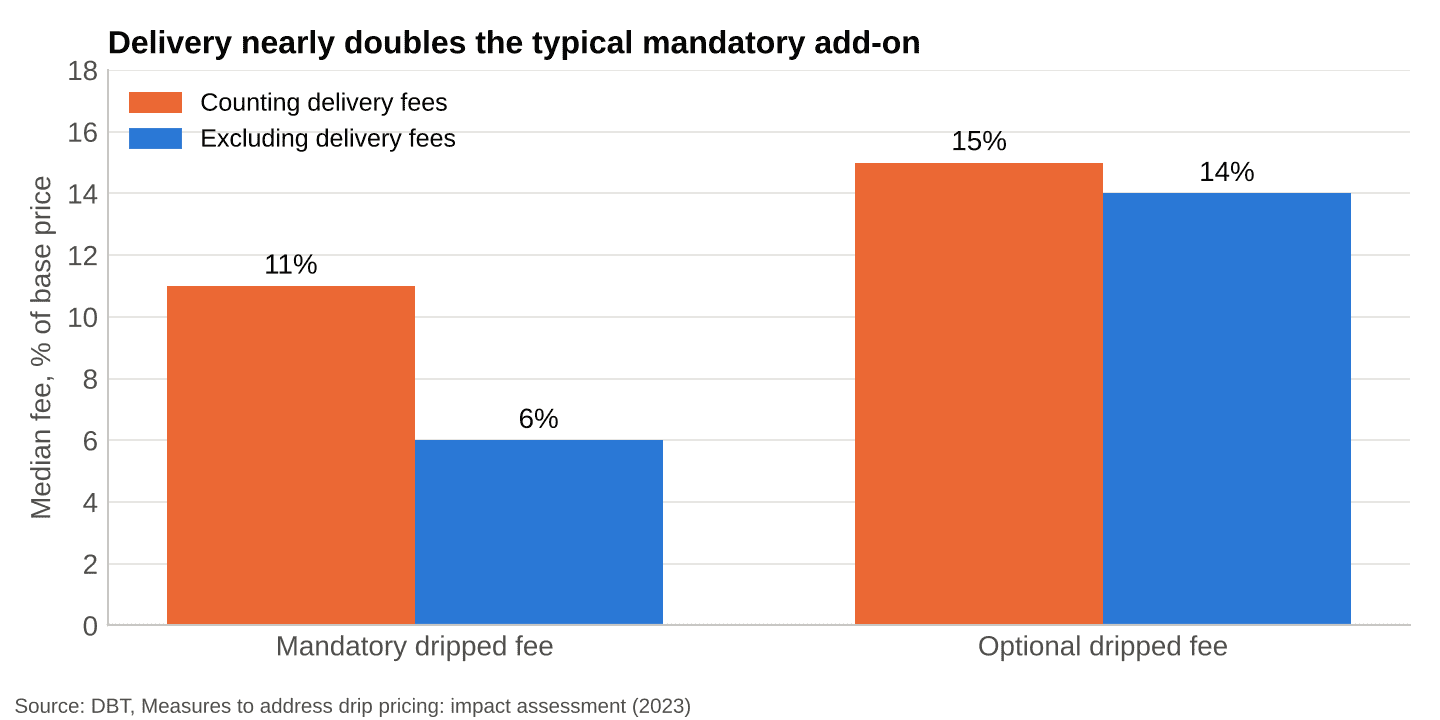
Median dripped fee as a share of the base product price, including and excluding delivery fees
Delivery has also become harder for stores to absorb, which is one reason so many kept it out of the headline price. Our analysis of why free shipping gets more expensive every year shows how courier prices have outpaced goods prices since 2004.
What the CMA says about delivery charges
The Competition and Markets Authority (CMA) published its final price transparency guidance (CMA209) on 18 November 2025. Chapter 5 deals with delivery, and it is more practical than many store owners expect.
The guidance accepts that a shop selling several items cannot sensibly add one delivery charge to every product price. Instead, it suggests three ways to comply:
- show the total price including delivery below or alongside a more prominent base price;
- show the base price and the delivery charge, plus a clear running total that updates as products go in the basket; or
- drop the delivery fee and build the cost into product prices, in effect offering free delivery.
Its worked examples make the rules concrete:
| Situation in the CMA guidance | What the CMA says is lawful |
|---|---|
| Dress with a £20 base price, advertised on a search results page; no collection; £4.50 minimum delivery | Advertise it at £24.50 |
| Homeware site with a flat £5.99 delivery fee | Explain the fee next to each price, then show a basket total of £30.99 for a £25 lamp and £60.99 once £30 plates are added |
| Free delivery over £40 | Include the full delivery fee in the total until the basket reaches £40, and say it will be removed above that |
| Delivery price varies by region | Show the charges on the product page, then put the right one in the running total once the address is known |
| Marketplace items with their own delivery charges | Show each product at its price including delivery, such as £12.99 for a £10 frame with £2.99 delivery |
The free delivery threshold is the one many stores get wrong. A “free delivery over £40” banner does not make the delivery fee unknown below £40. The CMA also warns that advertising free delivery above a threshold without saying what delivery costs below it may itself be a misleading omission.
Variable delivery charges that depend on things the shopper cannot know or control are not allowed, because the shopper cannot calculate the total.
The CMA is already enforcing
On 18 November 2025, the same day the guidance came out, the CMA launched its first consumer enforcement cases under the new powers. It had reviewed more than 400 businesses in 19 sectors and found potential concerns in 14. Eight businesses faced formal investigations. Five of the cases concern mandatory fees: StubHub, viagogo, AA Driving School, BSM Driving School and a joining fee at Gold’s Gym.
The CMA also wrote to 100 businesses across 14 sectors. Homeware retailers, fashion, food and drink delivery, and letter and parcel delivery were all on the list. The CMA can now order businesses that break the law to pay compensation and fine them up to 10% of global turnover. In the same release, it pointed out that leaving out mandatory charges or adding unavoidable fees at checkout had already been unlawful for years.
My view: put the delivery cost where shoppers can see it
First, the data shows drip pricing in retail is a delivery problem. A small store rarely adds booking or service fees. What it does is show a product at £20 and reveal a £4.50 delivery charge three screens later.
Second, compliance is cheap. DBT estimated the one-off cost for a micro business at about £170: £60 to learn the rules, £30 to reprice, £50 for system changes and £30 for other tasks. That is about seven hours of work. Across the whole economy, the option covering fixed mandatory fees was costed at £31.9 million in one-off costs against £588 million a year in consumer savings.
Third, hiding delivery costs never worked as well as it seemed. A shopper who only discovers the delivery charge at checkout leaves, and no reminder sequence fully wins them back. The usual fixes, such as a visible total in the basket and no surprises at the payment step, are the same ones that our guide to ecommerce checkout solutions recommends for conversion.
The stores that lose out are those whose low headline prices relied on a hidden delivery charge. A store that competes on its total price loses nothing.
The case against
Bigger headline prices can lose clicks. A £24.50 dress looks more expensive than a £20 one on a search results page, even if both cost the same delivered. If competitors keep the lower number up for longer, an honest store may lose traffic in the short term. The CMA’s investigations will only fix this if enforcement reaches beyond the eight named businesses.
The rules have grey areas. The difference between a delivery charge that “cannot reasonably be calculated” and one that is simply inconvenient to calculate will be settled through cases, not guidance. The CMA itself says its guidance is not a definitive reading of the law. Stores with complex delivery zones or bulky items face more work than the £170 estimate suggests.
DBT’s numbers come with wide ranges. The £0.6 billion to £3.5 billion estimate moves by a factor of almost six depending on assumptions about how shoppers react. The £588 million figure is a modelled transfer from businesses to consumers, not a measured outcome. DBT counted only £90.4 million a year of it as lost profit, using a 10% profit margin, and noted that consumers would likely spend the savings elsewhere.
Folding delivery into prices can backfire. Free delivery built into product prices is one of the CMA’s three routes, but it raises prices on cheap or light items to subsidise heavy ones. Our piece on what to measure after a price change explains how to tell whether a pricing switch helped or hurt.
None of this changes the law, but it does mean the switch is worth planning.
What to do
- Audit every place a price appears. Product pages, category pages, Google Shopping feeds, marketplace listings, social ads and emails are all invitations to purchase. Each must show the total price or a clear way to calculate it.
- Decide whether delivery is mandatory. If you offer collection, delivery can stay separate as long as it is shown clearly and early. If you do not, the delivery charge belongs in the price.
- Pick one of the CMA’s three routes. A flat rate suits a running basket total that includes delivery from the first item. Stores selling light, cheap items should test building delivery into the price.
- Fix your free delivery threshold message. Show the delivery fee in the total until the basket qualifies, and state the charge for orders below the threshold.
- Check your shopping feeds. A feed showing £0 delivery when your site charges £3.99 is the same problem in another place.
- Remove any other mandatory fee. Small order fees, handling fees and “packaging” charges are the easiest target for enforcement. Fold them into the price or drop them.
- Recheck abandonment after the change. Fewer surprises at checkout should mean fewer abandoned baskets. Track it before and after, and keep your abandoned cart emails honest about the total too.
Know your delivery cost before you price it
An all-in price only works if you know what delivery really costs you per parcel.
Our free courier price comparison tool compares Royal Mail, Evri and InPost prices for your parcel, so you can set a delivery charge or a delivered price that covers your real cost.
The bottom line
The drip pricing ban looks aimed at ticket sellers and booking sites, but DBT’s own data shows that in online retail it is mainly about delivery. 83% of retail providers dripped a fee, and only 15% did so once delivery is taken out. Delivery accounts for 68% of the harm from fixed mandatory fees. The CMA’s guidance gives small stores workable options: a running total, a dual price or delivery built into the price. For most stores, the cost of switching is a few hours of work. Treat the ban the same way as the UK card surcharge ban: price the full cost from the start and compete on a number the shopper can trust.