German Online Retail Has Doubled Since 2015. Its Share of Retail Has Not Grown Since 2021
Germany’s official numbers tell a story many sellers will recognise from their own dashboards. Online sales grew fast for years, jumped in the pandemic, slipped back for two years and are growing again. What has not come back is the online share of retail.
We analysed eleven years of monthly sales data for German online and mail order retailers from the Federal Statistical Office (Destatis), from January 2015 to September 2026, and set it against the HDE Online-Monitor 2026, the retail association’s annual report on the online market. Real online sales more than doubled over the decade while total retail grew by less than a fifth. But the online share of retail peaked at 14.7% in 2021 and is forecast at 13.8% for 2026, still below that peak. Our earlier study of EU online retail after the pandemic found a similar pause across Europe; Germany shows it with more detail, and with a catch in the latest figures.
Key findings
- Real sales of German online and mail order retailers rose 120.9% from 2015 to 2025, about 8.2% a year. Real sales of all retailers rose 17.7%, about 1.6% a year.
- The pandemic added 40.2% in two years. Real online sales grew 25.2% in 2020 and 11.9% in 2021.
- Then came two down years. Real online sales fell 1.5% in 2022 and 4.1% in 2023, even though nominal sales still rose. In January to July 2024, the last months before a statistical break, real online sales were 8.0% below the same months of 2021.
- Online prices rose far less than shop prices. From 2021 to 2025 the implied price level of online retailers rose 10.3%, against 18.1% for all retail.
- Growth is back, but slower than the headline. The 2024 and 2025 figures are inflated by the restructuring of one large company. On a clean comparison, real online sales in January to September 2026 were 4.8% above the same months of 2025, against 0.4% for all retail.
- HDE puts German online sales at €92.3 billion net in 2025 (+3.9%), or 13.5% of retail in the narrow sense, below the 14.7% reached in 2021.
- Electronics (45.1%) and fashion (44.2%) are close to half online, while food and drugstore goods are at 4.9%, but growing fastest online at 10.4% in 2025.
How we analyzed the data
Our main source is the Destatis monthly retail statistic, GENESIS table 45212-0004, which publishes a sales index (2021 = 100) for each retail branch, in constant prices (real) and current prices (nominal). We downloaded the original, unadjusted monthly values for:
- WZ 47.91, Versand- und Internet-Einzelhandel: retailers whose main business is selling by mail order or over the internet. This is the online and mail order branch.
- WZ 47, all retail excluding motor vehicles, as the benchmark.
We averaged the twelve monthly index values to get each calendar year from 2015 to 2025, and compared January to September 2026 with the same months of 2025. All growth rates in this study are our calculations from the index as Destatis published it on 17 November 2026. 2026 values are provisional. We also divided the nominal index by the real index to get an implied price level for each branch.
For the size of the market, the online share and categories we used the HDE Online-Monitor 2026, which is based on IFH Köln data. HDE counts all online sales of new goods to consumers in Germany, net of VAT and returns, whoever the seller is.
What the Destatis branch measures
The two sources do not measure the same thing, and that matters for the numbers that follow. Destatis classifies whole companies by their main activity. A pure player or a mail order house sits in WZ 47.91, including any sales it makes outside the internet. The webshop of a supermarket chain or a fashion chain does not: those companies stay in their own branch, so their online sales count as food or clothing retail.
HDE follows the channel instead: every online sale counts, whoever makes it. So HDE is the better measure of the online share, and the Destatis index, deflated and monthly, the better measure of real growth.
A decade of growth that outran the rest of retail
Before the pandemic, the online branch was already growing much faster than retail as a whole. Real sales rose 13.4% in 2016, 8.8% in 2017, 6.3% in 2018 and 8.5% in 2019. Total retail grew between 1.8% and 3.2% in real terms in each of those years.
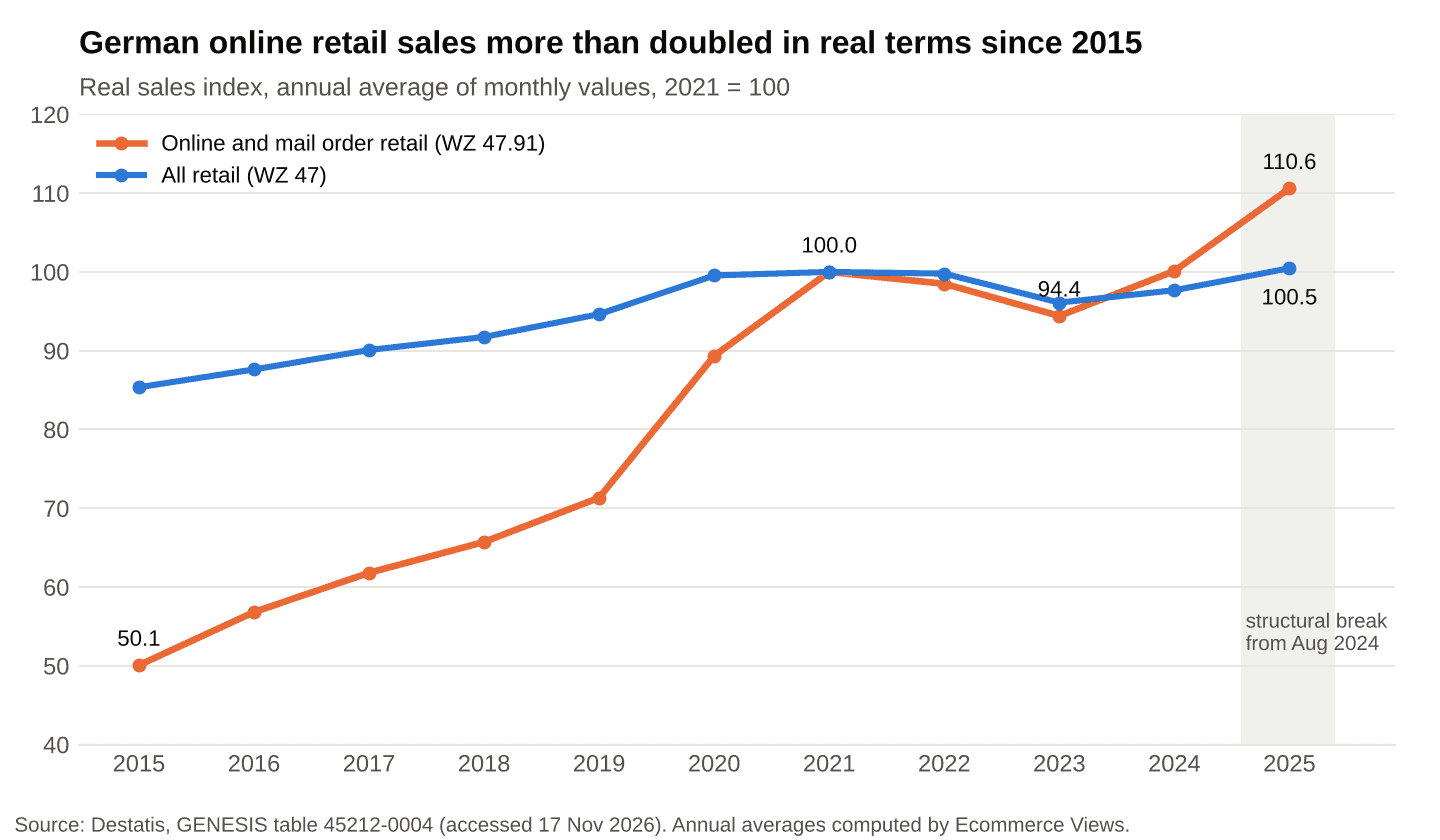
Real sales index of German online and mail order retailers vs all retail, 2015 to 2025
| Year | Online real | Online nominal | All retail real | All retail nominal |
|---|---|---|---|---|
| 2016 | +13.4% | +14.1% | +2.6% | +3.1% |
| 2017 | +8.8% | +9.0% | +2.8% | +4.3% |
| 2018 | +6.3% | +6.1% | +1.8% | +3.1% |
| 2019 | +8.5% | +8.8% | +3.2% | +3.8% |
| 2020 | +25.2% | +25.7% | +5.2% | +6.3% |
| 2021 | +11.9% | +12.5% | +0.5% | +2.3% |
| 2022 | -1.5% | +3.2% | -0.2% | +7.8% |
| 2023 | -4.1% | +0.4% | -3.7% | +2.8% |
| 2024 | +6.0% | +6.8% | +1.6% | +3.0% |
| 2025 | +10.5% | +10.3% | +2.9% | +4.0% |
Annual change of the average monthly index. Source: Destatis, table 45212-0004; calculations by Ecommerce Views.
Then 2020 arrived. With shops closed for weeks in the spring and again from December, real online sales rose 25.2%, and another 11.9% in 2021, while total retail barely moved in 2021. Measured against all retail, the online branch was 58.7% of its relative 2021 level in 2015 and 75.4% in 2019. In other words, the two pandemic years did more for online’s relative position than the four years before them. The UK went through a similar surge and pullback, as our look at 20 years of ONS online retail data showed.
The correction: two years of real decline
In 2022 and 2023 German consumers faced the highest inflation in decades. Real online sales fell 1.5% and then 4.1%. Over the two years, real sales dropped 5.6% while nominal sales still rose 3.6%, so most of the money shoppers spent online in 2023 bought less than it did in 2021.
The decline lasted longer than the annual figures suggest. In January to July 2024, real online sales were still 8.0% below the same months of 2021, while nominal sales were only 2.1% higher. That is the cleanest measure of where German online retail stood before the statistical break described below. The pattern matches what we found in the Netherlands, where twelve years of CBS data show online sales flat since 2021.
Online prices rose much less than shop prices
The split between real and nominal sales hides one of the more interesting results in the data. Dividing the nominal index by the real index gives an implied price level for each branch. From 2021 to 2025 that price level rose 10.3% for online and mail order retailers, against 18.1% for all retail.
Part of the gap is likely product mix, since food is a small part of online sales. Either way, online retailers passed on a much smaller price rise than the rest of retail, so their nominal sales in the inflation years understate how they did compared with shops in volume terms.
Why the 2024 and 2025 numbers need an asterisk
On the face of it, German online retail roared back: real sales up 6.0% in 2024 and 10.5% in 2025 on our averages of the current index. Monthly year on year growth ran between 8% and 19% from August 2024 to July 2025.
Much of that is not new demand. In its release on the 2025 retail year, Destatis says that the restructuring of a larger company in internet and mail order retail has produced a structural increase in the affected series since August 2024, and that this is partly why online sales rose so strongly in 2025. In effect, the branch gained sales from a change in company structure, not from extra shopping.
There is a second change. From the October 2025 reporting month, Destatis replaced its retail sample with a new one and applied it back to January 2024. That is why our averages differ from the first estimates published at the time: Destatis originally reported real online growth of 5.0% for 2024 and 10.1% for 2025.
The rule: never compare a month from August 2024 onwards with an earlier one.
2026 so far: steady growth on a clean basis
From August 2025, both sides of the year on year comparison are after the break. In January to September 2026, real sales of online and mail order retailers were 4.8% above the same months of 2025, and nominal sales 5.6% higher. Total retail grew 0.4% in real terms and 2.3% nominally over the same period.
| January to September 2026 vs 2025 | Real | Nominal |
|---|---|---|
| Online and mail order retail (WZ 47.91) | +4.8% | +5.6% |
| All retail (WZ 47) | +0.4% | +2.3% |
Source: Destatis, table 45212-0004, provisional 2026 values; calculations by Ecommerce Views.
Growth near 5% is far below the pandemic pace, but roughly twelve times the real growth of all retail. Single months swing widely (July 2026 was 2.5% below July 2025 in real terms, June 14.4% above), so the nine-month total is the number to watch.
The online share: 13.5% and still below 2021
For the size of the market we turn to the HDE Online-Monitor 2026. It puts online sales of new goods at €92.3 billion net in 2025, up 3.9% or €3.5 billion. HDE forecasts €96.3 billion for 2026, growth of 4.3%. Including second hand goods, the online market is about €103 billion.
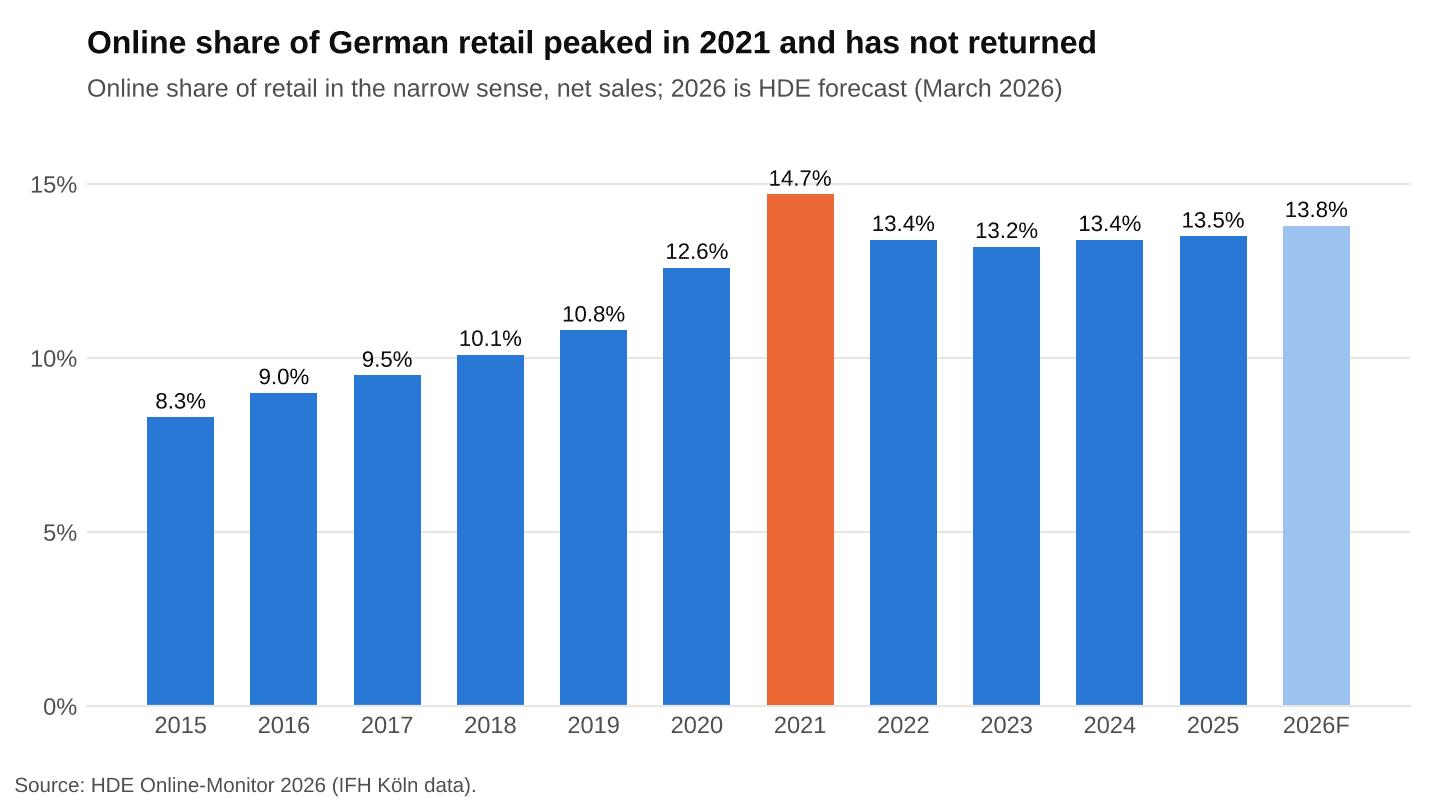
Online share of German retail, 2015 to 2026 forecast
The online share of retail in the narrow sense, which excludes pharmacies, cars and fuel, rose every year from 2015 (8.3%) to 2021 (14.7%). It then fell to 13.4% in 2022 and 13.2% in 2023, and has crept up since: 13.4% in 2024, 13.5% in 2025 and a forecast 13.8% for 2026. Retail in the narrow sense was €684 billion net in 2025.
| HDE measure | 2020 | 2021 | 2022 | 2025 | 2026F |
|---|---|---|---|---|---|
| Online sales, € billion net | 73.0 | 87.0 | 84.7 | 92.3 | 96.3 |
| Online share of retail | 12.6% | 14.7% | 13.4% | 13.5% | 13.8% |
Source: HDE Online-Monitor 2026, IFH Köln data; 2026 is a forecast from March 2026.
HDE’s figure grew 26.4% from 2020 to 2025, the nominal Destatis index 37.2%, a gap the 2024 restructuring and the different definitions help explain. Both show more online spending, but no share gains like those before 2021.
Categories: half of electronics, one in twenty euros of groceries
The category picture is more uneven than the total. HDE estimates the share of each category’s market that is sold online.
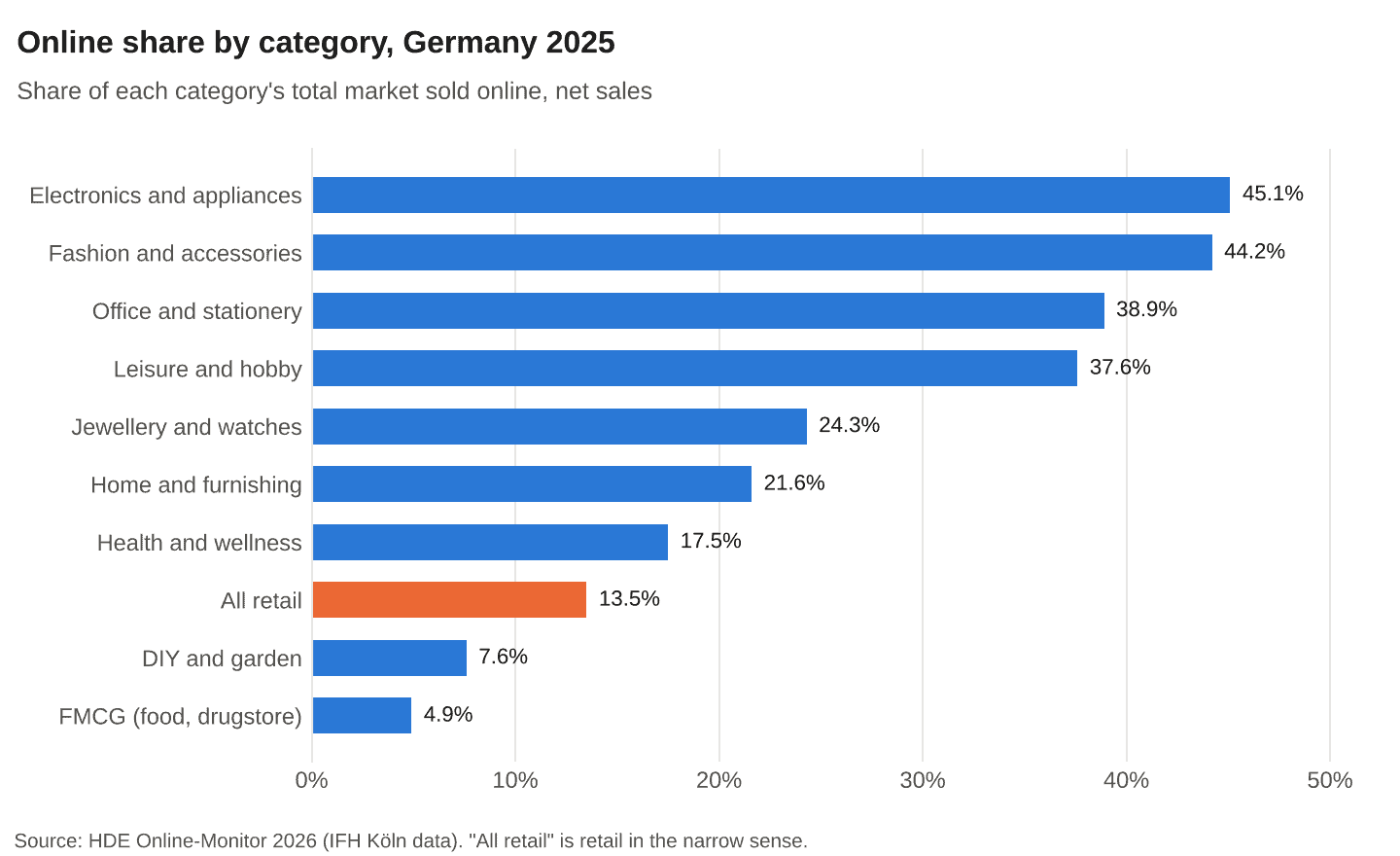
Online share by category in Germany, 2025
Electronics and appliances (45.1%) and fashion and accessories (44.2%) are already close to half online. Office and stationery (38.9%) and leisure and hobby (37.6%) follow. At the other end, DIY and garden is at 7.6% and fast moving consumer goods, meaning food and drugstore products, at 4.9%. Across all food, HDE puts the online share at 3.2% in 2025, against 19.1% for non-food.
| Category | Online share 2025 | Online growth 2025 |
|---|---|---|
| Electronics and appliances | 45.1% | +2.9% |
| Fashion and accessories | 44.2% | +2.8% |
| Office and stationery | 38.9% | +2.4% |
| Leisure and hobby | 37.6% | +2.9% |
| Jewellery and watches | 24.3% | +3.1% |
| Home and furnishing | 21.6% | +1.8% |
| Health and wellness | 17.5% | +4.9% |
| DIY and garden | 7.6% | +2.1% |
| FMCG (food, drugstore) | 4.9% | +10.4% |
Source: HDE Online-Monitor 2026, IFH Köln data.
The growth column tells a different story from the share column. The category with the lowest online share grew fastest online. FMCG grew 10.4% online in 2025, more than two and a half times the average, and health and wellness 4.9%. Offline, fashion sales fell 1.5% and electronics 4.5% in 2025, so the categories that are already heavily online are still shifting slowly from shops to screens even with modest online growth.
Marketplaces carry more than half of the market
HDE estimates that 56.7% of German online sales in 2025 went through marketplaces, which works out to about €52 billion. Temu and Shein, which HDE counts as online sellers rather than marketplaces, reached a combined share of 5.0%, or about €4.7 billion, and foreign online sellers as a group about €10.9 billion, or 11.8% of the market.
Outside marketplaces, sellers that started online held 55.0% of online sales in 2025, store-based sellers 34.9% and manufacturers 10.1%, barely changed since 2020. Store-based sellers lead in health and wellness (66.2%) and FMCG (44.1%), the two fastest growing categories, which is where shop chains with logistics and loyal customers have the edge. For a closer look at how the two biggest platforms compete for sellers, see our comparison of Amazon and Temu.
The year end matters more online
The monthly index also shows how much German online retail depends on the last weeks of the year. In 2025, November and December together brought 20.2% of the online branch’s annual sales, against 18.2% for all retail. Since 2021 the busiest online month has been November, not December, a sign of how far Black Week promotions have pulled demand forward. In 2015 and 2019 December was still the peak.
A strong November can make a small store’s year, but discounting against the largest sellers at their busiest moment is costly, which is why we argued that Black Friday is the wrong battle for most small shops.
What this means for online stores
Plan for growth of about 4% to 5%, not 10%. The clean 2026 comparison and HDE’s forecast both point to mid single digit growth. The double digit figures of 2025 are mostly a statistical effect.
Expect volume, not price, to drive your sales. Online prices rose about half as much as retail prices from 2021 to 2025. Sellers in Germany cannot count on price rises to lift revenue; they need more orders or a higher basket.
Look at the low share categories. Food, drugstore, health and DIY have the most room left online and are growing fastest. They also favour sellers with stores or strong logistics, so niche specialists should focus on assortment and service rather than price.
Count your marketplace costs carefully. With more than half of online sales going through marketplaces, many German sellers will make most of their revenue on platforms. Before you scale a channel, check what you keep after fees, shipping and returns.
You can do that per product with our free seller profit calculator.
Prepare for an earlier peak. November is now the biggest online month, so stock and marketing need to be ready when it starts.
Limits of the data
- The Destatis branch is not the online channel. WZ 47.91 counts companies, not sales channels. Webshops of store-based retailers are missing, and non-online sales of mail order houses are included.
- There is a structural break in August 2024. Any growth rate that compares a month from August 2024 onwards with an earlier month is inflated by the restructuring of one company.
- The sample changed in 2025. Destatis replaced its sample from the October 2025 reporting month and revised figures back to January 2024, so current values differ from the first estimates.
- 2026 values are provisional and will be revised.
- HDE figures are estimates from IFH Köln, net of VAT and returns, and include only new goods. The 2026 value is a forecast from March 2026.
The bottom line
German online retail is far bigger than it was a decade ago, with real sales up 120.9% since 2015. But the pandemic surge pulled years of growth forward, and the market spent 2022 and 2023 giving some of it back. The online share of retail is still below its 2021 peak, and the eye-catching growth of 2025 owes more to a company restructuring than to shoppers. On a clean basis, online sales are growing about 5% a year in real terms, well ahead of retail as a whole. That is a healthy market for sellers who plan around steady gains, not another boom.