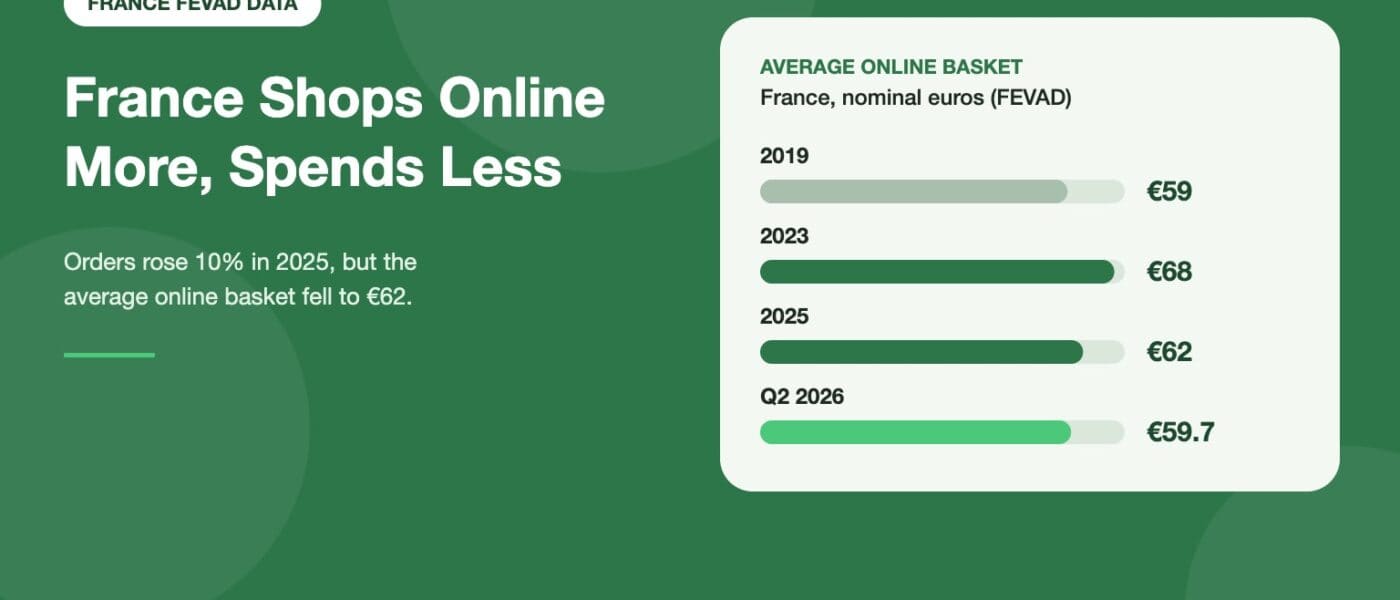
French shoppers made 3.2 billion online purchases in 2025, 10% more than a year earlier, and spent €196.4 billion doing it. But the average order fell 3% to €62. FEVAD, the French ecommerce and distance selling federation, gives these figures in its annual Bilan du e-commerce for 2025. They point to a market that grows because people order more often, not because each order is bigger. We lined up six years of FEVAD releases and adjusted the basket for inflation. The pattern is clearer than any single year shows: after inflation, a French online order is now worth about 11% less than it was in 2019.
Key findings
- €196.4 billion was spent online in France in 2025, up 7%. Growth has slowed every year since 2021, when it was 15.1%.
- 3.2 billion transactions were made in 2025, up 10%. Using FEVAD’s own yearly growth rates, transaction volume is about 66% higher than in 2019.
- The average basket fell to €62 in 2025, from €68 in both 2023 and 2024. In the second quarter of 2026 it fell again, to €59.7.
- After inflation, the basket is 11% smaller than in 2019. Nominally it is €3 higher than the €59 of 2019, while French consumer prices rose 18.6% over the same years.
- Services take 61% of online spending: €120.3 billion in 2025, against €76.1 billion for physical products. In 2021 the split was close to 50/50.
- Product sales are flat in real terms since 2021. They grew 14.1% in euros between 2021 and 2025, which is about 1% less than inflation.
- The count of active merchant sites kept rising, by 11% in 2021 and 5% in 2022, which means more stores competing for each order.
How we analyzed the data
Our main source is FEVAD’s annual Bilan du e-commerce, a press release published every February with the previous year’s figures. We used the releases for 2020 to 2025 and the September 2026 release on the first half of 2026. FEVAD estimates the whole market by combining a panel of more than 100 leading sites (the iCE 100), card payment data from nine payment providers, and a survey on offline payments.
FEVAD revises its back data, sometimes by a lot. So we used two methods. In the year-by-year tables we show each figure as it was first published. For the 2019 to 2025 trend in transactions we chained FEVAD’s stated yearly growth rates instead of comparing first published levels, because those levels mix different revisions.
To turn the nominal basket into a real one we divided it by France’s harmonised consumer price index, using the annual average from Eurostat’s HICP table (2019 = 104.95, 2025 = 124.43). All calculations were done in Python and checked against the French text of each release.
Online sales passed €196 billion, but growth is slowing
The market has grown by three quarters since the pandemic year. FEVAD put 2020 online sales at €112 billion; five years later the figure was €196.4 billion. But the growth rate has fallen every year since 2021.
| Year | Online sales | Growth | Transactions | Average basket |
|---|---|---|---|---|
| 2020 | €112.0bn | +8.5% | 1.84bn | €61 |
| 2021 | €129.1bn | +15.1% | 2.1bn | €60 |
| 2022 | €146.9bn | +13.8% | 2.3bn | €65 |
| 2023 | €159.9bn | +10.5% | 2.35bn | €68 |
| 2024 | €175.3bn | +9.6% | 2.6bn | €68 |
| 2025 | €196.4bn | +7.0% | 3.2bn | €62 |
Figures as first published in each February release. Source: FEVAD Bilans du e-commerce 2020 to 2025.
The growth also changed character. In 2022 and 2023, inflation and pricier travel lifted the basket and did much of the work. The 2024 Bilan called 2024 a return of volume: transactions rose 10% while the basket stayed at €68. In 2025 volume carried all of the growth: transactions grew 10%, the basket shrank 3%, and sales grew 7%.
At 3.2 billion transactions a year, French shoppers place about 8.8 million online orders a day. In 2024 FEVAD said the average online buyer made more than one purchase a week and spent €4,216 over the year.
The average basket has lost €6 in two years
The basket is the clearest sign of how French shoppers have adjusted. It was €59 in 2019, rose to €61 in the first pandemic year, held at €60 in 2021, then climbed to €65 in 2022 and €68 in 2023 as prices rose. It stayed at €68 in 2024, then fell to €62 in 2025.
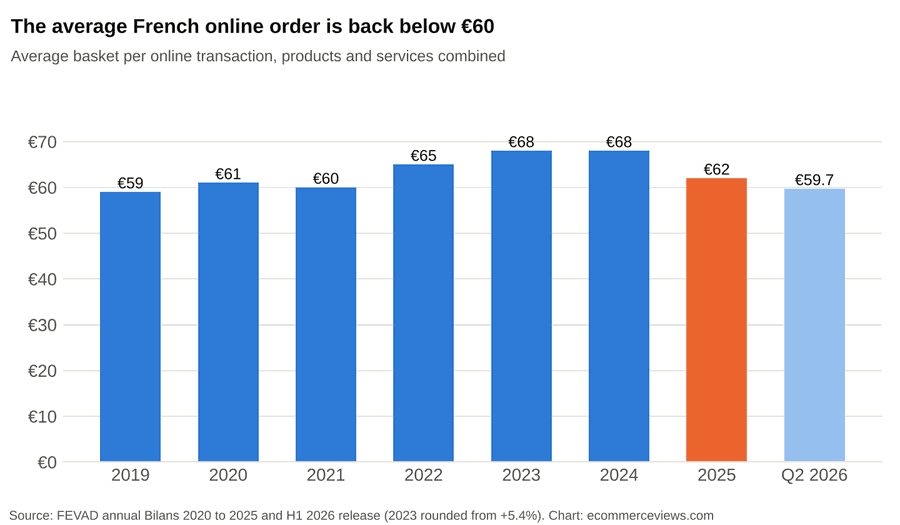
The average French online order is back below €60
The 2020 Bilan noted that the average transaction had been falling for several years before Covid interrupted the trend. With hindsight, 2022 to 2024 look like an inflation bump on a long downward slope rather than a lasting change.
FEVAD gives the reasons in its own words. In 2025 the basket fell for both products (down 4%) and services (down 3%), and the federation links the product decline to shoppers hunting for low prices. Its 2024 release said the basket held only because inflation slowed, and pointed to cheaper offers and cheaper channels.
The split by type matters. In 2023, the last year FEVAD published both figures, the average product order was €59 and the average services order was €75. Since services now account for most online spending, the combined average depends heavily on travel and ticket prices. When the product basket and the services basket both fall, as they did in 2025, the decline is broad.
After inflation, a French online order is worth 11% less than in 2019
The nominal basket hides how much spending per order has shrunk. French consumer prices rose 18.6% between 2019 and 2025 on the HICP measure. A €62 basket in 2025 buys what €52.3 bought in 2019. Against the €59 basket of 2019, that is a real decline of about 11%.
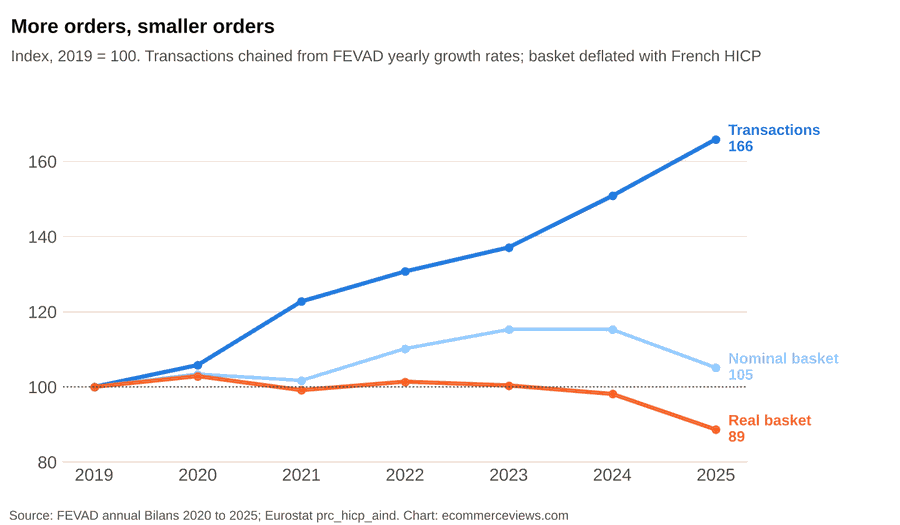
More orders, smaller orders
Set against transactions, the gap is wide. Chained from FEVAD’s yearly growth rates, transactions are up about 66% since 2019. The real basket was close to its 2019 level from 2020 to 2024, then dropped to 89 on the index in 2025. All the real growth in French ecommerce over these six years came from more orders.
| Year | Nominal basket | HICP (2019 = 100) | Basket in 2019 euros | Real index |
|---|---|---|---|---|
| 2019 | €59 | 100.0 | €59.0 | 100 |
| 2021 | €60 | 102.6 | €58.5 | 99 |
| 2023 | €68 | 114.8 | €59.2 | 100 |
| 2024 | €68 | 117.5 | €57.9 | 98 |
| 2025 | €62 | 118.6 | €52.3 | 89 |
Source: FEVAD Bilans du e-commerce; Eurostat prc_hicp_aind, France, all items. Our calculation.
For a store, a smaller real basket means each order brings in less money to cover fixed costs per order: picking, packing, the parcel, payment fees. If you changed prices recently, check average order value alongside conversion, as covered in what a small retailer should measure after a price change.
Services carry the market, products are only just recovering
Services, mainly travel, transport, tickets, leisure and energy, now dominate French online spending. In 2021 products still made up 51.7% of the total. By 2023 their share had dropped to 38.3%, and it was 38.7% in 2025.
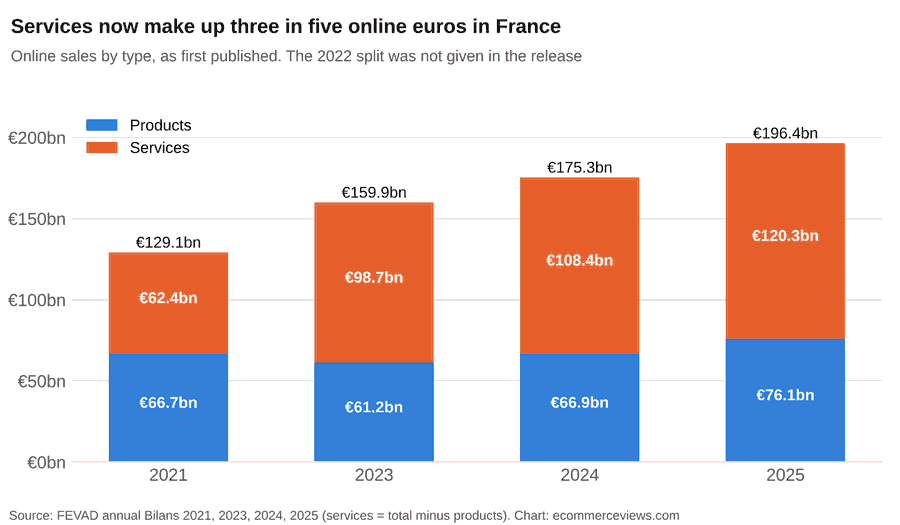
Services now make up three in five online euros in France
Product sales went through a two-year dip after the pandemic peak. FEVAD reported a 7% fall in 2022 and a further 1.8% fall in 2023, to €61.2 billion. They recovered to €66.9 billion in 2024 (up 6%) and €76.1 billion in 2025 (up 4%). From 2021 to 2025 product sales grew 14.1% in euros, while prices rose about 15.6% over the same years, so in real terms the product side is about where it was in 2021. The same post-pandemic plateau shows up across Europe in 11 years of Eurostat online retail data.
Over the same period services grew from €62.4 billion to €120.3 billion, an increase of 92.8%. In its 2023 release FEVAD attributed services growth to both more transactions (up 12%) and a higher basket (up 7%). By 2025 the services basket was falling too.
Among the leading product sites in the iCE 100 panel, sales rose 5.6% in 2025. Electronics and household appliances led with 5.2%, followed by sport (5.1%), furniture and decor (3%), home textiles (2.9%), consumer goods (2.7%) and beauty (2%). Clothing and footwear fell 0.5%.
More sites competing, and marketplaces that held up
Earlier releases also counted merchant sites. In 2020 FEVAD reported 17,400 more sites than a year before. Active sites grew 11% in 2021 and 5% in 2022, which FEVAD described as more than 10,000 new sites in a year. That implies a base of around 200,000 active sites, our estimate rather than a published figure. FEVAD has not repeated the count in its last three annual releases.
| Year | Change in active merchant sites | Marketplace sales in iCE 100 panel |
|---|---|---|
| 2020 | +17,400 sites | +27% |
| 2021 | +11% | +5% |
| 2022 | +5% (over 10,000 new sites) | -1.6% |
| 2023 | not published | -1% |
Source: FEVAD Bilans du e-commerce 2020 to 2023.
Marketplace sales (third-party sellers on the panel sites) more or less held level in 2022 and 2023, while panel product sales fell 9% in 2022. In 2021 marketplaces made up 33% of the product sales volume of the sites that host them, up from 31% in 2020. For context on how that compares with the rest of Europe, see our analysis showing that marketplaces now take more than one in six euros of European web sales.
More sites and a smaller basket point the same way. Each store competes for a share of orders that are getting smaller in real terms.
2026 so far: the basket slipped below €60
The first half of 2026 shows no reversal. In its September 2026 release FEVAD reported online sales of €52.2 billion in the second quarter, up 8.5% on a year earlier, after a 4.7% rise in the first quarter. Growth for the half was 6.6%, against 7.1% for 2025 (FEVAD’s revised figure).
In the second quarter the basket fell 4.3% to €59.7, its lowest level since the €59 of 2019. Transactions rose 13.5%. FEVAD put it plainly: market growth now depends on more purchases, not bigger ones. It links this to shoppers’ ongoing concern about purchasing power.
June was unusual. Panel product sales rose 12.2%, helped by a favourable promotional calendar and heatwaves that drove demand for fans and air conditioning. In July panel growth slowed to 4.8%, so the June spike looks temporary.
What this means for online stores
Price for the smaller basket. If the average order is shrinking in real terms, fixed costs per order take a bigger bite. A €4 parcel is 6.8% of a €59 order and 5.9% of a €68 one. Recheck free shipping thresholds that were set when baskets were larger.
Grow order value deliberately. French shoppers are not refusing to buy; they buy smaller. Bundles, multi-buy offers and a free shipping threshold a little above your current average order are the usual ways to raise basket size without raising prices.
Plan for frequency. More frequent, smaller orders favour stores that are easy to come back to: saved carts, quick reorder, loyalty perks, and delivery options that suit small parcels.
To see what a smaller basket does to your margin per order after fees, shipping and returns, try our seller profit calculator.
Watch product categories separately. Electronics, sport and furniture grew faster than the market in 2025, while clothing shrank. A store’s own category may follow a very different trend from the national average.
Limits of the data
FEVAD’s market figure is an estimate built from a panel, payment data and a survey, not a census. It revises past years heavily. The 2025 release implies 2024 sales of about €183.6 billion and 2.9 billion transactions, against €175.3 billion and 2.6 billion when first published. Comparing levels across releases can therefore mislead, which is why we chained growth rates for the trend.
| 2024 figure | First published (Feb 2025) | Implied by the 2025 release |
|---|---|---|
| Online sales | €175.3bn | about €183.6bn |
| Transactions | 2.6bn | 2.9bn |
| Average basket | €68 | about €64 |
Implied values derived from FEVAD’s 2025 growth rates and stated prior-year transactions. Our calculation.
The ecommerce share of product retail is also not consistent over time: 14.1% for 2021, 12.5% for 2022, 11% for 2024 and 12% for 2025, which suggests changes in method. The basket includes both products and services, so shifts in the mix move it. The iCE 100 panel does not include Shein or Temu, which matters for apparel and low-cost goods; read more on why the end of duty-free parcels could change that competition. Finally, HICP measures all consumer prices, not online prices specifically.
The bottom line
French ecommerce is still growing, by 7% in 2025 and 6.6% in the first half of 2026, but almost all of that growth comes from more orders. The average basket fell from €68 to €62 in 2025 and to €59.7 in the second quarter of 2026. After inflation it is about 11% below its 2019 level. For merchants the job is to protect margin on each order, since smaller baskets leave less room for shipping costs that keep rising, as our analysis of parcel prices since 2004 shows.