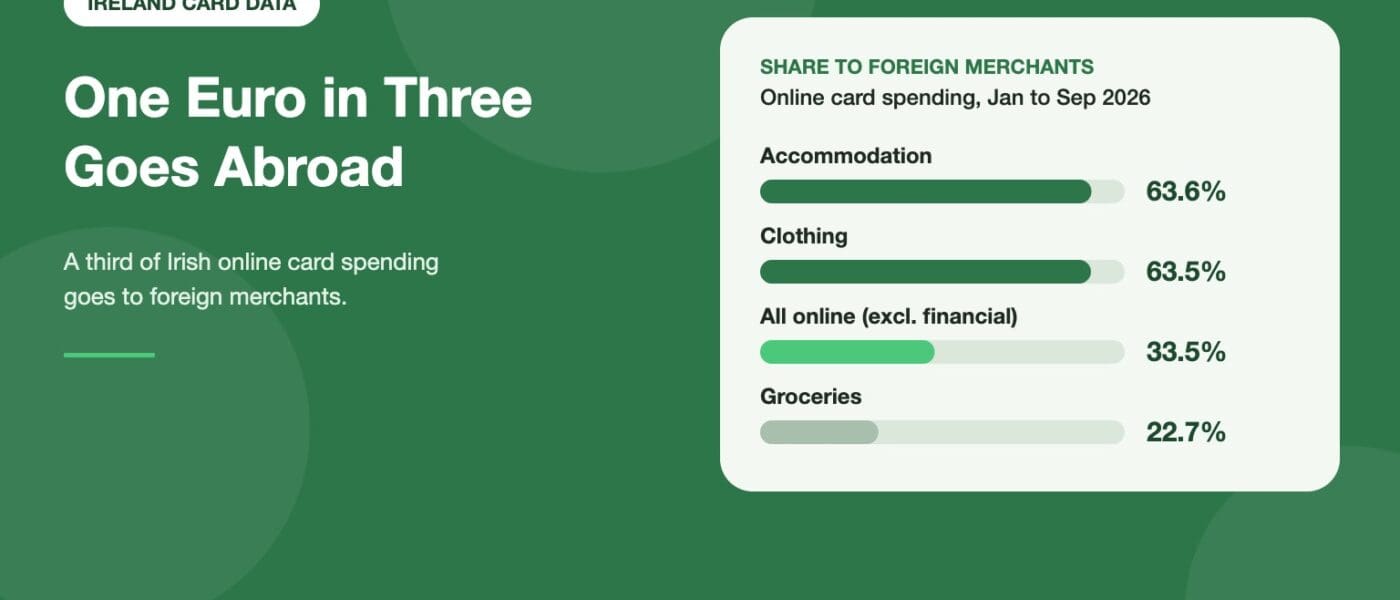
Irish consumers put more of their card spending online than almost anyone would guess. In the first nine months of 2026, online card payments by Irish cardholders came to €45.2 billion, against €41.9 billion spent in shops. But that headline hides two things that matter more to an online store owner. First, about 41% of the online total is not shopping at all: it is card payments to financial services firms, mostly people moving money between their own accounts. Strip that out and the true online share of spending is 39.1%, and it is still rising. Second, a stable one third of that genuine online spending goes to merchants based outside Ireland.
We rebuilt both numbers from Central Bank of Ireland card data, month by month and sector by sector, from 2015 to September 2026.
Key findings
- The online share of Irish card spending rose from 30.1% in 2015 to 38.6% in 2019 and 46.0% in 2020, on the Central Bank’s old ecommerce series. The pandemic year added more than seven points in one go.
- On the new monthly survey, the online share reached 52.5% in 2025. For January to September 2026 it slipped to 51.9%, the first fall since the new survey began.
- The fall is a payments story, not a shopping story. Online card payments to financial services dropped 33.2% year on year in September 2026 as households switched to open banking transfers.
- Excluding financial services, the online share kept climbing: 36.6% in 2023, 37.5% in 2024, 38.4% in 2025 and 39.1% for January to September 2026.
- Genuine online spending grew 10.7% year on year in January to September 2026, to €26.7 billion, while shop (POS) spending grew 6.6%.
- One third of that online spending goes abroad: 33.5% in January to September 2026, almost unchanged from 33.8% in 2023. Foreign merchants took €8.97 billion in the first nine months of 2026.
- Clothing and accommodation are the most exposed: 63.5% of online clothing spending and 63.6% of online accommodation spending goes to non-Irish merchants. In groceries the figure is 22.7%.
How we analyzed the data
The main source is the Central Bank of Ireland’s Monthly Card Payment Statistics, which covers debit and credit cards issued in Ireland from October 2022 to September 2026. We used the full data file, not the press summaries.
The survey splits card payments into two channels. “Remote” payments are made without the card being present, which in practice means online and in-app purchases. “Non-remote” payments are made at a physical terminal (point of sale, or POS). We call the first group “online” and the second “in-store”. Cash withdrawals are excluded from all shares.
Each payment is also tagged as domestic or non-domestic, based on where the merchant is located. A non-domestic online payment is an Irish cardholder buying from a merchant outside Ireland. That is the figure we use for “spending that goes abroad”.
The sector breakdown (table 4 of the data file) maps merchant category codes to 25 sectors. We used it to remove the financial services sector, where much of the online value is households funding other accounts by card. Those payments are recorded as online card spending but are not purchases of goods or services from an online store.
For 2015 to 2022 we used the Central Bank’s discontinued table A.13, which reported “e-commerce expenditure” by Irish cards. All shares and growth rates are our own calculations.
The online share has climbed for a decade
The longer history comes from the discontinued table A.13, which ran until March 2023. On that measure, ecommerce spending on Irish cards rose from €22.05 billion in 2019 to €38.60 billion in 2022, an increase of 75% in three years.
The share climbed about two points a year before the pandemic and jumped in 2020 when shops closed. It did not fall back when shops reopened. It held at 46.8% in 2021 and 46.2% in 2022, even as in-store spending recovered.
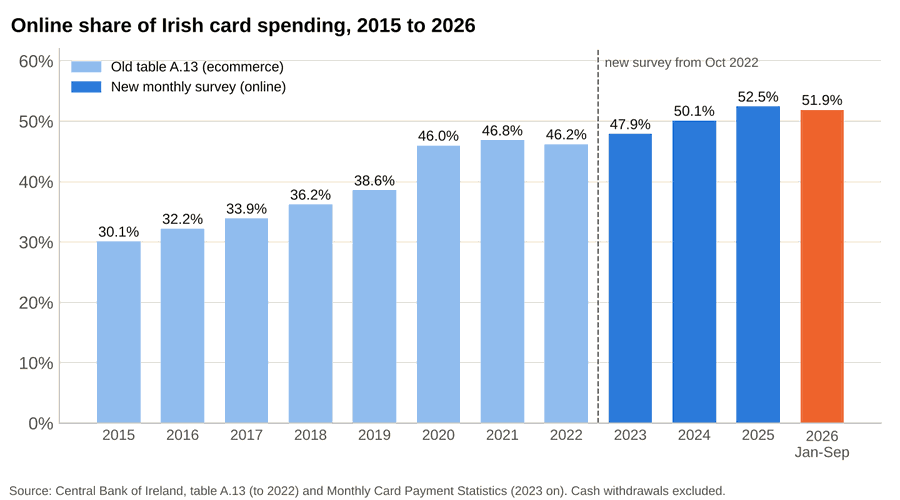
Online share of Irish card spending, 2015 to 2026. The old and new series overlap for six months and give shares within about one point of each other.
The two series differ in euro levels, but the shares line up. The old and new surveys overlapped from October 2022 to March 2023, and the monthly online shares in those six months were never more than 1.2 points apart.
The headline is now falling, and that is misleading
On the new survey, more than half of all Irish card spending was online by 2024. Then, in the summer of 2026, the share turned down. In July 2026 it was 48.4%, compared with 51.2% a year earlier.
The explanation is in the sector data. Online card payments to financial services peaked at €26.09 billion in 2025, up from €16.22 billion in 2023. In mid 2026 they started shrinking fast: from €2.25 billion in September 2025 to €1.50 billion in September 2026, a fall of 33.2%. The Central Bank’s September 2026 release puts this down to households moving money between their own accounts with open banking transfers, which are not card payments.
Remove financial services and the online share of spending on goods and services has risen every year since the survey started.
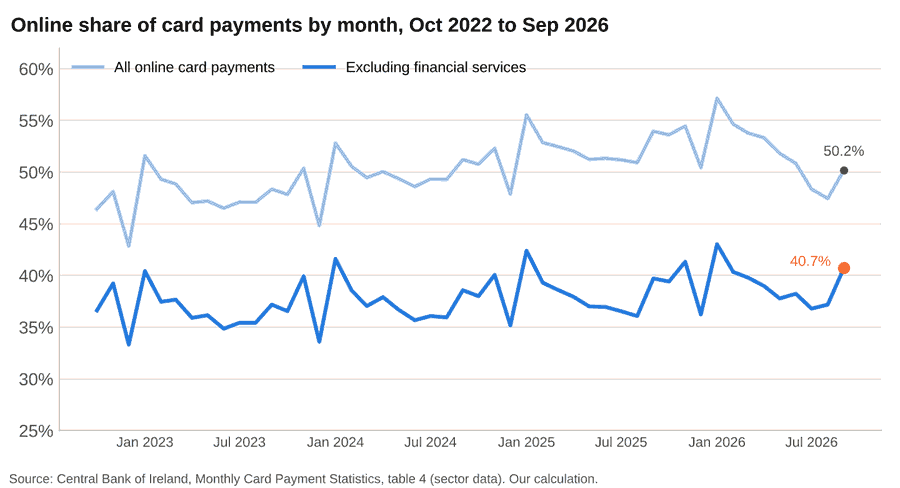
Online share of card payments by month, with and without financial services.
| Year | Online spending excl. financial services | Online share excl. financial services | Share going to foreign merchants |
|---|---|---|---|
| 2023 | €26.84bn | 36.6% | 33.8% |
| 2024 | €30.61bn | 37.5% | 33.7% |
| 2025 | €33.42bn | 38.4% | 33.3% |
| Jan-Sep 2025 | €24.16bn | 38.2% | 33.5% |
| Jan-Sep 2026 | €26.75bn | 39.1% | 33.5% |
Online spending on goods and services grew 14.0% in 2024 and 9.2% in 2025. In the first nine months of 2026 it grew 10.7%, which is faster than in-store spending and faster than the 2025 pace.
January is the most online month of the year
The monthly data also show a strong and repeatable seasonal pattern. The online share (excluding financial services) peaks every January: 42.4% in January 2025 and 43.0% in January 2026. It drops sharply every December, to 36.2% in December 2025, because Christmas shopping in physical stores pushes up POS spending more than online spending.
December is the biggest month for online sales in euro terms (€3.14 billion in December 2025, excluding financial services), but it is the weakest month for online share. January is when shoppers lean hardest on their screens, likely helped by January sales and travel bookings. The UK shows a similar post-Christmas lift in its long-run ONS online retail data, although the measures are not directly comparable.
A second dip appears every summer, when Irish cardholders spend more in person, partly abroad on holiday. July 2026 had an online share of 36.8%, close to the July 2025 level of 36.5%.
One euro in three goes to merchants abroad
How much Irish online spending do foreign sellers capture? In January to September 2026, Irish cardholders spent €8.97 billion online with non-Irish merchants, 33.5% of online spending on goods and services. Domestic online spending was €17.78 billion.
The share is remarkably stable: 33.8% in 2023 and 33.5% in 2026. Foreign online spending grew 10.9% in the first nine months of 2026, while domestic online spending grew 10.6%. Irish merchants are not losing ground overall, and they are not gaining it either.
Including financial services, the foreign share looks smaller (23.1% in 2025), because most of those payments go to Irish firms.
We argued earlier that the end of duty-free parcels could help small domestic stores. These card data will show whether it does.
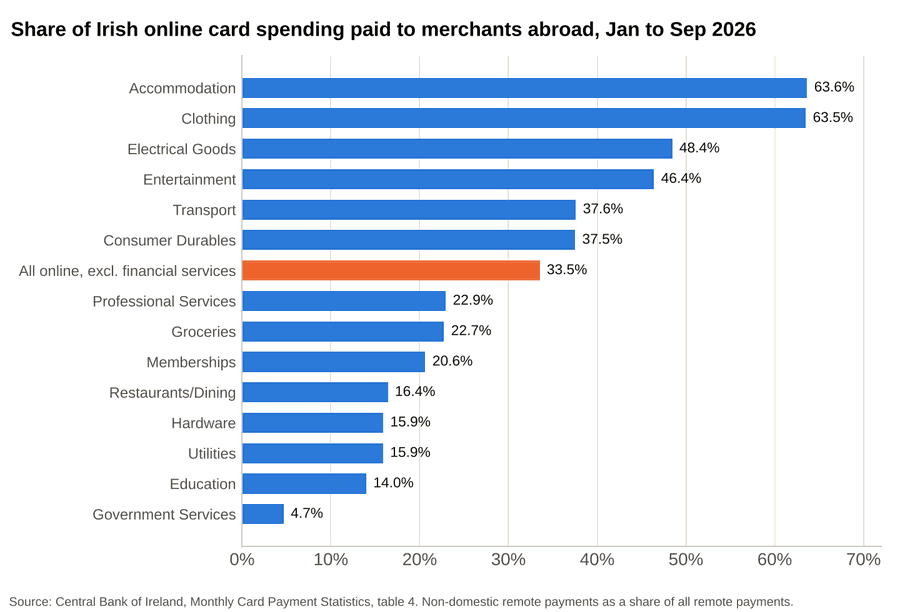
Share of Irish online card spending paid to merchants abroad, by sector, January to September 2026.
Where foreign merchants win and where Irish ones hold
The sector split shows that foreign competition is concentrated in a few categories. In clothing, 63.5% of online card spending goes to non-Irish merchants, up from 60.5% in the same period of 2025. Electrical goods rose from 42.2% to 48.4%. Accommodation, mostly hotel and short-let bookings, sits at 63.6%.
At the other end, groceries (22.7%), hardware (15.9%) and restaurants (16.4%) are mostly domestic online categories. These are products that are bulky, perishable or local by nature. The same pattern shows up across Europe in what Europeans buy online: clothing is the most-bought category, and it is also the easiest to buy from another country.
| Sector (Jan-Sep 2026) | Online spending | Growth vs Jan-Sep 2025 | Online share of sector | Share to foreign merchants |
|---|---|---|---|---|
| Electrical goods | €910m | 31.2% | 68.7% | 48.4% |
| Consumer durables | €2,495m | 10.6% | 44.7% | 37.5% |
| Clothing | €1,558m | 4.8% | 43.8% | 63.5% |
| Hardware | €1,015m | 4.9% | 32.7% | 15.9% |
| Groceries | €1,380m | 12.1% | 8.6% | 22.7% |
| Accommodation | €1,202m | 15.0% | 40.1% | 63.6% |
| Entertainment | €2,962m | 14.0% | 81.6% | 46.4% |
| Total retail | €9,126m | 12.3% | 25.1% | 39.4% |
Two numbers stand out. Electrical goods had the fastest online growth of any retail sector, at 31.2%, and the online share of the sector is now 68.7%. Groceries, by contrast, are still overwhelmingly bought in shops: only 8.6% of grocery card spending is online, even though it grew 12.1%.
Clothing is the weak spot for Irish sellers: online clothing spending grew only 4.8%, and the foreign share increased.
Domestic stores kept pace, but payment habits are moving
Domestic online spending growth of 10.6% in 2026 is a healthy number for Irish stores. The open banking shift in financial services is a signal worth watching, though. Irish households are already willing to move large sums by bank transfer instead of card when the experience is smooth, and the Central Bank notes that mobile wallets now account for about 61% of domestic in-store transaction volume.
For merchants, this changes the cost side. Card payments carry interchange and scheme fees, and the payment gateway fees a store pays depend heavily on the mix of cards, wallets and countries. A store selling into Ireland from abroad pays cross-border card rates on most transactions. An Irish store selling to Irish shoppers usually pays domestic rates.
What this means for online stores
Do not read the headline as a slowdown. The fall in Ireland’s online share in 2026 is caused by financial transfers leaving the card system. Spending on goods and services online grew 10.7%, faster than in-store spending.
Plan for January, not just December. January is the peak month for online share in every year of the data. Stores that cut marketing after Christmas are pulling back when Irish shoppers are most engaged online.
Treat clothing and electricals as cross-border fights. In these categories, foreign merchants take roughly half or more of online spending. Irish sellers need a clear reason to buy local: faster delivery, easy returns, local sizing advice or prices in euro with no surprise fees.
Look at categories where domestic sellers already win. Hardware, groceries and restaurants have low foreign shares. Bulky, local and time-sensitive products are hard for overseas sellers to serve.
Check your payment costs by card origin. If you sell into Ireland from the UK or outside Europe, most of your Irish orders are cross-border card payments with higher fees. Compare the real cost per order before choosing a provider.
To see what different providers would charge on your own order values and card mix, try our free payment fee calculator.
Limits of the data
- Card payments are not all ecommerce. The data cover cards issued in Ireland. Bank transfers, open banking payments, buy now pay later and cash on delivery are not included, so the true online share of retail could be higher or lower.
- “Online” means remote card payments. This includes bill payments, subscriptions and in-app purchases, not just orders from online stores.
- Merchant location is the acquirer’s view. A foreign brand that processes payments through an Irish entity counts as domestic, and an Irish brand using a foreign acquirer can count as non-domestic. Large marketplaces with Irish or EU subsidiaries may blur the split.
- Sector codes can shift. The foreign share for consumer durables fell from 59% in February 2025 to 45% in April 2025, while electrical goods rose at the same time. That pattern looks like a reclassification of a large merchant rather than a change in shopping behaviour, so we do not read it as a trend.
- The March 2023 expansion. The Central Bank notes that additional customer accounts were added to the survey in March 2023, which raises euro amounts from that month. Shares are less affected than euro levels, and we compare shares, not euro values, across the October 2022 break.
The bottom line
More than half of all Irish card spending was online in 2025. The 2026 dip in that headline is caused by money transfers moving to open banking, not by shoppers going back to stores. Excluding financial services, online spending on goods and services grew 10.7% in the first nine months of 2026 and reached a record 39.1% share. One third of it goes to foreign merchants, and that share has barely moved in three years. For Irish stores, the market is growing, the foreign competition is concentrated in clothing, electricals and travel, and January is the month to be visible.